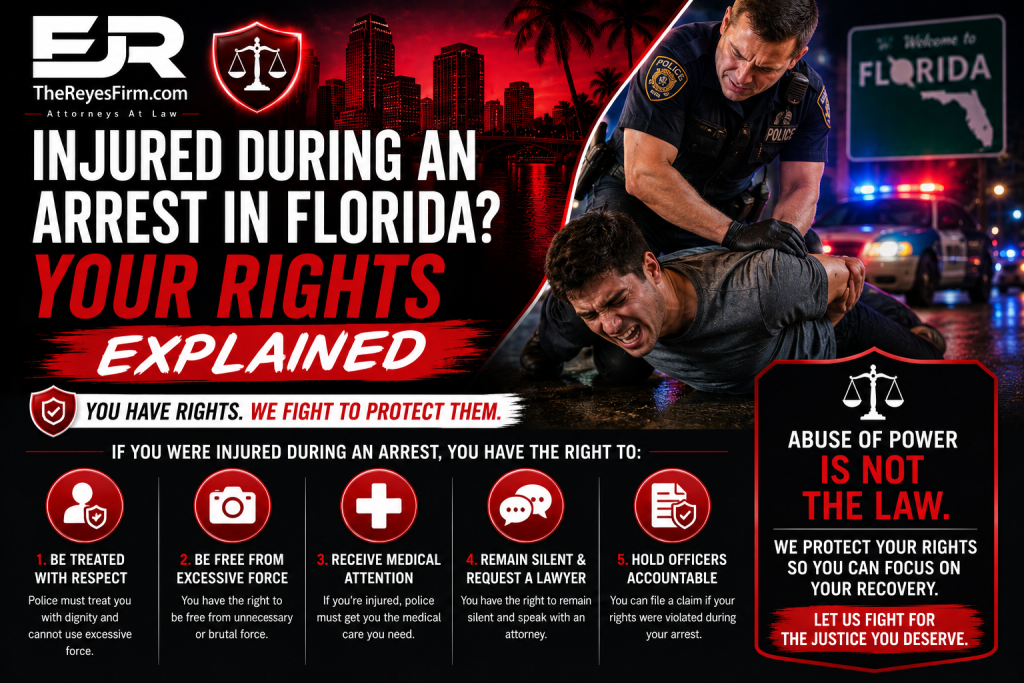
You were being arrested, and something went too far. Now you’re hurt, maybe seriously, and you’re not sure whether the law is on your side. Here’s what most people don’t realize: even during an arrest, police can only use force that’s reasonable, and if an officer crossed that line and left you injured, you may have a civil claim, no matter what you were charged with.
TL;DR — QUICK SUMMARY
- Police may use only objectively reasonable force to make an arrest. Force that goes beyond what the situation calls for can be unlawful.
- If an officer used excessive force and injured you, you may have a civil claim, separate from any criminal case, even if you were charged.
- Two main paths exist: a federal civil rights claim under 42 U.S.C. § 1983 and a Florida state-law claim for battery.
- These cases face real hurdles, including qualified immunity and special rules for suing a government agency under Fla. Stat. § 768.28.
- Deadlines are strict and vary by claim type, so getting legal advice quickly is critical.
The Reyes Firm
Injured During an Arrest in Tampa?
Find out if police used more force than the law allows. Had a bad day?
Can the police use any amount of force to arrest you?
No. An officer making an arrest is allowed to use force, but only the amount that’s reasonable under the circumstances. This comes from the Fourth Amendment, and the U.S. Supreme Court spelled out the standard in Graham v. Connor: police force is judged by “objective reasonableness,” looking at factors like how serious the suspected crime was, whether the person posed an immediate threat, and whether they were actively resisting or trying to flee.
The key word is reasonable. An officer can use enough force to safely make an arrest. What they cannot do is use force that’s out of proportion to what’s actually happening. When that line gets crossed and someone is hurt, the injury can become the basis for a civil claim, no matter how the criminal side plays out.
⚠️ Deadline Warning: Excessive-force claims run on strict deadlines that depend on the type of claim. A Florida battery claim generally must be filed within four years under Florida Statute § 95.11, federal civil rights claims have their own deadline, and claims against a government agency require written notice even sooner. Don’t wait to talk to a lawyer.
What counts as excessive force during an arrest?
Excessive force is force that goes beyond what a reasonable officer would use in the same situation. There’s no single checklist, because it always depends on the facts, but some situations raise serious red flags: striking or using a weapon on someone who is already restrained or compliant, continuing force after a person has stopped resisting, or using force wildly disproportionate to a minor offense.
The injuries tell part of the story. Excessive force can cause broken bones, head trauma, spinal and brain injuries, and worse. When the force used doesn’t match the threat the person actually posed, and that force causes real harm, it may support a claim, even though an arrest was being made.
Does resisting arrest mean the police can do whatever they want?
No. This is one of the biggest misconceptions. Resisting arrest is a crime in Florida, and the safest course is always to comply and challenge the arrest later in court rather than physically resist. But the fact that someone resisted does not give officers unlimited authority to use force. Even when a person resists, the force used must stay proportional to the threat. Officers are still required to stop using force once the resistance ends.
That means two things can be true at once. A person can be charged with resisting arrest and still have been the victim of excessive force. The criminal charge and the civil excessive-force claim are separate questions, decided under different standards. One does not automatically cancel out the other.
💡 Did You Know? Your civil claim for excessive force is separate from your criminal case and uses a different standard of proof. A criminal conviction requires proof beyond a reasonable doubt, while a civil claim generally only requires showing it’s more likely than not that the force was unreasonable. That’s why you can sometimes pursue a civil claim even when the criminal case resolves differently. Source: Graham v. Connor; 42 U.S.C. § 1983.
What kind of claim can you bring if police injured you?
There are generally two paths, and sometimes both apply to the same incident:
- A federal civil rights claim under 42 U.S.C. § 1983. This is the main tool for excessive-force cases. It lets you sue when a government official violates your constitutional rights, here, your Fourth Amendment right to be free from unreasonable force. These cases are usually filed in federal court, and you can seek compensation for your injuries, lost income, pain, and attorney fees.
- A Florida state-law claim for battery. Excessive force can also be a battery under state law. Battery is an intentional tort, which carries a four-year filing deadline that was not shortened by Florida’s 2023 tort reform.
Which path fits, and whether you pursue one or both, depends on the facts and on who’s responsible, an individual officer, a department, or a government entity. That choice has major consequences for deadlines and procedure, which is exactly why these cases need a lawyer’s eye early.
What makes these cases hard, and what about suing the government?
Excessive-force cases are winnable, but they’re not easy, and it helps to know the obstacles going in. The biggest is qualified immunity, a doctrine that shields officers from personal liability unless their conduct violated a “clearly established” constitutional right. In practice, it can be a serious hurdle. It is not absolute, though, and courts have shown more willingness to deny it where misconduct is obvious. How the case is framed matters a great deal.
Suing a government agency adds another layer. Under Florida’s sovereign immunity law, Fla. Stat. § 768.28, claims against the state or its subdivisions require strict written pre-suit notice, a mandatory investigation period before you can file, and statutory caps on what can be recovered. Miss a step and the claim can be lost on procedure alone. None of this means your case is hopeless. It means the rules are unforgiving, and an experienced attorney is essential.
🛡️ Your Rights After an Arrest: Being arrested does not strip you of your constitutional protections. The Fourth Amendment guards against unreasonable force, and you keep that right even while being taken into custody. If an officer used force far beyond what the situation called for and you were injured, an experienced attorney can help you hold the responsible parties accountable.
What steps should you take if you were injured during an arrest?
These steps protect your health and your potential claim. The order matters.
- Comply first, fight it in court later. Don’t resist or escalate, even if the arrest feels wrong. Your safety comes first, and resisting only creates new problems. The place to challenge what happened is the courtroom.
- Get medical care immediately. See a doctor as soon as you can and make sure your injuries are documented. That record ties your injuries to the arrest and is critical evidence.
- Document everything. Photograph your injuries, write down the officers’ names and badge numbers, note the date, time, and location, and get the contact information of any witnesses.
- Preserve the footage. Body-camera, dash-camera, and nearby surveillance video can be decisive, but it doesn’t last forever. A lawyer can move quickly to demand it be preserved.
- Call The Reyes Firm before giving statements. Deadlines and government-notice rules are tight and easy to miss. Call 833-4 BAD DAY for a free, confidential consultation.
The Reyes Firm
4730 N. Habana Ave., Suite 201, Tampa, FL 33614
Phone: 833-4 BAD DAY | thereyesfirm.com
How The Reyes Firm handles your case
When you’re injured during an arrest, it’s easy to feel like no one will take your side. The system can feel stacked, and the other side knows the rules cold. We make sure your injuries and your rights get taken seriously, and that the evidence gets locked down before it disappears.
When we take on an injury-during-arrest case, we typically:
- Move fast to preserve evidence, demanding body-camera, dash-camera, and surveillance footage before it can be overwritten or lost
- Document the full extent of your injuries, working with medical providers to connect your harm directly to the force used
- Identify the right claims and defendants, weighing a federal civil rights claim, a state battery claim, or both, against the officer, department, or government entity responsible
- Handle the procedural minefield, including the strict notice requirements and deadlines that apply when a government agency is involved
- Build the case to overcome qualified immunity, framing the facts and the law to push the case toward discovery and trial
- Pursue full compensation, for medical bills, lost income, pain, and the lasting impact the incident has had on your life
No lawyer can promise an outcome, and these cases are genuinely challenging. What we can promise is that we treat your injury seriously and don’t let procedure or intimidation push you out. We represent injured people throughout Hillsborough County and the Tampa Bay area, and you can read more about how filing deadlines work in our guide to Florida’s statute of limitations. When police force causes a death, our Tampa wrongful death attorneys handle those cases with particular care.
Frequently asked questions about injuries during an arrest in Florida
Can police use as much force as they want to make an arrest?
No. Officers may use only objectively reasonable force under the circumstances, based on the standard from Graham v. Connor. Force that’s out of proportion to the threat can be unlawful, even during a valid arrest.
What is considered excessive force in Florida?
Excessive force is force beyond what a reasonable officer would use in the same situation. Examples can include striking someone who is already restrained, continuing force after resistance has stopped, or using force wildly disproportionate to a minor offense. It always depends on the specific facts.
Can I sue if I was injured during an arrest, even if I was charged with a crime?
Possibly, yes. Your civil claim for excessive force is separate from any criminal charge and is decided under a different standard. You can be charged with resisting and still have a valid claim if the force used against you was unreasonable.
What is a Section 1983 claim?
A claim under 42 U.S.C. § 1983 lets you sue when a government official violates your constitutional rights, such as the Fourth Amendment right to be free from unreasonable force. These claims are typically filed in federal court and can recover compensation for injuries, lost income, pain, and attorney fees.
What is qualified immunity, and does it block my case?
Qualified immunity protects officers from personal liability unless their conduct violated a clearly established constitutional right. It’s a real hurdle, but it isn’t absolute, and courts have denied it in cases of obvious misconduct. How the case is framed makes a significant difference.
Are there special rules for suing the police or a government agency?
Yes. Under Florida’s sovereign immunity law, Fla. Stat. § 768.28, claims against a government entity require written pre-suit notice, a mandatory investigation period before filing, and are subject to statutory damage caps. These procedures are strict, and missing a step can end the claim.
How long do I have to file a claim for excessive force?
It depends on the claim. A Florida battery claim generally must be filed within four years under Fla. Stat. § 95.11(3)(o), federal civil rights claims have their own deadline that can differ, and claims against a government agency require notice well before that. Because the rules overlap and are unforgiving, confirm your specific deadline with a lawyer right away.
What should I do if I was hurt during an arrest?
Comply at the scene and challenge what happened later. Get medical care and have your injuries documented, photograph your injuries, record officer names and badge numbers, gather witnesses, and contact a lawyer quickly so footage can be preserved before it’s lost.
How much does it cost to hire an attorney for this kind of case?
The Reyes Firm works on a contingency fee basis, which means you pay nothing upfront and nothing at all unless the firm recovers compensation for you. The consultation is free and confidential. Call 833-4 BAD DAY to talk through what happened.

Edward Reyes, Esq. is a Florida Bar-admitted personal injury attorney and the founder of The Reyes Firm in Tampa, Florida. His practice focuses on serious injury and wrongful death cases, representing people harmed by the negligence or wrongful conduct of others. Edward Reyes, Esq. represents injured Floridians in Tampa and throughout Hillsborough County on a contingency fee basis, meaning clients pay nothing unless the firm recovers compensation for them.
Read more about Edward Reyes.
How Can The Reyes Firm Help You?
If you’ve had a bad day — a car accident, a slip and fall, a trucking crash, or any injury that wasn’t your fault — The Reyes Firm is in your corner. Our Tampa personal injury attorneys offer free consultations and work on a contingency fee basis, which means you pay us nothing unless we win your case.
You shouldn’t have to fight the insurance companies alone. Let us fight for you.
📍 Address: 4730 N. Habana Ave., Suite 201, Tampa, FL 33614
📞 Phone: 833-4 BAD DAY
🌐 Website: Schedule your free consultation today at thereyesfirm.com
Had a bad day? Call The Reyes Firm. We’ll handle the rest.