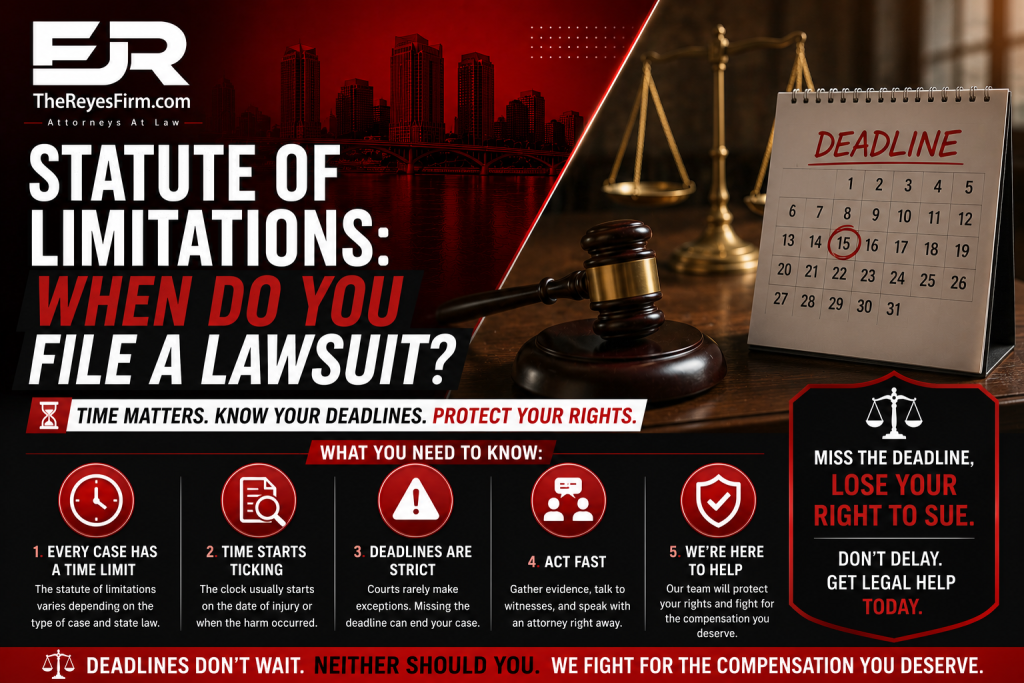
You were just going about your day. Then a car accident changed everything. Now you’re in pain, the bills are stacking up, and the insurance company is already counting on one thing: that you’ll wait too long to act. In Florida, the clock on your right to file a lawsuit starts the day you’re hurt. Here’s exactly how much time you really have.
TL;DR — QUICK SUMMARY
- Florida’s deadline to file most personal injury lawsuits is now two years from the date of the injury under Florida Statute § 95.11(3)(a).
- This was cut from four years to two years by House Bill 837, which took effect on March 24, 2023.
- If your accident happened before March 24, 2023, the old four-year deadline still applies to your case.
- Different claims have different clocks: wrongful death, medical malpractice, and claims against the government each follow their own rules.
- Miss the deadline and the court will almost always dismiss your case permanently, no matter how strong it is.
The Reyes Firm
Not Sure How Much Time You Have Left to File?
Get clear answers about your Florida filing deadline before it’s too late. Had a bad day?
What is a statute of limitations, and why does it matter?
A statute of limitations is a legal deadline. It sets the maximum amount of time you have to file a lawsuit after you’ve been harmed. Once that window closes, your claim is extinguished. You lose the right to sue, even if the other side was clearly at fault and even if your injuries were severe.
Florida sets these deadlines for a practical reason. Courts and defendants don’t want people filing lawsuits 10, 20, or 30 years after the fact, when memories have faded, witnesses have moved or died, and physical evidence is long gone. The deadline forces claims to move forward while the facts can still be proven. That protects the system. Unfortunately, it can also work against you if you wait too long to talk to a lawyer.
How long do you have to file a personal injury lawsuit in Florida?
For most personal injury cases in Florida, you now have two years from the date of the injury to file a lawsuit. This is set by Florida Statute § 95.11(3)(a) and covers the great majority of negligence claims: car accidents, truck accidents, motorcycle crashes, pedestrian and bicycle accidents, slip and falls, and similar injury cases.
This is a major change from how Florida law worked for decades. For years, accident victims had four full years to file. That longer window gave people time to finish medical treatment, understand the full impact of their injuries, and try to settle before deciding whether to sue. That extra time is gone for most new cases. The two-year clock is shorter than most people expect, and it runs out faster than you think.
⚠️ Deadline Warning: Under Florida Statute § 95.11(3)(a), you generally have two years from the date of your injury to file a personal injury lawsuit. Missing this deadline almost always means losing your right to recover anything. Don’t wait to call a lawyer.
Why did Florida cut the deadline from four years to two?
The deadline was cut in half by House Bill 837, a sweeping tort reform law signed by Governor Ron DeSantis on March 24, 2023. The change applies to claims that accrued, meaning the injury occurred, on or after that date. The same law also shifted Florida from a pure comparative fault system to a modified one, which is why your share of the blame now matters more than ever.
The takeaway is simple. If you were injured on or after March 24, 2023, you have two years. The reduction was one of the most significant changes Florida’s civil justice system has seen in decades, and it tilted the timeline in favor of insurers and defendants. That makes acting quickly more important than it has ever been.
💡 Did You Know? Before March 24, 2023, Florida gave injury victims four years to file a negligence lawsuit. House Bill 837 cut that in half to two years and reshaped how fault is handled statewide. The two-year clock starts on the date of the injury, not the date you finish treatment or the date your insurance claim is denied. Source: Fla. Stat. § 95.11; Fla. HB 837 (2023).
Watch: How the Florida statute of limitations works
This short video breaks down the Florida filing deadline and what it means for your claim.
Have questions the video didn’t answer? The Reyes Firm offers a free case review so you know exactly where your deadline stands.
When does the two-year clock actually start?
In most cases, the clock starts on the date of the accident, because that’s the date the injury occurred. It does not start on the day you hire an attorney, the day you finish physical therapy, or the day an insurance company rejects your claim. For a typical car crash, the deadline is two years from the day of the collision.
There are narrow exceptions where the clock starts later, such as when an injury could not reasonably have been discovered right away. These situations are fact-specific and are easy to get wrong. If there is any question about when your clock started, that is a question for a lawyer, not a guess you want to make on your own.
Do all injury cases have the same deadline in Florida?
No. While two years covers most negligence-based injury claims, several important case types follow their own rules. Getting the wrong deadline can be just as costly as missing it.
- Wrongful death. A wrongful death claim generally must be filed within two years, but the clock runs from the date of death, not the date of the accident that caused it.
- Medical malpractice. These claims have a two-year deadline that often runs from when the harm was discovered, along with additional repose limits and required pre-suit steps.
- Claims against the government. Suing a city, county, or the State of Florida triggers special written-notice requirements under Florida’s sovereign immunity law, and the investigation period can delay when you’re even allowed to file.
- Intentional acts. Some intentional-tort claims follow a different limitations period than ordinary negligence cases.
Because the right deadline depends on the type of claim and the specific facts, the safest move after any serious injury is to have a lawyer confirm your timeline early.
🛡️ Your Rights Under Florida Law: Under Florida Statute § 768.81, your compensation is reduced by your share of fault, and you may be barred from recovery entirely if you are found greater than 50% responsible for your own harm. An experienced Tampa personal injury lawyer works to protect the facts, challenge unfair blame, and keep your percentage of fault as low as the evidence allows.
What happens if you miss the statute of limitations?
If you try to file after the deadline has passed, the defendant will ask the court to dismiss your case, and the court almost always grants it. There is no extension for not knowing the deadline, for still negotiating with an insurer, or for simply needing more time. The court won’t hear the case, no matter how strong your evidence is.
This is why the deadline is so dangerous. Insurance companies understand the calendar better than you do. Dragging out negotiations until your time runs low is a recognized tactic, because once the deadline passes, your leverage disappears completely.
Can the deadline ever be paused or extended?
Sometimes, but only in limited circumstances, and you should never assume an exception applies to you. Florida law recognizes a handful of situations that can pause, or “toll,” the clock, such as cases involving minors, a defendant who leaves the state to avoid suit, or certain injuries that could not reasonably have been discovered right away.
These exceptions are narrow, heavily litigated, and fact-dependent. Relying on one without legal guidance is a serious risk. The only reliable way to know whether an exception protects your claim is to have an attorney review the specific facts of your case.
What steps protect your right to file before the deadline?
These steps protect both your health and your legal case. The order matters.
- Get medical care immediately. Even if you feel fine, see a doctor the same day. Adrenaline masks injury, and many serious conditions don’t show symptoms for 24 to 72 hours. Prompt treatment also ties your injuries to the accident, which matters for your claim.
- Write down the date of your injury and count forward. Mark the exact date on your calendar and note the deadline two years out. That single date controls your entire case.
- Preserve evidence early. Save photos, the crash report number, medical records, and the contact information of any witnesses. Evidence disappears fast, and a lawsuit filed at the last minute is far weaker without it.
- Do not let an adjuster run out your clock. Insurance companies know the deadline as well as anyone. Don’t let open-ended negotiations push you past the point where you can still file.
- Call The Reyes Firm long before the deadline. Building a strong case takes time. The earlier a lawyer is involved, the more options you have. Call 833-4 BAD DAY for a free consultation.
The Reyes Firm
4730 N. Habana Ave., Suite 201, Tampa, FL 33614
Phone: 833-4 BAD DAY | thereyesfirm.com
How The Reyes Firm handles your case before the clock runs out
When an injury splits your life into before and after, the last thing you should be worrying about is a legal deadline you didn’t know existed. The insurance company already has professionals protecting them. We make sure you have someone protecting you.
When we take on your case, we typically:
- Confirm your exact deadline first, pinning down the date your claim accrued and the precise statute that governs your specific type of case
- Preserve evidence immediately, gathering crash reports, medical records, scene photos, and witness statements before they’re lost
- Identify every responsible party, so the right defendants are named well before the filing window closes
- Handle all insurance communication on your behalf, keeping you shielded from adjusters who benefit when you wait
- Calculate full damages, covering past and future medical expenses, lost wages, loss of earning capacity, and the real impact on your daily life
- Prepare your case as if it will go to trial, filing suit on time when settlement talks stall instead of letting your rights expire
No lawyer can promise an outcome. What we can promise is that we treat your deadline as the hard line it is, not an afterthought. We explain every decision in plain language and keep you in the loop. If you were recently injured and aren’t sure where your timeline stands, the safest thing you can do is ask, and you can read more about how our team approaches liability questions while you decide.
Frequently asked questions about Florida’s statute of limitations
How long do I have to file a personal injury lawsuit in Florida?
For most negligence-based injury claims, you have two years from the date of the injury under Fla. Stat. § 95.11(3)(a). This applies to car accidents, truck accidents, motorcycle crashes, slip and falls, and similar cases that occurred on or after March 24, 2023.
When does the two-year clock start?
In most cases, the clock starts on the date of the accident, because that’s typically when the injury occurred. It does not start when you hire a lawyer, finish treatment, or get a claim denied. A narrow exception can apply when an injury could not reasonably have been discovered right away, but that should be confirmed by an attorney.
What happens if I miss the statute of limitations in Florida?
If you file after the deadline, the court will almost certainly dismiss your case permanently. There are no extensions for not knowing the deadline or for still negotiating with an insurer. Once the window closes, your right to recover is generally gone for good.
Does the two-year deadline apply if my accident was before March 24, 2023?
No. If your injury occurred before March 24, 2023, the older four-year deadline generally still applies to your claim. The two-year rule under HB 837 only applies to injuries that accrued on or after that date. If you’re unsure which rule applies, have a lawyer confirm it before you assume anything.
Is the deadline different for wrongful death claims?
Wrongful death claims in Florida generally carry a two-year deadline, but the clock runs from the date of death rather than the date of the underlying accident. Because the starting point is different, these cases should be reviewed by a Tampa wrongful death attorney as early as possible.
What about claims against a city, county, or the State of Florida?
Claims against government entities trigger special pre-suit notice requirements under Florida’s sovereign immunity law, and the entity is given time to investigate before you can file. These rules are strict and easy to miss, so you should speak with a lawyer immediately if a government vehicle, agency, or property was involved.
Can the statute of limitations ever be extended?
Only in limited circumstances. Florida recognizes certain situations that can pause the clock, such as cases involving minors or a defendant who leaves the state to avoid being sued. These exceptions are narrow and fact-specific, so you should never count on one without having an attorney review your case.
Do I have to settle my case within two years, or just file the lawsuit?
You have to file the lawsuit within two years. Your case does not have to be resolved or settled by then. Filing on time preserves your rights, and negotiations or litigation can continue afterward. This is why waiting on settlement talks until the deadline is near is so risky.
Why should I call a lawyer long before the deadline?
Building a strong case takes time to investigate, gather evidence, and identify every responsible party. The earlier a lawyer is involved, the more options you have and the less leverage the insurance company has. Calling early also removes the risk of accidentally running out the clock. Call 833-4 BAD DAY for a free consultation.

Edward Reyes, Esq. is a Florida Bar-admitted personal injury attorney and the founder of The Reyes Firm in Tampa, Florida. His practice focuses on serious injury and wrongful death cases arising from car, truck, and commercial vehicle crashes. Edward Reyes, Esq. represents injured Floridians in Tampa and throughout Hillsborough County on a contingency fee basis, meaning clients pay nothing unless the firm recovers compensation for them.
Read more about Edward Reyes.
How Can The Reyes Firm Help You?
If you’ve had a bad day — a car accident, a slip and fall, a trucking crash, or any injury that wasn’t your fault — The Reyes Firm is in your corner. Our Tampa personal injury attorneys offer free consultations and work on a contingency fee basis, which means you pay us nothing unless we win your case.
You shouldn’t have to fight the insurance companies alone. Let us fight for you.
📍 Address: 4730 N. Habana Ave., Suite 201, Tampa, FL 33614
📞 Phone: 833-4 BAD DAY
🌐 Website: Schedule your free consultation today at thereyesfirm.com
Had a bad day? Call The Reyes Firm. We’ll handle the rest.