A day at the park should not end in the emergency room. When it does, because a ride malfunctioned, a walkway was unsafe, or an operator was careless, you may be left with serious injuries and a confusing question: who is responsible, and what can you do about it? Florida is the theme park capital of the country, and its rules for amusement park injuries have some surprising features. Here is a clear guide to amusement park injury claims in Florida.
The Reyes Firm
Injured at a Florida Amusement Park?
Find out who may be responsible for your injury. Had a bad day?
With Walt Disney World, Universal, SeaWorld, Busch Gardens, and countless fairs and carnivals, Florida draws tens of millions of visitors to its rides every year. The overwhelming majority have a safe, fun time. But when something goes wrong on a ride or on park grounds, the injuries can be severe, and figuring out your rights involves a mix of premises liability, product liability, and a regulatory system with some unusual gaps.
What kind of claim is an amusement park injury?
Most amusement park injury cases are premises liability claims, which are a form of negligence. As a paying guest, you are what the law calls a business invitee, and the park owes you a duty to use reasonable care to keep its property safe and to warn you of dangers it knew about or should have discovered. When the park falls short and you are hurt, that failure can form the basis of a claim.
Depending on what happened, other legal theories may apply as well. If a ride was defectively designed or manufactured, you may have a product liability claim against the ride’s maker. If an operator was careless or a maintenance company did shoddy work, ordinary negligence principles apply to them. Many serious cases involve more than one of these at the same time.
How does Florida regulate amusement park rides?
This is where Florida gets interesting. The Florida Department of Agriculture and Consumer Services, or FDACS, has statewide responsibility to inspect amusement rides under Florida Statute § 616.242. Rides fall into two broad groups: temporary rides, like those at traveling fairs and carnivals, which are inspected each time they are set up, and permanent rides at fixed facilities, which are permitted and inspected on a regular basis.
The surprising part is the exemption. Parks with more than 1,000 employees that keep full-time ride inspectors on staff are exempt from state inspection and instead inspect their own rides. That is why Florida’s largest parks operate under a self-regulation system rather than routine state oversight. After the 2022 death of a teenager on an Orlando ride, the Legislature passed the Tyre Sampson Act in 2023, tightening some requirements, but the core exemption for the biggest parks remains.
💡 Did You Know? Florida’s largest theme parks, those with more than 1,000 employees and full-time inspectors on staff, are exempt from state ride inspections under § 616.242 and instead inspect their own rides. Whether that self-inspection was done properly is often a central question when someone is seriously injured at a major park.
What causes amusement park injuries?
Amusement park injuries come from a range of causes, and identifying the right one is key to knowing who is responsible. Common causes include:
- Mechanical failure. Restraint or lap-bar failures, structural component failures, brake failures, and detachments can turn a ride dangerous in an instant.
- Operator error. Mistakes during loading and unloading, failing to properly secure riders, or improperly stopping or starting a ride.
- Inadequate maintenance. Skipped or careless maintenance and inspection that allows a defect to go unaddressed.
- Design or manufacturing defects. A ride that is unsafe as designed or built, which can support a product liability claim against the manufacturer.
- Unsafe premises. Slip, trip, and fall hazards on walkways, stairs, and queue areas, which are especially common at fairs and temporary setups on uneven ground.
- Inadequate warnings or screening. Failing to warn about a ride’s risks or to enforce height, health, or safety restrictions.
Injuries range from broken bones, sprains, and lacerations to serious head, neck, and back trauma, and in the worst cases, catastrophic injury or death. Because the forces involved can be significant, an injury that seems minor at first should still be evaluated promptly.
Who can be held liable for an amusement park injury?
Liability depends entirely on what caused your injury, and more than one party may share responsibility. The park or ride operator may be liable for unsafe premises, negligent operation, poor maintenance, or inadequate training and warnings. The ride’s manufacturer may be liable if a design or manufacturing defect caused the failure. A separate maintenance or inspection contractor may be liable if its work fell short.
Sorting this out takes investigation, because the evidence, ride maintenance logs, inspection records, operator training files, and surveillance video, is largely in the hands of the park. At the largest parks, where inspections are done in-house under the § 616.242 exemption, whether those self-inspections were thorough often becomes a focal point of the case. Serious ride injuries can involve a traumatic brain injury or a spinal cord injury, and the most tragic result in a wrongful death claim.
🛡️ Your Rights Under Florida Law: As a paying guest, you are a business invitee, and an amusement park owes you a duty to use reasonable care to keep its premises safe and to warn of dangers it knew about or should have discovered. If the park breached that duty and you were injured as a result, you may have a valid claim for your losses.
How long do you have to file an amusement park injury claim in Florida?
You generally have two years. Under Florida Statute § 95.11(5)(a), a claim founded on negligence, which includes most amusement park injury cases, must be filed within two years of the date of injury. This deadline was shortened from four years to two years under the law change that took effect in March 2023.
Fault matters too. Florida uses comparative negligence under Florida Statute § 768.81, so your compensation is reduced by your percentage of fault, and if you are found more than 50 percent at fault, you generally cannot recover from the other party. Parks often argue that a rider ignored instructions or a posted restriction, which is one reason strong evidence and early legal help matter.
⚠️ Deadline Warning: Under § 95.11(5)(a), you generally have two years from the date of your amusement park injury to file a lawsuit, reduced from four years in March 2023. Because critical evidence like ride video and maintenance records can be lost or overwritten quickly, waiting to act can hurt your case long before the deadline arrives.
What should you do after an amusement park injury?
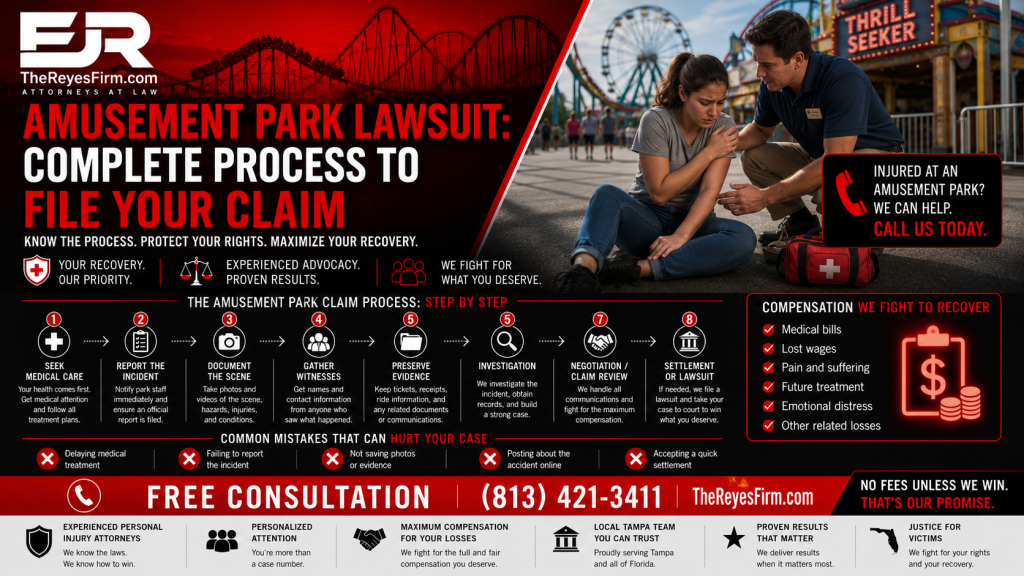
The steps you take right after an injury can make or break a future claim. Report the injury to park staff immediately and ask that an incident report be created, then get prompt medical attention even if you think your injuries are minor, since some conditions surface later and undocumented injuries are hard to claim. Document everything you can: the name and location of the ride, photographs of the scene and your injuries, and the names and contact information of any witnesses.
Be careful about what comes next. Do not give a recorded statement to the park’s insurer or sign a broad release before speaking with a lawyer, since these can be used to limit your claim. Preserving evidence quickly is especially important at large parks, where surveillance video and maintenance records are controlled by the very company you may have a claim against. A lawyer can move fast to secure that evidence before it disappears.
How can you protect your amusement park injury claim?
These five steps protect your health and your claim. The order matters.
- Report the injury to the park immediately. Ask staff to document what happened in an incident report, and get a copy if you can.
- Get prompt medical care. Even a seemingly minor injury should be evaluated, both for your health and to document the harm.
- Document everything. Record the ride name and location, take photos, and collect witness contact information while memories are fresh.
- Do not give statements or sign releases. Avoid recorded statements to the park’s insurer and unsigned broad releases until you have legal advice.
- Consult a lawyer well before the deadline. Evidence can vanish quickly, and the two-year deadline under § 95.11(5)(a) is firm. Call 833-4 BAD DAY for a free consultation.
The Reyes Firm
4730 N. Habana Ave., Suite 201, Tampa, FL 33614
Phone: 833-4 BAD DAY | thereyesfirm.com
How The Reyes Firm handles amusement park injury claims
Amusement park cases are rarely simple, because the evidence is held by well-resourced companies and the liability can be spread across several parties. As a Tampa personal injury firm, The Reyes Firm takes these cases on directly for clients throughout Tampa and Hillsborough County, and we do not hand you off to someone else.
When we take on an amusement park injury case, we typically:
- Investigate the cause, obtaining ride records, maintenance and inspection logs, operator training files, and surveillance video
- Identify every liable party, from the park and its operators to the ride manufacturer and maintenance contractors
- Move quickly to preserve evidence, sending preservation demands so critical records and video are not lost or overwritten
- Work with qualified experts, including engineers and medical professionals, to establish what went wrong and the full extent of your injuries
- Handle the park’s insurers and defense lawyers, so you are not pressured into a quick, inadequate settlement
- Pursue your full damages, including medical bills, lost income, future care, and pain and suffering, as our guide to what drives a settlement explains
No lawyer can promise a particular outcome. What we can promise is a thorough investigation, honest guidance, and a firm that treats your injury and your case with the seriousness they deserve.
Frequently asked questions about amusement park injuries in Florida
What kind of claim is an amusement park injury?
Most are premises liability or negligence claims, based on the park’s duty to keep its premises reasonably safe. If a ride was defectively designed or built, a product liability claim against the manufacturer may also apply, and many serious cases involve more than one theory.
Who is liable for an amusement park injury in Florida?
It depends on the cause. The park or operator may be liable for unsafe conditions, negligent operation, or poor maintenance, the ride manufacturer for a defect, and a maintenance contractor for faulty work. Sometimes more than one party shares responsibility.
Are Florida theme parks inspected by the state?
Smaller parks and traveling rides are inspected by FDACS under Fla. Stat. § 616.242. But parks with more than 1,000 employees and full-time inspectors on staff are exempt and inspect their own rides, which is why the largest parks operate under self-regulation.
How long do I have to file an amusement park injury claim?
Under Fla. Stat. § 95.11(5)(a), you generally have two years from the date of injury to file a negligence claim, reduced from four years in March 2023. Missing this deadline generally ends your right to sue.
Can I sue a major park like Disney or Universal for a ride injury?
Potentially, yes, if negligence or a defect caused your injury. Because the largest parks inspect their own rides under the § 616.242 exemption, whether those self-inspections were done properly is often a central issue in these cases.
What if I was partly at fault for my injury?
Under Fla. Stat. § 768.81, your recovery is reduced by your share of fault, and if you are found more than 50 percent at fault, you generally cannot recover from the other party. Parks often argue a rider ignored instructions, which strong evidence can rebut.
What should I do right after being hurt at a park?
Report the injury and request an incident report, get prompt medical care, and document the ride, the scene, and any witnesses. Avoid giving recorded statements or signing releases, and speak with a lawyer as soon as possible.
Do I need a lawyer for an amusement park injury claim?
It is strongly advisable. These cases involve complex liability, technical evidence held by the park, and well-funded defendants, and an experienced attorney can investigate, preserve evidence, and level the playing field.

Edward Reyes, Esq. is a Florida Bar-admitted personal injury attorney and the founder of The Reyes Firm in Tampa, Florida. He represents people injured by the negligence of others in cases involving car accidents, premises liability, and other serious injuries throughout Tampa and the surrounding counties. Edward Reyes, Esq. handles personal injury claims on a contingency fee basis, meaning clients pay nothing unless the firm recovers compensation for them.
Read more about Edward Reyes.
How Can The Reyes Firm Help You?
If you’ve had a bad day, whether a car accident, a slip and fall, an amusement park injury, or another incident that wasn’t your fault, The Reyes Firm is in your corner. Our Tampa personal injury attorneys offer free consultations and work on a contingency fee basis, which means you pay us nothing unless we win your case.
You shouldn’t have to fight a well-funded company alone. Let us fight for you.
📍 Address: 4730 N. Habana Ave., Suite 201, Tampa, FL 33614
📞 Phone: 833-4 BAD DAY
🌐 Website: Schedule your free consultation today at thereyesfirm.com
Had a bad day? Call The Reyes Firm. We’ll handle the rest.
The information in this blog post is for general informational purposes only and does not constitute legal advice. The statutes and regulations described here contain conditions and exceptions not fully summarized above, and Florida law is subject to change and judicial interpretation. Reading this article does not create an attorney-client relationship with The Reyes Firm. Every case is unique. If you have been injured at an amusement park or on another property due to someone else’s negligence, consult a licensed Florida personal injury attorney about your specific situation.