Catastrophic Injury

Valor de un caso con cirugía en Florida después de un accidente, con paciente en hospital, choque de auto, reclamo por lesiones y factores como gastos médicos, dolor, pérdida de ingresos, culpa y seguro.
Blog, Catastrophic Injury, Spanish

Valor de un Caso con Cirugía en Florida: Qué Vale Tu Reclamo

Lo Que Necesitas Saber Una cirugía puede aumentar el valor de un reclamo por lesiones en Florida porque frecuentemente prueba una lesión grave, facturas médicas más altas y una recuperación más larga. No existe un valor promedio fijo para un caso con cirugía en Florida en el que las víctimas puedan confiar. Tus hechos, registros, culpa y cobertura de seguro controlan el resultado. La ley de negligencia comparativa modificada de Florida puede reducir tu recuperación, y puede que no recuperes nada si eres más del 50% culpable. La compañía de seguros puede cuestionar la cirugía, el momento del tratamiento y cualquier historial de lesiones previas antes de hacer una oferta justa. The Reyes Firm ayuda a personas lesionadas en Tampa a proteger reclamos de cirugía de alto valor. ¿Tuviste un mal día? Llámanos. 833-4 BAD DAY. The Reyes Firm ¿Tuviste una Cirugía Después de un Accidente en Florida? Tu reclamo puede valer más de lo que la compañía de seguros te está ofreciendo. Obtén respuestas claras antes de llegar a un acuerdo. Programa una Revisión Gratuita de Tu Caso Si necesitaste cirugía después de un accidente, probablemente estás asustado, adolorido y preguntándote qué viene después. También puede que estés haciéndote una pregunta muy real: ¿Cuánto vale mi caso con cirugía en un reclamo en Florida? Una cirugía generalmente significa que tu lesión es grave. También puede significar facturas médicas más altas, trabajo perdido, dolor y una pelea más larga con la compañía de seguros. En The Reyes Firm, ayudamos a personas lesionadas en Tampa a entender cuánto puede valer su reclamo antes de que una aseguradora los presione a aceptar una oferta baja. ¿Cuánto Vale un Caso con Cirugía en Florida? Un caso con cirugía en Florida puede valer más que un reclamo por lesión sin cirugía porque la cirugía crea prueba médica sólida de daño grave, daños más altos y necesidades de recuperación más largas. El valor final depende del tipo de cirugía, los costos médicos, la atención futura, la pérdida de ingresos, el dolor y sufrimiento, la culpa y la cobertura de seguro disponible. Ningún abogado puede prometer una cifra sin revisar tus registros. Un caso de fusión espinal, reparación de hombro, cirugía de rodilla o cirugía por fractura puede tener valores muy diferentes. Los reclamos de cirugía más sólidos generalmente incluyen: Prueba clara de culpa Atención de emergencia y tratamiento consistente Registros quirúrgicos Opiniones sobre atención médica futura Prueba de salarios perdidos Calificaciones de impedimento permanente Cobertura de seguro sólida Para los casos en Tampa, la ubicación también puede importar. Un choque en la I-275, I-4 o I-75 puede involucrar evidencia diferente a la de una caída en un negocio en Brandon, Riverview o Plant City. ⚠️ Advertencia: Florida generalmente le da a las víctimas de lesiones dos años para presentar una demanda por negligencia. Si pierdes el plazo, puede que pierdas el derecho a demandar. El Estatuto de Florida § 95.11 incluye las acciones basadas en negligencia bajo el período de limitación de dos años. ¿Aumenta la Cirugía una Compensación por Lesiones Personales en Florida? La cirugía frecuentemente aumenta una compensación por lesiones personales en Florida porque proporciona evidencia médica objetiva. Las compañías de seguros pueden argumentar sobre dolor, rigidez o lesiones de tejidos blandos, pero los registros quirúrgicos son más difíciles de desestimar cuando los médicos conectan la operación con el accidente. La cirugía puede afectar el valor del reclamo de varias maneras: Factor Por Qué Importa Tipo de cirugía Una cirugía mayor generalmente respalda daños más altos que los procedimientos menores. Facturas médicas Las facturas pasadas y futuras ayudan a probar la pérdida económica. Tiempo de recuperación Una recuperación más larga puede significar más dolor, trabajo perdido y limitaciones diarias. Impedimento permanente La calificación de un médico puede respaldar daños a largo plazo. Causalidad Tus registros deben conectar la cirugía con el accidente. Límites del seguro La cobertura disponible puede limitar la recuperación práctica. Para los reclamos por accidentes de auto, los beneficios PIP de Florida también pueden importar. El Estatuto de Florida § 627.736 regula los beneficios de protección por lesión personal requeridos bajo las pólizas calificadas. Un caso con cirugía aún puede ser cuestionado. La aseguradora puede argumentar que tu dolor provino de la edad, artritis, problemas de espalda previos, lesiones deportivas antiguas o una brecha de tratamiento tardío. Por eso la documentación importa. ¿Qué Factores Afectan el Valor de un Caso con Cirugía en Florida? Los factores más importantes son la gravedad de la lesión, el tipo de cirugía, la evidencia médica, la culpa, la atención futura, la pérdida de ingresos, el impedimento permanente y la cobertura de seguro. Un caso de cirugía sólido no depende solo de la operación. Conecta cada daño con el accidente a través de registros, opiniones de expertos y evidencia clara. Aquí están los principales factores de valor: Factor de Valor del Caso Lo Que Revisa la Compañía de Seguros Responsabilidad Quién causó el choque, la caída o el evento de lesión Culpa comparativa Cuánta culpa pueden intentar transferirte Necesidad médica Por qué fue necesaria la cirugía Causalidad Cómo el accidente causó o empeoró la lesión Tratamiento futuro Terapia, inyecciones, cirugía de revisión o atención de seguimiento Pérdida de ingresos Trabajo perdido y capacidad de ingresos reducida Impacto diario Sueño, caminar, levantar, conducir, vida familiar y dolor Límites de póliza Lesiones corporales, UM/UIM, cobertura comercial u otro seguro La regla actualizada de evidencia de daños médicos de Florida también puede afectar cómo se presentan las facturas médicas en los casos de lesiones personales. El Estatuto de Florida § 768.0427 aborda la evidencia de gastos de tratamiento médico pasados y futuros en acciones por lesiones personales y muerte injusta. Esta es una razón por la que los reclamos de cirugía necesitan un trabajo de caso cuidadoso. El número en una factura del hospital puede no ser el único número que importa. 💡 ¿Sabías Que? El FLHSMV es el repositorio oficial de Florida para registros de choques y datos de choques. Sus recursos de choques incluyen informes
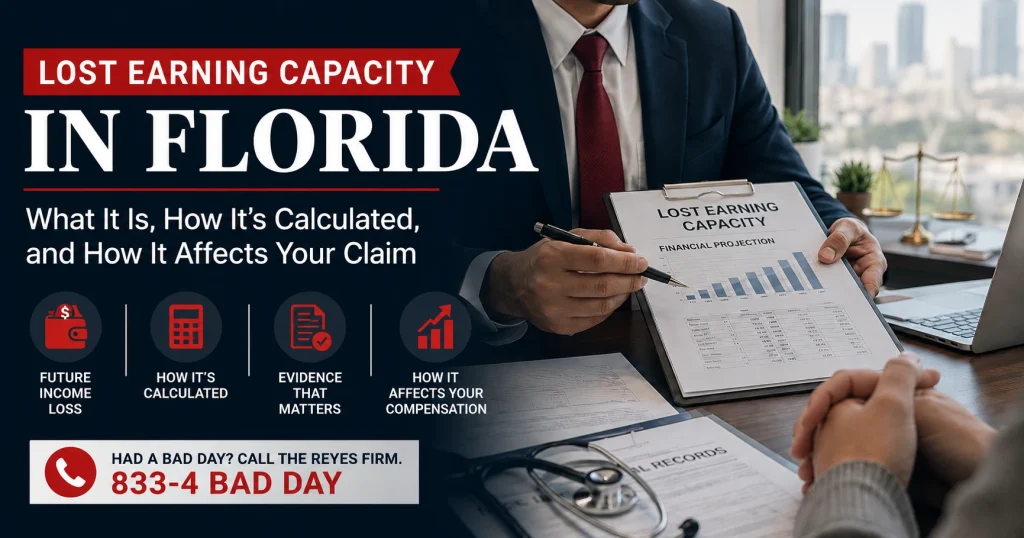
Featured image for a Florida personal injury blog about lost earning capacity, showing a legal consultation with financial projection documents and future income loss details.
Blog, Catastrophic Injury

Lost Earning Capacity in Florida: What Is It Worth?

What You Need to Know Lost earning capacity is the future income you may lose because an injury affects your ability to work, earn, or advance in your career. It is different from lost wages, which usually cover income you have already missed after an accident. In a Florida personal injury case, lost earning capacity can matter when an injury changes your long-term work life. This may happen after a serious car accident, truck crash, slip and fall, motorcycle accident, pedestrian accident, rideshare crash, or another serious injury claim. Lost earning capacity is especially important in catastrophic injury cases because the harm may affect more than today’s paycheck. It may affect your future job options, business growth, promotions, benefits, overtime, or ability to support your family. For a broader overview of serious injury claims, visit our guide to working with a Tampa catastrophic injury attorney. A person may still have a lost earning capacity claim even if they were not working at the exact time of the accident. Students, self-employed workers, business owners, gig workers, stay-at-home parents, and people between jobs may still be able to show that their future earning potential was reduced. 🛡️ Important Florida Deadline: Most Florida negligence-based personal injury claims must be filed within two years. Some exceptions may apply, but waiting too long can affect your right to recover compensation. Florida Statute § 95.11 lists “an action founded on negligence” under a two-year limitations period. Had a bad day? Call The Reyes Firm at 833-4 BAD DAY. What Counts as Lost Earning Capacity in Florida? Lost earning capacity is the loss of your ability to earn money in the future because of an injury. It looks at your earning power, not just the paychecks you already missed. This type of claim may apply if your injury causes you to: Leave a higher-paying job Work fewer hours Stop doing physical work Miss overtime, tips, bonuses, or commissions Lose future promotions Change careers Reduce or close a business Accept lower-paying work because of medical limits For example, a warehouse worker with a serious back injury may return to work, but only in a lighter-duty role that pays less. A business owner with a traumatic brain injury may still run the business, but not at the same pace or level of growth. A student may have to change career paths because their injury limits what they can do physically or mentally. The key question is not only, “How much money did you lose already?” The deeper question is, “How has this injury changed what you can reasonably earn in the future?” How Is Lost Earning Capacity Different From Lost Wages? Lost wages are income you already missed. Lost earning capacity is the future income you may lose because your injury limits your ability to work. Here is the simple difference: Type of Claim What It Covers Common Proof Lost wages Paychecks, tips, commissions, or income already missed after the accident Pay stubs, tax returns, employer letters, schedules Lost earning capacity Future reduction in your ability to earn money Medical records, work history, vocational expert reports, and economist reports Lost wages are often easier to prove because they look backward. You can usually show missed income with payroll records, tax documents, or an employer statement. Lost earning capacity is harder because it looks forward. It asks what your career, income, or business could have looked like if the injury had not happened. Florida’s Personal Injury Protection, or PIP, may provide limited disability benefits after a motor vehicle crash. Florida Statute § 627.736 states that PIP disability benefits include 60% of the loss of gross income and loss of earning capacity caused by the injury, subject to policy limits and other rules.  However, PIP is limited. A serious injury may create future losses that go far beyond available PIP benefits. That is why lost earning capacity often becomes part of a broader claim against the at-fault driver, company, property owner, or other responsible party. How Do You Calculate Lost Earning Capacity in Florida? Lost earning capacity is usually calculated by comparing what you could reasonably earn before the injury with what you can reasonably earn after the injury. The difference may then be projected over your expected work life and adjusted to present value. There is no single formula that works for every case. A calculation may consider: Your age Education Training Work history Career path before the injury Physical or cognitive limits after the injury Whether you can return to your old job Whether you can work full-time or only part-time Lost overtime, bonuses, commissions, or benefits Lost business income Work-life expectancy Inflation, wage growth, and present value A simple example may look like this: Factor Example Pre-injury earning ability $70,000 per year Post-injury earning ability $45,000 per year Annual earning capacity loss $25,000 per year Expected remaining work life 20 years Raw future loss before adjustments $500,000 That example is only a simplified illustration. Real claims usually require deeper analysis because future income can be affected by raises, promotions, benefits, inflation, taxes, work-life expectancy, and present value. In many cases, a vocational expert and an economist are used. The vocational expert looks at what work you can realistically do after the injury. The economist turns that information into a financial projection. What Evidence Helps Prove Lost Earning Capacity? The strongest lost earning capacity claims use medical, employment, vocational, and financial evidence together. Helpful evidence may include: Medical records Doctor opinions about work restrictions Functional capacity evaluations Pay stubs W-2s or 1099s Tax returns Business records Profit and loss statements Employer letters Job descriptions Performance reviews Overtime history Vocational expert reports Economist reports Testimony from coworkers, supervisors, clients, or family members The goal is to connect the injury to the work limitation and then connect the work limitation to the financial loss. It is usually not enough to say, “I cannot work as I used to.” A stronger claim shows: What you could do before the injury What

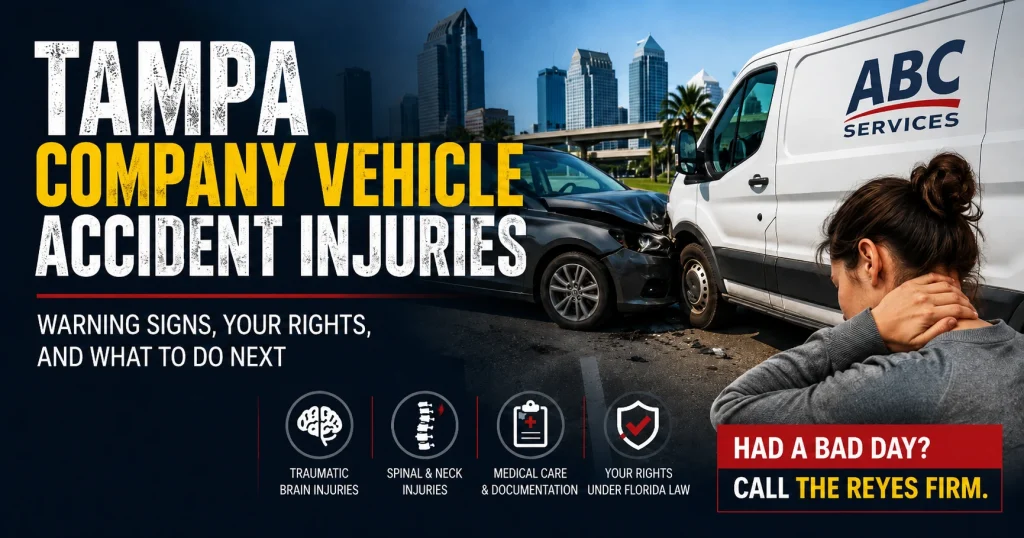
Featured image for a Tampa company vehicle accident injuries blog showing a company van crash scene, an injured person with neck pain, and injury-related legal topics.
Blog, Catastrophic Injury, Commercial Vehicles, Company-Caused Car Accidents

Tampa Company Vehicle Accident Injuries: 4 Common Types

Quick Answer The most common Tampa company vehicle accident injuries include whiplash, traumatic brain injury, spinal injury, and PTSD. These injuries may not show up right away. They can still affect your medical care, work, daily life, and injury claim.  The key points below explain what you should know first.  What You Need to Know Whiplash, traumatic brain injury, spinal damage, and PTSD are common after crashes involving delivery vans, work trucks, rideshare vehicles, service vehicles, and commercial trucks. Preliminary 2024 FLHSMV data listed 46,651 commercial motor vehicle crashes in Florida, with 315 fatalities.  Florida PIP benefits generally require that initial medical care be obtained within 14 days of a motor vehicle accident.  Florida negligence claims are generally subject to a two-year deadline under Fla. Stat. § 95.11.  If you were injured by a company vehicle in Tampa, your case may involve the driver, employer, vehicle owner, insurance company, or another responsible party. The Reyes Firm Had a Bad Day? Was There a Logo on the Vehicle? A company name, logo, DOT number, app record, or trailer marking can help identify who may be responsible after a Tampa company vehicle crash. Schedule Your Free Consultation After a crash involving a Tampa company vehicle, injuries can feel confusing and unfair. Your neck may hurt days later. You may feel foggy, anxious, or unable to drive without fear.  The problem is that insurance companies may treat delayed pain as if it were not serious. They may also question whether the company, the driver, or another party is responsible.  This guide explains four injuries we often see after company vehicle crashes: whiplash, traumatic brain injury, spinal injury, and PTSD. It also explains why immediate medical care and clear records matter for your claim.  Before looking at the legal side, it helps to understand the injuries that often appear first.  What Injuries Are Most Common After a Tampa Company Vehicle Crash? The most common catastrophic injuries after a Tampa company vehicle crash include whiplash, TBI, spinal injury, and PTSD. These injuries often appear after crashes with delivery vans, work trucks, rideshare vehicles, utility vehicles, and commercial trucks.  Company vehicles are often larger, heavier, or used under work pressure. A smaller car can take the worst of the impact when a company pickup, van, box truck, or semi-truck causes a crash.  The injury you suffer may depend on: The size and weight of the company vehicle The speed of impact The type of crash How your body moved during impact Any prior medical issues How quickly you received medical care We built this injury hub so you can find the condition that matches your symptoms. These injuries matter, but the type of vehicle can also change the legal path. Why Are Company Vehicle Injury Claims Different? Company vehicle injury claims are different because they may involve more than one responsible party. The driver may have caused the crash. The company, vehicle owner, contractor, or insurer may also play a role.  For example, a Tampa company vehicle crash may raise these questions: Was the driver working at the time? Did the business own the vehicle? Was the driver an employee or a contractor? Did the company train or screen the driver? Did poor vehicle maintenance play a role? Was the driver rushing for work? Which insurance policy applies? These questions matter because they can affect insurance coverage and case strategy.  A company vehicle crash is not always a simple driver-versus-driver case. It may require business records, insurance policies, vehicle data, driver logs, app records, and repair history.  Once the responsible parties are clear, the next step is proving what the crash did to your body.  Why Does Whiplash Need Medical Documentation Right Away? Whiplash needs fast medical documentation because insurance companies often dismiss it as “just soreness.” Without early medical records, an adjuster may argue that your pain came from something else. Whiplash happens when your head and neck snap forward and backward too fast. This movement can strain muscles, stretch ligaments, irritate nerves, and worsen disc problems.  Symptoms may include: Neck stiffness Headaches Shoulder pain Upper back pain Reduced range of motion Tingling or numbness Dizziness Pain that appears 24 to 72 hours later The key is not to wait. If your neck hurts after a crash, get checked as soon as you can. Florida PIP benefits generally require that initial care be provided within 14 days of the crash. Warning: Do Not Wait Too Long to Get Medical Care Florida’s PIP law generally requires initial medical care within 14 days after a motor vehicle accident. Waiting too long may affect your insurance benefits. It may also make your injury claim harder to prove. See Florida Statute § 627.736. Neck pain is the only injury that insurers may downplay after a crash involving a company vehicle.  Still have questions? Call The Reyes Firm at 833-4 BAD DAY. The consultation is free, and there’s no obligation.  How Serious Is a Traumatic Brain Injury From a Commercial Vehicle Crash? A traumatic brain injury from a commercial vehicle crash can be serious, even without a visible head wound. A sudden crash can cause your brain to move inside your skull.  The CDC lists motor vehicle crashes as one common cause of traumatic brain injuries. A TBI can affect your medical care, work, and daily life.  TBI symptoms may appear right away. They may also develop over time. The CDC notes that some mild TBI symptoms can change during recovery. Some people notice mood or sleep changes later.  Possible TBI symptoms include: Headaches Confusion Memory gaps Trouble concentrating Dizziness Light or sound sensitivity Mood changes Nausea Sleep problems Feeling “foggy” Trouble returning to work A brain injury can affect your work, family, and future care needs. Tell your doctor about every symptom, even if it feels minor.  Did You Know? A traumatic brain injury does not always require a direct hit to the head. A hard jolt or sudden stop may still affect how the brain works. Brain injuries can be hard

Abogado de lesiones catastróficas en Tampa con imagen de una persona en silla de ruedas frente al skyline de Tampa, destacando apoyo legal después de una lesión grave.
Blog, Catastrophic Injury

Abogado de Lesiones Catastróficas en Tampa: Ayuda Después de una Lesión que Cambia Tu Vida

Lo Que Necesitas Saber Una lesión catastrófica puede cambiar tu salud, tus ingresos, tu independencia y tu vida familiar en un solo momento. Las lesiones catastróficas comunes incluyen lesiones cerebrales traumáticas, lesiones de médula espinal, amputaciones, quemaduras graves, daño a órganos y discapacidad permanente. Los casos de lesiones catastróficas frecuentemente requieren planes de cuidado de por vida, expertos médicos, especialistas vocacionales, reconstrucción de accidentes y preparación legal lista para juicio. La mayoría de las demandas por lesiones personales basadas en negligencia en Florida deben presentarse dentro de los 2 años según el Estatuto de Florida § 95.11(5)(a). La regla de culpa comparativa modificada de Florida puede impedir la recuperación si se determina que eres más del 50% culpable en casos de negligencia cubiertos. ¿Tuviste un mal día? Llámanos. 833-4 BAD DAY. The Reyes Firm ¿Te Lastimaste con una Lesión Catastrófica en Tampa? Obtén los próximos pasos claros después de una lesión que cambia tu vida. ¿Tuviste un mal día? Contáctanos Ahora Una lesión grave puede convertir un día normal en una vida completamente diferente. Puede que estés sentado junto a una cama de hospital. Puede que estés tratando de entender un diagnóstico. Puede que estés escuchando palabras como parálisis, lesión cerebral, amputación o discapacidad permanente por primera vez. Un abogado de lesiones catastróficas en Tampa en quien las familias confían puede ayudar a proteger tus derechos mientras te concentras en tu atención médica. En The Reyes Firm, ayudamos a personas en Tampa y las comunidades de South Shore que han sido lesionadas en accidentes, en propiedades inseguras, por vehículos comerciales o por empresas negligentes. Los casos de lesiones catastróficas no son reclamos de rutina. Frecuentemente involucran cirugías futuras, atención a largo plazo, pérdida de capacidad de ingresos, planificación de cuidado de por vida, y compañías de seguros que empiezan a construir su defensa desde temprano. The Reyes Firm sirve a Tampa, Riverview, Brandon, Plant City, y comunidades de todo el Condado de Hillsborough desde 4730 N. Habana Ave., Suite 201, Tampa, FL 33614. Llama al 833-4 BAD DAY para una consulta gratuita. ¿Qué Califica como Lesión Catastrófica en Florida? Una lesión catastrófica es una lesión grave que cambia permanentemente cómo vives, trabajas, te mueves, piensas, te comunicas o te cuidas a ti mismo. Estas lesiones van mucho más allá de una recuperación corta. Frecuentemente requieren tratamiento médico a largo plazo, planificación de atención futura y prueba experta de cómo la lesión afecta tu vida. Las lesiones catastróficas comunes incluyen: Lesiones cerebrales traumáticas Lesiones de médula espinal Parálisis Amputaciones Quemaduras graves Daño a órganos Fracturas complejas Pérdida de visión o audición Discapacidad permanente Lesiones fatales que dan lugar a reclamos por muerte injusta Florida no usa un solo estatuto de lesiones personales para definir cada lesión catastrófica. En casos reales, la pregunta clave es práctica. ¿La lesión cambió permanentemente tu vida, tu trabajo o tu capacidad de cuidarte a ti mismo? Si la respuesta es sí, tu caso necesita más que simples facturas médicas. Puede requerir médicos, planificadores de cuidado de por vida, economistas, expertos vocacionales y especialistas en reconstrucción de accidentes. ⚠️ Advertencia: El Plazo de 2 Años de Florida: La mayoría de las demandas por lesiones personales basadas en negligencia en Florida deben presentarse dentro de los 2 años según el Estatuto de Florida § 95.11(5)(a). Este plazo puede afectar los casos de lesiones catastróficas después de accidentes, caídas, incidentes en propiedades inseguras y otros reclamos por negligencia. Esperar demasiado puede poner en riesgo tu caso porque la evidencia puede desaparecer, los testigos pueden mudarse y las grabaciones de video pueden eliminarse. ¿Qué Causa Lesiones Catastróficas en Tampa? Las lesiones catastróficas en Tampa frecuentemente ocurren cuando un accidente, una caída, un incidente laboral o una condición insegura crea una fuerza violenta en el cuerpo. Las carreteras de alta velocidad, el tráfico comercial, la actividad de construcción y las zonas peatonales concurridas pueden aumentar el riesgo de lesiones que cambian la vida en Tampa y el Condado de Hillsborough. Las causas comunes incluyen: Accidentes de carro en la I-4, I-75, I-275 y las vías locales de Tampa Choques con semirremolques y vehículos comerciales Choques con vehículos de reparto Accidentes de motocicleta Choques con peatones y ciclistas Accidentes de construcción Condiciones peligrosas en propiedades Productos defectuosos Negligencia médica Los accidentes de vehículos motorizados siguen siendo una de las fuentes más claras de daño catastrófico. La NHTSA reportó que 39,254 personas fallecieron en choques de tráfico en Estados Unidos en 2024, con una tasa de mortalidad de 1.19 muertes por cada 100 millones de millas recorridas por vehículos. En Tampa, las lesiones graves frecuentemente ocurren a lo largo de corredores rápidos y congestionados. La I-275, I-75, I-4, Dale Mabry Highway, Hillsborough Avenue, Fowler Avenue, y las rutas que sirven a Brandon, Riverview, Plant City y las comunidades de South Shore pueden presentar riesgos graves de accidentes. 📊 ¿Sabías Que? El FLHSMV reportó 381,210 choques de tráfico registrables en Florida en 2024, con 3,184 personas fallecidas en choques de vehículos. El mismo informe del FLHSMV registró 46,651 choques de vehículos motorizados comerciales y 315 fallecidos. Fuente: FLHSMV By the Numbers 2024. ¿Quién Puede Ser Responsable de una Lesión Catastrófica en Tampa? Más de una persona o empresa puede ser responsable de una lesión catastrófica en Tampa. Un caso grave frecuentemente requiere una investigación más profunda sobre conductores, empleadores, dueños de propiedades, contratistas, fabricantes y cobertura de seguro. El objetivo es identificar a cada parte cuyas acciones contribuyeron a la lesión. Dependiendo del caso, las partes responsables pueden incluir: Un conductor negligente Una empresa de camiones Una empresa de reparto Un empleador Un dueño de propiedad Un operador de negocio Un contratista de construcción Una empresa de mantenimiento Una empresa de carga Un fabricante de productos Una entidad gubernamental, en casos limitados Esto importa porque los daños por lesiones catastróficas pueden ser muy altos. La atención futura, la pérdida de ingresos y la discapacidad a largo plazo pueden costar mucho más de lo que una sola póliza de seguro puede cubrir. Por ejemplo,

Featured image for a Florida personal injury blog about surgery case value, showing medical records, a shield, scales of justice, a gavel, and a Florida background, for illustrative purposes only.
Blog, Catastrophic Injury

Surgery Case Value in Florida: What Your Claim Is Worth

What You Need to Know Surgery can raise the value of a Florida injury claim because it often proves catastrophic injury, higher medical bills, and a longer recovery. There is no fixed average value for a surgery case in Florida that victims can rely on. Your facts, records, fault, and insurance coverage control the result. Florida’s modified comparative negligence law can reduce your recovery, and you may recover nothing if you’re more than 50% at fault. The insurance company may question the surgery, the timing of treatment, and any prior injury history before making a fair offer. The Reyes Firm helps injured people in Tampa protect high-value surgery claims. Had a bad day? Call us. 833-4 BAD DAY. The Reyes Firm Had Surgery After an Accident in Florida? Your claim may be worth more than the insurance company is offering. Get clear answers before you settle. Schedule a Free Case Review If you needed surgery after an accident, you’re probably scared, sore, and wondering what happens next. You may also be asking one very real question: How much is my surgery case worth in a Florida claim? Surgery usually means your injury is serious. It may also mean higher medical bills, missed work, pain, and a longer fight with the insurance company. At The Reyes Firm, we help injured people in Tampa understand what their claim may be worth before an insurer pushes them into a low offer. How Much Is a Surgery Case Worth in Florida? A surgery case in Florida may be worth more than a non-surgical injury claim because surgery creates strong medical proof of serious harm, higher damages, and longer recovery needs. The final value depends on the type of surgery, medical costs, future care, lost income, pain and suffering, fault, and available insurance coverage. No lawyer can promise a number without reviewing your records. A spinal fusion case, shoulder repair case, knee surgery case, or fracture surgery case may all have different values. The strongest surgery claims usually include: Clear proof of fault Emergency care and consistent treatment Surgical records Future medical care opinions Lost wage proof Permanent impairment ratings Strong insurance coverage For Tampa cases, location can also matter. A crash on I-275, I-4, or I-75 may involve different evidence than a slip and fall at a business in Brandon, Riverview, or Plant City. ⚠️ Warning: Florida generally gives injury victims two years to file a negligence lawsuit. If you miss the deadline, you may lose the right to sue. Florida Statutes section 95.11 lists actions founded on negligence under the two-year limitations period. Does Surgery Increase a Personal Injury Settlement in Florida? Surgery often increases a personal injury settlement in Florida because it provides objective medical evidence. Insurance companies may argue about pain, stiffness, or soft tissue injuries, but surgical records are harder to dismiss when doctors connect the operation to the accident. Surgery can affect claim value in several ways: Factor Why It Matters Type of surgery Major surgery usually supports higher damages than minor procedures. Medical bills Past and future bills help prove economic loss. Recovery time A longer recovery can mean more pain, missed work, and daily limits. Permanent impairment A doctor’s rating may support long-term damage. Causation Your records must connect the surgery to the accident. Insurance limits The available coverage may cap practical recovery. For car accident claims, Florida PIP benefits may also matter. Florida Statutes section 627.736 governs required personal injury protection benefits under qualifying policies.  A surgery case can still be challenged. The insurer may argue that your pain came from age, arthritis, prior back problems, old sports injuries, or a delayed treatment gap. That’s why documentation matters. What Factors Affect Surgery Case Value in Florida? The biggest factors are injury severity, type of surgery, medical evidence, fault, future care, lost income, permanent impairment, and insurance coverage. A strong surgery case doesn’t rely on the operation alone. It connects every damage to the accident through records, expert opinions, and clear evidence. Here are the main value drivers: Case Value Factor What The Insurance Company Reviews Liability Who caused the crash, fall, or injury event Comparative fault How much blame they may try to put on you Medical necessity Why was surgery needed Causation How the accident caused or worsened the injury Future treatment Therapy, injections, revision surgery, or follow-up care Lost income Missed work and reduced earning ability Daily impact Sleep, walking, lifting, driving, family life, and pain Policy limits Bodily injury, UM/UIM, business coverage, or other insurance Florida’s updated medical damages evidence rule can also affect how medical bills get presented in personal injury cases. Florida Statutes section 768.0427 addresses evidence of past and future medical treatment expenses in personal injury and wrongful death actions.  This is one reason surgery claims need careful case work. The number on a hospital bill may not be the only number that matters. 💡 Did You Know? FLHSMV is Florida’s official repository for crash records and crash data. Its crash resources include Florida crash reports, statewide crash data, and annual traffic crash facts used by lawmakers, agencies, media, and the public. Cases involving permanent disability, multi-level spinal fusions, or catastrophic injuries may require specialized legal support. Learn more about how our catastrophic injury attorney in Tampa helps people with life-changing injury claims. How Does Florida Comparative Negligence Affect Surgery Case Value? Florida comparative negligence can lower your personal injury case value based on your percentage of fault. If you’re found more than 50% at fault in most negligence cases, you may recover nothing, even after surgery. If you’re 50% or less at fault, your damages get reduced by that percentage. Here’s a simple example: Total Damages Your Fault Possible Recovery $300,000 0% $300,000 $300,000 20% $240,000 $300,000 40% $180,000 $300,000 50% $150,000 $300,000 51% $0 Florida Statutes section 768.81 says a party found greater than 50% at fault for their own harm may not recover damages in covered negligence actions. The statute also states that this specific greater-than-50%

Featured image for a catastrophic injury attorney Tampa article showing a wheelchair user with the Tampa skyline, for illustrative purposes only.
Blog, Catastrophic Injury

Catastrophic Injury Attorney Tampa: Help After a Life-Changing Injury

What You Need to Know A catastrophic injury can change your health, income, independence, and family life in one moment. Common catastrophic injuries include traumatic brain injuries, spinal cord injuries, amputations, severe burns, organ damage, and permanent disability. Catastrophic injury cases often require life care plans, medical experts, vocational specialists, accident reconstruction, and trial-ready legal preparation. Most Florida negligence-based personal injury lawsuits must be filed within 2 years under Florida Statute § 95.11(5)(a). Florida’s modified comparative fault rule may block recovery if you are found to be greater than 50% at fault in covered negligence cases. Had a bad day? Call us. 833-4 BAD DAY. The Reyes Firm Hurt by a Catastrophic Injury in Tampa? Get clear next steps after a life changing injury. Had a bad day? Contact Us Now A serious injury can turn one normal day into a completely different life. You may be sitting beside a hospital bed. You may be trying to understand a diagnosis. You may be hearing words like paralysis, brain injury, amputation, or permanent disability for the first time. A catastrophic injury attorney Tampa families trust can help protect your rights while you focus on medical care. At The Reyes Firm, we help people in Tampa and the South Shore communities who have been injured in crashes, on unsafe properties, by commercial vehicles, or by negligent companies. Catastrophic injury cases are not routine claims. They often involve future surgeries, long-term care, lost earning capacity, life care planning, and insurance companies that start building their defense early. The Reyes Firm serves Tampa, Riverview, Brandon, Plant City, and communities across Hillsborough County from 4730 N. Habana Ave., Suite 201, Tampa, FL 33614. Call 833-4 BAD DAY for a free consultation. What qualifies as a catastrophic injury in Florida? A catastrophic injury is a serious injury that permanently changes how you live, work, move, think, communicate, or care for yourself. These injuries go far beyond a short recovery. They often require long-term medical treatment, future care planning, and expert proof of how the injury affects your life. Common catastrophic injuries include: Traumatic brain injuries Spinal cord injuries Paralysis Amputations Severe burns Organ damage Complex fractures Loss of vision or hearing Permanent disability Fatal injuries that lead to wrongful death claims Florida does not use a single personal injury statute to define every catastrophic injury. In real cases, the key question is practical. Did the injury permanently change your life, your work, or your ability to care for yourself? If the answer is yes, your case needs more than basic medical bills. It may require doctors, life care planners, economists, vocational experts, and accident reconstruction specialists. ⚠️ Warning: Florida’s 2-Year Deadline: Most Florida negligence-based personal injury lawsuits must be filed within 2 years under Florida Statute § 95.11(5)(a). This deadline can affect catastrophic injury cases after crashes, falls, unsafe property incidents, and other negligence claims. Waiting too long can put your case at risk because evidence can disappear, witnesses can move, and video footage can be deleted. What causes catastrophic injuries in Tampa? Catastrophic injuries in Tampa often happen when a crash, fall, workplace incident, or unsafe condition creates violent force on the body. High-speed roads, commercial traffic, construction activity, and busy pedestrian areas can all increase the risk of life-changing injuries across Tampa and Hillsborough County. Common causes include: Car crashes on I-4, I-75, I-275, and local Tampa roads Semi-truck and commercial vehicle crashes Delivery vehicle crashes Motorcycle crashes Pedestrian and bicycle crashes Construction accidents Dangerous property conditions Defective products Medical negligence Motor vehicle crashes remain one of the clearest sources of catastrophic harm. NHTSA reported that 39,254 people died in U.S. traffic crashes in 2024, with a fatality rate of 1.19 deaths per 100 million vehicle miles traveled.  In Tampa, serious injuries often happen along fast, congested corridors. I-275, I-75, I-4, Dale Mabry Highway, Hillsborough Avenue, Fowler Avenue, and routes serving Brandon, Riverview, Plant City, and South Shore communities can all involve severe crash risks. 📊 Did You Know? FLHSMV reported 381,210 codable traffic crashes in Florida in 2024, with 3,184 people killed in vehicle crashes. The same FLHSMV report listed 46,651 commercial motor vehicle crashes and 315 fatalities. Source: FLHSMV By the Numbers 2024. Who may be liable for a catastrophic injury in Tampa? More than one person or company may be liable for a catastrophic injury in Tampa. A serious case often requires a deeper investigation into drivers, employers, property owners, contractors, manufacturers, and insurance coverage. The goal is to identify every party whose actions contributed to the injury. Depending on the case, liable parties may include: A negligent driver A trucking company A delivery company An employer A property owner A business operator A construction contractor A maintenance company A cargo loading company A product manufacturer A government entity, in limited cases This matters because catastrophic injury damages can be very high. Future care, lost income, and long-term disability may cost far more than one insurance policy can cover. For example, a truck crash may involve the driver, motor carrier, maintenance company, cargo loader, or broker. A premises case may involve the property owner, tenant, maintenance vendor, or security company. The Reyes Firm looks beyond the obvious defendant. Serious injury cases require fast action, focused investigation, and a firm built to handle hard cases, not just high case volume. What evidence should be preserved after a catastrophic injury? The most important evidence after a catastrophic injury should be preserved as soon as possible. Photos, video, vehicle data, witness statements, medical records, and company records can help prove what happened, who caused it, and how the injury changed your life. Important evidence may include: Police reports Crash reports Incident reports Medical records Photos and videos Witness names and statements Surveillance footage Dashcam footage Vehicle black box data Driver logs Maintenance records Dispatch records Cell phone records GPS or telematics data Company safety policies In a commercial vehicle case, evidence may be in the hands of the company that caused the crash.

Scroll to Top