Injury

When to see a doctor after an accident
Accident Injuries & why, After A Car Accident, After an Accident, FAQ, For Parents, For Teens, Health, Injury, Traumatic injury, Why we serve

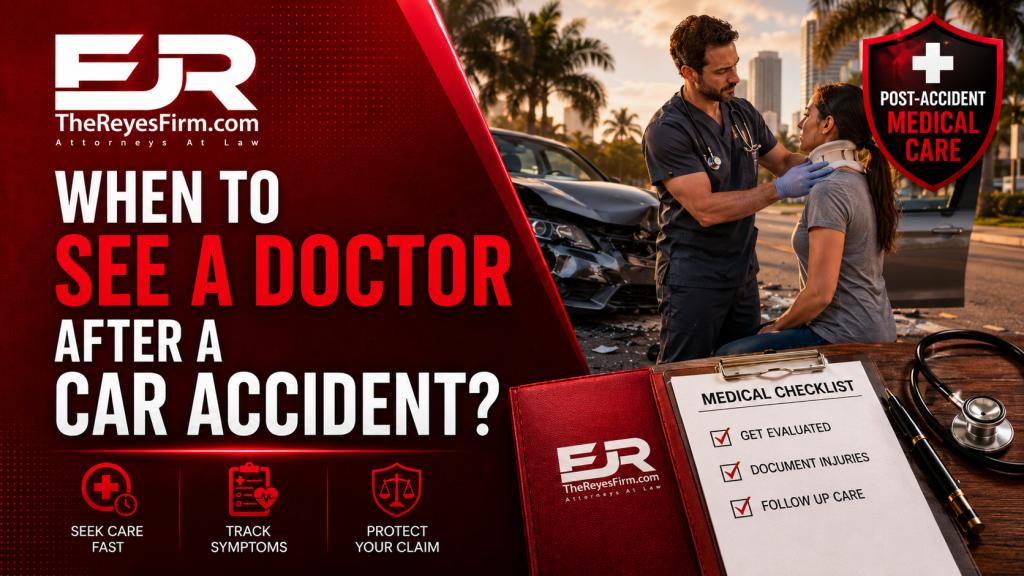
When to See A Doctor After A Car Accident?

You were just going about your day. Then a Tampa car accident changed everything. Now you’re sore but not sure if it’s “really” an injury, and the other driver’s insurance team is already working to protect their interests. Here’s what you need to know about seeing a doctor — before you say another word to them. TL;DR — QUICK SUMMARY See a doctor within 24 to 72 hours of any Florida car accident, even if you feel “fine” — adrenaline and shock routinely mask concussions, internal injuries, and soft-tissue damage. Florida’s no-fault PIP law under Florida Statute § 627.736 requires you to obtain initial medical services within 14 days of the crash or lose your $10,000 in PIP benefits entirely. Gaps in treatment are the single most common reason insurance adjusters reduce or deny a Tampa car accident claim — every missed appointment is leverage for the other side. Florida Statute § 95.11(3)(a) gives you two years from the date of the crash to file a personal injury lawsuit, but the medical record you build in the first month often decides what your case is worth. You do not have to use the at-fault driver’s “preferred” doctor; you have the right to choose your own physician and to be evaluated for delayed-onset injuries like whiplash, concussion, and disc damage. The Reyes Firm Hurt in a Tampa Car Accident? Get clear next steps before the 14-day PIP deadline. Had a bad day? Contact Us Now 14 Days FL PIP medical deadline Fla. Stat. § 627.736 $10,000 Florida PIP benefit limit Fla. Stat. § 627.736 2 Years FL statute of limitations Fla. Stat. § 95.11(3)(a) 72 Hours Delayed injury window Mayo Clinic / CDC guidance When should you see a doctor after a car accident in Tampa? You should see a doctor within 24 to 72 hours of any Florida car accident, ideally the same day. Even a “minor” crash transfers enough force to cause whiplash, concussion, internal bleeding, and soft-tissue damage that you may not feel at the scene because adrenaline and shock chemistry suppress pain signals for hours, sometimes days. By the time the discomfort actually shows up, the injury has often already begun to worsen. The honest answer most people don’t hear from the at-fault driver’s insurer: it doesn’t matter how “fine” you feel walking away. The standard medical guidance is to be evaluated as soon as possible after any collision involving airbag deployment, head impact, neck strain, abdominal contact with a seatbelt, or any loss of consciousness — and frankly, after any crash where another vehicle hit yours at speed. ⚠️ Deadline Warning: Under Florida Statute § 95.11(3)(a), you have two years from the date of your crash to file a personal injury lawsuit. But you have only 14 days to start medical treatment to keep your $10,000 in Florida PIP benefits under § 627.736. Miss the 14-day window and you lose your no-fault coverage entirely. Don’t wait to call a lawyer or a doctor. Why is the 14-day PIP rule so important after a Florida car accident? Florida is a no-fault auto insurance state, which means your own Personal Injury Protection (PIP) coverage pays the first $10,000 of your medical bills regardless of who caused the crash — but only if you obtain “initial services and care” within 14 days of the accident. This deadline is written directly into Florida Statute § 627.736 and the insurance industry enforces it strictly. Two things go wrong when people miss the 14-day deadline. First, they lose access to PIP coverage entirely, which means thousands of dollars of medical bills come out of their own pocket or get pushed onto their health insurance. Second, the gap between the crash and the first medical visit becomes the at-fault driver’s favorite argument — that you weren’t really hurt, or that the injury came from something else. The 14-day rule isn’t just an insurance technicality; it’s a legal trap for people who try to “tough it out.” What injuries are commonly missed at the scene of a Tampa car accident? The most dangerous car accident injuries are the ones that don’t show up at the scene. Emergency responders are trained to triage life-threatening trauma first, and many serious injuries simply don’t produce visible symptoms in the minutes after a crash. By the time the symptoms catch up to you, the underlying damage may be days or weeks ahead of the pain. Injuries that commonly stay hidden in the first 24 to 72 hours include: Concussion and mild traumatic brain injury — headache, brain fog, light sensitivity, sleep disruption, and memory problems often start a full day or two after impact, especially when there was no loss of consciousness Whiplash and cervical strain — neck stiffness and reduced range of motion typically peak between 24 and 72 hours, long after the adrenaline has worn off Herniated and bulging discs — radiating pain, numbness, or weakness in an arm or leg can take weeks to fully present, even though the disc injury occurred at impact Internal bleeding and organ damage — abdominal pain, lightheadedness, and bruising after a seatbelt impact can signal a life-threatening injury that needs immediate imaging Soft-tissue and ligament tears — shoulder, knee, and wrist injuries often feel like soreness at first and only declare themselves when swelling and inflammation peak Psychological injury — anxiety, intrusive thoughts, sleep disruption, and avoidance of driving are real, compensable injuries that need clinical documentation 💡 Did You Know? According to FLHSMV’s 2024 “By the Numbers” report, Florida recorded more than 395,000 crashes in 2024, with roughly 247,000 injuries reported statewide. Hillsborough County alone consistently ranks among the top three Florida counties for traffic crashes. Source: FLHSMV By the Numbers 2024, flhsmv.gov. Note: 2024 crash numbers are preliminary. Which doctor should you see first after a car accident in Tampa? The right first stop depends on what you’re feeling, but the rule of thumb is to go higher rather than lower. If there is any chance
Slip and fall
Accident Injuries & why, Blog, For Parents, For Teens, Injury, Legal, Premise Liability, Slip and fall, Strict Negligence, Why we serve

Slip, Falls and Premise Liability

Liability is when you’re injured inside a premise, a building, a structure of somebody or a company or likewise. It could be that you’re injured in someone’s home. It could be that you’re injured in their yard. It could be that you’re inside a company, like a grocery store, and you slip and you fell. It could be that you’re in an apartment complex, and you slipped and you fell. Or going down the stairs, you may have slipped and fallen because the stairs were improperly placed on that stairway. Premise liability is different than regular car accidents and regular personal injury in the sense that instead of going after car insurance, you’re going after liability insurance that that company or those homeowners may have a homeowner’s coverages, or that company may have it as liability coverage for incidences for injuries. Every case is different, and there’s still a duty to mitigate, which means if you had an injury from falling down, and you decided not to go to the doctor, and you decided not to get help for any reason, and you made the condition worse. Tampa personal injury lawyer Edward Reyes represents people in Tampa and Hillsborough County, Florida who have suffered an injury in an incident or accident type of accident. Speak Directly to Me, At No Cost, Today 813.421.3411 Well, the other insurance company, or the insurance company even though you’re not at fault, is going to deduct part of your injuries and your recovery because you didn’t mitigate or reduce the number of losses that you could’ve saved. As well as, if it was Open and Obvious. If you went to a store, and you saw that the floor was wet, you saw that there was a stack of books there, you saw, or it could’ve been there for a period that you could’ve seen it, and at that point, it’s going to raise an argument of Open and Obvious. That does not mean that it’s a grand slam on the other side, that just means it creates issues when fighting the case because they’re going to claim Open and Obvious. On the flip side to that, if it’s a condition that is not readily visible to you, but it’s been there for a long period of time, that’s also considered constructive notice. So when you’re dealing with premise liability, either slip and falls or just general premise liability, the issues that come up are Open and Obvious on their side and constructive notice. And then, of course, the injuries itself, and the number of damages, and the duty to mitigate. If you have any questions about this, feel free to give us a call. Our number is 813-421-3411. (Transcript from the video, transcribed but not reviewed)

Spinal Cord Stimulation
Body Shops, FAQ, For Parents, For Teens, Health, Injury, Why we serve

Spinal Cord Stimulation

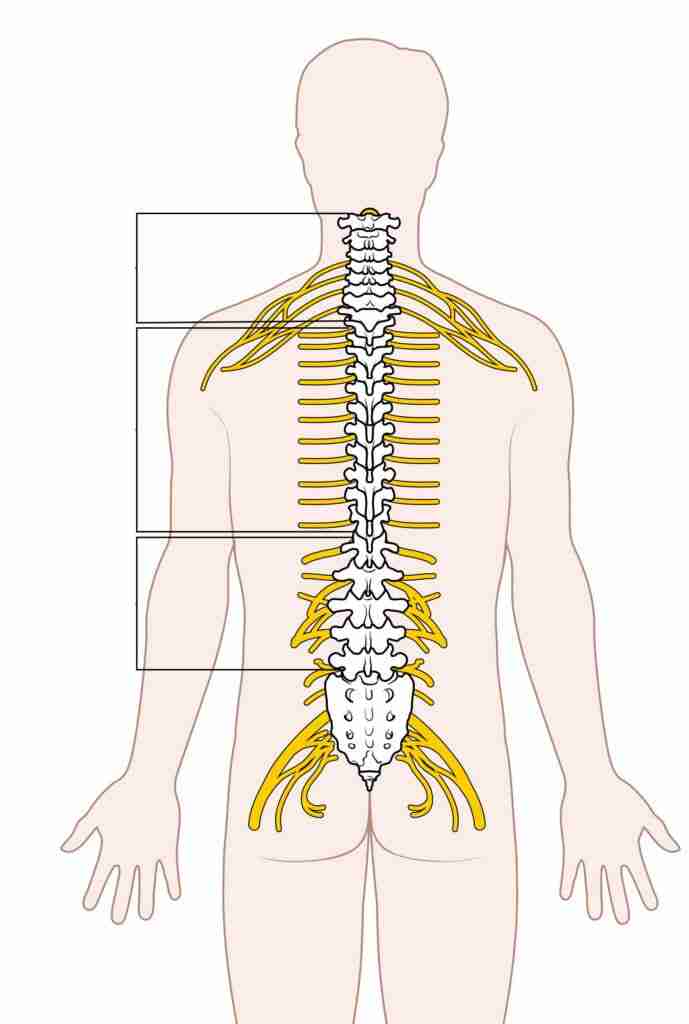
Spinal cord stimulation is not very well known and it doesn’t make sense to a lot of people. But it is is basically a pacemaker for pain. I don’t know if we can see it here but it is a little battery that causes impulses that are taken to the spine through these wires. And they’re going to go to the spine. And they have an effect, a very subtle effect, on the nerves that are going into the brain from the back, for example. It can also be down in the neck and the mid-back. It can alleviate the pain that is otherwise not responding to anything else. And beyond that it serves two major purposes: avoid surgery, particularly on patients that have disc lesions that produce mostly the pain that goes down the legs or down the arms, and also it can rescue patients who have persistent pain after undergoing surgery. As you know, spine surgery has a high incidence of persistent pain after the surgery, and spinal cord stimulation can really help that. So patients who are looking to avoid surgery but they’re having pain – they had an injury and they continue to have pain – this is one of the alternatives that I can offer them. Tampa personal injury lawyer Edward Reyes represents people in Tampa and Hillsborough County, Florida who have suffered an injury in an incident or accident type of accident. Speak Directly to Me, At No Cost, Today 813.421.3411 Those who did have surgery and continue to have pain, this is many times the only choice they have. I think when a lot of people when they think of pain management, and myself included especially before I was an attorney, was they think of prescription drugs and pills and things like that. But this is completely different. This is more of a really get in there and help the person not so much cover-up with medicine. Probably the basic mission of interventional pain medicine is to avoid patients from being on chronic opioids. Call us for more information. (Transcript from the video, transcribed but not reviewed)

Medical treatment after a crash explained
After A Car Accident, Injury

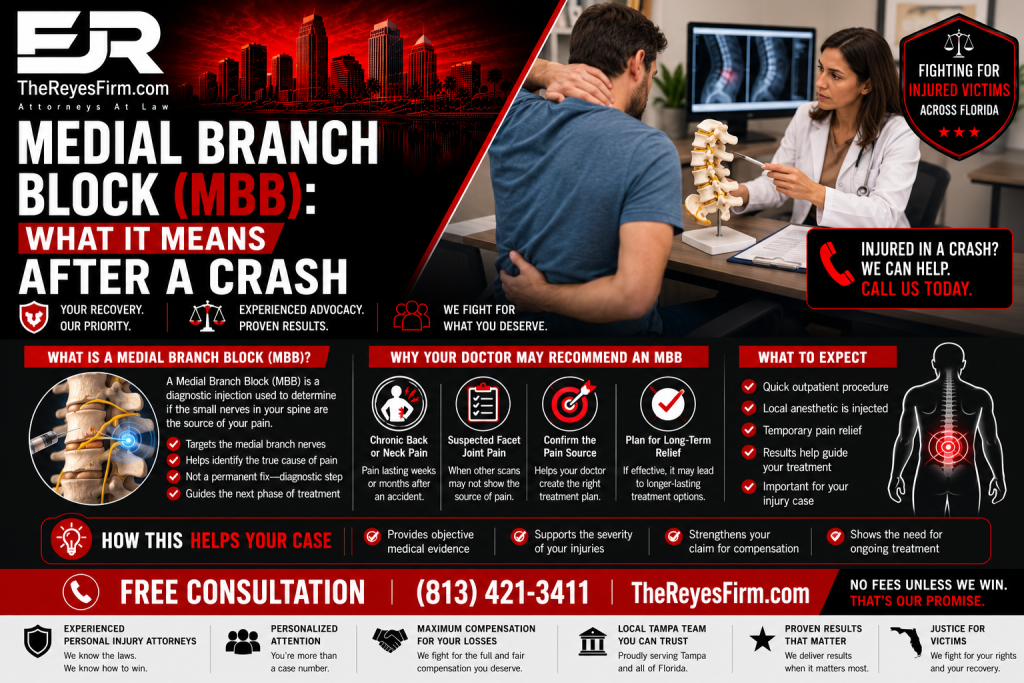
Medial Branch Block (MBB): What It Means After a Crash

Your doctor mentioned a medial branch block, and you nodded along without really knowing what it meant. If you were hurt in a crash and now face spinal injections, you deserve a clear explanation, both of the procedure and of what it means for your injury claim. Here is what an MBB is, in plain language. The Reyes Firm Facing Spinal Injections After a Tampa Crash? Make sure your treatment is documented and valued properly. Had a bad day? Contact Us Now Diagnostic An MBB helps pinpoint your pain source Facet joint nerves 6-12 Mo. Typical relief from radiofrequency ablation Varies by patient Permanent Injury finding needed for pain and suffering Fla. Stat. § 627.737(2) 2 Years Deadline to file an injury claim Fla. Stat. § 95.11 After a car accident, back and neck pain can linger long after the bruises fade. When it does, doctors often look to the small joints along the spine as a possible source, and a medial branch block is one of the main tools they use to investigate. Understanding the procedure, and why it matters beyond the exam room, helps you make informed decisions and protect your claim. What is a medial branch block (MBB)? A medial branch block is a targeted injection used to find out whether the facet joints in your spine are causing your pain, and it is a well-established procedure described by resources like Spine-Health. The facet joints are the small joints that connect your vertebrae and allow your spine to bend and twist. Tiny nerves called the medial branches carry pain signals away from these joints, and an MBB places a small amount of local anesthetic near those nerves, usually with imaging guidance to position the needle precisely. The goal at this stage is information, not a cure. By temporarily numbing the medial branch nerves, the procedure tests a simple question: if these nerves stop sending signals and your pain drops, then those facet joints are very likely the source of your pain. How does a medial branch block work as a diagnostic test? The logic is straightforward. After the anesthetic is injected, your doctor asks you to track how much your pain improves over the next several hours while the numbing lasts. Significant temporary relief points to the facet joints as the culprit. Little or no relief suggests the pain is coming from somewhere else, which is useful information too. Because the relief from the anesthetic is short-lived, an MBB is generally a diagnostic step rather than a long-term treatment. Doctors often repeat the block to confirm the result before moving on to a longer-lasting procedure. Your physician will explain how many blocks they recommend and why. What is radiofrequency ablation, and how is it different? If one or more medial branch blocks confirm that the facet joints are the source of your pain, a doctor may recommend radiofrequency ablation, sometimes called radiofrequency neurotomy. This is where the longer-lasting relief comes in. Using needles placed in the same area, the doctor passes radiofrequency energy through a small electrode to create a controlled lesion on the medial branch nerves, interrupting their ability to transmit pain signals. Think of the block as the test and the ablation as the treatment that follows a positive test. Relief from ablation commonly lasts somewhere in the range of six months to a year, though it varies from patient to patient. It is not a guaranteed or one-size-fits-all outcome, and your doctor is the right person to explain what you can realistically expect. Is a medial branch block a permanent fix? Not exactly, and it helps to understand why. Radiofrequency ablation does not remove the underlying injury. It quiets the nerves that carry the pain, and over time those nerves can regenerate, which is why relief eventually wears off and some patients repeat the procedure. That can make it feel like a temporary patch. But there is another way to look at it. These procedures buy real relief while your body works through a slow healing process, and some patients improve enough over time that they do not need to repeat them indefinitely. Whether that will be true for you depends on your specific injury and your body, and it is not something anyone can promise in advance. Your treating physician can give you the most accurate picture. 💡 Did You Know? In a Florida car accident case, you generally cannot recover for pain and suffering unless your injury meets a legal threshold, such as a permanent injury within a reasonable degree of medical probability. Diagnostic and treatment procedures like a medial branch block and radiofrequency ablation are part of how physicians document the nature and persistence of a spinal injury. Source: Fla. Stat. § 627.737(2). Why does a medial branch block matter for your injury claim? Insurance companies love to describe back and neck injuries as minor soft-tissue strains that will resolve on their own. A medial branch block cuts against that narrative in a powerful way, because it is objective and diagnostic. When a block pinpoints a specific facet joint as the source of your pain, it connects your symptoms to an identifiable injury rather than a vague complaint, which is exactly the kind of evidence that holds up under scrutiny. These procedures also carry real weight in the value of a claim. They are meaningful medical expenses, they show that your pain was serious enough to warrant an invasive intervention, and when future radiofrequency ablations are likely, the projected cost of that ongoing care can become part of your damages. For serious cases, a life care plan can help account for those future treatments. This is also closely tied to reaching maximum medical improvement, which we explain in our guide to how your case progresses during the pre-suit phase. ⚠️ Deadline Warning: Under Florida Statute § 95.11, you generally have two years from the date of your crash to file a personal injury lawsuit, even if you are still undergoing

E- Scooter and Car Accidents
Accident Injuries & why, Car accident, FAQ, florida cities we serve, For Parents, For Teens, Injury, Road Accidents, Scooter Accident, Uninsured Motorists Coverage, Why we serve

E- Scooter and Car Accidents: The Difference Between the Two

Scooters are fun. Scooters are growing. You see scooters now on every corner. In fact, in every area in Florida especially in every major city in Florida, you’ll see scooters growing in popularity amongst every age group. Scooters are unique because you do not need insurance and you do not need a license and you do not need a helmet. Tampa personal injury lawyer Edward Reyes represents people in Tampa and Hillsborough County, Florida who have suffered an injury in an incident or accident type of accident. Speak Directly to Me, At No Cost, Today 813.421.3411 With all that being said, if you’re involved in a scooter accident and you don’t have a helmet on the insurance company that’s protecting their client that’s the at-fault party can and will reduce the damages to your head if the helmet would have reduced the damages. If you do not own a car you can be covered by the person that crashed into you, the at-fault party’s personal injury protection for your medical, your lost wages and we can submit a claim against that party for the pain and suffering that they’ve caused you. Call us now for more information. (Transcript from the video, transcribed but not reviewed)

Traumatic Brain Injury
Accident Injuries & why, After A Car Accident, After an Accident, Car accident, FAQ, For Parents, For Teens, Health, Injury, Migraines, Personal Injury, Why we serve

Traumatic Brain Injury how is it Caused?

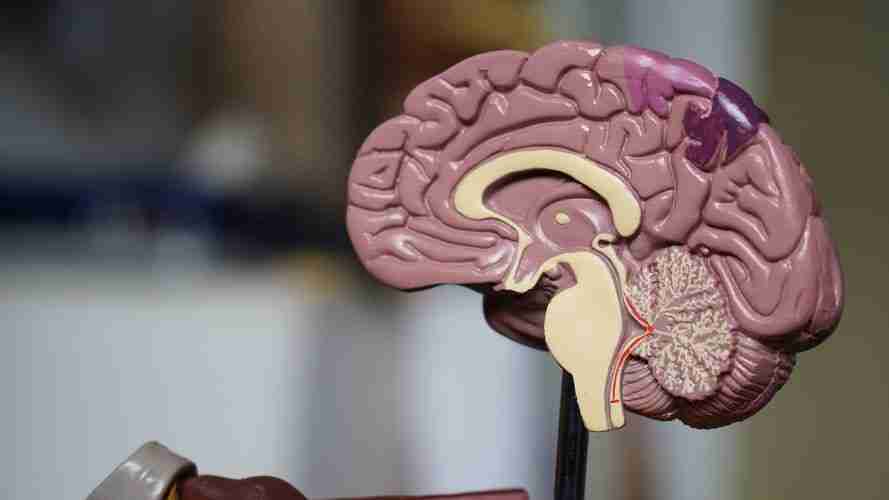
When you have the whiplash, motion, either side to side or forward, there’s a liquid, and you can, of course, you know a lot more than I do. We just help people recover from their injuries. But, a liquid inside that protects the brain a little bit but, because of the impact, it crashes back and forth into the skull walls, but if you can just kind of elaborate more on what you’ve seen on the traumatic brain injuries. Well, the brain is swimming in the fluid. There is a number of structures that are anchoring the brain down to the neck, et cetera. And those are the structures that tend to be stretched by the motion of the brain inside the skull. In this, deceleration injuries, you’re going at 80 miles per hour and all of a sudden, you’re at zero miles per hour. Traumatic Brain Injury Your brain wants to keep going. And when it does, it stretches a big number of possible structures inside your skull that can cause the traumatic brain injury. It could be even bleeding from that. Now, and I’ve heard the statistic, and I don’t know how true this is, 70 to 80% of CT scans miss traumatic brain injury, cause CT only shows if there’s hemorrhaging or blood in the brain, but, have you heard anything of each, CT scan has a very low sensitivity for traumatic brain injury, unless there is a bleed, which is, thankfully, not very common because of how strong the skull is. You don’t see evidence of traumatic brain injury in a CT scan, which is what is typically performed in ERs. What do we see, what are common, if somebody was out there, what are the common symptoms, I guess, I would ask, if somebody said, and, you know, we’ve heard, “I just don’t feel right”, or, “I feel dizzy.” What have you found is the most common symptoms, what do you, traumatic brain injury.⁣ Time of the Accident Well, the patient would have an initial loss of consciousness at the time of the accident and then when they come back they, as you said, they don’t feel right, they feel dizzy, they feel this vertigo-like everything is moving around. They can have a severe headache. And then, which is the most concerning, is that these symptoms may dissipate initially, and then they would start having chronic symptoms of traumatic brain injury which would even include emotional liability, problems like that, yeah.⁣ Tampa personal injury lawyer Edward Reyes represents people in Tampa and Hillsborough County, Florida who have suffered an injury in an incident or accident type of accident. Speak Directly to Me, At No Cost, Today 813.421.3411 So, a lot of times, focusing, maybe connecting with loved ones, you know, vertigo, standing up, mood swings, okay, stuff like that. Yeah, cause a lot of people, I think that they’re not really thinking about this traumatic brain injury issue, but it is happening, because even at low impacts, we’ve seen that it does affect people’s mood, they just don’t feel right, in the field. They feel off, that we’ve heard. They don’t understand what is happening. Nobody’s told them they could have a traumatic brain injury. And they just can’t back to their lives and they don’t know why. Call 813.421.3411 for more information. (Transcript from the video, transcribed but not reviewed)

Car accidents are the Most Common Accidents
After A Car Accident, Blog, Car accident, florida cities we serve, For Parents, For Teens, Injury, Legal, mass transit, Our Community, Ride Sharing, Road Accidents, Why we serve

Car accidents are the Most Common Accidents

Accidents are the most common forms of incidents on the road. Just in Hillsborough County, there’s close to 3,000 car accidents, per day, in Polk, Pasco, Pinellas. In almost every other county, there is an average of 2,000 to 25, to 3,000 car accidents per day. Even though that number sounds staggering, there are hundreds of thousands of cars on the road every single day. So, the more cars that are on the road, the greater the risk of car accidents happening. Car accidents, many times on bumper-to-bumper traffic, between eight in the morning till six p.m., are typically non-fatal accidents when they’re on regular roads. Car accidents, when they’re on the interstate, because of the higher speeds, there are fewer accidents but they’re typically more fatal than other incidents that are on local roads. Car accidents, if the person that crashed into you, could’ve avoided the accident, due to their negligence of speeding, following to close, careless driving, they would be the one at fault. Florida is a no-clause state, which that means if you’re involved in a car accident, your insurance company covers you for your injuries, and your medical payments up to $10,000 if it’s an emergency medical condition. You do not need to go to the hospital to get the emergency medical condition, you may have to see a physician, or a doctor, or a chiropractic doctor, to evaluate you and then eventually you will have to go to an MD, or a DO, or something like that. MD, which is a medical doctor, and DO is also a form of a medical doctor, as well. To qualify from the $2500 that the insurance company caps you up to the $10,000 of insurance benefits. Car accidents, when the person that crashes into you, if they have bodily injury coverages, that’s the part that helps us, as a law firm, help you recover for your injuries, pain, and suffering, and loss of enjoyment. If the person that crashes into you has non-sufficient insurance or no insurance, if you carry uninsured motorist on your policy, that uninsured motorist will cover you for any offset that the other side did not have. Tampa personal injury lawyer Edward Reyes represents people in Tampa and Hillsborough County, Florida who have suffered an injury in an incident or accident type of accident. Speak Directly to Me, At No Cost, Today 813.421.3411 For example, if you had a, if the person that crashed into you had a $10,000 bodily injury policy, and your injuries are worth $30,000, but you had a $20,000 uninsured motorist policy, that $10,000 would pay for the at-fault party, the person that caused the accident, and the $20,000 would pay for your insurance to make you whole. Not always does it make you whole, because many times if that’s the case, you may not have enough uninsured motorist, or they have enough bodily injury coverage that you don’t have to even impact your own policy. Every case is a little bit different, every auto accident is a little bit different. Auto accidents, it’s easier to find liability when it’s a rear-end collision, however, there are cases where there are T-bone collisions, there are cases where there’s making left-turn collisions, cases where people are making U-turns. So, every case is a little bit different. If you have any questions about auto accidents, feel free to reach out to us, it’s 813-421-3411. (Transcript from the video, transcribed but not reviewed)

Herniation
Accident Injuries & why, After A Car Accident, After an Accident, FAQ, For Parents, For Teens, Health, Injury, Traumatic injury, Why we serve

Herniations VS Bulging Disk

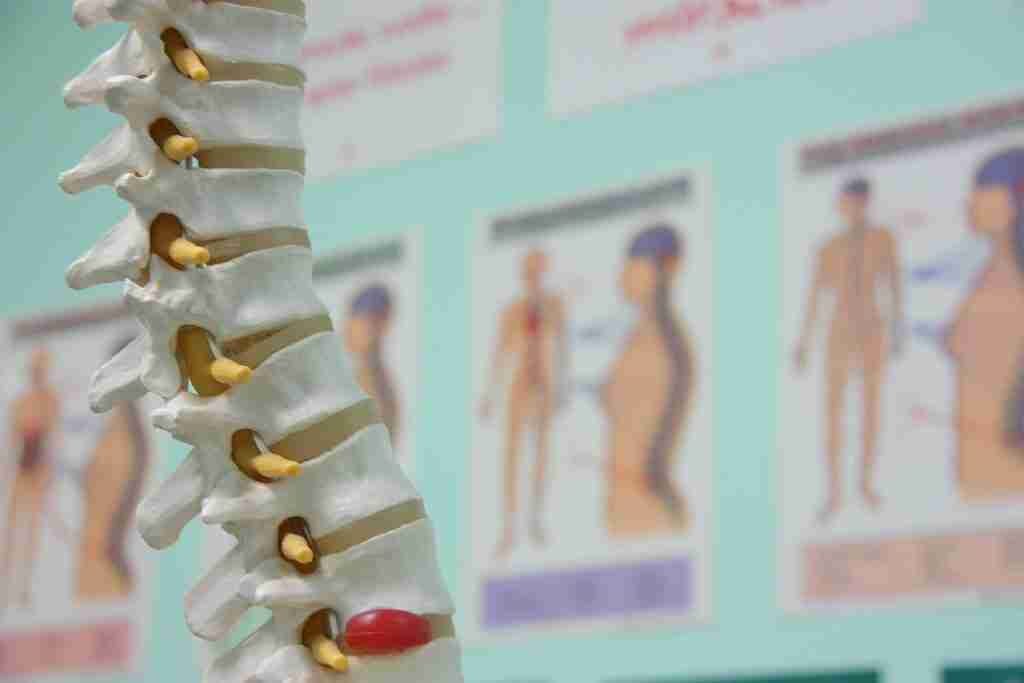
Some people have a misnomer of herniations is worse than bulging. If you could just kind of talk to us through that a little bit. – Yeah, there’s a lot of confusion that in rear-ending injuries that the basic mechanism is what we call a flexion-extension injury where the initial motion of the patient is forward with a backlash where there are two very common injuries. One to the ligaments that support the neck and to the disks that is separate the vertebrae in the neck. In those, we see what is common as seen as disk, or heard as, disk herniations, but the level, the severity, of that herniation is what prompts the severity of the symptoms. So a radiologist read a disk herniation in different ways which can be confusing. Herniation In general, a bulge is a step prior to a herniation. So it’s a very small herniation that is typically not causing symptoms, but that is not always true. Many times a disk bulge can cause symptoms of neck pain and sometimes pinched nerves in the neck that cause pain down the arms or into the head. A herniation can be divided into either a protrusion or an extrusion. Now to continue on that of course, but what exactly, and definitely go into the protrusion and extrusion things like that, but what exactly for everybody out there that don’t know what herniation even is, is that the disk that comes out of place? Let me show you this cause I like to show it. I don’t know if I can show the camera, but in the spine there are vertebrae. This is what you touch in the back. Whenever you touch the back of your neck you touch this part of the spine. The bones in between are separated by a structure that is mostly a gel. Designed for cushioning between the bones, and they are supposed to be fairly aligned with the edges of the bone. A herniated disk is when that gel comes out of place, typically backward where the nerves  Are coming out of. Hence creating pain going down your arms or something like that correct? And so that’s what a herniated disk is. What exactly is a bulge then? It’s just used in small herniation?⁣- Well, a bulge is typically a smaller herniation. Then when a herniation is a protrusion versus an extrusion what that typically means is a disk can herniate moving completely out or it can break.   Tampa personal injury lawyer Edward Reyes represents people in Tampa and Hillsborough County, Florida who have suffered an injury in an incident or accident type of accident. Speak Directly to Me, At No Cost, Today 813.421.3411 A Tear in the Fibers There can be a tear in the fibers of the disk and that gel comes out almost free-flowing into where the spine and the nerves are. And an extrusion is typically considered the most severe form of a disk herniation. Logically I would imagine if the gel or the liquid is coming out it would cause pain, but why does it cause pain? Is it because, well is it because it’s hitting the nerve roots or what? Why does it? – Two main reasons. One, the mechanical aspect of the disk pinching against the nerve, so it’s just pushing against it. It’s making this nice and big hole very small. And the other one is that a herniated disk is very inflammatory. It’s very warm and red. It’s angry. ⁣Everything it touches it causes it to be red and angry as well. So when the disk barely touches the nerve it can also cause the nerve to be very irritated and cause pain. That’s why even small herniations that do not appear to be impinging mechanically on a nerve can still cause a lot of pain. Call 813.421.3411 for help. (Transcript from the video, transcribed but not reviewed)

The Most Common Rear-End Type Injuries
Accident Injuries & why, After A Car Accident, After an Accident, Car accident, FAQ, For Parents, For Teens, Health, Injury, Personal Injury, Road Accidents, Scooter Accident, Slip and fall, Teen Accidents, Traumatic injury, Why does this hurt, Why we serve

The Most Common Rear-End Type Injuries

Whenever you get a person that got rear-ended, what are the most common injuries that you find from those types of accidents? Spine injuries to the neck. So what we call the cervical spine in the neck is very frequently injured and it presents with a variety of symptoms sometimes with very severe headaches, neck pain, pain in the shoulders. Tampa personal injury lawyer Edward Reyes represents people in Tampa and Hillsborough County, Florida who have suffered an injury in an incident or accident type of accident. Speak Directly to Me, At No Cost, Today 813.421.3411 Sometimes these patients even have something called vertigo where the patient feels dizzy and the world around them turns constantly. It’s not that uncommon to see that in a rear-ending injury. Now when you mentioned spinal injuries, ’cause there are different types of spinal injuries as well and different things that affect the disc, just walk us through what specifically do you find, herniations? Call us at 813.421.3411 for more information. (Transcript from the video, transcribed but not reviewed)

Motorcycle accident Here's what to do.
Accident Injuries & why, After an Accident, FAQ, For Parents, For Teens, Health, Injury, Motorcycles, Road Accidents, Scooter Accident, Traumatic injury, Uninsured Motorist Coverage, Why we serve

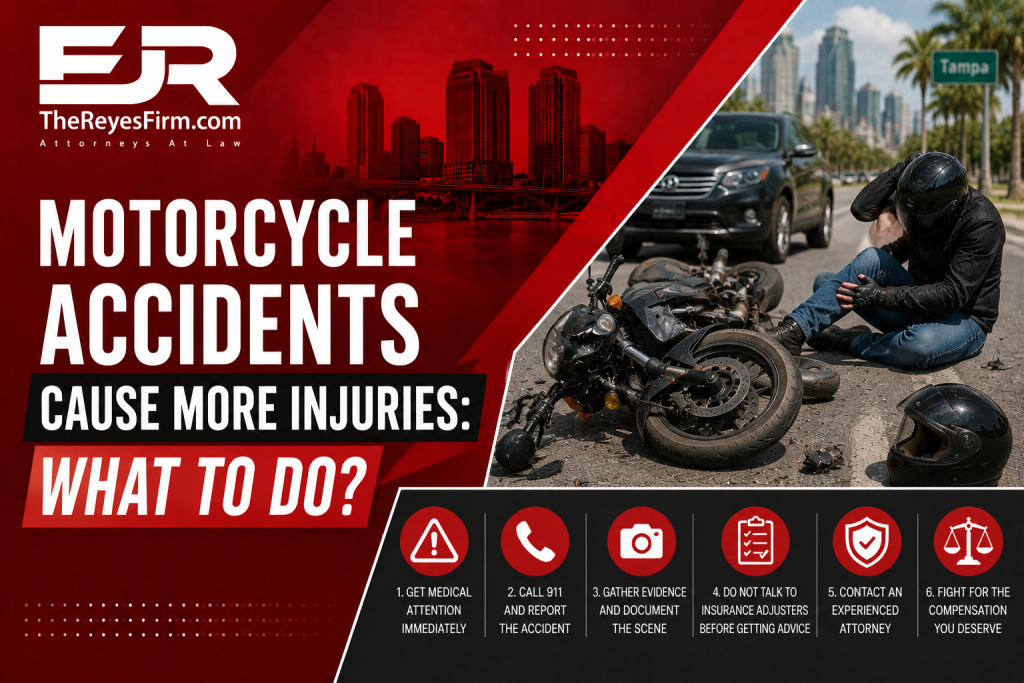
Motorcycle Accidents Cause More Injuries: What to Do?

You were just riding home through Tampa. Then a driver who never saw you turned across your lane, and in an instant everything changed. Now you’re facing serious injuries, mounting medical bills, and an insurance company that is already building its case against you. Here’s what you need to know about your Florida motorcycle accident claim before you say another word to an adjuster. TL;DR — QUICK SUMMARY Motorcycle riders absorb the full force of a crash with almost no protection, which is why these collisions cause far more severe injuries than typical car accidents. Florida’s no-fault PIP insurance does not cover motorcycle injuries, so you generally must pursue the at-fault driver and their bodily injury liability coverage directly. Evidence such as skid marks, vehicle damage, and dashcam or surveillance footage disappears quickly, so preserving it early can make or break your case. You have two years from the date of the crash to file a personal injury lawsuit under Florida Statute 95.11(3)(a), and missing this deadline usually ends your claim. Even if you legally rode without a helmet, the insurer may try to blame you to cut your payout, and an experienced Tampa attorney can push back. The Reyes Firm Hurt in a Motorcycle Crash in Tampa? Get clear next steps after a serious motorcycle accident. Had a bad day? Contact Us Now 578 Florida motorcycle deaths in 2024 FLHSMV Crash Dashboard 2024 9,420 Florida motorcycle crashes in 2024 FLHSMV Crash Dashboard 2024 2 Years Florida statute of limitations Fla. Stat. 95.11(3)(a) #1 Deadliest U.S. state for riders FLHSMV / NHTSA, 3 years running Why do motorcycle accidents cause so much more serious injury than car crashes? Motorcycle accidents cause more severe injuries because a rider has almost nothing between their body and the road, while a car occupant is surrounded by a steel frame, seatbelts, crumple zones, and airbags. When a motorcycle is struck, the rider is often thrown from the bike and hits the pavement, another vehicle, or a fixed object with the full force of the impact. That physics is why a crash that might leave a car driver shaken but uninjured can leave a motorcyclist with life-altering harm. Common motorcycle accident injuries include traumatic brain injuries, spinal cord injuries and paralysis, broken bones, severe road rash, internal organ damage, and amputations. Head injuries are especially dangerous. A serious traumatic brain injury can change how you think, work, and live, sometimes permanently. In the most tragic cases, families are left pursuing a wrongful death claim after losing someone they love. The severity of these injuries is also why motorcycle claims deserve to be taken seriously from day one. Can you sue the driver who caused your Tampa motorcycle accident? Yes. If another driver’s negligence caused your motorcycle crash, you can pursue a claim against that driver for the harm they caused you. Florida law lets injured riders seek compensation when someone else’s careless or reckless driving leads to their injuries, whether the other driver ran a red light, turned left across your path, followed too closely, or was distracted behind the wheel. The challenge is that motorcyclists face an unfair stigma. Insurance companies often assume the rider was speeding or weaving, even when the driver of the car was entirely at fault. Building your case means proving what actually happened, and that work starts the moment the crash occurs. ⚠️ Deadline Warning: Under Florida Statute § 95.11(3)(a), you have two years from the date of your crash to file a personal injury lawsuit. Missing this deadline almost always means losing your right to recover anything. Don’t wait to call a lawyer. Does Florida’s no-fault insurance cover your motorcycle accident? No. Florida’s no-fault Personal Injury Protection (PIP) system does not cover motorcycle injuries, even though it covers drivers and passengers in cars. Under Florida Statute § 627.736, PIP benefits apply to motor vehicles as the statute defines them, and motorcycles fall outside that definition. This is one of the most misunderstood points in Florida motorcycle law, and it has real consequences. Unlike a car accident, where your own PIP pays the first portion of your medical bills regardless of fault, an injured motorcyclist usually has to recover from the at-fault driver’s bodily injury liability coverage, plus any uninsured or underinsured motorist and MedPay coverage you carry on your own policy. Because that compensation depends on proving fault and locating the right insurance, having a lawyer who knows how to stack these sources of coverage matters. 💡 Did You Know? According to the Florida Highway Safety and Motor Vehicles Crash Dashboard, Florida recorded 9,420 motorcycle crashes in 2024, resulting in 578 rider deaths and 8,106 injuries. For the third year in a row, Florida led the nation in motorcycle fatalities. Source: FLHSMV Crash Dashboard, 2024. Note: 2024 crash numbers are preliminary. Watch: How Motorcycle Accidents Are Different Than Car Accidents This short video walks through the first moves that protect both your health and your legal claim after a motorcycle crash in Florida. If you have questions after watching, The Reyes Firm offers free consultations and can review your situation at no cost. Who is actually liable for your Tampa motorcycle crash? Liability depends on who caused the crash, and it is not always only the other driver. Depending on the facts, responsible parties can include the at-fault motorist, their employer if they were driving for work, a vehicle owner who let an unsafe driver use their car, a government agency responsible for a dangerous road defect, or a manufacturer whose defective part contributed to the wreck. Florida also follows a modified comparative negligence rule, which means the insurance company will look for ways to shift blame onto you. One common tactic in motorcycle cases involves helmets. Florida law under Florida Statute § 316.211 allows riders 21 and older to ride without a helmet if they carry at least $10,000 in medical benefits coverage. Even when you rode legally, a defense lawyer may argue that not wearing

Scroll to Top