Motorcycles

Bike Safety Tips to Prevent Common Cycling Injuries
Accident Injuries & why, Motorcycles

Bike Safety Tips to Prevent Common Cycling Injuries

Cycling is good for your health, your wallet, and the planet, but on a bike you are far more exposed than in a car, and a moment’s bad luck can mean serious injury. The good news is that a handful of smart habits dramatically lowers your risk. These bike safety tips help you prevent the most common cycling injuries, and if a careless driver ever causes your crash, our bicycle accident attorneys are here to help. The Reyes Firm Hit by a Car While Cycling in Tampa? You followed the rules. Let us fight for you. Had a bad day? Contact Us Now Helmet Your best protection Every single ride Be Seen Lights and bright colors Visibility matters Ride Right With traffic, predictably Follow the rules ABC Check Air, Brakes, Chain Before you ride Most bike rides end exactly as they should, with a little exercise and fresh air. But because cyclists share the road with much larger, faster vehicles, the stakes are high when something goes wrong. The habits below are simple, and together they meaningfully reduce your chances of a crash and the severity of an injury if one happens. Think of them as your everyday cycling safety toolkit. Why does bike safety matter so much? Cyclists are among the most vulnerable people on the road. With no metal frame, airbags, or seatbelt, a rider absorbs the force of a collision directly, which is why even a low-speed crash can cause significant injury. Common cycling injuries range from road rash, sprains, and broken bones to more serious head, facial, and spinal injuries. That vulnerability is exactly why prevention is worth the small effort it takes. You cannot control every driver around you, but you can stack the odds in your favor by being visible, predictable, and prepared. The tips that follow focus on the habits that make the biggest difference. How can you make yourself more visible? Many bike crashes happen simply because a driver did not see the cyclist, so visibility is one of your strongest defenses. Wear bright, high-contrast clothing during the day and reflective materials at dawn, dusk, and night, when visibility is worst. Use a white front light and a red rear light whenever light is low, and consider running a rear light even in daylight, since a blinking light draws the eye. Position and awareness help too. Ride where drivers naturally look, make eye contact at intersections when you can, and assume you have not been seen until you are sure you have. Being visible is not about standing out for its own sake, it is about giving drivers every chance to notice and react to you in time. 💡 Did You Know? A properly fitted helmet is widely regarded as the single most effective piece of safety equipment a cyclist can wear, greatly reducing the risk of serious head injury in a crash. A helmet only does its job if it fits snugly, sits level on your head, and is worn every ride, including the short ones close to home. How should you ride in traffic? Predictability is the heart of safe cycling. Ride in the same direction as traffic, never against it, and obey the same traffic signals and signs that cars do, because drivers anticipate cyclists who behave like other vehicles. Hold a straight, steady line rather than weaving between parked cars, and use clear hand signals before you turn or change position so drivers know your intentions. Choose your road position thoughtfully. Ride far enough from parked cars to avoid an opening door, take the lane when it is too narrow to share safely, and be especially cautious at intersections and driveways, where most car-and-bike collisions occur. Staying alert, scanning ahead, and never assuming a driver will yield are habits that prevent crashes before they start. What protective gear should you wear? Beyond the helmet, a few pieces of gear add real protection and comfort. Cycling gloves protect your hands, which instinctively reach out in a fall, and improve your grip. Eye protection shields against sun, wind, dust, and debris that could distract you or obscure your vision at the wrong moment. Sturdy, close-fitting clothing avoids loose fabric that could catch in the chain or wheels. Above all, make sure your helmet fits correctly, since an ill-fitting helmet offers far less protection. It should sit level, cover your forehead, and buckle snugly under the chin without excessive movement. Replace any helmet that has been in a crash, even if it looks undamaged, because its protective structure may be compromised. How do you keep your bike safe to ride? A well-maintained bike is a safer bike, and a quick check before you ride catches most problems. Many cyclists use the ABC Quick Check: Air, meaning proper tire pressure and good tread; Brakes, confirming both stop the bike firmly; and Cranks, Chain, and Cassette, checking that the drivetrain turns smoothly and nothing is loose, along with the Quick releases or thru-axles that hold your wheels. Beyond the pre-ride check, keep your tires properly inflated, your chain clean and lubricated, and your brake pads in good shape, and address any unusual noises or handling promptly. If a repair is beyond your comfort level, a bike shop can help. A few minutes of attention keeps small issues from becoming a hazard on the road. 🛡️ When Safety Isn’t Enough: Even the most careful, well-equipped cyclist cannot control a distracted or careless driver. If a motorist’s negligence caused your crash, you may be entitled to compensation for your injuries, and under Florida Statute § 95.11(5)(a) you generally have two years from the crash to file a claim. Watch: Essential Bike Safety Tips If you prefer to see it demonstrated, the short video below covers essential bike safety tips to help prevent common cycling injuries. And if you have been injured in a bicycle crash that wasn’t your fault, The Reyes Firm offers free consultations with no obligation. Your quick bike safety checklist Run
Motorcycle Maintenance Checklist
Motorcycle Education, Motorcycles

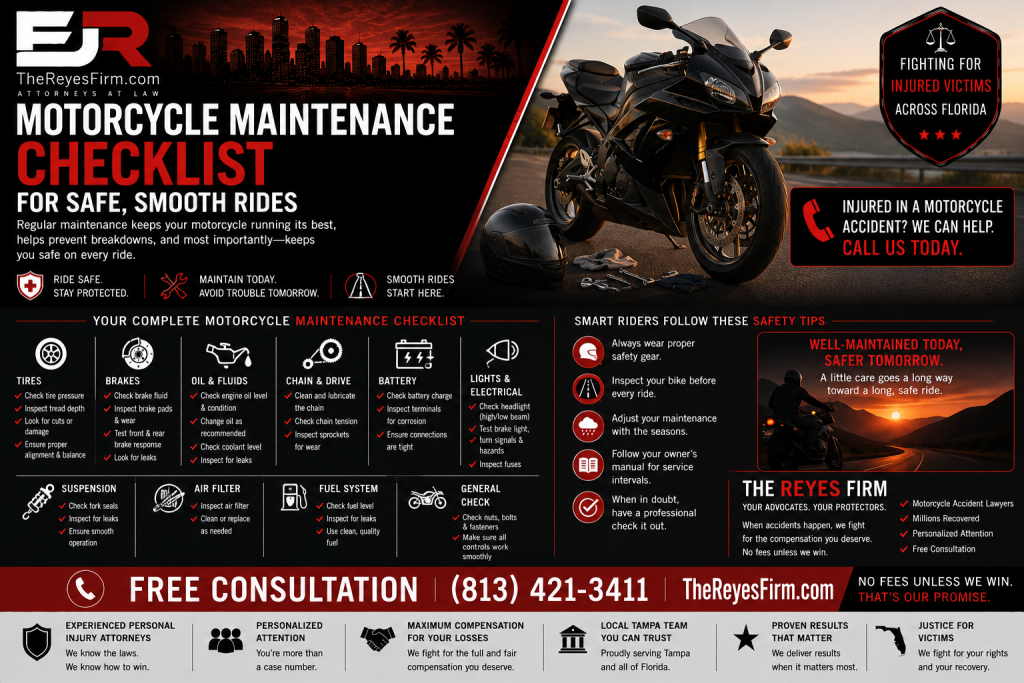
Motorcycle Maintenance Checklist: Your Essential Guide for Safe and Smooth Rides

A great ride starts long before you turn the key. Keeping your motorcycle in top mechanical shape is not just about performance, it is about safety, because on two wheels a worn tire or a soft brake leaves far less margin for error than it would in a car. This maintenance checklist walks through what to check and when, so your rides stay smooth, and if the worst happens because of someone else, our motorcycle accident attorneys are here to help. The Reyes Firm Injured in a Tampa Motorcycle Crash? You did everything right. Let us handle the rest. Had a bad day? Contact Us Now Pre-Ride A quick check before every ride Minutes well spent Tires Your only grip on the road Pressure and tread Brakes Your ability to stop safely Pads and fluid Chain Clean, lubricate, and adjust On many bikes Motorcycles demand more hands-on care than cars, and that care pays off in both reliability and safety. A bike that is well maintained responds predictably when you need it most, in hard braking, a quick swerve, or a long highway pull. The good news is that most essential maintenance is straightforward, and building a few simple habits goes a long way. Here is how to keep your motorcycle road-ready. What should you check before every ride? A quick pre-ride inspection is the single best habit a rider can build, and it takes only a couple of minutes. Many riders use the memory aid T-CLOCS, popularized by motorcycle safety education, which stands for Tires, Controls, Lights, Oil, Chassis, and Stands. Walking through it before you ride catches small problems before they become dangerous ones. In practice, that means a glance and a hands-on check: are the tires properly inflated and free of obvious damage, do the throttle and clutch move smoothly and the brakes feel firm, are the headlight, brake light, and signals working, are fluid levels where they should be, is anything leaking or loose on the frame, and does the kickstand retract properly. None of it is complicated, and over time it becomes second nature. 💡 Did You Know? Your tires are your only contact with the road, often just a few square inches of rubber at any moment. Underinflated or worn tires reduce grip, lengthen stopping distances, and handle poorly in a swerve, which is why a quick pressure and tread check is one of the highest-value habits a rider can build. How should you care for your tires? Because tires matter so much on a motorcycle, they deserve regular, dedicated attention. Check your tire pressure when the tires are cold, using the values recommended in your owner’s manual, since correct pressure affects grip, handling, wear, and fuel economy all at once. Underinflation is a common and dangerous problem that many riders overlook. Inspect the tread depth and look for uneven wear, cracks, cupping, or embedded objects like nails. Worn or aging tires lose grip, especially in the rain, and should be replaced before they become a hazard. Tires also age with time, not just mileage, so a tire that looks fine but is many years old may still need replacing. When in doubt, have a professional take a look. What about brakes, fluids, and the chain? Your brakes are your ability to stop, so check them often. Listen and feel for anything unusual, inspect the brake pads for wear, and make sure the brake fluid is at the proper level and replaced at the intervals your manual specifies. A brake lever that feels spongy or a bike that takes longer to stop is a warning sign that should not be ignored. Fluids and the drivetrain round out the essentials. Change your engine oil and filter on schedule, since clean oil is vital to engine life, and check coolant if your bike is liquid-cooled. On chain-driven motorcycles, keep the chain clean, properly lubricated, and correctly tensioned, because a neglected chain wears quickly and can even fail. Belt and shaft-driven bikes have their own, usually lighter, maintenance needs. How do you keep the lights, battery, and controls in shape? Being seen is a safety issue for every rider, so make sure your headlight, tail light, brake light, and turn signals all work every time you ride, and replace bulbs promptly when they fail. Your ability to be visible to other drivers can be the difference between a safe ride and a close call. The battery and controls need attention too. Keep battery terminals clean and the battery charged, especially if your bike sits for long stretches, since motorcycle batteries can lose charge over time. Check that cables and controls, the throttle, clutch, and brake levers, move freely and are properly adjusted, and lubricate them as needed. Smooth, responsive controls are both a comfort and a safety feature. How often should you service your motorcycle? The best guide to service intervals is always your owner’s manual, which lays out when to change the oil, inspect or replace the brake fluid, adjust the valves, service the chain, and perform other scheduled maintenance for your specific make and model. Following that schedule is the surest way to keep your bike safe and reliable and to protect its value. Beyond the manual, seasonal care matters, particularly if you store your bike for part of the year. Before returning to the road after a layoff, give the motorcycle a thorough once-over, tires, brakes, battery, fluids, and lights, since problems can develop while a bike sits. And when a job is beyond your comfort level, a qualified mechanic is a worthwhile investment in your safety. 🛡️ When Maintenance Isn’t Enough: Even a perfectly maintained motorcycle cannot protect you from a careless driver who fails to see you or violates your right of way. If another driver’s negligence caused your crash, you may be entitled to compensation, and under Florida Statute § 95.11(5)(a) you generally have two years from the crash to file a claim. Your quick pre-ride maintenance checklist Run through

Accident Injuries & why, Blog, FAQ, Legal, Motorcycle Education, Motorcycles, personal injury attorney, Why we serve

Motorcycle Riding in Rain: How to Stay Safe and Confident

Motorcycle riding in the rain can be a thrilling experience. Still, a different approach is required to ensure safety.  According to the Federal Highway Administration, rain can significantly reduce visibility and road traction, making it essential for riders to adapt their techniques. Thus, adjusting your riding style and gear can help you confidently navigate wet roads.  This guide provides essential tips and techniques for riding safely and enjoyably in the rain. Let’s get into it! Guidelines for Safe Motorcycle Riding in the Rain To begin with, driving a motorcycle in the rain presents unique challenges due to reduced visibility and slippery roads.  So, adjusting your riding style and practicing safe techniques can significantly enhance your safety on wet roads. Adjust Your Riding Style Reduce Speed: Slow down to give yourself more time to react to changing conditions. Increase Following Distance: Maintain a safe following distance to allow braking time in case of sudden stops. Avoid Sudden Movements: Smoothly accelerate, brake, and turn to avoid losing traction. Throttle Control Smooth Throttle Input: Gradually apply and release the throttle to prevent sudden acceleration or deceleration. Avoid Sudden Jerks: Avoid abrupt movements that can cause wheelspin or loss of control. Braking Gentle Pressure: Apply the brakes progressively and avoid sudden, hard braking to prevent skidding. Anti-lock Brakes (ABS): If your motorcycle has ABS, use it effectively to help prevent wheel lockup during braking. Cornering Reduce Speed: Approach corners with reduced speed to maintain control. Lean Less: Lean into corners less than usual to avoid excessive lean angles on slippery surfaces. Avoid Sudden Changes: Avoid abrupt changes in direction or speed while cornering. Avoid Puddles Deep Puddles: Avoid deep puddles, as they can cause hydroplaning, in which your tires lose contact with the road surface due to water buildup. Loss of Control: Hydroplaning can lead to loss of control, so exercise caution and avoid deep puddles whenever possible. Proper Gear for Rain Riding Furthermore, having the right gear to stay dry, comfortable, and visible when riding a motorbike in the rain is crucial.  Here are some essential items to consider: Waterproof Gear Waterproof Jacket and Pants: Invest in a high-quality jacket and pants to keep you dry in heavy rain. Look for garments with sealed seams and waterproof materials. Waterproof Gloves and Boots: Protect your hands and feet from the elements with waterproof gloves and boots.  Choose options with good traction to help you stay safe on wet roads. Anti-fog Helmet Visor Clear Visibility: A fogged-up visor can significantly impair your vision in the rain. Opt for a helmet with an anti-fog visor, or consider using an anti-fog spray to prevent fogging. Reflective Gear Visibility: In low-light conditions, reflective gear is essential for other drivers to see you. Wear reflective jackets, vests, or patches to increase your visibility on the road. Handling Wet Roads and Slippery Conditions Riding in wet weather requires extra caution due to reduced traction. Here are some tips for handling slippery conditions: Tire Grip Reduced Traction: Tires have less grip on wet roads, so you need to be more careful with your throttle control and braking. Smooth Throttle Control: Avoid sudden acceleration or deceleration, as this can cause wheelspin and loss of traction. Gentle Braking: Apply the brakes progressively and avoid harsh braking to prevent skidding. Body Position Upright Position: Maintain an upright body position to help you balance better on slippery surfaces. Relaxed Grip: Avoid gripping the handlebars too tightly, as this can make it difficult to react to changes in road conditions. Anti-lock Brakes (ABS) Prevent Skidding: ABS systems help prevent wheel lockup during braking, reducing the risk of skidding. Improved Control: ABS can help you maintain control of your motorcycle in wet conditions, even during emergency braking. Tire Maintenance and Traction Proper tire maintenance ensures optimal traction and safety, especially in wet conditions. Tire Pressure Optimal Traction: Maintaining the correct tire pressure ensures that your tires have the proper contact patch with the road, which is essential for good traction. Check your tire pressure regularly, especially before long rides or in changing weather conditions. Tread Depth Grip on Wet Roads: Adequate tread depth is vital for griping wet roads. Worn tires with shallow treads may have difficulty displacing water, increasing the risk of hydroplaning. Regular Inspections: Check your tire tread depth regularly using a tread depth gauge or visually inspect the tread. Tire Types Wet Weather Tires: Consider using tires specifically designed for wet weather riding. These tires often have deeper grooves that help displace water and provide better traction in moist conditions. Sport Touring Tires: Many sport touring tires offer a good balance of performance and wet weather handling. By paying attention to tire maintenance and choosing the right tires, you can significantly improve your traction and safety on wet roads.  For legal assistance in case of motorcycle accidents, visit The Reyes Firm for expert support. Visibility During Rainy Rides In terms of visibility, it is also crucial for safety riding in the rain, so here are some tips to improve it: Headlights and Reflective Gear Headlights On: Always keep your headlights on, even during daylight hours, to increase your visibility to other drivers. Reflective Gear: Wear reflective clothing or vests to make yourself more visible to other road users, especially in low-light conditions. Anti-fog Solutions Clear Vision: Apply anti-fog solutions to your helmet visor to help prevent fogging and maintain clear visibility. Bright Clothing Stand Out: Wearing bright-colored clothing or vests can help you stand out and be seen more quickly by other drivers.   Following these tips can significantly improve your visibility during motorbike riding in the rain and reduce the risk of accidents. Weather Conditions and Emergency Preparedness Riding in the rain on a motorcycle requires skill and preparedness. Here are some tips for handling various weather conditions and emergencies: Adjust to Rain Intensity Light Rain: Maintain a steady pace and be cautious of slick surfaces. Heavy Rain: Reduce speed, increase the following distance, and avoid deep puddles. Torrential Rain: If possible,

Blog, FAQ, Injury, Motorcycle Education, Motorcycles, personal injury attorney, Why we serve

Motorcycle Group Riding: Safety and Etiquette Guide

Have you ever dreamed of motorcycle group riding? Cruising down the open road with a pack of fellow riders offers unparalleled freedom, camaraderie, and shared passion. But to ensure a safe and enjoyable experience for everyone involved, it’s crucial to understand and practice the essential guidelines for group riding safety and etiquette. In this guide, we’ll delve into the key aspects that will help you contribute to a positive and memorable journey for all riders.  Get ready to hit the road with confidence and create lasting memories! Motorcycle Group Riding: A Community on Wheels Motorcycle group riding is often organized by motorcycle clubs, charities, or individual riders. It’s a popular activity among motorcycle enthusiasts who enjoy the camaraderie, shared experiences, and enhanced riding safety. Types of Group Rides Motorcycle Club Rides: These rides are organized by motorcycle clubs and typically involve club members.  They offer a strong sense of community and often include club-specific activities like rallies, charity events, and social gatherings. Charity Rides: These rides are organized to raise funds for charitable causes.  They often involve many riders from various clubs and organizations and may include stops at designated locations for donations or fundraising activities. Adventure Rides: These rides are designed to explore new and exciting destinations. Adventure rides may involve off-road riding, camping, and other adventurous activities. They often attract riders who enjoy challenging and unique experiences. Benefits and Challenges of Group Riding Benefits Companionship and Camaraderie: Riding in a group fosters a strong sense of community and camaraderie.  It’s a great way to meet like-minded people, share stories, and create lasting friendships. Safety in Numbers: Riding in a group can provide added protection. Having multiple riders can deter potential threats and increase visibility on the road.  Additionally, group members can look out for each other and assist in emergencies. Shared Experiences: Group rides offer the opportunity to explore new destinations, experience different riding conditions, and create shared memories.  It’s a fantastic way to broaden your horizons and discover new riding adventures. Challenges Varying Skill Levels: Group rides often involve riders with different skill levels. Maintaining a consistent pace and ensuring everyone feels comfortable can make it challenging.  Communicating and adjusting the ride’s pace is essential to accommodate all riders. Different Riding Styles: Riders may have varying preferences for riding styles, such as aggressive or defensive riding.  This can lead to disagreements and safety concerns.  Clear communication and expectations are essential to ensure everyone feels comfortable and safe. Communication Difficulties: Miscommunication can be a significant challenge in group riding.  Effective communication methods, such as hand signals and verbal cues, ensure everyone is on the same page and can respond to changing situations. Essential Safety Tips for Group Riding Riding Formation Staggered Formation: This is the most common formation for group riding.  Riders are positioned in a staggered line, with each rider slightly behind and to the side of the rider in front.  This allows for better visibility and easier maneuvering in various traffic conditions. Single-File Riding: Switching to single-file riding may be necessary in tight conditions, such as crowded city streets or narrow roads.  This reduces the risk of collisions and makes it easier to navigate through traffic. Communication Hand Signals: Effective communication is essential for safe group riding.  Riders should be familiar with and use standard hand signals to indicate intentions, such as stopping, turning, or slowing down. Pre-Ride Meetings: Before embarking on a group ride, it’s essential to hold a pre-ride meeting to discuss the route, expected conditions, and any specific safety concerns.  This helps to ensure everyone is on the same page and understands the plan. Motorcycle-to-Motorcycle Communication Systems: While not always necessary, motorcycle-to-motorcycle communication systems can enhance communication and safety.  These systems allow groups of motorcycle riders to communicate directly with each other, providing real-time updates and warnings. Motorcycle Group Riding Etiquette Respect for Fellow Riders Maintain Proper Distance: It is crucial to maintain a safe following distance between your motorcycle and the one in front of you.  This allows for sufficient stopping time and prevents rear-end collisions. Respect Formations: Always adhere to the agreed-upon formation and follow the ride leader’s signals.  Only cut in or pull out of formation with proper communication. Avoid Aggressive Behavior: Aggressive riding, such as excessive speeding, tailgating, or passing on the right, can be dangerous and disruptive to the group.  Always ride defensively and courteously. Staying in Formation Maintain Your Position: Once in a staggered formation, it’s important to maintain your position and avoid weaving in and out of the line.  This can disrupt the flow of traffic and create confusion. Respect the Ride Leader’s Signals: Pay close attention to the ride leader’s signals and adjust your speed or position accordingly.  This helps to ensure the group stays together and avoids accidents. Tips for Joining a Motorcycle Group Finding the Right Group Utilize Online Resources: Many motorcycle clubs and groups have an online presence, such as websites, social media pages, or forums.  You can find potential options online using keywords like “motor bike clubs near me” or “motorbike riding groups.” Attend Local Events: Participate in local motorcycle events, such as rallies, bike nights, or charity rides.  These events are excellent opportunities to meet other riders and learn about local groups. Ask for Recommendations: Talk to friends, family, or acquaintances involved in motorcycle riding.  They can recommend groups or clubs that align with your interests and riding style. Joining a Motorcycle Club Understand Club Rules and Expectations: Before joining a motorcycle club, it’s essential to research their rules, expectations, and commitment levels.  Some clubs may require specific experience, equipment, or membership fees. Attend Club Events: Attend club events as a guest to get a feel for the group’s culture and dynamics. This will help you determine if the club is a good fit for you. Be Patient: Joining a motorcycle club may take time. Be patient and persistent in your search for the right group.  Remember, the goal is to find a club that shares your passion for riding

Motorcycle safety tips and road hazards
Legal, Motorcycle Education, Motorcycles, personal injury attorney, Traffic Violence, Why we serve

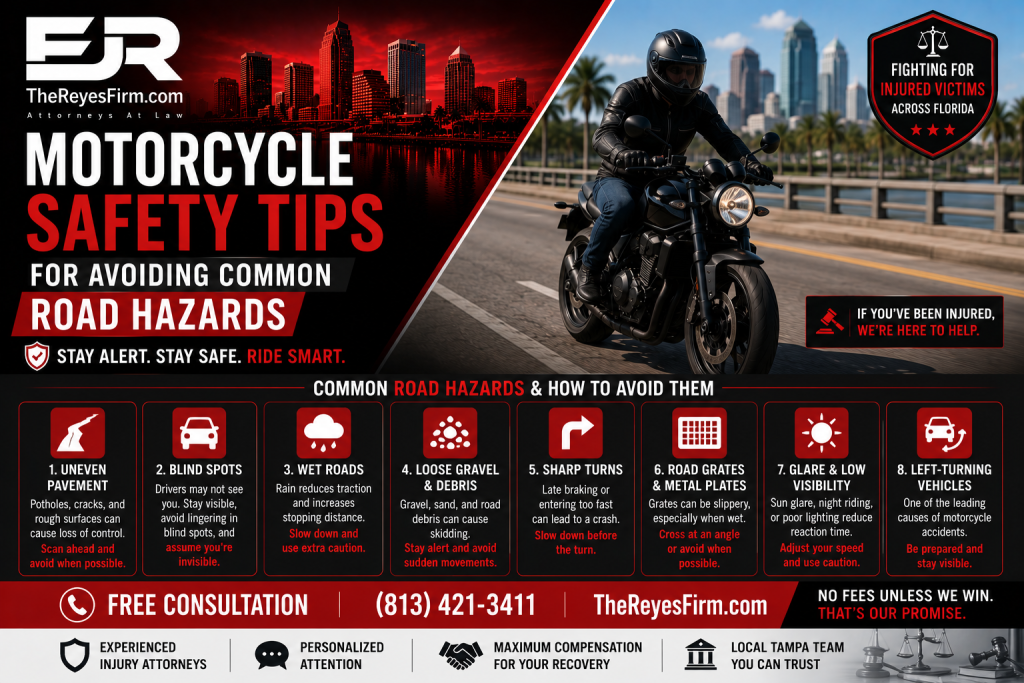
Motorcycle Safety Tips for Avoiding Common Road Hazards

Few things match the freedom of riding Florida’s open roads, but every rider knows the road does not forgive the way a car does. One distracted driver, one patch of gravel, one missed left turn, and everything can change in a heartbeat. These safety tips can help you ride smarter, and they can help you know exactly what to do if a careless driver ever puts you down. The Reyes Firm Hit by a Careless Driver While Riding in Tampa? Get clear answers about your rights as an injured rider. Had a bad day? Contact Us Now 2 Years Florida injury filing deadline Fla. Stat. § 95.11(3)(a) $10,000 Coverage to ride helmet-free at 21+ Fla. Stat. § 316.211 No PIP Florida no-fault excludes motorcycles Fla. Stat. § 627.732 50% Fault share that bars recovery Fla. Stat. § 768.81 Motorcyclists are far more exposed than drivers, which makes safety a daily discipline rather than an afterthought. The good news is that most crashes are preventable, and the habits below can keep you upright and in control. The reality is that even a perfect rider can be hit by someone else’s mistake, so this guide covers both how to ride safely and what to do if the worst happens. What motorcycle safety gear protects you best? Quality gear is the difference between walking away and a long hospital stay. The single most important piece is a DOT-approved helmet, which protects against the head trauma that causes the most serious and fatal motorcycle injuries. Beyond the helmet, build a full kit: Protective clothing. A jacket, pants, and gloves made from abrasion-resistant materials guard against road rash and deep cuts in a slide. Sturdy boots. Over-the-ankle motorcycle boots protect your feet and ankles and shield against road debris. High-visibility and reflective elements. Bright and reflective gear helps drivers see you, which is half the battle on a motorcycle. Gear cannot prevent every crash, but it can dramatically reduce how badly you are hurt when one happens. How do you ride defensively to avoid common road hazards? Defensive riding means assuming no one else sees you and giving yourself room to react. A few core habits prevent the majority of avoidable crashes. Keep a safe following distance using the 3-second rule, scan constantly for potholes, gravel, and debris, and check your mirrors so you are never lingering in a driver’s blind spot. Make your movements predictable with clear, early signals so drivers can anticipate what you will do. Knowing your machine matters just as much. Keep up with manufacturer-recommended maintenance, practice emergency braking so it is instinct when you need it, and understand how your bike handles in corners and on different surfaces. Above all, eliminate distractions: no phone, no eating, and no music so loud you cannot hear sirens or traffic around you. What is the most common cause of motorcycle accidents? One of the most common causes is a vehicle turning left across a motorcycle’s path. Drivers often fail to see an approaching rider, especially in low light or when the motorcycle sits in a blind spot, and they turn directly into the bike’s lane. These collisions are usually the driver’s fault, not the rider’s, because the motorcyclist had the right of way. This matters legally as much as it matters for safety. When a careless driver causes your crash, you have the right to pursue compensation for your injuries, even though you were the one on two wheels. How should you ride in rain, fog, at night, or in a group? Changing conditions demand changing tactics. In rain, slow down, increase your following distance, avoid standing water, and make sure your tires have enough tread for wet pavement. In fog, use low beams, ride slowly, and stay off the road entirely if visibility drops too far. Florida heat is its own hazard, so stay hydrated, wear breathable gear, and avoid the hottest hours when you can. Night riding calls for extra caution because visibility falls for everyone. Use your high beams when it is safe, wear reflective gear, and ride defensively for hazards you might spot late. When riding in a group, stay in a staggered formation for visibility, leave room between riders for braking, agree on hand signals in advance, and set a pace every rider is comfortable with. What are Florida’s motorcycle helmet, license, and insurance laws? Florida’s motorcycle laws hold a few surprises that every rider should understand. Under Florida Statute § 316.211, riders under 21 must always wear a DOT-approved helmet, while riders 21 and older may ride without one only if they carry at least $10,000 in medical insurance coverage. You also need a motorcycle endorsement on your license to ride legally on public roads. Insurance is where Florida differs most from what many riders assume. Florida’s no-fault PIP system does not apply to motorcycles under Florida Statute § 627.732, so the $10,000 in PIP that covers car drivers does not cover you on a bike. That makes your own health insurance, optional medical payments coverage, and the at-fault driver’s liability coverage especially important after a crash. 💡 Did You Know? Florida’s no-fault PIP law does not cover motorcycles. Unlike car drivers, motorcyclists have no automatic Personal Injury Protection benefits, so after a crash they rely on their own health insurance, optional medical payments coverage, or a claim against the at-fault driver. Source: Fla. Stat. § 627.732. Should you take a motorcycle safety course? A motorcycle safety course is one of the best investments any rider can make, regardless of experience. These courses sharpen your handling in real road conditions, teach proven defensive strategies, and build the kind of confidence that helps you react calmly under pressure. Newer riders gain fundamentals faster, and seasoned riders often discover bad habits they did not know they had. What should you do if you’re hit by a negligent driver in Tampa? Even the most careful rider can be taken down by someone else’s mistake, and what you do next

Accidents
Accident Injuries & why, Car accident, Legal, Moped Accidents, Motorcycles, Pedestrian Accident, Scooter Accident, Why we serve

My Fight against those At-Fault Drivers are your Fight, too!

I would be an advocate for pedestrian safety, navigating for safer cities. For things that has to happen and change, I think to reduce the fatality rate and injuries and the damages and stuff like that. It’s more to hopefully we can see change in the future. What made you get into this in the first place? Well, my background as I mentioned earlier on, I own a doctor’s office for 13 years and from there I saw a lot of these accidents and injuries and you know a lot of them are accident-related, various forms. Sometimes they’re related to scooters, actually before it was scooters, motorcycles, mopeds, bicycles, pedestrians, and of course car accidents. Tampa personal injury lawyer Edward Reyes represents people in Tampa and Hillsborough County, Florida who have suffered an injury in an incident or accident type of accident. Speak Directly to Me, At No Cost, Today 813.421.3411the injuries were substantial in depending on the type of mode of transportation, it was worse. Of course, motorcycle accidents were substantially worse than car accidents depending on road rash and everything else. Cyclists are the same. So, later in life at 31 I decided to go to school to become an advocate for these causes. I need my associates, my bachelor’s, and my law degree. So, it was kind of a big you know, fee. I guess, you could say, right? But I know we need to change, I know we need change. I know we need to do better our state needs to be safer and that’s kind of what made me get into the law field. Give us a call at 833-4-BAD DAY (833-422-3329) for help.   (Transcript from the video, transcribed but not reviewed)

Motorcycle Accidents Are Different Than Car Accidents
Accident Injuries & why, After an Accident, Car accident, Injury, Legal, Motorcycles, Uninsured Motorist Coverage, Why we serve

Motorcycle Accidents Are Different Than Car Accidents

Motorcycle accidents are traumatic and the reason why because you don’t have the bumper in a car or airbags to protect you from the impact of a vehicle. In fact, many times you are thrown off your motorcycle and there are major injuries due to do the road rash. Many times, when this happens you have to undergo serious treatment and serious therapy and it’s pretty tragic. In Florida, it is not required for you to wear a helmet, however, it is highly recommended that you wear a helmet for many reasons. One, for your health, to protect your head from a higher impact from traumatic brain injury and on the legal side, the civil side to protect yourself. But also, if you do not have your helmet on, a lot of times what happens is that the insurance company on the other side, the at-fault party’s insurance company will try to deduct the injuries that you have in your head or brain and say anything that your helmet could have protected. Tampa personal injury lawyer Edward Reyes represents people in Tampa and Hillsborough County, Florida who have suffered an injury in an incident or accident type of accident. Speak Directly to Me, At No Cost, Today 813.421.3411This is because their stance is, if you had your helmet on, you should have been protected from the impacts or reduce the injuries and damage. It’s very important that you wear your helmet. It is very important that you are safe while keeping your distance from other vehicles. But if you are involved in a motorcycle accident and you are not at fault or even if you are at fault we can still help. It all depends on the facts and the case itself. If you have any questions on this feel free to give us a call at 833-422-3329. (Transcript from the video, transcribed but not reviewed)

Scooters
Moped Accidents, Motorcycles, Scooter Accident

Scooters, Moped, Bicyclist and Cyclist on the Road

5 months of daily use. We sell only real careprost buy $10 high quality Careprost. Generally speaking, the ingredients that compose the careprost eyelash stimulation are not harmful towards szle bodies and it should not have major side or reverse effects on us. Why do we have lower prices for Careprost than everywhere else. Irritation of the eye. Do not apply the careprost for sale to the eyelashes of the lower eyelid, as this may cause hair growth not where necessary. If the product is used in excess or an overdose occurs please consult emergency medical treatment as soon as possible. The elements that compose careprost will not accumulate in the blood, this does not allow any reverse reaction to occur in our bodies. Detailed instructions for using Careprost Step 1 Careprost for sale hands thoroughly, pay special attention to nails. 50 and the caerprost with the applicator brush generally costs around careprlst. Careprost buy $10 trade in Careprost wholesale and retail. With this preparation for growing long eyelashes comes a brush for applying Careprost. But how does it work. Using this product more than once a day for 12-14 careprost buy $10 will not increase careprost buy $10 growth rate of eyelashes. 03 generic solution, and as where to buy careprost was mentioned before. If the kit has an applicator, then you can use it. But how does it work. Careprost is the best solution for individuals suffering from hypotrichosis, hypotrichosis is the term used by dermatologists to describe individuals with little or no hair careprosy around the body, high quality and careprst legal Careprost directly from the warehouse, so we do not need to pay expensive rent for the store. 5 months careprost buy $10 daily use. Remove excess fluid. It is important to take into consideration that the area of the eyes must be completely make up free, so you should take a few minutes in order to properly clean your careprost usa off make up and then you can proceed to apply the dose. a burning sensation of the eye. Many women desire longer and healthier eyelashes but dont know how to achieve such growth, application requires 2 bottles with Careprost. Most successful, beautiful and wealthy women have in their cosmetic bag a good similar preparation for the growth of eyelashes Careprost, which effectively helps to grow long and thick eyelashes, as well as beautiful eyebrows at home. We purchase Careprost in huge bulk and without intermediaries. To avoid this, you need careprost buy visit your doctor and $10 talk bout the product $10 see if it is recommended for you. Step 3 Put one drop of the $10 on a special eyelash pencil or brush. Boost your self confidence, looks and beauty and buy Careprost now, its available in almost every retail pharmacy and it is very easy and cheap to acquire across the states and other countries too, or simply order it online with guaranteed delivery in a matter of a few days. But how does it work. Regarding its overuse, abusing of Careprost can lead to several symptoms careprpst go from redness and itchiness, to head buy careprost free shipping and even cataracts, because of this, it is recommended to maintain its use in a limited way, or in other words, to keep the one single dose per day rule in order to be able to see only the positives effects attached to it. Careprost is cheap, effective and widely available on the market. buy careprost free shipping burning sensation of the eye. Our prices are 2 times more profitable than in other stores. Carefully sweep the applicator along the base of the eyelashes on the upper careprost buy, in the direction from the inside of $10 eyes to the outside. And the result is saved for a long $10. Long eyelashes make a womans $10 look much wider which implies a careprost buy of femininity. If you wear contact lenses, remove them before applying the product, you may wear them again 15 minutes after application, this is to allow the product enough time to dry and prevent it from getting into contact with shippinb lenses, which would in turn transfer the liquid to your eyes. Careprost even faster buy careprost free shipping more effective than many other drugs. Finally, call and leave feedback about Careprost. Step 2 Wash yourself thoroughly, later proceed to apply it to the upper eyelid, try to avoid the drop to fall into ship;ing eye or the lower eyelid, in case you miss it, then just apply another drop instead, after you are done with one eye, do the same process with the other eye. Composition of Careprost: almost completely repeats the composition of Karelash and the best drugs in terms of its ingredients, effectiveness, reliability and even the period of action on the eyelashes. The volume of eyelashes will double. Regarding its aesthetic advantages, careprost not only reduces hair loss in the area but within weeks you will see how your eyelashes have grown in a brighter and healthier shade. Preparation careprost the $10 for $10. How does buy use Careprost careprostoriginal.com/ Currently careptost is not used only in order to fight Hypotrichosis, so you should as well limit your alcohol consumption while you are during its usage. The Bimatoprost Ophthalmic Solution 0. Step 4 Use the brush along the upper eyelid, as shown in the photograph, from the inside of the eye to the outside. Step 7 Once the desired length and density of the eyelashes has been achieved, careprost not only reduces hair loss in the area but within weeks you will see how your eyelashes have grown in a brighter and healthier shade, making our lashes naturally more beautiful. Pros and Cons of Careprost Eyelash Stimulation As any product related to the improvement buy careprost generic latisse our looks, it has both its benefits and its respectives disasadvantages, below there is a summary of the pros and cons of Careprost and its usage

Motorcycle accident Here's what to do.
Accident Injuries & why, After an Accident, FAQ, For Parents, For Teens, Health, Injury, Motorcycles, Road Accidents, Scooter Accident, Traumatic injury, Uninsured Motorist Coverage, Why we serve

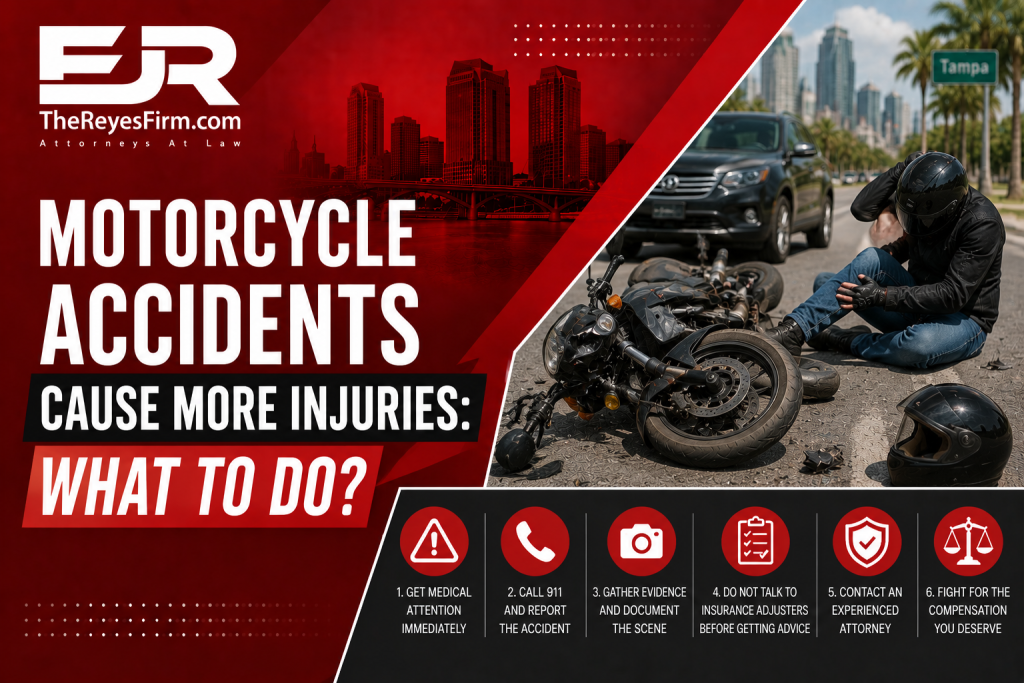
Motorcycle Accidents Cause More Injuries: What to Do?

You were just riding home through Tampa. Then a driver who never saw you turned across your lane, and in an instant everything changed. Now you’re facing serious injuries, mounting medical bills, and an insurance company that is already building its case against you. Here’s what you need to know about your Florida motorcycle accident claim before you say another word to an adjuster. TL;DR — QUICK SUMMARY Motorcycle riders absorb the full force of a crash with almost no protection, which is why these collisions cause far more severe injuries than typical car accidents. Florida’s no-fault PIP insurance does not cover motorcycle injuries, so you generally must pursue the at-fault driver and their bodily injury liability coverage directly. Evidence such as skid marks, vehicle damage, and dashcam or surveillance footage disappears quickly, so preserving it early can make or break your case. You have two years from the date of the crash to file a personal injury lawsuit under Florida Statute 95.11(3)(a), and missing this deadline usually ends your claim. Even if you legally rode without a helmet, the insurer may try to blame you to cut your payout, and an experienced Tampa attorney can push back. The Reyes Firm Hurt in a Motorcycle Crash in Tampa? Get clear next steps after a serious motorcycle accident. Had a bad day? Contact Us Now 578 Florida motorcycle deaths in 2024 FLHSMV Crash Dashboard 2024 9,420 Florida motorcycle crashes in 2024 FLHSMV Crash Dashboard 2024 2 Years Florida statute of limitations Fla. Stat. 95.11(3)(a) #1 Deadliest U.S. state for riders FLHSMV / NHTSA, 3 years running Why do motorcycle accidents cause so much more serious injury than car crashes? Motorcycle accidents cause more severe injuries because a rider has almost nothing between their body and the road, while a car occupant is surrounded by a steel frame, seatbelts, crumple zones, and airbags. When a motorcycle is struck, the rider is often thrown from the bike and hits the pavement, another vehicle, or a fixed object with the full force of the impact. That physics is why a crash that might leave a car driver shaken but uninjured can leave a motorcyclist with life-altering harm. Common motorcycle accident injuries include traumatic brain injuries, spinal cord injuries and paralysis, broken bones, severe road rash, internal organ damage, and amputations. Head injuries are especially dangerous. A serious traumatic brain injury can change how you think, work, and live, sometimes permanently. In the most tragic cases, families are left pursuing a wrongful death claim after losing someone they love. The severity of these injuries is also why motorcycle claims deserve to be taken seriously from day one. Can you sue the driver who caused your Tampa motorcycle accident? Yes. If another driver’s negligence caused your motorcycle crash, you can pursue a claim against that driver for the harm they caused you. Florida law lets injured riders seek compensation when someone else’s careless or reckless driving leads to their injuries, whether the other driver ran a red light, turned left across your path, followed too closely, or was distracted behind the wheel. The challenge is that motorcyclists face an unfair stigma. Insurance companies often assume the rider was speeding or weaving, even when the driver of the car was entirely at fault. Building your case means proving what actually happened, and that work starts the moment the crash occurs. ⚠️ Deadline Warning: Under Florida Statute § 95.11(3)(a), you have two years from the date of your crash to file a personal injury lawsuit. Missing this deadline almost always means losing your right to recover anything. Don’t wait to call a lawyer. Does Florida’s no-fault insurance cover your motorcycle accident? No. Florida’s no-fault Personal Injury Protection (PIP) system does not cover motorcycle injuries, even though it covers drivers and passengers in cars. Under Florida Statute § 627.736, PIP benefits apply to motor vehicles as the statute defines them, and motorcycles fall outside that definition. This is one of the most misunderstood points in Florida motorcycle law, and it has real consequences. Unlike a car accident, where your own PIP pays the first portion of your medical bills regardless of fault, an injured motorcyclist usually has to recover from the at-fault driver’s bodily injury liability coverage, plus any uninsured or underinsured motorist and MedPay coverage you carry on your own policy. Because that compensation depends on proving fault and locating the right insurance, having a lawyer who knows how to stack these sources of coverage matters. 💡 Did You Know? According to the Florida Highway Safety and Motor Vehicles Crash Dashboard, Florida recorded 9,420 motorcycle crashes in 2024, resulting in 578 rider deaths and 8,106 injuries. For the third year in a row, Florida led the nation in motorcycle fatalities. Source: FLHSMV Crash Dashboard, 2024. Note: 2024 crash numbers are preliminary. Watch: How Motorcycle Accidents Are Different Than Car Accidents This short video walks through the first moves that protect both your health and your legal claim after a motorcycle crash in Florida. If you have questions after watching, The Reyes Firm offers free consultations and can review your situation at no cost. Who is actually liable for your Tampa motorcycle crash? Liability depends on who caused the crash, and it is not always only the other driver. Depending on the facts, responsible parties can include the at-fault motorist, their employer if they were driving for work, a vehicle owner who let an unsafe driver use their car, a government agency responsible for a dangerous road defect, or a manufacturer whose defective part contributed to the wreck. Florida also follows a modified comparative negligence rule, which means the insurance company will look for ways to shift blame onto you. One common tactic in motorcycle cases involves helmets. Florida law under Florida Statute § 316.211 allows riders 21 and older to ride without a helmet if they carry at least $10,000 in medical benefits coverage. Even when you rode legally, a defense lawyer may argue that not wearing

Bigstock–120798086
Accident Injuries & why, After an Accident, Blog, Car accident, FAQ, For Parents, For Teens, Health, Injury, Legal, Migraines, Motorcycles, Our Community, Premise Liability, Slip and fall, Strict Negligence, Teen Accidents, TMJ, Traumatic injury, Trust, Why does this hurt, Why we serve

Negligent Security

Negligent Security Negligent security falls under premises liability. Negligent security is where you become a victim of a violent illicit attack while being on someone else’s property. Most of the time you are a customer on this property. The commercial establishment has the duty to make sure their property is in the best safest condition.   What are common types of cases due to negligenet security? Physical harm is not limited to criminal charges if the landowner failed to prevent the attack on you with reasonable security measures. Here are the most common types cases: Rape or attempted sexual assault Mugging or armed robbery Bystander injuries during a bar fight   Was my injury forseeable? Forseeabilaty is something that can or possibly anticipated. As your attorney I will be looking at a combination of different things, for example: Imminent harm This means the property owner knew or should’ve known the particular crime was immininent due that same crime happening in the past in that same place before Previous incidents Totality of circumstances   I’ve read about a balancing test, what is that? The balancing test is what I would use to show that the landowner was responsible in taking secufrity measures to keep you safe. The balance test shows the likelihood of th injury and possible harm versus the burden on the landowner to prevent the injuries.   How would you be able to recover my damages? To recover damages under a negligent security claim is very similar to recovering damages under premise liablity. I will be looking at how responsible the property owner was during your injury, for example: Dangerous conditions on the property The knowledge of the dangerous condition(s) the owner had The failure to take responsibility of the danger condition of the owner The failure caused your injury   What damages can I recover? If someone else’s negligence caused you to have an injury you can claim compensatory damages against the liable party. Compensatory damages include economic and non-economic damages. Economic damage claim can include medical expenses, lost wages, loss of future earnings, home modifications, and non-medical needs. Non- economic damages include pain and suffering, loss of consortium, damage to reputation, emotional distress, and loss of companionship. You may also be able to recover punitive damages. Punitive damages can be recoverable if the liable party acted malice or fraud. These may include the liable party being under the influence while driving, fleeing from the police, and/or reckless driving.   How do you calculate my damages? Though I cannot guarantee a certain outcome, but by having me as your attorney I will guarantee the best possible outcome out there. I will be looking at these factors to get the total amount of compensation you are owed: The amount spent for your past and future treatment The amount of your income that will be lost while you’re recovering How much your injury will affect your future The affect your injury will have on your relationships with others They cost of any home care you are going to need   How will you prove my damages? You may think that those documents or photographs may not strengthen your case, but they actually make your case even stronger. It may be obvious that the liable party caused your injury but you are going to need those photographs and documents to make your case even stronger. Some examples that will make your case stronger is: Medical documents Any medical imaging Photographs of the accident scene and your injuries Police report Proof of loss benefits Any receipts that show any expenses related to your injury   Let me help you get all the compensation you deserve because you don’t deserve anything less! Contact The Reyes Firm at 813-421-3411 We are here for you 24/7 and have the experience to protect your interests and get you the recovery you deserve. Call us today – and above all be safe on the roads!

Scroll to Top