Personal Injury

Know your case, know your value
After A Car Accident, Health, Legal, Migraines, Personal Injury, personal injury attorney, Settlement, Traumatic injury

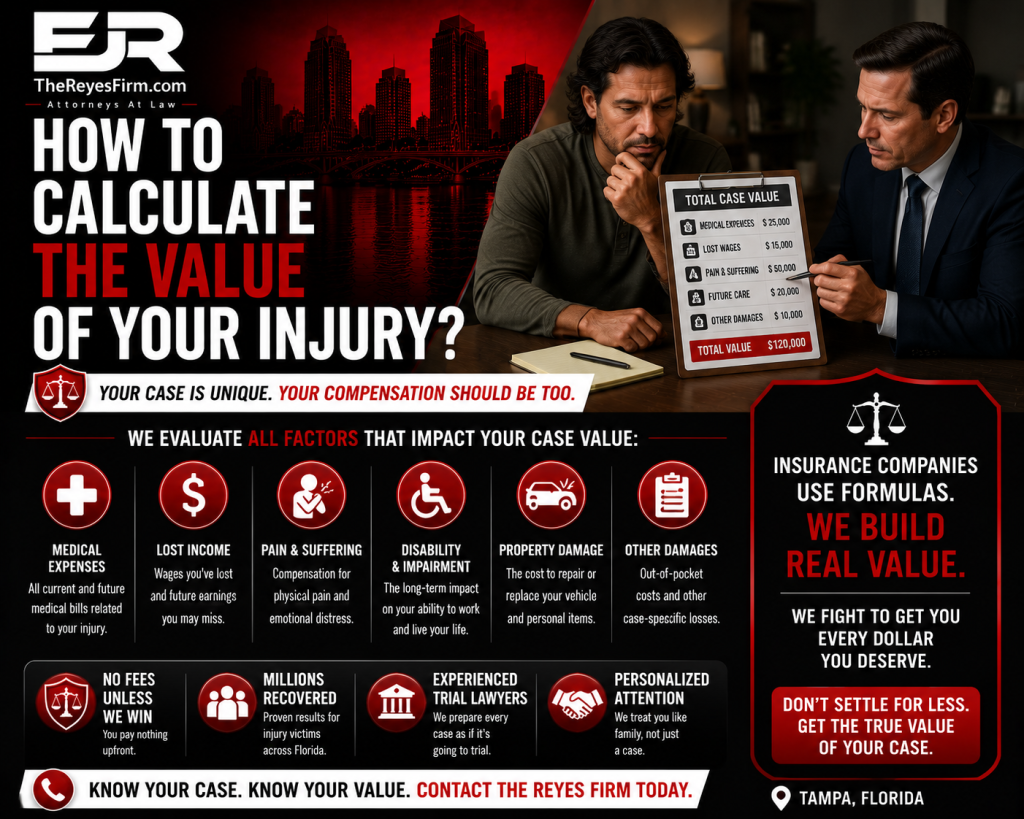
How To Calculate The Value of Your Injury?

After a serious Tampa accident, one question outweighs almost every other: how much is my case actually worth? Put a number too high and the insurer stops taking you seriously. Settle for too little and you are stuck paying for an injury that was never your fault. Here’s how the value of an injury claim is really calculated in Florida, and what quietly raises or lowers that number. TL;DR — QUICK SUMMARY Your claim’s value is the sum of your economic damages and your non-economic damages, then adjusted for your share of fault and the available insurance. Economic damages are documentable losses like medical bills, lost wages, and future care; non-economic damages cover pain, suffering, and lost quality of life. Most insurers start with the multiplier method, adding up your medical bills and multiplying by a number, usually between 1.5 and 5, based on how serious your injury is. In Florida you can only recover pain and suffering from an at-fault driver if your injury meets the permanency threshold under Florida Statute 627.737. Comparative fault and insurance policy limits can shrink what you actually collect, and you have two years to file under Florida Statute 95.11(3)(a). The Reyes Firm Wondering What Your Case Is Worth? Get an honest valuation of your Tampa injury claim. Had a bad day? Contact Us Now 1.5 to 5 Common multiplier applied to your damages Industry standard No Cap On pain and suffering in most FL injury cases Florida law >50% Your fault share that bars recovery Fla. Stat. 768.81 2 Years To file an injury lawsuit Fla. Stat. 95.11(3)(a) How do you calculate the value of a personal injury claim? You calculate the value of an injury claim by adding together two kinds of damages, your economic losses and your non-economic losses, and then adjusting that total for real-world factors like your share of fault and the insurance coverage available. There is no single official formula a court hands you, but insurance companies and experienced attorneys both start from a recognized method and refine it based on the facts of your case. The goal of these damages is to make you whole, meaning to put you back, as much as money can, in the position you would have been in if the injury had never happened. Getting the number right matters in both directions. Aim too high and the insurer assumes you are not serious about settling. Accept too little and you are left covering costs that should have been someone else’s responsibility. What are economic, or special, damages? Economic damages are the losses you can put a receipt to. They include your past and future medical bills, your lost wages, your reduced earning capacity if you cannot work the way you used to, the property damage to your vehicle, and out-of-pocket costs like medication and travel to appointments. In a Florida auto case, your own Personal Injury Protection coverage pays the first portion of these medical bills before you pursue the at-fault party for the rest. The piece people most often undervalue is the future. A catastrophic injury can require surgeries, therapy, and care for years or even a lifetime, and all of that belongs in your claim. Counting only the bills you have already received is one of the fastest ways to settle for far less than your case is worth. What are non-economic, or general, damages? Non-economic damages compensate you for harm that has no invoice: physical pain, mental anguish, the loss of enjoyment of your life, disfigurement, and the strain an injury puts on your relationships. These losses are real, but because they are subjective, they are the hardest part of a claim to value and the part insurers fight the most. In Florida there is an important gate. You can only recover non-economic damages from an at-fault driver if your injury meets the permanency threshold under Florida Statute § 627.737, which generally requires a permanent injury such as a spinal cord injury or a traumatic brain injury. The good news is that Florida does not cap pain and suffering in typical injury cases, so when the threshold is met, the value of these damages is limited by the evidence, not by an arbitrary ceiling. 💡 Did You Know? In a Florida car accident, you cannot recover pain and suffering from the at-fault driver unless your injury meets the permanency threshold in Fla. Stat. § 627.737. When it does, Florida places no cap on non-economic damages in ordinary injury cases, so the value is driven by the strength of your medical evidence. Source: Fla. Stat. § 627.737, leg.state.fl.us. How does the multiplier method work? The multiplier method is the most common starting point for valuing pain and suffering. An adjuster or attorney adds up your economic damages, focusing on your medical bills, and multiplies that total by a number, usually between 1.5 and 5. A minor injury with a full recovery sits near the bottom of that range, while a severe, permanent injury sits near the top, and the result is an estimate of your non-economic damages that gets added to your economic losses. A second approach, the per diem method, assigns a set dollar amount for each day you live with your injury, which works better for shorter-term injuries than for lifelong ones. Both are only starting points. This is also why the free calculators you find online are unreliable, because they cannot weigh permanency, fault, your future prognosis, or the specific facts that move the multiplier up or down. Watch: How injury value is calculated In this short video, attorney Edward Reyes breaks down how the value of an injury claim is calculated and the mistakes that leave money on the table. If you want a clear, honest read on what your case is worth, The Reyes Firm offers free consultations at no cost to you. How do fault and insurance limits change what you actually collect? Two factors can separate what your claim is worth from


Powerful legal representation in Florida
florida cities we serve, Legal, Personal Injury, personal injury attorney, Why we serve

Personal Injury Attorney in Florida | The Reyes Firm

One careless driver, one unsafe property, one moment that wasn’t your fault, and suddenly you’re hurt, behind on bills, and facing an insurance company that does this every day. A Florida personal injury attorney exists to level that playing field. Here’s what one actually does and how the process works in Florida. TL;DR — QUICK SUMMARY A Florida personal injury attorney helps people who were hurt by someone else’s negligence recover compensation for their injuries, lost income, and suffering. Personal injury covers a wide range of cases, from car, truck, and motorcycle crashes to slip-and-falls, wrongful death, and catastrophic injuries like spinal cord and brain trauma. Florida is a no-fault state. Your own PIP coverage pays first up to $10,000, and you generally need to meet a serious-injury threshold to pursue the at-fault party for pain and suffering. Under Florida Statute § 768.81, your compensation drops with your share of fault, and you recover nothing if you’re found more than 50% at fault. You have two years from the date of injury to file a personal injury lawsuit under Florida Statute § 95.11(3)(a). Most reputable firms, including The Reyes Firm, work on contingency, so you pay nothing unless they recover for you. The Reyes Firm Injured by Someone Else in Florida? Find out what your personal injury claim may be worth. Had a bad day? Contact Us Now 2 Years Florida statute of limitations Fla. Stat. § 95.11(3)(a) $10,000 Florida PIP minimum coverage Fla. Stat. § 627.736 50% Fault bar to recovery in FL Fla. Stat. § 768.81 $0 Upfront cost on contingency Pay nothing unless you recover What does a Florida personal injury attorney do? A Florida personal injury attorney helps people who were hurt by someone else’s negligence get compensated for their injuries. That’s the core purpose: to give an injured person an advocate whose only priority is their interests, not the insurance company’s. In practice, that means investigating how the injury happened, gathering medical and other evidence, identifying who is responsible, dealing with insurers and their adjusters, valuing the full extent of the harm, and negotiating or litigating for a fair recovery. Most people don’t know what their claim is worth or what deadlines apply, and an attorney closes that knowledge gap. The injuries that lead people to a personal injury attorney range widely, from traumatic brain injuries, spinal cord injuries, and fractures to soft-tissue injuries and everything in between. What they share is that someone else’s carelessness caused harm that the injured person shouldn’t have to pay for. ⚠️ Deadline Warning: Under Florida Statute § 95.11(3)(a), you generally have two years from the date of your injury to file a personal injury lawsuit. Miss that deadline and you usually lose the right to recover anything. The sooner you talk to a lawyer, the easier it is to preserve evidence. What types of cases do Florida personal injury attorneys handle? Personal injury law covers any situation where someone is harmed by another party’s negligence, which is why the case types are so varied. The same legal principles apply whether the harm came from a vehicle, a property owner, or another source. Common Florida personal injury cases include car accidents, truck and commercial vehicle crashes, motorcycle and pedestrian accidents, slip-and-fall and other premises liability claims, spinal cord injuries, traumatic brain injuries, and wrongful death. The most serious of these often become catastrophic injury cases with lifelong consequences. Each case type has its own evidence, its own insurance considerations, and its own challenges, but all of them turn on proving that another party’s negligence caused your harm. Watch: Why hire a Florida personal injury attorney? In this short video, Tampa personal injury attorney Edward Reyes explains how a personal injury attorney levels the playing field against insurance companies after you’ve been hurt. If you’re not sure whether you have a case, The Reyes Firm offers a free case review to help you understand your rights. How does Florida law affect your personal injury claim? Florida law shapes nearly every personal injury claim, starting with the fact that Florida is a no-fault auto insurance state. Under Florida Statute § 627.736, your own Personal Injury Protection (PIP) coverage pays up to $10,000 in medical bills and lost wages regardless of who caused a crash. To pursue the at-fault party for pain and suffering in an auto case, your injury generally has to meet a serious-injury threshold. Fault matters too: under Florida Statute § 768.81, your compensation is reduced by your share of fault, and you cannot recover at all if you’re found more than 50% responsible. These rules give insurers tools to reduce or deny claims, which is a large part of why having an attorney matters. A lawyer who knows how Florida applies these statutes can push back on unfair blame and protect the value of your claim. 💡 Did You Know? Because Florida is a no-fault state, your own PIP coverage pays your first $10,000 in medical bills no matter who caused the crash, under Fla. Stat. § 627.736. But PIP rarely covers a serious injury in full, and it never pays for pain and suffering, which is where most disputes begin. What is your Florida personal injury claim worth? There is no single number, because the value of a personal injury claim depends on your specific losses. Two people in similar crashes can have very different claims based on the severity of their injuries and how those injuries change their lives. Claims are generally built from two categories of damages. Economic damages cover measurable losses like medical bills, future treatment, lost wages, and lost earning capacity. Non-economic damages cover pain and suffering, mental anguish, and loss of enjoyment of life. In cases of extreme misconduct, punitive damages may also apply, though those are limited. Insurers often start low, hoping you’ll accept before the full picture of your injuries is clear. A thorough valuation, backed by complete medical documentation, is what supports a fair recovery. 🛡️ Your Rights

Legal, Personal Injury, personal injury attorney, Settlement, Traumatic injury, Why we serve

Personal Injury Protection (PIP)

What is PIP? Why is PIP important? In Florida, PIP is Personal Injury Protection. What that means is that for the medical coverages after an accident, you got 14 days to see a doctor. That locks in your coverages to pay your PIP benefits which is the $10,000 worth of coverages. However if you’re not injured or not injured enough, they’ll cut you at $2500. Watch this video for the full details.

After an Accident, FAQ, For Parents, For Teens, Health, Legal, Our Community, Personal Injury, Trust, Why does this hurt, Why we serve

Mediation Is Not Always The Case Resolution

Is mediation a resolution? Typically a mediation is a meeting of the minds to meet with and agreeable solution. But when you’re involved in a car accident, any law suit, or whatever case it may be. Mediation is joke for most part. You’ll be sitting there to discuss when you already know what your injuries are worth yet the insurance company is saying you’re not really injured. Mediation is just a fact-finding thing for the insurance company to discredit your claim. Mediation is not always the case resolution. Sometimes, it is during mediation that the insurance company will try to discredit the value of your injuries. The insurance company want you to receive the lowest settlement check possible. So a lawyer like Atty. Edward Reyes will help you get the most out of your injuries. Watch this video for the full details.

After an Accident, FAQ, For Parents, For Teens, Health, Injury, Personal Injury, Strict Negligence, Why does this hurt, Why we serve

Minor Injuries can be a Threat: Mechanism of Injury Explained!

You’re probably wondering why does your jaw hurt so much, why do your wrists hurt, why does your knee hurt? When you are involved in a car accident, this is the thing. When you are driving, let’s say you’re driving a car then somebody rear-ends you. The first thing that happens if you notice, your wrist goes back because the impact it pushes forward puts a lot of strain in your elbow and it pushes your shoulder back. That is how you can have problems at the wrist, your elbow, and your shoulder. Many times it also hurts the vertebrates in the back. But because of the accident that happens your knee hits the steering wheel and your body goes side to side hitting other parts of the car. Your jaw, because you’re doing the whiplash motion back and forth, goes backward and forward creating that stretch in these ligaments and that’s called TMJ- temporal mandibular joint dysfunction. Tampa personal injury lawyer Edward Reyes represents people in Tampa and Hillsborough County, Florida who have suffered an injury in an incident or accident type of accident. Speak Directly to Me, At No Cost, Today 813.421.3411 Sometimes you can also have issues with your brain that has micro-tears and the reason why because your brain sits inside a gel-like substance and when you go back and forth it swishes back and forth crashing into your skull. So, when you’re involved in a car accident, many people think it’s just their neck in their back. In fact, there are memes about my neck and my back but there is so much more to it. You got to look at the injury and how it happened slowly it down in your mind and that’s how you can figure out what is really hurting you and what can hurt you for the foreseeable future. You have to understand many attorneys may not get this idea. Many individuals may not get this idea because automatically they assume that that had to come from something else. But when you are involved in a car accident or some sort of major impact you’ve got to slow down the process because you’ll realize that that accident caused many other issues to happen because of the incident. So, if you’re falling, you’re compensating one side, you’re bending to protect yourselves. Our very smart and our bodies will do whatever it takes to protect ourselves from these injuries. But many times creates more injuries in different areas because it tightens up. So, the mechanics of injury is very important when thinking about your injuries and thinking about your future care. If you have any questions on this feel free to give us a call at 813-421-3411 or 833- 4 BAD DAY. (Transcript from the video, transcribed but not reviewed)

Accident Injuries & why, After A Car Accident, After an Accident, Legal, Our Community, Personal Injury, personal injury attorney, Police Interaction, Settlement, Uninsured Motorists Coverage, Why we serve

How Important is it to have a Police Report?

I have a question related to personal injury. How important is having a police report when you are making a personal injury claim? Or just reporting to your insurance company that you’ve had an accident and maybe you just felt like oh I didn’t call the police because I was in a hurry, but then later you’re reporting your insurance the damage. Can you talk a little bit about that? Yeah, that’s a great question because a lot of people don’t want to wait for the police and they just want to exchange information. It’s important for you to get a police report because you need documentation because everybody inherently is telling the truth at that time when people are around. But the moment you drive away people start lying and they start saying I didn’t say that. The person hit me, or this is how it happened. Then we run into an issue of liability and then the insurance company will deny, the at-fault party will deny coverage because they’ll say it’s not their drivers’ fault. Their driver said something different when they did the recorded statement. So, now we have the problem of we may have to file suit and go through this process. It creates something I could have taken maybe an hour. Now it takes months and months even if you even get to that point. If it’s not very clear-cut. So, it’s very important and on the same subject, we need to get this. We need to ask for a long-form. A lot of sheriffs and law enforcement they don’t actually want to do this because it’s a lot of work. But a lot of times they just want to do a quick thing if there are no injuries because people feel pain the next day. They’d always feel pain the same day unless it’s pretty substantial. Then I say feel I got hit by a truck, so the long-form it goes into deeds detail and it was like a narrative of what they write in detail of what happened in the accident and it’s all a map. Tampa personal injury lawyer Edward Reyes represents people in Tampa and Hillsborough County, Florida who have suffered an injury in an incident or accident type of accident. Speak Directly to Me, At No Cost, Today 813.421.3411In short form they don’t do any of those things. So and then, later on, we have one that the police cited that the other party at fault but because they didn’t do a long-form there the teenage driver that hit my client that my client didn’t speak English which is another problem we can talk about because they discriminate a lot towards people don’t understand the language. They took the word of a 17-year-old high school kid that wasn’t his fault after the police cited him and that they rejected liability because they said there’s no narrative on the long-form. So now we must file suit, in the end, we call the sheriff like it’s been a few months I don’t remember I did. So, it’s very important that you had a police report on a long-form. Is there any way to remedy it later on after the accident has passed several days can you call the police back at that point or what yeah what’s common practice? Yeah, we do. We call the police, we look for witnesses, we look at the actual damage the pictures to the car itself because that tells the story a lot of times because they might say whatever but in depending on how the car is dented how the impact was, there’s no way another scenario we have another one they said Oh your client, our client like but your client their phone in the car is completely damaged. So, for sure the pictures that your client hits something he’s substantial. The front end and my client have a date like they hit a pole so the pictures up a lot of witnesses and putting a little bit of pressure and we’ve been able to change my ability. But it is it’s more difficult more challenging. Yeah but this very thing is definitely an issue and that leads me to an immigration question. For more questions, call us at 833-4-BAD DAY (833-422-3329).   (Transcript from the video, transcribed but not reviewed)

Get the right attorney after an accident
After A Car Accident, After an Accident, FAQ, For Parents, For Teens, Legal, Pedestrian Accident, Personal Injury, personal injury attorney, Road Accidents, Settlement, Why we serve

Do you Really Need an Attorney After an Accident?

You were just going about your day. Then a car accident changed everything, and now you’re wondering whether you really need a lawyer or can just handle the insurance company yourself. Meanwhile, the adjuster who already called you sounds friendly and helpful. Here’s what you need to know before you decide to go it alone. TL;DR — QUICK SUMMARY You are not legally required to hire an attorney after an accident, but it is strongly recommended any time you’ve been injured. Insurance adjusters work for the insurance company and its policyholder, not for you, and their goal is to settle for as little as possible. An attorney levels the field by knowing the law, valuing your claim correctly, and handling the insurers so you don’t say something that hurts your case. Under Florida Statute § 95.11(3)(a), you generally have two years from the crash to file a personal injury lawsuit, so waiting too long can cost you no matter what. Most personal injury attorneys, including The Reyes Firm, work on contingency, so you pay nothing upfront and owe fees only if they recover for you. The Reyes Firm Not Sure If You Need a Lawyer? Get a free, honest answer about your accident. Had a bad day? Contact Us Now 2 Years Florida statute of limitations Fla. Stat. § 95.11(3)(a) 14 Days To seek care and keep PIP benefits Fla. Stat. § 627.736 Free Initial case consultation The Reyes Firm 50%+ Fault that bars recovery in Florida Fla. Stat. § 768.81 Do you really need an attorney after an accident in Tampa? No, you are not legally required to hire an attorney after an accident, but having one is strongly recommended any time you’ve been hurt. Think of it less as a requirement and more as a necessity, the way gum isn’t required after bad breath but is highly advisable. An attorney works in your best interest. They know when someone is trying to take advantage of you, they understand the laws that apply to your claim, and they’re ready to fight when fighting is what it takes. The other side already has trained professionals protecting their money. The question isn’t really whether you’re allowed to go it alone, but whether you should. When can you handle an accident claim without a lawyer? You can sometimes handle a claim on your own when the accident was truly minor, no one was injured, fault is clear and undisputed, and the only issue is modest property damage. In those situations, the stakes are low enough that hiring a lawyer may not change the result. The moment any of that breaks down, the calculus changes. If you were injured, if fault is in question, if multiple parties or a commercial vehicle are involved, or if the insurer is delaying or lowballing you, the value of professional help climbs fast. A free consultation is the easiest way to find out which situation you’re actually in. ⚠️ Deadline Warning: Under Florida Statute § 95.11(3)(a), you generally have two years from the date of your crash to file a personal injury lawsuit. Missing this deadline almost always means losing your right to recover anything. Don’t wait to call a lawyer. Watch: Do you really need an attorney after an accident? In this short video, Edward Reyes, Esq. explains why an attorney is less of a requirement and more of a necessity after an injury accident. If you still have questions after watching, The Reyes Firm offers a free consultation so you can talk through your specific situation with a real attorney. Why don’t insurance adjusters work in your best interest? Insurance adjusters don’t work in your best interest because they don’t work for you. The adjuster, the opposing party, and the insurance company are all working to protect their insured and their own bottom line, which means paying you as little as possible. That’s not a personal attack on adjusters; it’s their job. They’re trained negotiators who handle claims every day, while you may be doing this for the first time in your life, in pain, and under financial pressure. A friendly phone call early on is often designed to get you talking before you understand what your claim is really worth. 💡 Did You Know? You can hire an experienced Tampa injury attorney without paying anything upfront. The Reyes Firm works on a contingency fee basis, so you owe attorney fees only if the firm recovers compensation for you — which means cost is rarely a reason to face the insurance company alone. Source: The Reyes Firm fee policy. What does a personal injury attorney actually do for you? A personal injury attorney does the work that protects your recovery while you focus on healing. Rather than leaving you to guess at the process, they take over the parts that most often go wrong when people handle claims alone. In practical terms, a good attorney typically: Values your claim correctly, accounting for future medical care and long-term impact, not just the bills already in front of you Handles all communication with adjusters, so you don’t accidentally say something that gets used to reduce your payout Gathers and preserves evidence, including the police report, medical records, photos, and witness statements, before they disappear Identifies every source of coverage, including policies you may not realize apply to you Negotiates from a position of strength, and is prepared to file suit if the insurer won’t pay fairly Does a lawyer affect how much fault matters in your case? Yes, because how fault is assigned has a direct effect on what you recover, and that’s an area where representation matters. Insurers routinely try to shift blame onto the injured person to shrink what they owe. A lawyer’s job is to push back on unfair blame with the actual evidence. Even a modest reduction in your assigned share of fault can mean a meaningful difference in your recovery, which is exactly the kind of fight you don’t want to

update on your personal injury case
After an Accident, Personal Injury, personal injury attorney

How To Get An Update On Your Personal Injury Case?

Tampa personal injury lawyer Edward Reyes represents people in Tampa and Hillsborough County, Florida who have suffered an injury in an incident or accident type of accident. Speak Directly to Me, At No Cost, Today 813.421.3411 You hired a Tampa personal injury attorney weeks ago, and now the phone has gone quiet. You’re still in pain, the bills are coming, and you’re wondering what’s actually happening with your case. Here’s the honest answer to “what’s the update?” — and why the silence usually means your lawyer is doing exactly what they should be. TL;DR — QUICK SUMMARY The single biggest factor controlling case updates is your medical treatment — most cases cannot move forward until you reach maximum medical improvement (MMI) or complete care. You have an absolute right to ask your attorney for an update any time, but the meaningful answer in the early months is usually “we’re waiting on medical records and the final narrative report from your doctor.” Demand packages, settlement negotiations, and lawsuit filing all happen after treatment wraps up — not during it — because Florida law requires the full extent of your injury to be documented before the case has real value. Florida Statute § 95.11(3)(a) gives you two years from the date of the crash to file a personal injury lawsuit, which is why even “slow” cases are on a real clock behind the scenes. The fastest way to get a real update is to keep your attorney informed of every doctor visit, every new symptom, and every change in your status — quiet on your end usually means quiet on theirs. The Reyes Firm Need a Real Update on Your Tampa Injury Case? Get clear answers about where your case stands. Had a bad day? Contact Us Now 2 Years FL statute of limitations Fla. Stat. § 95.11(3)(a) 6–12 mo Typical pre-suit timeline Industry standard estimate 1–3 yrs Litigated case timeline Florida court averages $10,000 Florida PIP benefit limit Fla. Stat. § 627.736 How do you actually get an update on your Tampa personal injury case? You can call your attorney’s office any time and ask — that’s the literal answer. But the more useful answer is this: the meaningful update in any personal injury case is tied directly to where you are in medical treatment, and your lawyer can only push the case as far as your medical records allow. The first question your firm will ask when you call is almost always the same one: “Are you still treating? Are you still seeing the doctors?” That question isn’t a brush-off. It’s the gating fact of the entire case. Until your treatment is complete, or until you’ve reached the point where your doctors can speak to your long-term prognosis, the case can’t be valued, can’t be packaged for settlement, and can’t be filed in court with the right damages number. So the early updates are short on purpose — there isn’t much to report yet beyond “still gathering records.” ⚠️ Deadline Warning: Under Florida Statute § 95.11(3)(a), you have two years from the date of your crash to file a personal injury lawsuit. Even when your case feels “quiet,” your firm is tracking that two-year deadline in the background. If you’ve been waiting months without hearing anything at all, call your attorney — silence is normal, total silence is not. Why do personal injury cases move so much slower than people expect? Most clients expect a personal injury case to feel like a transaction — file paperwork, get a number, get paid. The reality is that a personal injury case is more like a medical investigation that happens to have a legal wrapper. Your case is essentially the story your medical records tell, and that story takes months to fully develop because injuries take months to fully present, treat, and resolve. Three things have to happen before any meaningful settlement number can land on a table. Your treatment has to reach a point where doctors can speak to permanency. Your firm has to subpoena every relevant medical record, bill, and imaging report — providers often take 30 to 90 days to produce them. And your attorney has to package all of that into a demand the insurance company actually has to respond to. None of those steps can be skipped without leaving money on the table, which is why “slow” usually means “being done right.” What is your lawyer actually doing while you’re “still treating”? The quiet months are not idle months. A personal injury firm is constantly working behind the scenes during the treatment phase, and most of that work is invisible because it isn’t generating phone calls to you. What looks like silence from your end is usually paperwork, deadlines, and follow-ups on your end being handled without you having to think about it. During your treatment phase, your Tampa personal injury attorney is typically: Opening and managing the property damage claim, so your vehicle is repaired or totaled out promptly and a rental is arranged where coverage allows Securing your PIP benefits under Fla. Stat. § 627.736 so the first $10,000 in medical bills flows where it’s supposed to Putting the at-fault insurer on notice and gathering policy information, including any umbrella or excess coverage that might apply Requesting and tracking every medical record, bill, and imaging report from every provider you see, then chasing the slow ones until they produce Communicating with treating physicians about narrative reports and permanency opinions that will anchor the value of your case Investigating liability, preserving evidence, locking down witness statements, and identifying every potentially responsible party Tracking the statute of limitations and every pre-suit deadline, so you never lose a right because a calendar slipped 💡 Did You Know? According to FLHSMV’s 2024 “By the Numbers” report, Florida recorded more than 395,000 crashes in 2024, with roughly 247,000 injuries reported statewide. Each of those injury cases follows the same general arc — treat first, document, demand, negotiate, then litigate if

Traumatic Brain Injury
Accident Injuries & why, After A Car Accident, After an Accident, Car accident, FAQ, For Parents, For Teens, Health, Injury, Migraines, Personal Injury, Why we serve

Traumatic Brain Injury how is it Caused?

When you have the whiplash, motion, either side to side or forward, there’s a liquid, and you can, of course, you know a lot more than I do. We just help people recover from their injuries. But, a liquid inside that protects the brain a little bit but, because of the impact, it crashes back and forth into the skull walls, but if you can just kind of elaborate more on what you’ve seen on the traumatic brain injuries. Well, the brain is swimming in the fluid. There is a number of structures that are anchoring the brain down to the neck, et cetera. And those are the structures that tend to be stretched by the motion of the brain inside the skull. In this, deceleration injuries, you’re going at 80 miles per hour and all of a sudden, you’re at zero miles per hour. Traumatic Brain Injury Your brain wants to keep going. And when it does, it stretches a big number of possible structures inside your skull that can cause the traumatic brain injury. It could be even bleeding from that. Now, and I’ve heard the statistic, and I don’t know how true this is, 70 to 80% of CT scans miss traumatic brain injury, cause CT only shows if there’s hemorrhaging or blood in the brain, but, have you heard anything of each, CT scan has a very low sensitivity for traumatic brain injury, unless there is a bleed, which is, thankfully, not very common because of how strong the skull is. You don’t see evidence of traumatic brain injury in a CT scan, which is what is typically performed in ERs. What do we see, what are common, if somebody was out there, what are the common symptoms, I guess, I would ask, if somebody said, and, you know, we’ve heard, “I just don’t feel right”, or, “I feel dizzy.” What have you found is the most common symptoms, what do you, traumatic brain injury.⁣ Time of the Accident Well, the patient would have an initial loss of consciousness at the time of the accident and then when they come back they, as you said, they don’t feel right, they feel dizzy, they feel this vertigo-like everything is moving around. They can have a severe headache. And then, which is the most concerning, is that these symptoms may dissipate initially, and then they would start having chronic symptoms of traumatic brain injury which would even include emotional liability, problems like that, yeah.⁣ Tampa personal injury lawyer Edward Reyes represents people in Tampa and Hillsborough County, Florida who have suffered an injury in an incident or accident type of accident. Speak Directly to Me, At No Cost, Today 813.421.3411 So, a lot of times, focusing, maybe connecting with loved ones, you know, vertigo, standing up, mood swings, okay, stuff like that. Yeah, cause a lot of people, I think that they’re not really thinking about this traumatic brain injury issue, but it is happening, because even at low impacts, we’ve seen that it does affect people’s mood, they just don’t feel right, in the field. They feel off, that we’ve heard. They don’t understand what is happening. Nobody’s told them they could have a traumatic brain injury. And they just can’t back to their lives and they don’t know why. Call 813.421.3411 for more information. (Transcript from the video, transcribed but not reviewed)

The Most Common Rear-End Type Injuries
Accident Injuries & why, After A Car Accident, After an Accident, Car accident, FAQ, For Parents, For Teens, Health, Injury, Personal Injury, Road Accidents, Scooter Accident, Slip and fall, Teen Accidents, Traumatic injury, Why does this hurt, Why we serve

The Most Common Rear-End Type Injuries

Whenever you get a person that got rear-ended, what are the most common injuries that you find from those types of accidents? Spine injuries to the neck. So what we call the cervical spine in the neck is very frequently injured and it presents with a variety of symptoms sometimes with very severe headaches, neck pain, pain in the shoulders. Tampa personal injury lawyer Edward Reyes represents people in Tampa and Hillsborough County, Florida who have suffered an injury in an incident or accident type of accident. Speak Directly to Me, At No Cost, Today 813.421.3411 Sometimes these patients even have something called vertigo where the patient feels dizzy and the world around them turns constantly. It’s not that uncommon to see that in a rear-ending injury. Now when you mentioned spinal injuries, ’cause there are different types of spinal injuries as well and different things that affect the disc, just walk us through what specifically do you find, herniations? Call us at 813.421.3411 for more information. (Transcript from the video, transcribed but not reviewed)

Scroll to Top