Settlement

Accident Injuries & why, After A Car Accident, After an Accident, Blog, Car accident, FAQ, florida cities we serve, Legal, Our Community, personal injury attorney, Settlement, Why we serve

Car Crash Lawyer: How They Prove Fault and Secure Your Claim

Proving fault is crucial for securing fair compensation for damages in a car accident. However, understanding the legal process and gathering the necessary evidence can be overwhelming. Thus, a skilled car crash lawyer can make a significant difference. With extensive experience in handling car accident cases, lawyers for auto accidents can help you navigate the complexities of the legal system and build a solid case to prove fault.    Demonstrating that the other party was responsible for the accident can increase your chances of obtaining the compensation you deserve. Understanding Car Accidents Car accidents can take many forms, but some of the most common types include: Rear-end collisions: These occur when a vehicle strikes another vehicle from behind, often due to excessive speed, following too closely, or distracted driving. Side-impact collisions (T-bones) happen when a vehicle collides with the side of another vehicle, typically at intersections or when one car runs a red light. Head-on collisions: These are direct collisions between two vehicles facing each other, often resulting from driving on the wrong side of the road, speeding, or impaired driving. Multi-car accidents involve more than two vehicles colliding, often caused by chain reactions or traffic congestion. Determining fault in a car accident is crucial for personal injury claims. Establishing who is responsible for the accident can significantly impact your ability to recover compensation for medical expenses, lost wages, and pain and suffering.  A skilled car crash lawyer can help you gather evidence, build a strong case, and negotiate with insurance companies for fair compensation. Common Causes of Car Accidents A variety of factors can cause car accidents, but some of the most common include: Speeding: Driving at excessive speeds reduces a driver’s ability to react quickly to unexpected situations, significantly increasing the risk and severity of accidents. Distracted Driving: Using a mobile phone, eating, or other distractions can impair a driver’s ability to focus on the road, leading to accidents. Drunk Driving: Driving under the influence of alcohol significantly increases the risk of accidents and can result in severe consequences. Adverse Weather Conditions: Rain, snow, fog, and other adverse weather conditions can reduce visibility and make roads slippery, increasing the risk of accidents. If you or someone you know has been involved in a car accident caused by one of these factors, it’s essential to consult a car crash lawyer.    An experienced auto accident attorney can help you gather evidence, build a strong case, and pursue compensation from the responsible party. The Role of a Car Crash Lawyer in Proving Fault A skilled car crash lawyer plays a crucial role in proving fault and securing compensation for victims of car accidents. Here’s how they can assist: Investigating the Accident Scene: A good lawyer for car accident will meticulously investigate the accident scene to gather critical evidence, including photos, police reports, and witness statements. This evidence can be instrumental in determining fault and reconstructing the accident. Obtaining Police Reports: Police reports often contain initial fault determinations based on the officer’s accident assessment. A car crash lawyer can get and analyze these reports for potential errors or inconsistencies. Working with Medical Experts and Witnesses: To substantiate injury claims, the at fault accident attorney collaborates with medical professionals who can provide expert testimony regarding the extent of the victim’s injuries and their long-term effects. Additionally, lawyers may enlist witnesses who can give firsthand accounts of the accident and corroborate other evidence. Using Accident Reconstruction Experts: In complex cases, car crash lawyers may hire accident reconstruction experts to scientifically analyze the accident and determine the cause and contributing factors. These experts can use advanced techniques to recreate the accident and identify the party at fault. By leveraging these strategies, a car crash lawyer can effectively prove fault and build a solid case to maximize client compensation. Proving Fault in Various Types of Accidents Rear-End Collisions In most cases, rear-end collisions are considered the driver’s fault in the rear. This is because the driver in the rear typically has more time to react and avoid the collision.  However, there may be exceptions, such as if the driver in the front suddenly braked without warning or was driving recklessly. T-Bone Accidents Side-impact collisions, or T-bone accidents, often involve a vehicle running a red light or failing to yield at an intersection.  In these cases, the driver who violated traffic laws is generally considered at fault. However, other factors like excessive speed or distracted driving can also contribute to the accident. Multi-Car Accidents Multi-car accidents can be complex, and determining fault may involve analyzing multiple factors, such as the sequence of events, the speed of each vehicle, and each driver’s actions.  A car crash lawyer can help gather evidence and build a solid case to prove fault. It’s important to note that fault can be complex in any car accident. Multiple factors may contribute to the accident, and the specific circumstances of each case will influence the outcome.  A skilled car crash lawyer can help you navigate these complexities and maximize your chances of obtaining fair compensation. How a Car Crash Law Firm Builds a Strong Case for Fault A skilled car crash law firm plays a crucial role in building a solid case to prove fault and secure compensation for car accident victims.  Here’s how they typically approach these cases: Case Preparation Gathering Evidence: Car crash law firms meticulously gather evidence from the accident scene, including photos, police reports, witness statements, and medical records. Hiring Experts: In complex cases, law firms may hire accident reconstruction experts or medical specialists to provide expert testimony and support the client’s claims. Negotiating with Insurance Companies: Automobile accident lawyers are skilled negotiators who can handle interactions with insurance companies to ensure clients receive fair compensation. Experience and Expertise A reputable car crash law firm has a proven track record of successfully representing clients in various car accident cases. Their experience and expertise enable them to: Identify Potential Liable Parties: In commercial vehicle cases, car crash lawyers can

Settlements and Claims
After an Accident, Blog, FAQ, Legal, personal injury attorney, Settlement, Why we serve

Understanding Truck Accident Lawsuits: Settlements and Claims Explained

Truck accidents can have devastating effects on victims and their families, leading to severe injuries, emotional trauma, and significant financial burdens due to medical bills and lost wages. Understanding the intricacies of truck accident lawsuits, including settlements and claims, is crucial for victims seeking compensation. This article aims to provide a comprehensive overview of truck accident lawsuits, the average settlement amounts, how to choose the right lawyer, what damages can be claimed, and common mistakes to avoid in the claims process. What is a Truck Accident Lawsuit, and How Does it Work? Overview of Truck Accident Lawsuits A truck accident lawsuit is a legal action taken by an injured party or the family of a deceased victim against a truck driver, trucking company, or other responsible parties for compensation related to injuries or damages sustained in a collision involving a truck. These lawsuits fall under personal injury law, which addresses negligence cases that harm individuals. In a truck accident case, the plaintiff must prove that the defendant’s negligence contributed to the accident. This may involve demonstrating that the truck driver was operating the vehicle recklessly, that the trucking company failed to maintain their commercial truck properly, or that another party was responsible for the accident. The complexity of these cases often necessitates the expertise of a truck accident lawyer to navigate the legal system effectively. Steps Involved in Filing a Truck Accident Lawsuit The process of filing a truck accident lawsuit typically begins with the collection of evidence that supports the claim. This evidence may include police reports, witness statements, photographs of the accident scene, and medical documentation of injuries. Once sufficient evidence is gathered, the injured party or their personal injury lawyer will file a complaint with the appropriate court, detailing the circumstances of the accident and the damages sought. Following the filing, both parties may engage in a discovery process, exchanging information and evidence related to the case. If the case does not settle during negotiations, it may proceed to trial, where a verdict will be reached, and a judge or jury will determine a settlement amount. Key Players in a Truck Accident Lawsuit Several key players are involved in a truck accident lawsuit. The primary parties are the plaintiff, usually the injured person or their family, and the defendant, who may be the truck driver, the trucking company, or even a third party responsible for the accident. Insurance companies also play a significant role, as they often handle the claims process and negotiate settlement offers on behalf of the defendants. Additionally, expert witnesses may be called upon to provide testimony related to the accident, such as accident reconstruction specialists or medical experts who can detail the extent of the injuries sustained. Each of these players contributes to the overall dynamics of the lawsuit, influencing the outcome of settlement negotiations or trial proceedings. What Are the Average Truck Accident Settlement Amounts? Factors Influencing Truck Accident Settlement Amounts The average truck accident settlement amount can vary significantly based on several factors. One crucial factor is the severity of the injuries sustained by the accident victims. Cases involving severe injuries, such as traumatic brain injuries or spinal cord injuries, typically result in higher settlement amounts due to the extensive medical bills and long-term care needs associated with such conditions. Other factors include: Lost wages due to the inability to work. The degree of negligence involved. The specific circumstances of the accident. Additionally, the experience and reputation of the truck accident lawyer representing the victim can influence the settlement amount, as a skilled attorney may be more adept at negotiating favorable terms with insurance companies. Average Semi-Truck Accident Settlement Explained When discussing truck accidents, it’s essential to understand the average semi-truck accident settlement. These settlements can range from tens of thousands to over $1 million, depending on the case’s specifics. Factors such as the extent of injuries, property damage, and the impact on the victim’s quality of life determine the settlement amount. For instance, an accident in Texas involving an 18-wheeler may have different average settlements compared to a collision involving a smaller commercial truck due to the potential for more severe injuries and damages. Each case is unique, and understanding the average settlement can help victims set realistic expectations for their claims. Comparing Settlement Amounts for Different Types of Truck Accidents Settlement amounts can differ significantly based on the type of truck accident involved. For example, a semi-truck collision will likely yield a higher settlement than a minor auto accident due to the severe injuries often associated with larger commercial vehicles. Accidents involving multiple cars or trucking companies’ negligence in maintaining their fleet may also lead to higher settlements. Understanding these differences is crucial for accident victims to navigate their claims effectively and to seek compensation that accurately reflects the damages incurred. How to Choose the Right Truck Accident Lawyer? Qualities to Look for in a Truck Accident Lawyer Choosing the right truck accident lawyer is essential for successfully navigating the complexities of a truck accident lawsuit. One of the most critical qualities to look for is experience, particularly in handling truck accident cases. A lawyer specializing in truck accident law will deeply understand the regulations governing trucking companies and the unique challenges associated with these cases. Additionally, strong communication skills are crucial, as a reasonable attorney should be able to explain legal concepts clearly and keep clients informed throughout the process. Moreover, a proven track record of successful verdicts and settlements in similar cases strongly indicates a lawyer’s ability to secure favorable client outcomes. How a Truck Accident Lawyer Can Help Your Case A skilled truck accident lawyer can provide invaluable assistance throughout the claims process. They will investigate the accident thoroughly, gathering evidence and expert testimony to build a strong case. This includes obtaining police reports, medical records, and any available surveillance footage from the accident scene. Furthermore, an experienced attorney can negotiate with insurance companies on behalf of the victim to ensure that the settlement offer

large truck crash | fatal 18-wheeler crash truck
Accident Injuries & why, Blog, FAQ, Legal, personal injury attorney, Settlement, Truck Accidents, Why we serve

Large Truck Crash: Tragic Accident Involving Texas A&M Professor

The recent large truck crash in College Station has shaken the local community and drawn attention to the critical issues surrounding truck safety and regulation. This tragic accident, which involved a Texas A&M professor, resulted in severe injuries and raised questions about the factors that contribute to such devastating truck wrecks. As we delve deeper into the details of this truck accident, we aim to explore its causes, implications, and the legal aspects that follow such incidents. What Happened in the Large Truck Accident in College Station? Details of the Truck Crash Incident The large truck crash occurred on a busy afternoon in College Station, Texas, when a semi-truck collided with a passenger vehicle, leading to a catastrophic truck wreck. Eyewitnesses reported seeing the truck driver lose control of the car while navigating a lane change on the interstate, which ultimately resulted in the truck rolling over and crashing into a nearby bus stop. The impact of the collision was severe, causing extensive damage to the large truck and the passenger vehicle involved. Emergency services arrived promptly, assessing the scene for injuries and fatalities. The tragic nature of this accident has prompted a crash report sampling system initiated by the National Highway Traffic Safety Administration (NHTSA), aiming to gather critical data on the incident. Victims Involved in the Truck Wreck The truck crash sadly resulted in fatalities, including the Texas A&M professor who was an occupant of the passenger vehicle. The NHTSA’s fatality analysis reporting system has indicated that the professor was a respected member of the academic community and a beloved figure among students and colleagues. Multiple other truck occupants sustained injuries, with some requiring immediate medical attention. The toll of this accident extends beyond physical injuries, affecting the emotional well-being of the victims’ families and the local community as a whole. Immediate Response to the Truck Accident Following the truck accident, local authorities and emergency responders worked diligently to secure the scene and assist the injured. This immediate response is crucial in truck crash cases, as it can significantly affect the victims’ outcomes. Paramedics transported injured individuals to nearby hospitals, where they received critical care for their injuries. The police launched a thorough investigation to determine the circumstances leading to the crash, gathering evidence and interviewing witnesses to piece together the events that led to this tragic accident. What Are the Causes of Large Truck Crashes? Common Factors Leading to Truck Accidents Crashes involving large trucks often stem from vehicle maintenance issues, driver error, and external conditions. The size and weight of large trucks play a significant role in their ability to maneuver and stop effectively, making them more susceptible to accidents in certain situations. Road conditions, weather, and traffic patterns can also contribute to the likelihood of a collision. Understanding these factors is paramount in preventing future truck accidents and ensuring the safety of all road users. The Role of Driver Error in Truck Crashes Driver error remains a leading cause of truck crashes, with studies indicating that a significant percentage of accidents involve mistakes the truck driver makes. Distracted driving, fatigue, and improper training can all lead to a hazardous situation on the road. In the case of the College Station accident, investigators focus on the truck driver’s actions leading up to the incident. The Federal Motor Carrier Safety Administration (FMCSA) emphasizes the importance of proper training and adherence to safety regulations as vital components in reducing driver error and preventing truck wrecks. Impact of Vehicle Maintenance on Collision Rates Maintenance of large trucks is another critical factor in crash prevention. A well-maintained truck is less likely to experience mechanical failures that can lead to accidents. Regular inspections and adherence to maintenance schedules are essential practices that trucking companies must follow to minimize risks. Failures in brakes, tires, or other critical systems can result in devastating truck crashes, as evidenced by the recent incident in College Station. The trucking industry must prioritize vehicle maintenance to safeguard truck occupants and other road users. How Do Truck Accidents Affect the Community? Implications for Local Traffic Safety Truck accidents, such as the one involving the Texas A&M professor, have far-reaching implications for local traffic safety. Following a tragic event, the community often experiences heightened anxiety about road safety. This can lead to increased calls for stricter regulations and enhanced safety measures to prevent similar incidents. Local authorities may respond by implementing awareness campaigns and educational programs aimed at promoting safe driving practices for both truck drivers and the general public. Support for Victims and Their Families In the aftermath of a truck crash, support systems must be in place for the victims and their families. Community organizations, mental health services, and even local government agencies can provide resources to help those affected cope with the emotional and financial repercussions of a truck accident. The tragic loss of life and injuries sustained in such accidents necessitate a compassionate response from the community, ensuring that victims receive the necessary support during their recovery process. Long-Term Community Recovery After a Truck Crash Long-term recovery from a truck crash involves physical healing and rebuilding the community’s sense of safety and security. This can include infrastructural changes to improve road safety and the establishment of memorials to honor those lost in tragic accidents. Communities often rally together to advocate for safer road conditions, pushing for legislative changes that address the root causes of truck-related incidents. Fostering a safety culture can help mitigate the impact of future truck accidents and create a more secure environment for all road users. What Are the Legal Aspects of Truck Accident Cases? Understanding Liability in Truck Wrecks Understanding liability is essential for victims seeking justice and compensation for their losses following a truck accident. Determining fault can be complex in many cases, as multiple parties may share responsibility, including the truck driver, the trucking company, and vehicle manufacturers. Liability can hinge on factors such as adherence to safety regulations and vehicle maintenance during the crash. Legal experts often

Truck accident legal help infographic
After an Accident, Blog, Legal, personal injury attorney, Settlement, Truck Accidents, Why we serve

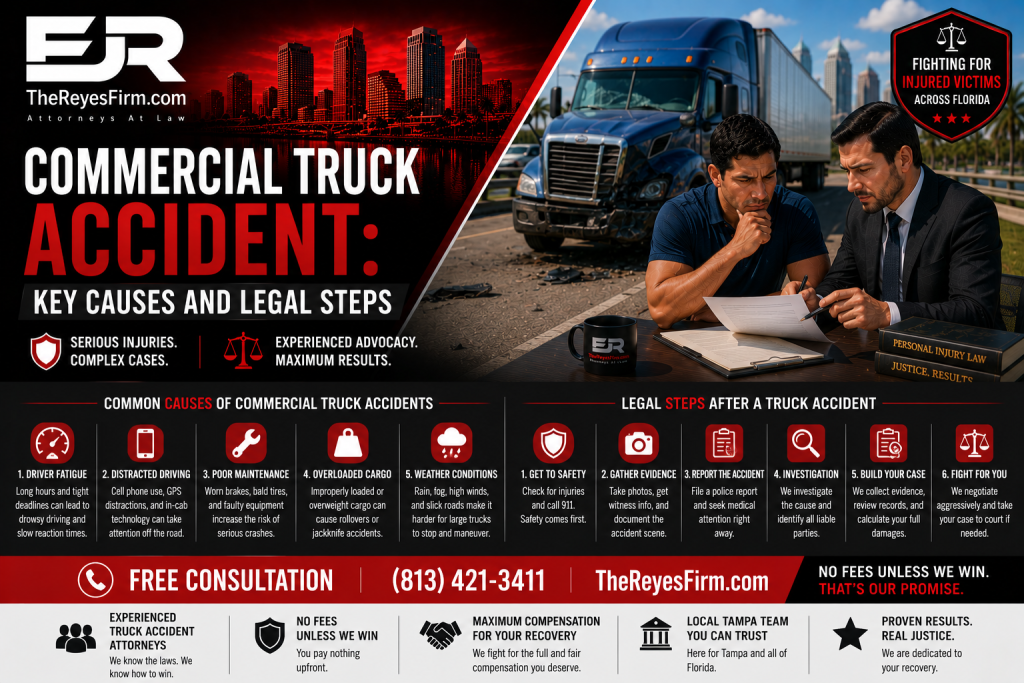
Commercial Truck Accident: Key Causes and Legal Steps

One moment traffic was moving normally. The next, a fully loaded commercial truck turned your day into a fight for your health and your future. Between severe injuries, mounting bills, and a trucking company’s insurer already building its defense, the steps you take now matter. Here is what is really behind these crashes and what to do next. The Reyes Firm Hit by a Commercial Truck in Tampa? Get clear next steps against the trucking company and its insurer. Had a bad day? Contact Us Now 46,651 Florida CMV crashes in 2024 FLHSMV By the Numbers 2024 2 Years Florida statute of limitations Fla. Stat. § 95.11(3)(a) $750K+ FMCSA min. liability coverage 49 C.F.R. § 387.9 315 CMV fatalities in Florida, 2024 FLHSMV By the Numbers 2024 Commercial trucks keep Florida’s economy moving, but their size makes them dangerous when something goes wrong. The category covers semi-trucks and tractor-trailers, tanker trucks hauling liquids or gas, dump trucks loaded with heavy material, and refrigerated trucks. When any of these collides with a passenger vehicle, the people in the smaller vehicle almost always bear the worst of it. Understanding the causes, the liability, and the legal steps puts you in a far stronger position. Can you sue a trucking company after a commercial truck accident in Tampa? Yes, if a truck driver or trucking company’s negligence caused your crash, Florida law allows you to pursue compensation for your injuries. These cases are rarely as simple as a standard car accident claim, because responsibility can extend beyond the driver to the company and other businesses behind the truck. They also involve federal trucking regulations, large commercial insurance policies, and evidence the trucking company controls. That is why the steps you take in the first days after a crash, and the lawyer you choose, can shape the entire outcome of your case. ⚠️ Deadline Warning: Under Florida Statute § 95.11(3)(a), you generally have two years from the date of your crash to file a personal injury lawsuit. Missing this deadline almost always means losing your right to recover anything. Don’t wait to call a lawyer. What are the most common causes of commercial truck accidents? Most commercial truck crashes trace back to preventable failures by the driver or the trucking company. Identifying the cause matters legally, because it often points directly to who is responsible. The most common causes include: Driver fatigue. Long hours and tight delivery schedules push drivers past safe limits, slowing reaction time and impairing judgment. Federal hours-of-service rules exist to prevent this, but violations are common. Speeding. Driving too fast for conditions, or passing unsafely, leaves a driver unable to react in time and lengthens an already long stopping distance. Distracted driving. Texting, phone use, eating, and other distractions pull a driver’s attention off the road at highway speed. Mechanical failures. Worn brakes, tire blowouts, and engine problems can cause a driver to lose control, often the result of skipped maintenance. Adverse weather. Florida’s sudden rain, fog, and high winds make trucks harder to control, and a driver who fails to slow down sharply raises the risk. 💡 Did You Know? According to FLHSMV’s 2024 “By the Numbers” report, Florida recorded 46,651 commercial motor vehicle crashes in 2024, resulting in 315 fatalities. That is nearly 128 CMV crashes every single day across Florida’s roads. Source: FLHSMV By the Numbers 2024, flhsmv.gov. Note: 2024 crash numbers are preliminary. Why are commercial truck accidents so much more severe than car crashes? The damage comes down to physics. A loaded commercial truck can weigh many times more than a passenger car, so the force it transfers in a collision is enormous, frequently crushing or pushing the smaller vehicle off the road. Trucks also have a high center of gravity that makes them prone to rollovers, which can cause catastrophic injuries. Several features of large trucks make them especially dangerous, and knowing them helps you share the road more safely: Large blind spots. Trucks have wide blind zones on all sides, so avoid lingering directly in front of, behind, or beside one where the driver cannot see you. Long braking distance. A loaded truck needs far more room to stop, so never cut in front of one or tailgate it. Overloading. Trucks carrying too much weight, or poorly secured cargo, are harder to control and more likely to roll or jackknife. Who is liable for a commercial truck accident in Florida? Liability in a commercial truck crash often extends well beyond the driver. Because federal regulations and commercial contracts govern how these trucks operate, several parties may share responsibility for your injuries, including: The truck driver, for negligent driving, fatigue, distraction, or hours-of-service violations The trucking company, for poor hiring, inadequate training or supervision, unrealistic schedules, or neglected maintenance A maintenance provider, for failing to inspect or repair brakes, tires, or other critical systems A cargo loading company, when overloaded or improperly secured freight contributed to the crash A parts manufacturer, if a defective component such as a brake or tire failed Commercial trucks must carry federally mandated insurance, often $750,000 or more under FMCSA rules (49 C.F.R. § 387.9), far above a typical car policy. Identifying every responsible party is one of the most important parts of building a full claim, especially in the most serious crashes that lead to a wrongful death or a traumatic brain injury. 🛡️ Your Rights Under Florida Law: Under Florida Statute § 768.81, your compensation is reduced by your share of fault, and you may be barred from recovery if you are found greater than 50% responsible for your own harm. An experienced Tampa truck accident lawyer works to protect the facts, challenge unfair blame, and keep your percentage of fault as low as the evidence allows. Why do commercial truck accident cases move faster than you think? The most important evidence in a truck accident case can disappear within days of the crash. Trucking companies are not required to preserve everything indefinitely, and routine business

Truck accidents
After an Accident, FAQ, Legal, personal injury attorney, Settlement, Truck Accidents, Why we serve

Average Cost of a Truck Accident Settlement: What to Expect

Truck accidents can lead to devastating consequences, both physically and financially. Understanding the average cost of a truck accident settlement is crucial for accident victims seeking compensation for their injuries and losses. This article delves into the various aspects of truck accident settlements, including the average costs, factors influencing these amounts, and what to expect throughout the claims process. What is the Average Cost of a Truck Accident Settlement? Understanding Truck Accident Settlement Amounts The average cost of a truck accident settlement can vary significantly based on numerous factors. Typically, these settlements encompass compensation for medical bills, lost wages, pain and suffering, and other damages incurred due to the accident. In general, the average truck accident settlement can range from tens of thousands to millions of dollars, depending on the severity of the injuries, the extent of property damage, and the specifics of each case. It’s essential to note that the complexity of truck accident cases often leads to higher settlement amounts than other vehicular accidents. Factors Influencing Average Truck Accident Settlement Typical Costs Associated with Truck Accidents The costs associated with truck accidents can be extensive and multifaceted. Typical expenses include: Immediate medical bills. Rehabilitation costs. Lost income due to time off work. Long-term care for chronic conditions resulting from the accident. Furthermore, accident victims may incur indirect costs such as transportation for medical appointments and modifications to their living environments to accommodate disabilities. Understanding these costs is essential for accurately estimating the average price of a truck accident settlement and ensuring comprehensive compensation for all damages incurred. What are the Average Costs of a Commercial Truck Accident? Breakdown of Costs in Commercial Truck Accident Cases The average costs in commercial truck accident cases are substantial. These accidents often involve larger vehicles, which can cause more significant damage and injuries. The breakdown of costs typically includes medical expenses, property damage, legal fees, and potential punitive damages if negligence is proven. The average price of a commercial truck accident settlement may be higher than a standard vehicle accident due to the complexities involved, including multiple parties such as the driver, trucking companies, and sometimes even truck parts manufacturers. Comparing Semi-Truck Accident Costs with Other Vehicles When comparing semi-truck accident costs with those of other vehicles, it becomes evident that truck accidents often result in higher settlement amounts. This disparity arises from the sheer size and weight of commercial trucks, which can lead to more severe injuries and fatalities. For instance, while the average settlement for a car accident might range from a few thousand to several hundred thousand dollars, an average semi-truck accident settlement can easily exceed these figures, often reaching the millions, particularly in cases involving significant injuries or wrongful death claims. Medical Bills and Other Expenses in Commercial Truck Accidents Medical bills are a primary concern for victims of commercial truck accidents. The costs can accumulate quickly, encompassing emergency room visits, surgeries, physical therapy, and ongoing treatment for lasting injuries. Additionally, accident victims may face other expenses, such as psychological counseling for trauma related to the accident. These medical expenses are critical in determining the average cost of a commercial truck accident settlement, as they directly impact the financial burden on the victim and their family. How Much is the Average Truck Accident Settlement? Average Settlement Figures for Truck Accident Claims Various factors, including the specifics of the accident and the injuries involved, influence the average settlement figures for truck accident claims. While an average truck accident settlement can range from $20,000 to over $1 million, many factors contribute to the final amount. For instance, cases involving severe injuries, long-term disabilities, or fatalities tend to result in higher settlements. Understanding these averages can help victims set realistic expectations as they navigate the complexities of their truck accident claim. Impact of Negligence on Settlement Amounts The impact of negligence on settlement amounts cannot be overstated. If a truck driver is operating under the influence, speeding, or violating safety regulations, this negligence significantly affects the settlement. It often leads to higher compensation for the victim due to the clear liability established against the negligent party. In contrast, if the accident is determined to involve shared fault, the settlement may be adjusted accordingly, emphasizing the importance of thorough investigations in truck accident cases. Variations in Settlement Amounts Based on Accident Cases It’s essential to recognize that each truck accident case is unique, leading to variations in settlement amounts. Factors such as the jurisdiction of the accident, the insurance policies in place, and the willingness of the involved parties to negotiate all play significant roles in determining the final settlement. Moreover, mitigating circumstances, such as weather conditions during the accident, can influence the outcome. Understanding these variations helps victims approach their claims with a realistic perspective. What Should I Expect in a Truck Accident Case? Steps Involved in a Truck Accident Claim Process The truck accident claim process typically involves several key steps. Initially, the accident victim must gather evidence related to the accident, including police reports, medical records, and witness statements. Following this, consulting with a truck accident attorney specializing in personal injury claims is advisable. The attorney will assist in evaluating the case, negotiating with insurance companies, and filing necessary legal documents. Ultimately, the goal is a fair settlement compensating the victim for their losses. Role of a Truck Accident Attorney in Your Case A truck accident attorney plays a crucial role in navigating the complexities of a truck accident case. Their expertise in personal injury law allows them to advocate for the victim’s rights and interests effectively. This includes negotiating with insurance adjusters, preparing legal arguments, and representing the victim in court if necessary. A skilled truck accident lawyer can significantly enhance the chances of securing a favorable settlement, ensuring that all aspects of the victim’s suffering are accounted for in the final compensation. Possible Outcomes of a Truck Accident Settlement Possible outcomes of a truck accident settlement can range from total compensation for all damages to partial

Maximizing your car accident settlement
Blog, Car accident, FAQ, Legal, personal injury attorney, Settlement, Why we serve

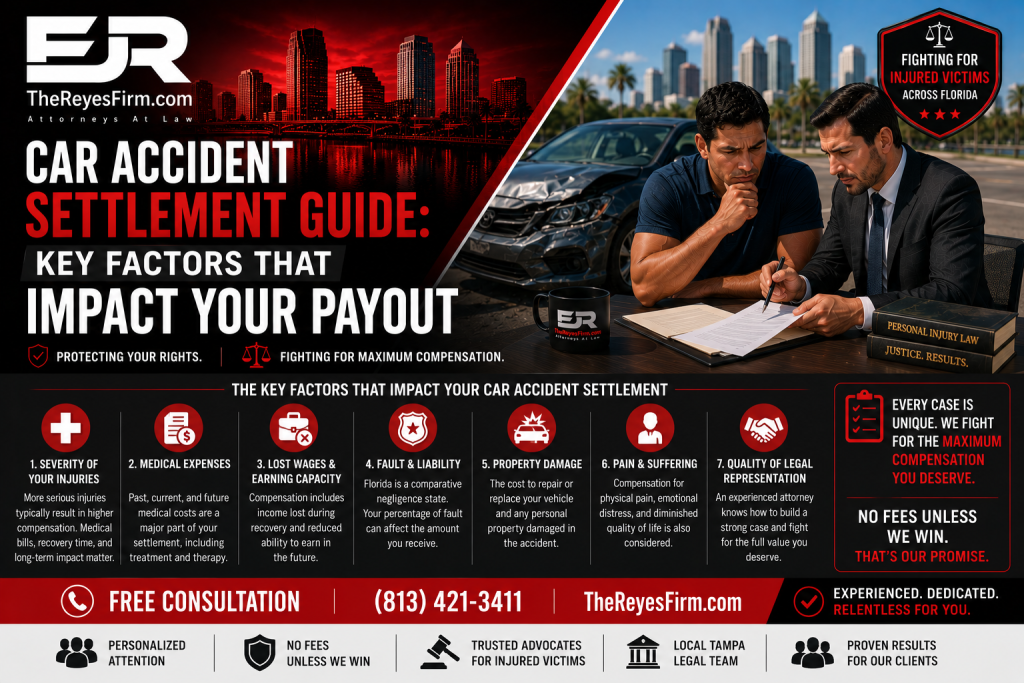
Car Accident Settlement Guide: Key Factors That Impact Your Payout

You were just driving through Tampa when someone else’s mistake left you injured and facing a pile of bills. Now an insurance adjuster has put a number in front of you after your car accident, and it feels like a lifeline. Before you accept it, here is what actually drives the value of a settlement in Florida and why that first offer is rarely what your claim is worth. The Reyes Firm Offered a Settlement After a Tampa Car Accident? Find out what your claim is really worth before you sign. Had a bad day? Contact Us Now 2 Years Florida statute of limitations Fla. Stat. § 95.11(3)(a) 50% Fault share that bars recovery Fla. Stat. § 768.81 $10,000 Florida minimum PIP coverage Fla. Stat. § 627.736 14 Days Deadline to seek care for PIP Fla. Stat. § 627.736(1)(a) A car accident settlement is rarely a random number, and it is rarely the figure an insurer offers first. Understanding what shapes your payout, from your injuries to Florida’s fault and insurance rules, puts you in a far stronger position to recover what you actually deserve. Here is how it works. How much is a car accident settlement worth in Tampa, Florida? There is no fixed dollar figure, because every settlement reflects the specific harm a crash caused. A claim involving a permanent injury and years of future treatment is worth far more than one involving a minor injury that fully heals. The strength of your evidence, the available insurance coverage, and your share of fault all factor in alongside the injuries themselves. Because so much depends on details that are easy to undervalue, the steps you take early and the lawyer you choose can significantly change the outcome. ⚠️ Deadline Warning: Under Florida Statute § 95.11(3)(a), you generally have two years from the date of your crash to file a personal injury lawsuit. This deadline was shortened from four years in March 2023, so older guides may be out of date. Missing it almost always means losing your right to recover anything. What is a car accident settlement, and what does it cover? A car accident settlement is an agreement to resolve your claim without a trial, where you receive compensation in exchange for releasing your right to pursue further legal action. Most settlements are reached out of court through direct negotiation between you, your attorney, and the insurance company. In some cases, a settlement comes through court-supervised mediation or arbitration. A settlement can compensate you for several types of losses, including: Medical bills, covering current and future treatment, surgery, medication, and physical therapy Lost wages, for the income you missed while unable to work, plus reduced future earning capacity Property damage, to repair or replace your vehicle and other damaged property Pain and suffering, for the physical pain and emotional toll the crash caused Loss of consortium, when the injury harms your relationship with your spouse or partner What factors affect the size of your car accident settlement? Several specific factors determine what your claim is worth, and overlooking any of them can cost you. The most significant include the severity of your injuries, the total of your medical expenses, your lost income, and the extent of property damage. The more serious and lasting the injury, the higher the settlement tends to be. Permanent or catastrophic injuries carry the highest value because they require lifelong care. A serious spinal cord injury or a claim that rises to the level of a catastrophic injury often involves future surgeries, therapy, and assistive care. In these cases, a life care plan can project those long-term costs so your settlement reflects what you will truly need, not just the bills you have already received. 💡 Did You Know? Florida’s PIP law requires you to seek initial medical care within 14 days of your car accident. Waiting longer can cost you your Personal Injury Protection benefits and can also weaken your settlement, because a gap in treatment gives insurers a reason to argue your injuries were not serious. Source: Fla. Stat. § 627.736(1)(a). How does Florida’s comparative negligence rule affect your payout? Your share of fault can reduce your settlement, and in some cases eliminate it. As of March 24, 2023, Florida shifted from a pure comparative negligence system to a modified comparative negligence system under Florida Statute § 768.81. Under the current rule, your compensation is reduced in proportion to your percentage of fault, and you are barred from recovering anything if you are found more than 50% responsible. This is exactly why insurers work so hard to shift blame onto you. Even a modest increase in your assigned fault can shrink your payout, which makes protecting the facts of your case a critical part of any settlement. 🛡️ Your Rights Under Florida Law: Under Fla. Stat. § 768.81, your compensation is reduced by your share of fault, and you may be barred from recovery if you are found greater than 50% responsible for your own harm. An experienced Tampa car accident lawyer works to protect the facts, challenge unfair blame, and keep your percentage of fault as low as the evidence allows. How does Florida’s low insurance minimum affect your settlement? The available insurance coverage sets a practical ceiling on many settlements, and Florida’s required minimums are surprisingly low. State law requires only $10,000 in Personal Injury Protection under Florida Statute § 627.736 and $10,000 in property damage liability. Importantly, Florida does not require most drivers to carry bodily injury liability coverage at all. That gap matters when the at-fault driver has little or no coverage. In those situations, your own uninsured or underinsured motorist coverage may become the primary source of compensation for your injuries. Identifying every applicable policy, including your own, is one of the most important steps in pursuing a full settlement. Watch: How Car Accident Settlements Work in Tampa If you prefer to hear it explained, the short video below walks through what shapes a car accident

Lutz Car Accident Lawyers Infographic
Legal, Settlement

Odessa Car Accident Lawyers and Personal Injury Law Firm

Odessa is Old Florida at the edge of a growing region: horse farms, spring-fed lakes, and quiet two-lane roads on the Hillsborough side, and fast-rising master-planned communities pushing north into Pasco. That mix of rural roads and rapid growth creates its own accident risks. When a crash on Gunn Highway, State Road 54, or the Suncoast Parkway leaves you hurt, you need a firm that understands both the local roads and Florida law. The Reyes Firm helps injured drivers throughout Odessa with their car accident claims. The Reyes Firm Injured in an Odessa Car Accident? Get a free case review from a local Tampa firm. Had a bad day? Contact Us Now 2 Years Deadline to file your injury claim Fla. Stat. § 95.11(5)(a) 2 Counties Odessa spans Hillsborough and Pasco Where you crashed matters 14 Days To seek care for full PIP benefits Fla. Stat. § 627.736 No Fee Unless we recover for you Contingency basis Part of Odessa’s appeal is how peaceful it is, with lakefront homes, equestrian estates, and stretches of open land that still feel like the countryside. But the same rural roads that give the area its charm can be dangerous, and the rapid development along the State Road 54 corridor has brought more traffic, more construction, and more risk. When a serious crash happens here, the consequences can be severe, and knowing your rights is the first step toward recovery. Why do car accidents happen in Odessa? Odessa’s road network is a mix of quiet rural routes and fast-moving highways, and each brings its own dangers. Two-lane roads like Gunn Highway and Van Dyke Road wind through semi-rural areas around Keystone and the lakes, often with higher speeds, limited lighting, and little room for error. On roads like these, a single distracted or speeding driver can cause a head-on or run-off-road crash with devastating results. At the same time, the area’s main corridors carry heavy traffic. State Road 54 has grown into a busy, rapidly developing route lined with new communities and constant construction, while the Suncoast Parkway, a high-speed toll expressway, moves drivers quickly south toward Tampa and north into Pasco. Common crashes in the Odessa area include rear-end collisions in growing-corridor traffic, high-speed highway wrecks, intersection accidents, and single-vehicle crashes on dark rural roads. What should you do after a car accident in Odessa? What you do in the minutes and days after a crash can shape your entire claim. Call 911 to report the accident and get medical help on the way, and make sure an official crash report is created, which matters even more on rural roads where there may be fewer witnesses. Get evaluated by a medical professional promptly even if you feel only mildly hurt, since some injuries take days to appear. If you are able, photograph the scene, exchange information with the other driver, and gather the names of any witnesses. In the days that follow, be careful with insurers. Notify your own insurance company as your policy requires, but be cautious about the other driver’s insurer. You are generally not required to give the at-fault driver’s insurance company a recorded statement, and it is wise to talk with a lawyer before doing so. 💡 Did You Know? Florida is a no-fault state, so your own Personal Injury Protection coverage under Florida Statute § 627.736 pays a portion of your medical bills and lost wages after a crash regardless of who was at fault. But you generally must seek medical care within 14 days of the accident to qualify for these benefits, so prompt treatment matters. How does Florida law affect your Odessa car accident claim? Several Florida rules govern every car accident claim in Odessa. The first is the filing deadline. Under Florida Statute § 95.11(5)(a), you generally have two years from the date of the crash to file a personal injury lawsuit, a deadline shortened from four years in March 2023. If you miss it, you can lose your right to recover entirely. The second is the no-fault system. Your PIP coverage handles your initial medical costs, but to step outside no-fault and hold the at-fault driver responsible for pain and suffering, your injury generally must meet a serious-injury threshold under Florida Statute § 627.737(2), such as a permanent injury. The third is how fault is measured, which we explain below and which directly affects your recovery. ⚠️ Deadline Warning: Under § 95.11(5)(a), you generally have two years from the date of your Odessa crash to file a lawsuit, reduced from four years in March 2023. On rural roads, key evidence like skid marks, roadside damage, and witness memories can disappear quickly, so contacting a lawyer early can make a real difference. Which county will handle your Odessa accident case? Odessa is genuinely split between two counties, and the difference is more than a line on a map. The northwest Hillsborough County side is the rural, established part, with horse farms, lakes, and older neighborhoods, while the southern Pasco County side is rapidly growing with new master-planned communities like Starkey Ranch. Because of this split, the exact location of your crash can determine which county’s court hears your case, affecting where a lawsuit is filed and how it proceeds. What this means for you is straightforward: you want a firm that handles injury claims in both counties without missing a beat. The Reyes Firm represents clients throughout Hillsborough County and Pasco County, so wherever in the Odessa area your accident happened, we can pursue your claim in the right court. 🛡️ Your Rights Under Florida Law: Under Florida Statute § 768.81, Florida uses comparative negligence, so your compensation is reduced by your percentage of fault. If you are found more than 50 percent at fault, you generally cannot recover from the other party, which is why building strong evidence of what happened is so important. What types of injury cases does The Reyes Firm handle near Odessa? Car accidents are among the most common

Uber accident claim timeline in Florida
Injury, Settlement

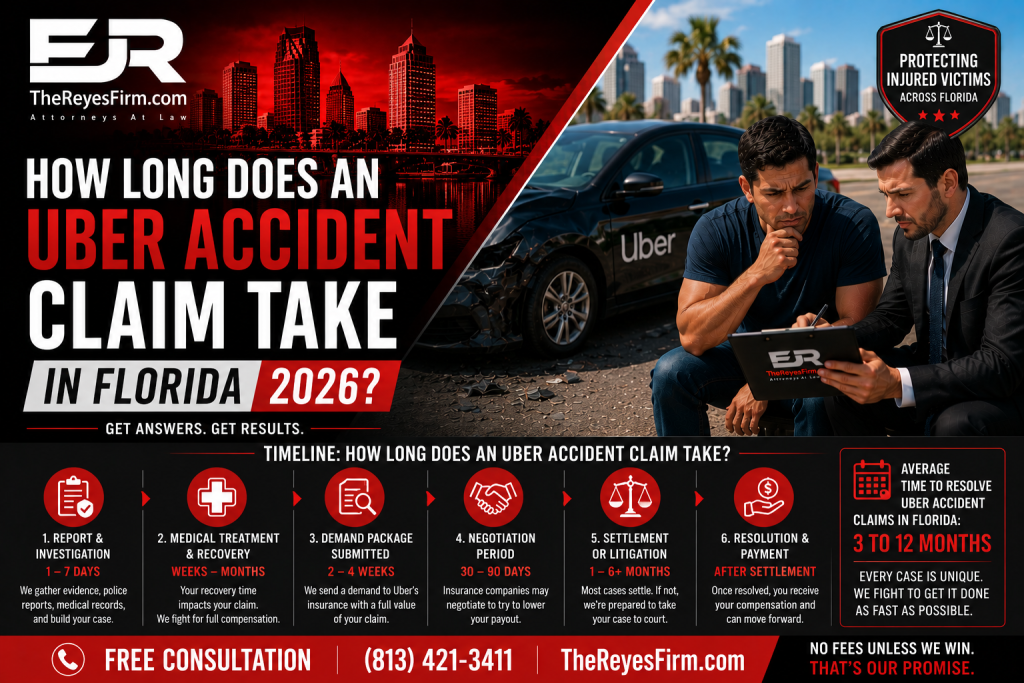
How Long Does an Uber Accident Claim Take in Florida 2026?

You were hurt in an Uber or Lyft crash, you’ve filed your claim, and now you’re stuck on the question nobody seems to answer straight: how long is this going to take? The honest version is more useful than the hopeful one, so here is how a Florida rideshare claim actually moves from the crash to a check. The Reyes Firm Waiting on an Uber or Lyft Claim in Tampa? Find out where your case stands and what’s slowing it down. Had a bad day? Contact Us Now 2 Years Deadline to file your lawsuit Fla. Stat. 95.11(3)(a) $10K PIP paid fast, no fault needed Fla. Stat. 627.736 $1M Coverage that can extend talks Fla. Stat. 627.748 3 Periods App statuses that set coverage Fla. Stat. 627.748 How long does an Uber or Lyft accident claim take in Florida? It depends on the severity of your injuries and whether fault and coverage are disputed, but a useful range helps. A clear-fault case with a full recovery can often settle within a few months of you finishing treatment. A serious-injury case, or one where the insurers fight over liability, commonly takes a year or longer, and cases that go into litigation can run longer still. The timeline is driven by the facts, not by a calendar. The single biggest factor is your own medical recovery. A claim should generally not settle until you reach maximum medical improvement, the point where doctors can say what your long-term condition and future care will look like. Settling before then risks accepting a number that doesn’t account for surgery you still need or income you’ll keep losing. In that sense, a longer timeline is sometimes the price of a fair result rather than a sign something is wrong. ⚠️ Deadline Warning: Under Florida Statute § 95.11(3)(a), you have two years from the date of your crash to file a personal injury lawsuit. That clock keeps running while you negotiate, so a stalling insurer can quietly push you toward the deadline. Don’t let the timeline run out before you act. What are the stages of an Uber accident claim? Most rideshare claims move through the same identifiable stages, and knowing where you are helps you see what’s left. The process generally looks like this. Medical treatment and PIP. You treat your injuries, and your own Personal Injury Protection pays the first portion of bills regardless of fault. This stage continues until you near maximum medical improvement. Investigation and evidence gathering. Your lawyer pins down which app period was active, secures trip and app data, the police report, witness statements, and your medical records. The demand. Once your damages are known, your attorney sends a demand package to the responsible insurer laying out liability and the full value of your claim. Negotiation. The insurer responds, usually low at first, and a period of back-and-forth follows. Many cases resolve here. Filing a lawsuit, if needed. If the insurer won’t be reasonable, your lawyer files suit, which opens discovery, depositions, and often mediation. Many cases still settle during this phase. Settlement or trial. The case resolves by agreement or, in a minority of cases, proceeds to a verdict. 💡 Did You Know? Under Florida Statute § 627.748, a rideshare crash falls into one of three coverage periods based on the driver’s app status, and the higher $1 million policy only applies once a ride is accepted. Disputes over which period was active are a common reason a claim takes longer. Source: Florida Statutes, leg.state.fl.us. Watch: What does the Uber accident claim process look like? This short overview walks through the stages of a rideshare injury claim and what tends to slow them down. If you’re unsure which stage your case is in, that’s a question The Reyes Firm answers for free at 833-4 BAD DAY. What makes a rideshare claim take longer? A few specific things stretch the timeline, and most of them are about complexity rather than your case being weak. The more of these that apply, the longer you should expect the process to run. Serious injuries take longer because the case has to wait on maximum medical improvement and often on future-care and earning estimates, including lost earning capacity. Disputed fault adds time because liability has to be proven before value is even discussed. Arguments over which app period was active can pull in multiple insurers, each with its own process. Medical liens and health-insurer reimbursement claims have to be sorted before disbursement. And an insurer that simply refuses to negotiate fairly forces the case into litigation, which is slower by design. None of this is unusual, and an ordinary car accident can hit the same snags. The difference with rideshare is the layered coverage. 🛡️ Your Rights Under Florida Law: Under Florida Statute § 768.81, your compensation is reduced by your share of fault, and you may be barred from recovery if you are found greater than 50% responsible for your own harm. Disputed fault can lengthen a claim, but a Tampa rideshare lawyer works to protect the facts and keep your percentage of fault as low as the evidence allows. How does the timeline affect what you can recover? The two are tied together. Settling quickly can feel good, but a rushed settlement often locks in a number before your full damages are known, which is why patience through maximum medical improvement usually protects your recovery. The slower track exists to make sure property damage, medical bills, lost income, pain and suffering, and any future losses are all on the table. For the full breakdown of the categories you can claim and how the rideshare coverage limits factor in, see our guide on how much an Uber or Lyft accident claim is worth. The short version is that a well-documented claim, given the time it needs, almost always ends up worth more than a fast one. What are the 5 steps to keep your Uber accident claim moving? You can’t control the insurer,

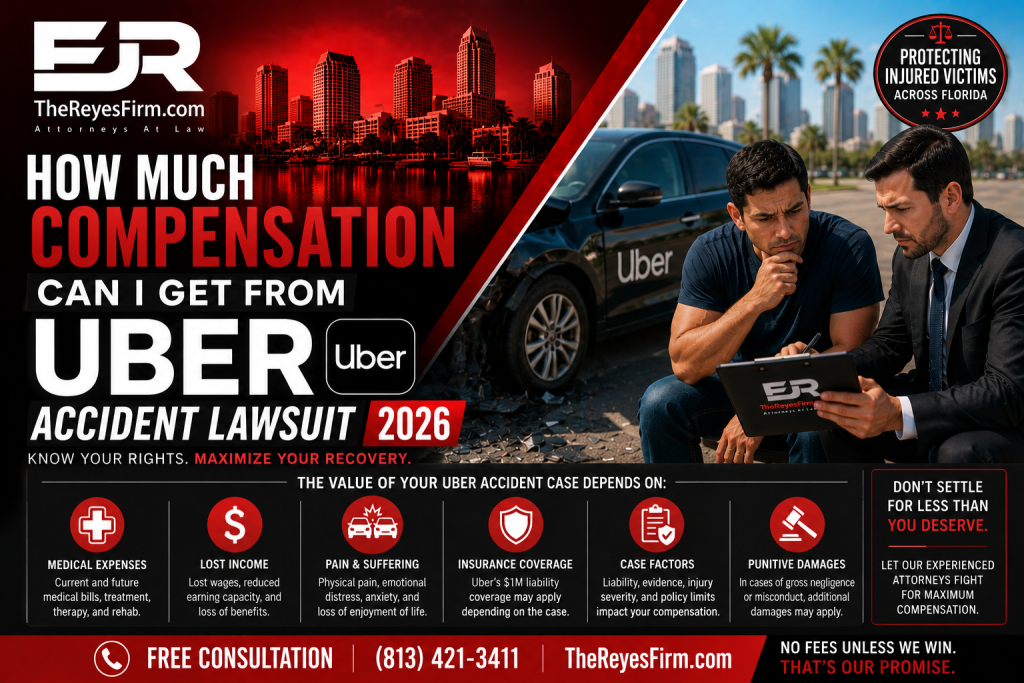
Maximize your Uber accident compensation
Legal, Settlement

How Much Compensation Can I Get from Uber Accident Lawsuit 2026

You climbed into an Uber or Lyft expecting a simple ride home. Then the crash happened, and now you’re hurt, staring at medical bills, and wondering who is even responsible when the car wasn’t yours and the driver works for an app. Before you accept any number an insurer floats, here’s how Florida rideshare compensation actually works. The Reyes Firm Hurt in an Uber or Lyft Crash in Tampa? Find out what your rideshare claim is really worth. Had a bad day? Contact Us Now $1M Uber/Lyft coverage during a ride Fla. Stat. 627.748 $10K Florida PIP that follows you Fla. Stat. 627.736 50/100/25 Min. liability, app on, no ride yet Fla. Stat. 627.748 2 Years Florida injury filing deadline Fla. Stat. 95.11(3)(a) How much compensation can you get from an Uber or Lyft accident in Florida? There is no single dollar figure, because every rideshare case turns on the severity of your injuries, who caused the crash, and which insurance policy was in force at that moment. A minor injury handled through Personal Injury Protection may resolve at the $10,000 PIP level, while a serious injury during an active ride can reach into Uber’s or Lyft’s $1 million coverage. The honest answer is that your case is worth what the facts and the available coverage support, which is exactly what a lawyer helps you establish. What makes rideshare cases different from an ordinary car accident is the layered insurance and the multiple parties involved. There may be the rideshare driver, another at-fault motorist, the rideshare company’s policy, your own PIP, and uninsured motorist coverage, all interacting. Sorting out which one pays, and in what order, is where the real value of your claim is won or lost. ⚠️ Deadline Warning: Under Florida Statute § 95.11(3)(a), you have two years from the date of your crash to file a personal injury lawsuit. Rideshare trip records, app data, and dashcam footage can be lost quickly, so the sooner you act, the more evidence survives. Don’t wait to call a lawyer. Whose insurance pays after a rideshare crash? The answer depends almost entirely on what the driver was doing on the app when the crash happened. Florida’s rideshare law, Florida Statute § 627.748, was created by House Bill 221 in 2017 and sets a tiered insurance system for Transportation Network Companies like Uber and Lyft. There are three periods that matter. When the app is off, only the driver’s personal auto insurance applies. When the app is on but the driver has not yet accepted a ride, the company must carry contingent coverage of at least $50,000 per person and $100,000 per crash for bodily injury, plus $25,000 for property damage. Once the driver accepts a ride and through the moment the passenger is dropped off, the company must carry at least $1 million in primary liability coverage. One important catch many drivers never realize is that most personal auto policies exclude rideshare, or “livery,” use, so during active work periods the rideshare company’s policy is often the real source of coverage. 💡 Did You Know? Under Fla. Stat. § 627.748, from the moment your Uber or Lyft driver accepts the ride until you are dropped off, the company must carry at least $1 million in primary liability coverage. Even better, under Florida Statute § 627.736, your own PIP follows you as a passenger and pays the first $10,000 regardless of who was at fault. Source: Florida Statutes, leg.state.fl.us. Watch: How are Uber and Lyft accident claims paid in Florida? This short overview explains the three coverage periods and what they mean for your payout. If your situation doesn’t fit neatly into one period, that’s normal, and it’s exactly the kind of question The Reyes Firm answers for free at 833-4 BAD DAY. What types of compensation can you recover after an Uber accident? A complete rideshare claim is built from several categories of damages, not one lump number. Depending on your case, you may be entitled to recover the following. Property damage, covering repair or replacement of your vehicle and any personal property damaged in the crash. Medical bills, covering emergency care, hospital stays, surgery, imaging, rehabilitation, and future treatment your injuries will require. Keep every bill and record. Lost income, covering the wages you missed during recovery and, in serious cases, your reduced ability to earn going forward. Where an injury changes your career, lost earning capacity can become a major part of the claim. Pain and suffering, covering the physical pain, emotional distress, and life disruption the crash caused, weighed by the severity and length of your recovery. Wrongful death damages, available to surviving family members under Florida’s Wrongful Death Act (Fla. Stat. § 768.21) when a rideshare crash takes a loved one. The Reyes Firm also handles these as wrongful death cases. Does not wearing a seatbelt reduce your settlement in Florida? It can. Florida recognizes the “seatbelt defense,” which means an insurer or defense lawyer may argue that your failure to wear an available, working seatbelt contributed to your injuries. If they succeed, it can reduce the amount you recover. This ties directly into Florida’s comparative fault system, where your own share of responsibility lowers your payout. That does not mean an unbelted passenger gets nothing. It means the defense will try to shift blame onto you, and a skilled rideshare attorney pushes back, separating which injuries were actually caused by the crash itself versus what the defense claims. How that argument is handled can swing the value of your case significantly. 🛡️ Your Rights Under Florida Law: Under Florida Statute § 768.81, your compensation is reduced by your share of fault, and you may be barred from recovery if you are found greater than 50% responsible for your own harm. An experienced Tampa rideshare accident lawyer works to protect the facts, challenge unfair blame, and keep your percentage of fault as low as the evidence allows. What are the 6 steps to take after an

Deleted posts and the truth found
Car accident, Legal, Settlement

Are Deleted Social Media Posts Retrievable in Injury Cases?

You posted something after your car accident, a photo, a status, a quick “I’m fine” to reassure family, and now you’re wondering if you should delete it. Stop before you do. In a Florida injury case, deleting the wrong post can hurt you far more than leaving it up. Here’s what’s really retrievable, and what to do instead. TL;DR — QUICK SUMMARY Deleted social media content is often not truly gone. It can survive in data archives, screenshots, tagged posts, and platform records. Relevant social media is discoverable in a Florida injury case, and privacy settings do not shield it (Nucci v. Target Corp.). Deleting posts after you have a claim can be spoliation of evidence, which carries serious penalties, sometimes worse than the post itself. Insurance companies actively monitor your accounts, and your friends’ and family’s, for anything that contradicts your injuries. The safe move is simple: don’t delete anything, stop posting, and talk to your lawyer before touching your accounts. The Reyes Firm Worried a Post Could Sink Your Claim? Get your case reviewed before you touch your social media. Had a bad day? Contact Us Now Nucci 2015 Set the social media rule Fla. 4th DCA Discoverable Relevant posts, even if private Fla. R. Civ. P. 1.280 Spoliation Risk of deleting after a claim Sanctions / adverse inference $0 Upfront cost on contingency Pay nothing unless you recover Are deleted social media posts really retrievable? Often, yes. Hitting delete removes a post from your timeline, but it doesn’t guarantee the content is gone. Platforms keep data behind the scenes, and the “download your data” archive feature can surface content you thought you erased. Beyond that, anyone who saw the post, including an insurance investigator, may have already screenshotted it, and friends or family may have shared or been tagged in the same content. There’s also the legal route. In a lawsuit, the other side can subpoena the platform or compel you to produce your account data, including deleted material. So the honest answer is that deleting is unreliable as a way to hide something, and as you’ll see, it’s also one of the most dangerous things you can do. Can the other side see my social media if I file an injury claim? Yes, to the extent it’s relevant to your case. When you file a personal injury claim, you put your physical and mental condition at issue, and that opens the door to discovery of social media that bears on it. Florida’s leading case, Nucci v. Target Corp., made this clear: photographs and posts that are relevant to an injury claim are discoverable, and your privacy settings do not protect them. The court treated social media as a kind of free surveillance, valuable to anyone defending a claim. That doesn’t mean the other side gets unlimited access to everything. Discovery still has to be relevant and reasonably tailored. But the takeaway is blunt: marking your account “private” is not a shield. If a post is relevant to your injuries or activities, a court can order you to hand it over. ⚠️ Deadline Warning: The moment you have a potential claim, you have a duty to preserve evidence, including social media. You also generally have two years to file an injury lawsuit under Florida Statute § 95.11(3)(a). Don’t delete anything, and don’t wait to talk to a lawyer about both. Watch: How social media can affect your injury claim This short video explains how posts, photos, and even deleted content can shape what your case is worth. Not sure whether something you posted is a problem? The Reyes Firm offers a free case review. Why is deleting posts the worst thing you can do? Because deleting can turn a minor problem into a major one. Once you reasonably anticipate a claim or a lawsuit, the law expects you to preserve relevant evidence. Destroying it, including scrubbing your social media, is called spoliation of evidence. Courts take it seriously, and the penalties can be severe. The most common consequence is an adverse-inference instruction, where the judge tells the jury they may assume the deleted content was unfavorable to you. In other words, you don’t just lose the post, you hand the other side a weapon, and you can also face monetary sanctions. A harmless photo you deleted out of caution can end up looking like a guilty cover-up. That’s why the rule is so important: don’t delete, preserve, and let your lawyer guide what happens next. 💡 Did You Know? Courts have imposed heavy sanctions on people, and even their attorneys, for deleting social media content after litigation became foreseeable. The danger isn’t only that the content resurfaces, it’s that the act of deleting it can be used to argue you were hiding something. Preserving everything and posting nothing new is almost always the safer path. Source: Nucci v. Target Corp., 162 So. 3d 146 (Fla. 4th DCA 2015). How do insurance companies actually use your social media? Aggressively, and from the moment you file. Insurers and their investigators monitor claimants’ accounts looking for anything that contradicts the injuries you’ve described. A photo of you smiling at a barbecue, a check-in at the gym, a vacation post, or a video of you lifting your child can all be twisted into an argument that your pain and limitations are exaggerated. It doesn’t stop at your own profile. They also look at your friends’ and family’s accounts, public posts, and photos you’re tagged in. A single out-of-context image can do real damage, even when the truth is that you pushed through pain for one moment and paid for it for days. Just as your medical records can be used against you, your social media becomes part of the evidence, whether you intended it to or not. 🛡️ Your Rights Under Florida Law: While relevant posts are discoverable, the other side does not automatically get access to your entire account. Under Florida’s rules of civil procedure, discovery must be relevant

Scroll to Top