Settlement

Injured at home Know your rights.
Legal, Personal Injury, personal injury attorney, Real Estate, Settlement

Injured in Your Own Home in Florida? You May Still Have a Claim

You were just at home, the one place you’re supposed to be safe. Then a fall or a hidden hazard changed your day, and now you’re hurt and wondering whether anything can even be done. Here’s the part most people don’t realize: being injured in your own home does not automatically mean no one else is responsible. TL;DR — QUICK SUMMARY You can still have a personal injury claim even if you were hurt inside your own home. It depends on who caused the hazard. Common at-fault parties include a landlord who ignored a known problem, the maker of a defective product, or a contractor whose bad work left a danger behind. Under Florida’s comparative fault law, being partly at fault reduces your recovery, and being more than 50% at fault can bar it entirely (Fla. Stat. § 768.81). Most injury claims must be filed within two years under Fla. Stat. § 95.11(3)(a), and defective-product cases carry their own deadlines. The Reyes Firm reviews how you were hurt for free and works on contingency, so you pay nothing unless the firm recovers for you. The Reyes Firm Hurt in Your Own Home in Tampa? Find out if someone else is responsible for your injury. Had a bad day? Contact Us Now 2 Years Deadline to file most injury claims Fla. Stat. § 95.11(3)(a) 51% Fault bar to recovery Fla. Stat. § 768.81 12 Years Product liability repose limit Fla. Stat. § 95.031(2)(b) $0 Upfront cost on contingency Pay nothing unless you recover Can you really have a claim if you were injured in your own home? Yes, you can, and this surprises a lot of people. The fact that an injury happened inside your own house doesn’t end the question of who’s responsible. It starts it. The real issue is what caused the injury and whether someone else’s negligence played a role. If it did, you may have a valid claim even though you were standing on your own property. Every case turns on its facts. Did you simply lose your footing, or was there a dangerous condition someone else should have fixed? Did a product fail? Did a contractor leave a hazard behind? Those answers decide whether a third party shares the blame. The point is that “it happened at home” is not a reason to assume you’re out of luck, it’s a reason to have a lawyer look at how it happened. ⚠️ Deadline Warning: Under Florida Statute § 95.11(3)(a), you generally have two years from the date of injury to file a personal injury lawsuit. Evidence of a home hazard, like a defective part or an unrepaired condition, can disappear fast. Don’t wait to call a lawyer. Who else can be liable when you’re hurt at home in Florida? More parties than you’d think. When a dangerous condition you didn’t create causes your injury, the person or company responsible for that condition may be on the hook. The most common at-fault parties in home injury cases include: A landlord. If you rent and your landlord failed to fix a known hazard or maintain the property, that failure can make them liable for your injuries. A product manufacturer or seller. If a defective appliance, tool, ladder, or other product malfunctioned and hurt you, the maker, distributor, or retailer may be responsible under Florida product liability law. A contractor or repair company. If someone did work in your home and left behind a danger, like an exposed nail, a faulty install, or unfinished repairs, their negligence can support a claim. A service provider. Delivery workers, utility crews, cleaners, or others who create a hazard in your home can be liable for injuries that result. A serious fall or a malfunctioning product can cause real harm, from broken bones to spinal cord and brain injuries. When that harm traces back to someone else’s negligence, the law gives you a path to hold them accountable. Watch: What happens if you’re injured in your own home? This short video breaks down when an injury at home can still lead to a valid claim and who might be responsible. Still not sure whether your situation qualifies? The Reyes Firm offers a free case review to walk through exactly how you were hurt. What if you rent and your landlord ignored a hazard? If you were injured in a rental because your landlord failed to address a known danger, you may have a strong claim. Landlords in Florida have a duty to keep their properties reasonably safe and to handle repairs they’re responsible for. When a landlord knows about a problem, a broken stair, a faulty railing, a leak that creates a slipping hazard, and does nothing, that inaction can be negligence. This is exactly the situation the law is built for. If you reported an issue, the timeline of your complaints and the landlord’s response, or lack of one, becomes powerful evidence. Save your messages, repair requests, and any photos. They help prove the landlord knew and failed to act. 💡 Did You Know? Your own homeowner’s or renter’s insurance liability coverage is generally designed to protect you if a guest is hurt on your property, not to pay you for injuries you suffer from your own actions. When a third party like a landlord, manufacturer, or contractor is at fault, compensation usually comes from their insurance, which is why identifying the responsible party early matters so much. What if a defective product or a contractor’s bad work caused it? Defective products and negligent repairs are two of the most common reasons people get seriously hurt at home. If a product was unreasonably dangerous because of a design flaw, a manufacturing defect, or a failure to warn, you may be able to pursue the manufacturer, distributor, or retailer, even though the injury happened in your living room. These cases can involve their own filing deadlines and a separate statute of repose under Fla. Stat. § 95.031, so prompt legal review is important.
Know your case, know your value
After A Car Accident, Health, Legal, Migraines, Personal Injury, personal injury attorney, Settlement, Traumatic injury

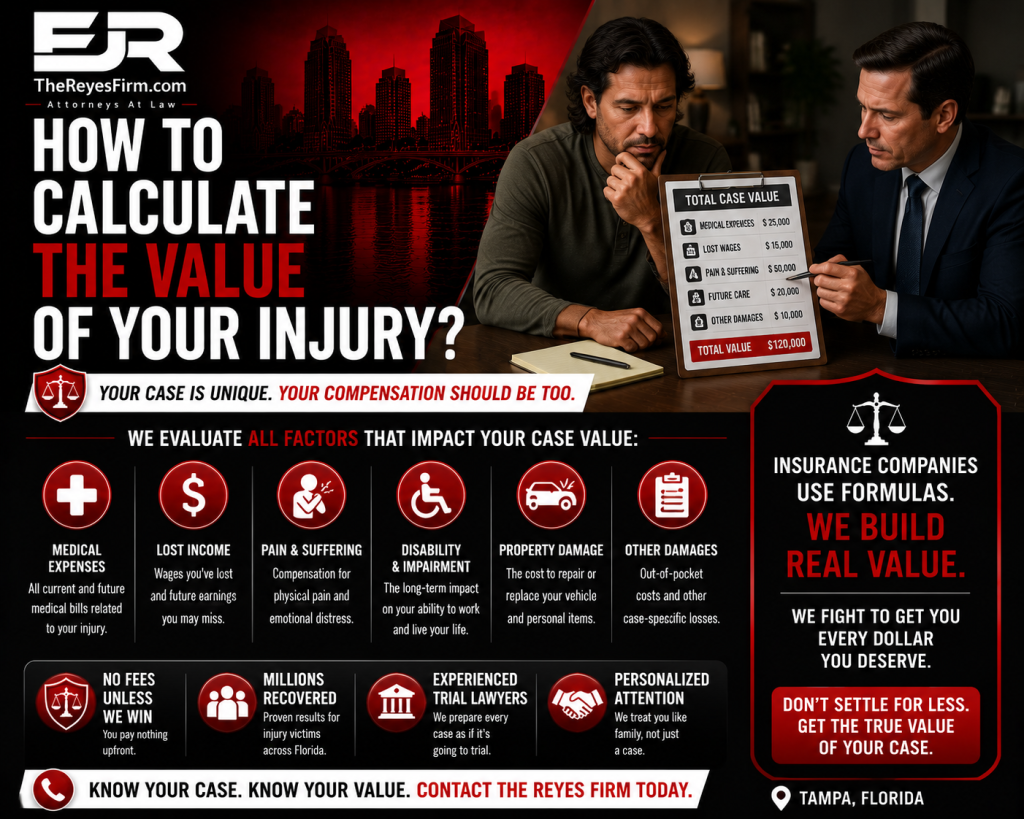
How To Calculate The Value of Your Injury?

After a serious Tampa accident, one question outweighs almost every other: how much is my case actually worth? Put a number too high and the insurer stops taking you seriously. Settle for too little and you are stuck paying for an injury that was never your fault. Here’s how the value of an injury claim is really calculated in Florida, and what quietly raises or lowers that number. TL;DR — QUICK SUMMARY Your claim’s value is the sum of your economic damages and your non-economic damages, then adjusted for your share of fault and the available insurance. Economic damages are documentable losses like medical bills, lost wages, and future care; non-economic damages cover pain, suffering, and lost quality of life. Most insurers start with the multiplier method, adding up your medical bills and multiplying by a number, usually between 1.5 and 5, based on how serious your injury is. In Florida you can only recover pain and suffering from an at-fault driver if your injury meets the permanency threshold under Florida Statute 627.737. Comparative fault and insurance policy limits can shrink what you actually collect, and you have two years to file under Florida Statute 95.11(3)(a). The Reyes Firm Wondering What Your Case Is Worth? Get an honest valuation of your Tampa injury claim. Had a bad day? Contact Us Now 1.5 to 5 Common multiplier applied to your damages Industry standard No Cap On pain and suffering in most FL injury cases Florida law >50% Your fault share that bars recovery Fla. Stat. 768.81 2 Years To file an injury lawsuit Fla. Stat. 95.11(3)(a) How do you calculate the value of a personal injury claim? You calculate the value of an injury claim by adding together two kinds of damages, your economic losses and your non-economic losses, and then adjusting that total for real-world factors like your share of fault and the insurance coverage available. There is no single official formula a court hands you, but insurance companies and experienced attorneys both start from a recognized method and refine it based on the facts of your case. The goal of these damages is to make you whole, meaning to put you back, as much as money can, in the position you would have been in if the injury had never happened. Getting the number right matters in both directions. Aim too high and the insurer assumes you are not serious about settling. Accept too little and you are left covering costs that should have been someone else’s responsibility. What are economic, or special, damages? Economic damages are the losses you can put a receipt to. They include your past and future medical bills, your lost wages, your reduced earning capacity if you cannot work the way you used to, the property damage to your vehicle, and out-of-pocket costs like medication and travel to appointments. In a Florida auto case, your own Personal Injury Protection coverage pays the first portion of these medical bills before you pursue the at-fault party for the rest. The piece people most often undervalue is the future. A catastrophic injury can require surgeries, therapy, and care for years or even a lifetime, and all of that belongs in your claim. Counting only the bills you have already received is one of the fastest ways to settle for far less than your case is worth. What are non-economic, or general, damages? Non-economic damages compensate you for harm that has no invoice: physical pain, mental anguish, the loss of enjoyment of your life, disfigurement, and the strain an injury puts on your relationships. These losses are real, but because they are subjective, they are the hardest part of a claim to value and the part insurers fight the most. In Florida there is an important gate. You can only recover non-economic damages from an at-fault driver if your injury meets the permanency threshold under Florida Statute § 627.737, which generally requires a permanent injury such as a spinal cord injury or a traumatic brain injury. The good news is that Florida does not cap pain and suffering in typical injury cases, so when the threshold is met, the value of these damages is limited by the evidence, not by an arbitrary ceiling. 💡 Did You Know? In a Florida car accident, you cannot recover pain and suffering from the at-fault driver unless your injury meets the permanency threshold in Fla. Stat. § 627.737. When it does, Florida places no cap on non-economic damages in ordinary injury cases, so the value is driven by the strength of your medical evidence. Source: Fla. Stat. § 627.737, leg.state.fl.us. How does the multiplier method work? The multiplier method is the most common starting point for valuing pain and suffering. An adjuster or attorney adds up your economic damages, focusing on your medical bills, and multiplies that total by a number, usually between 1.5 and 5. A minor injury with a full recovery sits near the bottom of that range, while a severe, permanent injury sits near the top, and the result is an estimate of your non-economic damages that gets added to your economic losses. A second approach, the per diem method, assigns a set dollar amount for each day you live with your injury, which works better for shorter-term injuries than for lifelong ones. Both are only starting points. This is also why the free calculators you find online are unreliable, because they cannot weigh permanency, fault, your future prognosis, or the specific facts that move the multiplier up or down. Watch: How injury value is calculated In this short video, attorney Edward Reyes breaks down how the value of an injury claim is calculated and the mistakes that leave money on the table. If you want a clear, honest read on what your case is worth, The Reyes Firm offers free consultations at no cost to you. How do fault and insurance limits change what you actually collect? Two factors can separate what your claim is worth from

Settle your case privately today
Accident Injuries & why, After A Car Accident, Legal, personal injury attorney, Settlement, Why we serve

Can you settle your case privately?

You finally got the call. The car accident case settled, and a check is coming. Now you’re wondering who has to know, and whether anyone can take a piece of it. Here’s the truth about settling your injury case privately in Florida, and the liens that don’t disappear just because the deal is quiet. TL;DR — QUICK SUMMARY Most Florida personal injury cases settle before a lawsuit is ever filed, which means there’s no public court record of the payout. A “private” settlement usually means two things: it’s resolved pre-suit, and the agreement includes a confidentiality clause. Private does not mean untouchable. Liens for medical care, health insurance, Medicare, Medicaid, and even past-due child support can still attach to your settlement. Government liens like Medicare and Medicaid generally must be paid first, and they’re protected by federal and Florida law. Most liens are negotiable. An attorney identifies them, fights to reduce them, and resolves them before your money is disbursed. The Reyes Firm Worried About Who Gets a Cut of Your Settlement? Get clear answers about liens, confidentiality, and your net recovery. Had a bad day? Contact Us Now Pre-Suit Stage where most cases resolve No public court record Confidential Common private settlement clause Settlement agreement term Paid First Priority for Medicare & Medicaid Federal & Fla. law 2 Years Florida deadline to file a claim Fla. Stat. § 95.11(3)(a) What does it mean to settle your case privately? Settling privately usually means two things. First, your case resolves before anyone files a lawsuit, so there’s no public court file documenting the amount you received. Second, the settlement agreement often includes a confidentiality clause that legally bars both sides from disclosing the terms. Put together, that’s what most people mean when they ask about a “private” settlement: a quiet, pre-suit resolution that doesn’t end up in the public record. This is the most common way personal injury cases end. The vast majority settle in the pre-suit phase, before a complaint is ever filed in court. The upside is real. You avoid the time, stress, and public exposure of litigation, and there’s no court docket broadcasting what you were paid. Can you settle a personal injury case without going to court in Florida? Yes. You absolutely can settle without going to court, and most people do. A claim can be negotiated and resolved directly with the at-fault party’s insurance company, and a signed settlement and release ends the matter without a judge, a courtroom, or a public trial. That said, there’s a catch worth understanding. Settling pre-suit only works if both sides reach an agreement before your filing deadline runs out. If negotiations stall and your time is running low, the only way to protect your claim is to file the lawsuit. You can read more about that clock in our guide to Florida’s statute of limitations, but the short version is this: don’t let a slow private negotiation quietly run out your right to sue. ⚠️ Deadline Warning: Under Florida Statute § 95.11(3)(a), you generally have two years from the date of your injury to file a lawsuit. Private settlement talks do not pause this clock. If a deal isn’t done in time, you must file suit to protect your claim. Don’t wait to call a lawyer. Does a private settlement stay completely secret? Not entirely, and this is where people get caught off guard. A confidentiality clause keeps the terms private between you and the other side, but it does not erase legal obligations attached to your money. If someone has a valid legal claim against your settlement, called a lien, that claim survives no matter how quiet the deal is. So while your neighbor or your coworkers won’t find out what you were paid, certain parties with a legal right to repayment can. The most common are healthcare providers, health insurers, government programs, and, in some cases, an agency collecting past-due child support. A private settlement protects your privacy. It does not protect you from obligations the law says you owe. Watch: How private settlements really work This short video walks through what a private settlement means and how liens can affect what you actually take home. Have a question the video didn’t cover? The Reyes Firm offers a free case review so you understand your settlement before you sign anything. What liens can attach to your injury settlement? A lien is a legal right to claim money from your settlement before it reaches your pocket. Several types can apply at once, and they’re paid in a specific order. The most common liens in Florida injury cases include: Medical and hospital liens. Providers who treated you, including hospitals and ambulance companies, can secure a lien for their bills, sometimes under Florida statutes and sometimes by contract when you signed intake paperwork. Letters of protection. If a doctor agreed to treat you and wait for payment until your case resolved, that agreement is a contractual lien paid out of your settlement. Health insurance subrogation. If your private health insurer paid accident-related bills, it may have a right to be reimbursed from your recovery. Medicare and Medicaid. Federal and Florida law require these programs to be repaid for accident-related care. Government liens like these generally get paid first. Child support. If you’re behind on child support, the obligation can attach to your settlement, which we’ll cover in detail below. Here’s the good news that often gets lost: most of these liens are negotiable. An experienced attorney requests itemized documentation, challenges inflated or unreasonable charges, and works to reduce what comes out of your settlement, so you keep as much of your recovery as possible. 💡 Did You Know? Under the federal Medicare Secondary Payer Act, Medicare must be repaid for accident-related care out of your settlement, and failing to handle it correctly can lead to penalties or collections. A smart settlement plan often holds funds in trust until the final lien amount is confirmed, so your check doesn’t get

Accident insurance guide and legal help
After A Car Accident, Settlement

What Not to Say to an Insurance Adjuster After a Car Accident in Florida

The Reyes Firm Insurance Adjuster Calling After a Crash? Do not give a recorded statement before you understand your rights. Had a bad day? Contact Us Now Should You Talk to an Insurance Adjuster After a Car Accident in Florida? After a crash, the phone may ring before you have even had time to process what happened. The caller may say they are an insurance adjuster and only want to “get your side of the story.” They may sound friendly. They may say the call is routine. They may ask if they can record you. Be careful. Knowing what not to say to an insurance adjuster after a car accident in Florida can protect your injury claim, your right to compensation, and your ability to respond if the insurance company later tries to blame you. The safest answer is this: you can report basic facts, but you should not provide a detailed statement, a recorded statement, a medical opinion, an apology, or an explanation of fault before speaking with a Florida personal injury attorney. This is especially important in Tampa and across Hillsborough County, where crash victims may be dealing with busy roads, commercial vehicles, uninsured drivers, rideshare vehicles, and multiple insurance companies. Why Does the Insurance Adjuster Call You So Fast After a Crash? Insurance adjusters often contact crash victims quickly because early statements can be valuable to the insurance company. Right after a crash, you may be scared, in pain, confused, or still trying to understand what happened. You may not know the full extent of your injuries yet. You may not have seen the police report, photos, witness statements, or medical records. That creates risk. An adjuster may listen for statements such as: “I’m fine.” “I didn’t see them.” “I’m sorry.” “It happened so fast.” “I might have been going a little over the speed limit.” “I think I’m okay.” “I just want this to be over.” Even if you are only trying to be polite, those statements can later be used to question your injuries, your credibility, or your share of fault. Many serious injuries do not fully appear right away. Back injuries, neck injuries, concussions, herniated discs, and soft tissue injuries can become more painful in the days after a crash. That is why it is safer to avoid giving injury details until you have been medically evaluated. ⚠️ Important Florida Deadline: For many negligence claims in Florida, the statute of limitations is now two years. Florida Statute § 95.11(5)(a) lists a two-year deadline for an action founded on negligence. This deadline is separate from your insurance claim. Waiting too long can put your right to file a lawsuit at risk. Speak with a Florida personal injury attorney as soon as possible after a crash. What Is the Difference Between Your Insurance Adjuster and the Other Driver’s Adjuster? Not all insurance adjusters have the same role. After a Florida car accident, you may hear from two different types of adjusters. First-party insurance adjuster A first-party adjuster works for your own insurance company. You may need to notify your insurer about the crash because your policy likely includes a cooperation clause. This does not mean you should give unlimited statements, guesses, or detailed injury explanations before speaking with a lawyer. It means you should report the crash and provide basic information. Third-party insurance adjuster A third-party adjuster works for the other driver’s insurance company. That company does not represent you. It represents the person or business that may be responsible for your injuries. You generally do not have to give the other driver’s insurance company a recorded statement. You can politely decline and tell them your attorney will handle communications. A simple response is: “I am not giving a recorded statement. Please contact my attorney.” Then end the call. Watch: Should You Speak to an Insurance Adjuster After a Car Accident? In this short video, The Reyes Firm explains when you should avoid speaking to the other driver’s insurance company, when you may need to communicate with your own insurer, and why having an attorney involved can help protect your claim. Key takeaway: You generally should not discuss the accident or your injuries with the other driver’s insurance company. If your own insurance company needs information, keep the conversation focused and consider having an attorney present for any recorded statement. Do You Have to Talk to the Other Driver’s Insurance Company in Florida? No. You generally do not have a legal obligation to give a recorded statement to the other driver’s insurance company after a Florida crash. The other driver’s insurer may call repeatedly. They may suggest that your claim cannot move forward unless you speak with them. They may ask for permission to record the call. They may ask you to explain how the accident happened. You do not have to help them build a defense against your claim. You can provide basic identifying information if needed, but you should not: Explain fault Guess what happened Describe your injuries in detail Agree to a recorded statement Sign a broad medical release Accept a settlement before knowing the full value of your claim If the other driver’s insurance company contacts you, the safest step is to speak with a lawyer first. 💡 Did You Know? Florida drivers often face insurance coverage issues after a crash. Some drivers may have limited coverage, no available bodily injury coverage, or no insurance at all. If the at-fault driver is uninsured or underinsured, your own policy may become important. That is one reason to be careful when speaking with any insurance company, including your own. Why Do Insurance Adjusters Ask for Recorded Statements? Insurance adjusters ask for recorded statements because they create a permanent version of your story. Once you give a recorded statement, the insurance company can compare it against: The police report Medical records Photos and video Witness statements Later deposition testimony Social media posts Repair estimates Prior medical history Even small inconsistencies can be used to

After A Car Accident, After an Accident, Car accident, Legal, Police Interaction, Settlement, Why we serve

When You’re Involved In a Car Accident, Always Get a Police Report

Personal injury attorney in Tampa, Edward Reyes discusses what are the roles of law enforcement officers at the scene of the accident. The reason why you want to call the officers is for documentation. They are there to hear both sides of the story. They will compare your side and the other person’s side. They will then look at the surrounding areas to see if there’s a stop sign, red light, the damages where the car has landed, and a whole bunch of different things to document the case. You need it because even though a police report is not admissible in court, it helps a lot before you even get to court. If the law enforcement officer does not show up, the other person may change his/her story and now the insurance company that should have covered the damages of your car and your injury is not going to pay for it because their client told them that they are not at fault. It’s a wise idea to document everything, take a lot of pictures, and make sure to call the police. This is to make sure that they have all the facts put together in a nice report. If there’s injuries, there’s got to be a long form. By doing this, it will save you months in filing lawsuit against somebody when you could’ve just spent 30-40 minutes for the law enforcement officer to show up to write the report the way it should be written. Watch this video for the full details.

Accident Injuries & why, After A Car Accident, After an Accident, Car accident, Legal, personal injury attorney, Settlement, Why we serve

What NOT to say to the insurance companies

[vc_row][vc_column][vc_column_text]Personal injury attorney in Tampa, Edward Reyes discusses what you shouldn’t disclose to your insurance company in case you got involved in a car accident. Sometimes when you got involved in a car accident, you want to be nice to there person. Like saying “It wasn’t that bad”, “It’s okay”, or “I’ll be alright”. Then days later you start feeling pain and you have do something like getting checked or be hospitalized. You will then realize that the insurance company is not so nice. They’ll say you’re lying or trying to milk the system. They’ll say a lot of other things to discredit your claim. Watch this video for the full details. [/vc_column_text][/vc_column][/vc_row]

florida cities we serve, Legal, Our Community, Settlement

Criminal Laws in Florida: Capital Punishment Laws

[vc_row][vc_column][vc_single_image image=”5712″ img_size=”800×450″][vc_column_text]To speak to an attorney, click to call now 833-4-BAD DAY (833-422-3329) Criminal Laws in Florida Some of Florida’s criminal laws have gathered public consideration as of recent years. One of the most dissected and talked about rule is Florida’s alleged “Stand Your Ground” gun law, which subtleties the legitimate manners by which one can act with lethal force if their life is at serious risk. Florida has laws on the books concerning computer crimes, cocaine offenses (beholding back to its long stretches of drug smuggling), tax evasion and prostitution, to give some examples. To speak to an attorney, click to call now 833-4-BAD DAY (833-422-3329) Capital Punishment Laws in Florida Florida allows and effectively implements capital punishment or death penalty for the most heinous of crimes. Florida utilizes lethal injection for its executions yet an inmate can request electrocution. Violent Crimes Punishable by Death in Florida In the state of Florida, the death penalty as a capital punishment is a present threat to those accused of heinous crimes. More or less, capital crimes have to do with the most noticeably awful sorts of murders. Murder under Section 782.04 of the Florida Statutes is characterized as the “unlawful killing of a human being.” At the point when murder is premeditated and intended to cause death of any person, or it was submitted while the guilty party was executing or attempting to perpetrate arson, robbery, sexual battery, burglary or another serious felony, it is a capital felony and punishable by death or by life in prison without the possibility of parole. You Need an Experienced and Aggressive Counsel To speak to an attorney, click to call now 833-4-BAD DAY (833-422-3329)[/vc_column_text][/vc_column][/vc_row]

Florida's personal injury statute of limitations is now 2 years under Fla. Stat. 95.11 after HB 837. Learn the deadline, exceptions, and what to do next.
Legal, Settlement, Why we serve

Statute of Limitations: When do you file a lawsuit?

You were just going about your day. Then a car accident changed everything. Now you’re in pain, the bills are stacking up, and the insurance company is already counting on one thing: that you’ll wait too long to act. In Florida, the clock on your right to file a lawsuit starts the day you’re hurt. Here’s exactly how much time you really have. TL;DR — QUICK SUMMARY Florida’s deadline to file most personal injury lawsuits is now two years from the date of the injury under Florida Statute § 95.11(3)(a). This was cut from four years to two years by House Bill 837, which took effect on March 24, 2023. If your accident happened before March 24, 2023, the old four-year deadline still applies to your case. Different claims have different clocks: wrongful death, medical malpractice, and claims against the government each follow their own rules. Miss the deadline and the court will almost always dismiss your case permanently, no matter how strong it is. The Reyes Firm Not Sure How Much Time You Have Left to File? Get clear answers about your Florida filing deadline before it’s too late. Had a bad day? Contact Us Now 2 Years Florida personal injury deadline Fla. Stat. § 95.11(3)(a) Mar 24, 2023 Date HB 837 took effect Fla. House Bill 837 (2023) 4 Years Old deadline (pre-3/24/2023) Prior Fla. Stat. § 95.11 51% Fault bar to recovery Fla. Stat. § 768.81 What is a statute of limitations, and why does it matter? A statute of limitations is a legal deadline. It sets the maximum amount of time you have to file a lawsuit after you’ve been harmed. Once that window closes, your claim is extinguished. You lose the right to sue, even if the other side was clearly at fault and even if your injuries were severe. Florida sets these deadlines for a practical reason. Courts and defendants don’t want people filing lawsuits 10, 20, or 30 years after the fact, when memories have faded, witnesses have moved or died, and physical evidence is long gone. The deadline forces claims to move forward while the facts can still be proven. That protects the system. Unfortunately, it can also work against you if you wait too long to talk to a lawyer. How long do you have to file a personal injury lawsuit in Florida? For most personal injury cases in Florida, you now have two years from the date of the injury to file a lawsuit. This is set by Florida Statute § 95.11(3)(a) and covers the great majority of negligence claims: car accidents, truck accidents, motorcycle crashes, pedestrian and bicycle accidents, slip and falls, and similar injury cases. This is a major change from how Florida law worked for decades. For years, accident victims had four full years to file. That longer window gave people time to finish medical treatment, understand the full impact of their injuries, and try to settle before deciding whether to sue. That extra time is gone for most new cases. The two-year clock is shorter than most people expect, and it runs out faster than you think. ⚠️ Deadline Warning: Under Florida Statute § 95.11(3)(a), you generally have two years from the date of your injury to file a personal injury lawsuit. Missing this deadline almost always means losing your right to recover anything. Don’t wait to call a lawyer. Why did Florida cut the deadline from four years to two? The deadline was cut in half by House Bill 837, a sweeping tort reform law signed by Governor Ron DeSantis on March 24, 2023. The change applies to claims that accrued, meaning the injury occurred, on or after that date. The same law also shifted Florida from a pure comparative fault system to a modified one, which is why your share of the blame now matters more than ever. The takeaway is simple. If you were injured on or after March 24, 2023, you have two years. The reduction was one of the most significant changes Florida’s civil justice system has seen in decades, and it tilted the timeline in favor of insurers and defendants. That makes acting quickly more important than it has ever been. 💡 Did You Know? Before March 24, 2023, Florida gave injury victims four years to file a negligence lawsuit. House Bill 837 cut that in half to two years and reshaped how fault is handled statewide. The two-year clock starts on the date of the injury, not the date you finish treatment or the date your insurance claim is denied. Source: Fla. Stat. § 95.11; Fla. HB 837 (2023). Watch: How the Florida statute of limitations works This short video breaks down the Florida filing deadline and what it means for your claim. Have questions the video didn’t answer? The Reyes Firm offers a free case review so you know exactly where your deadline stands. When does the two-year clock actually start? In most cases, the clock starts on the date of the accident, because that’s the date the injury occurred. It does not start on the day you hire an attorney, the day you finish physical therapy, or the day an insurance company rejects your claim. For a typical car crash, the deadline is two years from the day of the collision. There are narrow exceptions where the clock starts later, such as when an injury could not reasonably have been discovered right away. These situations are fact-specific and are easy to get wrong. If there is any question about when your clock started, that is a question for a lawyer, not a guess you want to make on your own. Do all injury cases have the same deadline in Florida? No. While two years covers most negligence-based injury claims, several important case types follow their own rules. Getting the wrong deadline can be just as costly as missing it. Wrongful death. A wrongful death claim generally must be filed within two years, but the clock runs

FAQ, Legal, Settlement, Why we serve

Misconception About Settlement Money

Is it a payday if you sue someone because of crashing into you? Many people are suing to get paid. Just like everything in life, there people who have that mindset, there are others that do not. You’re to getting paid for work. You are getting paid because your injuries have a value. And you have to go through medical visits. You have to change the way you do things in life. You had to do all these things to accommodate yourself because of somebody else’s fault for crashing into you. Is it a Payday? – NO Watch this video for the full details.

Business, FAQ, florida cities we serve, Legal, Settlement, Strict Negligence, Why we serve

What you do not know about about insurance companies

Do you think the insurance companies will do the right thing? If you think because they are showing pretty commercials “that you’re in good hands”, “like a good neighbor”, or “we’re here for you”. But don’t forget that the insurance company works for the insurance company. The people in the insurance company works for the stock holders in that insurance company. Insurance companies don’t work for you. In reality, these insurance companies will discredit your claim. That way they can reduce your amount of injuries to reduce the amount of money you deserve for the injuries you’re suffering. Watch this video for the full details.

Scroll to Top