You’re in real pain. The medical bills are only part of it — you can’t sleep, you can’t do the things you used to love, and a car accident you didn’t cause turned your daily life upside down. So can you actually be paid for that suffering, not just your bills? Here’s how pain and suffering compensation works in Florida.
TL;DR — QUICK SUMMARY
- Yes, you can recover money for pain and suffering after a Florida crash that wasn’t your fault, but only if your injuries clear Florida’s serious-injury threshold.
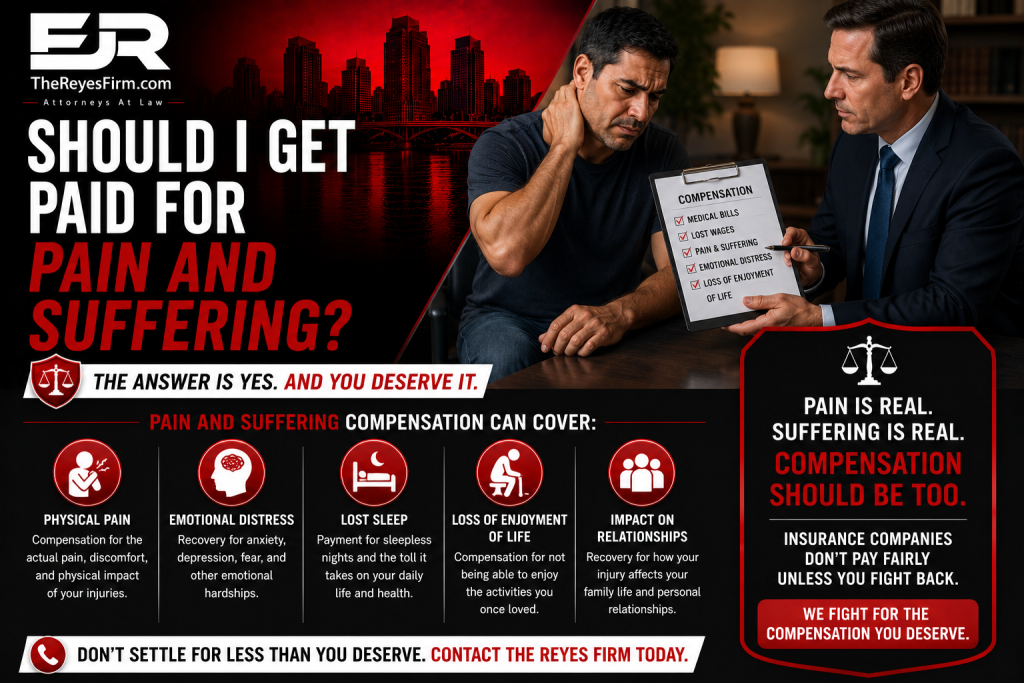
- Pain and suffering is a type of non-economic damage. It covers physical pain, mental anguish, loss of enjoyment of life, and inconvenience, on top of your medical bills and lost wages.
- Florida’s no-fault system means your own PIP pays your first $10,000 in bills regardless of fault, but pain and suffering generally comes from the at-fault driver once you meet the injury threshold under Florida Statute § 627.737.
- There’s no fixed formula. The value depends on the severity and permanence of your injuries, your treatment, and how the crash has changed your life.
- You have two years from the date of your crash to file a personal injury lawsuit under Florida Statute § 95.11(3)(a). Uninsured/underinsured motorist coverage can also be a source of recovery if the at-fault driver has no insurance.
The Reyes Firm
Hurt and in Pain After a Tampa Crash?
Find out what your pain and suffering claim may be worth. Had a bad day?
Can you get paid for pain and suffering after a Florida car accident?
Yes, you can be compensated for pain and suffering, as long as the crash wasn’t your fault and your injuries are serious enough to clear Florida’s threshold. Whether it actually happens depends on the facts: how badly you were hurt, whether the at-fault driver had insurance, and whether they have assets to reach if they didn’t.
If you’re in genuine pain, you should be able to recover for that pain, for the loss of enjoyment of life, for time you couldn’t work, and for the damage to your vehicle. That’s the principle. In practice, it doesn’t happen automatically, which is why how you handle your claim matters so much.
One of the biggest obstacles is uninsured drivers. Florida has a high number of people driving without adequate coverage, which is exactly why carrying uninsured/underinsured motorist coverage on your own policy is one of the smartest protections you can have.
⚠️ Deadline Warning: Under Florida Statute § 95.11(3)(a), you have two years from the date of your crash to file a personal injury lawsuit. Wait too long and you can lose the right to recover anything for your pain and suffering, no matter how badly you were hurt. Don’t let the clock run out.
What counts as pain and suffering in a Florida injury claim?
Pain and suffering is a category of non-economic damages, meaning losses that don’t come with a receipt. Unlike a medical bill or a paycheck stub, these harms are real but harder to put a dollar figure on, which is exactly why insurers fight them.
In a Florida injury claim, pain and suffering can include physical pain from your injuries, mental anguish and emotional distress, loss of enjoyment of life, inconvenience and disruption to your routine, and the lasting effect of scarring or disfigurement. A serious back or neck injury that limits you for years carries very different value than a sprain that heals in weeks.
These damages sit on top of your economic damages, which cover medical bills, future treatment, lost wages, and lost earning capacity. Together they make up the full value of your claim.
Watch: Should you get paid for pain and suffering in Tampa?
In this short video, Tampa personal injury attorney Edward Reyes explains when you can recover for pain and suffering after a Florida crash and what factors affect it.
If you’re hurting and unsure whether your injuries qualify, The Reyes Firm offers a free case review to walk you through where you stand.
How does Florida’s injury threshold affect pain and suffering?
Florida’s injury threshold is the gateway to recovering pain and suffering from an at-fault driver. Because Florida is a no-fault state, your own Personal Injury Protection (PIP) coverage pays your first medical bills regardless of who caused the crash, but PIP does not pay for pain and suffering.
To step outside no-fault and pursue non-economic damages from the at-fault driver, your injury generally has to meet the serious-injury threshold in Florida Statute § 627.737. That statute recognizes injuries involving significant and permanent loss of an important bodily function, permanent injury within a reasonable degree of medical probability, significant and permanent scarring or disfigurement, or death.
Whether your injury clears that threshold is often the central fight in a Florida case. Strong medical documentation and the right expert opinions are what move an injury from “soft tissue” in the insurer’s eyes to a permanent, compensable harm.
💡 Did You Know? Florida’s PIP system pays up to $10,000 in medical bills and lost wages no matter who caused the crash under Fla. Stat. § 627.736 — but PIP never pays for pain and suffering. Those damages only become available once your injury meets the threshold in Fla. Stat. § 627.737.
How is pain and suffering calculated in Florida?
There is no fixed formula for pain and suffering in Florida. Two cases with similar bills can settle for very different amounts depending on how the injuries affect each person’s life, which is why a number pulled from an online calculator means little.
In practice, the value turns on factors like the severity and permanence of your injuries, the length and intensity of your treatment, whether you’ll need future care, how the injuries limit your work and daily activities, and the credibility of your medical records. Insurers sometimes start from a “multiplier” of your economic damages or a per-day figure, but those are starting points for negotiation, not rules.
This is also where insurers push back hardest. They may argue your pain isn’t that serious, that a gap in treatment means you recovered, or that a prior condition is to blame. A thorough, well-documented claim is what counters those arguments.
🛡️ Your Rights Under Florida Law: Under Florida Statute § 768.81, your compensation is reduced by your share of fault, and you may be barred from recovery if you are found more than 50% responsible for the crash. Insurers use this rule to shrink pain and suffering payouts by blaming you. An experienced Tampa car accident lawyer works to keep your percentage of fault as low as the evidence allows.
What are the steps to protect your pain and suffering claim?
These five steps protect both your recovery and the value of your claim. The order matters.
- Get medical care right away and follow through. Same-day or next-day treatment ties your pain to the crash. Gaps and missed appointments are the first thing an adjuster uses to argue you weren’t really hurt.
- Document how the injuries affect your life. Keep a simple journal of pain levels, missed activities, lost sleep, and things you can no longer do. This is the evidence that turns abstract “suffering” into a concrete, provable loss.
- Check your own uninsured/underinsured motorist coverage. If the at-fault driver has no insurance or too little, your UM/UIM coverage may be the source that actually pays your pain and suffering. Don’t assume you have no options.
- Don’t give a recorded statement or accept a quick offer. Insurers move fast to settle low, often before the full extent of your injuries is known. Once you sign a release, you can’t ask for more.
- Call The Reyes Firm for a free case review. A Tampa car accident lawyer can document your injuries properly, value your pain and suffering, and push back on lowball offers. Call 833-4 BAD DAY to get started.
The Reyes Firm
4730 N. Habana Ave., Suite 201, Tampa, FL 33614
Phone: 833-4 BAD DAY | thereyesfirm.com
How The Reyes Firm handles your pain and suffering claim
When a crash leaves you in lasting pain, the loss is more than a stack of bills. Your life split into before and after, and the insurance company is already working to put the smallest possible number on what you’ve been through. We make sure someone is fighting for the full picture.
When we take on a pain and suffering claim, we typically:
- Build the medical record that proves permanence, working with your treating doctors and, where needed, medical experts to show your injury meets Florida’s threshold
- Document the human impact, gathering the details about lost activities, work limitations, and daily struggles that give pain and suffering its real value
- Identify every source of recovery, including the at-fault driver’s policy, your own uninsured/underinsured motorist coverage, and any other responsible party
- Take over insurer communication, so you stop fielding pressure calls and recorded-statement requests built to minimize your claim
- Prepare every case as if it will go to trial, because insurers value pain and suffering more honestly when they know we’re ready to file suit
No lawyer can promise a specific dollar figure. What we can promise is that we treat your suffering as something real and provable, not a line item to be argued away. We explain every step in plain language and keep you in the loop.
Frequently asked questions about pain and suffering in Tampa
What is the difference between pain and suffering and medical bills?
Medical bills are economic damages with a clear dollar amount. Pain and suffering is a non-economic damage covering physical pain, mental anguish, and loss of enjoyment of life. Both can be part of the same claim, but they’re valued in very different ways.
Can I recover pain and suffering if Florida is a no-fault state?
Yes, but you generally have to meet the serious-injury threshold in Florida Statute § 627.737 to step outside no-fault and pursue pain and suffering from the at-fault driver. Your PIP coverage pays medical bills regardless of fault, but it does not pay for pain and suffering.
How long do I have to file a pain and suffering claim in Florida?
Under Fla. Stat. § 95.11(3)(a), you generally have two years from the date of the crash to file a personal injury lawsuit. It’s best to talk to a lawyer early so evidence of your injuries can be preserved.
How is the dollar value of pain and suffering decided?
There’s no set formula. The value depends on the severity and permanence of your injuries, your treatment, how the injuries affect your daily life and work, and the strength of your medical documentation. A lawyer builds the record that supports a higher value.
What if the driver who hit me had no insurance?
If the at-fault driver is uninsured or underinsured, your own uninsured/underinsured motorist coverage may pay for your injuries and pain and suffering. This is exactly why carrying UM/UIM coverage matters, and why it’s worth reviewing your policy after a crash.
Does it hurt my claim if I had a prior injury?
Not necessarily. Insurers often blame a prior condition, but Florida law still allows recovery when a crash aggravates a pre-existing injury. Clear medical records showing how your condition changed after the crash are key to overcoming that argument.
How much does it cost to hire The Reyes Firm?
The Reyes Firm works on a contingency fee basis, which means you pay nothing up front and nothing at all unless we recover compensation for you. The case review is free, so there’s no risk in finding out where you stand.
Will I have to go to court to get pain and suffering compensation?
Many claims settle without a trial. But preparing your case as if it will go to court often produces a better settlement, because insurers take a well-documented, trial-ready claim far more seriously.

Edward Reyes, Esq. is a Florida Bar-admitted personal injury attorney and the founder of The Reyes Firm in Tampa, Florida. His practice focuses on serious injury and wrongful death cases arising from commercial vehicle crashes, including delivery truck accidents involving FedEx, UPS, Amazon, and other carriers. Edward Reyes, Esq. represents injured Floridians in Tampa and throughout Hillsborough County on a contingency fee basis, meaning clients pay nothing unless the firm recovers compensation for them.
Read more about Edward Reyes.
How Can The Reyes Firm Help You?
If you’ve had a bad day — a car accident, a slip and fall, a trucking crash, or any injury that wasn’t your fault — The Reyes Firm is in your corner. Our Tampa personal injury attorneys offer free consultations and work on a contingency fee basis, which means you pay us nothing unless we win your case.
You shouldn’t have to fight the insurance companies alone. Let us fight for you.
📍 Address: 4730 N. Habana Ave., Suite 201, Tampa, FL 33614
📞 Phone: 833-4 BAD DAY
🌐 Website: Schedule your free consultation today at thereyesfirm.com
Had a bad day? Call The Reyes Firm. We’ll handle the rest.