You were just at home, the one place you’re supposed to be safe. Then a fall or a hidden hazard changed your day, and now you’re hurt and wondering whether anything can even be done. Here’s the part most people don’t realize: being injured in your own home does not automatically mean no one else is responsible.
TL;DR — QUICK SUMMARY
- You can still have a personal injury claim even if you were hurt inside your own home. It depends on who caused the hazard.
- Common at-fault parties include a landlord who ignored a known problem, the maker of a defective product, or a contractor whose bad work left a danger behind.
- Under Florida’s comparative fault law, being partly at fault reduces your recovery, and being more than 50% at fault can bar it entirely (Fla. Stat. § 768.81).
- Most injury claims must be filed within two years under Fla. Stat. § 95.11(3)(a), and defective-product cases carry their own deadlines.
- The Reyes Firm reviews how you were hurt for free and works on contingency, so you pay nothing unless the firm recovers for you.
The Reyes Firm
Hurt in Your Own Home in Tampa?
Find out if someone else is responsible for your injury. Had a bad day?
Can you really have a claim if you were injured in your own home?
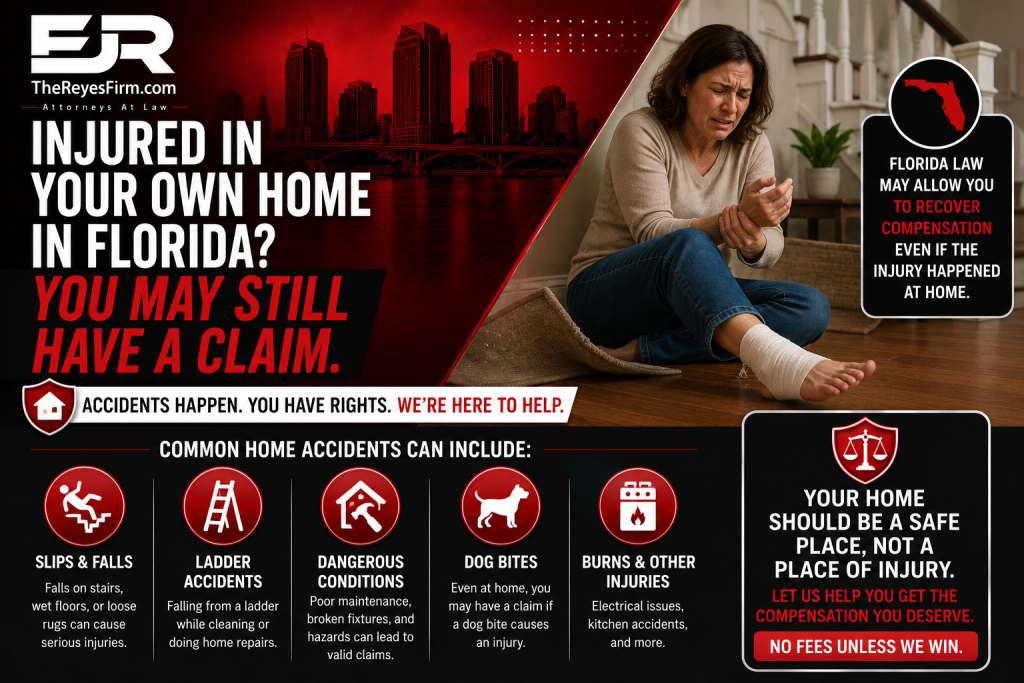
Yes, you can, and this surprises a lot of people. The fact that an injury happened inside your own house doesn’t end the question of who’s responsible. It starts it. The real issue is what caused the injury and whether someone else’s negligence played a role. If it did, you may have a valid claim even though you were standing on your own property.
Every case turns on its facts. Did you simply lose your footing, or was there a dangerous condition someone else should have fixed? Did a product fail? Did a contractor leave a hazard behind? Those answers decide whether a third party shares the blame. The point is that “it happened at home” is not a reason to assume you’re out of luck, it’s a reason to have a lawyer look at how it happened.
⚠️ Deadline Warning: Under Florida Statute § 95.11(3)(a), you generally have two years from the date of injury to file a personal injury lawsuit. Evidence of a home hazard, like a defective part or an unrepaired condition, can disappear fast. Don’t wait to call a lawyer.
Who else can be liable when you’re hurt at home in Florida?
More parties than you’d think. When a dangerous condition you didn’t create causes your injury, the person or company responsible for that condition may be on the hook. The most common at-fault parties in home injury cases include:
- A landlord. If you rent and your landlord failed to fix a known hazard or maintain the property, that failure can make them liable for your injuries.
- A product manufacturer or seller. If a defective appliance, tool, ladder, or other product malfunctioned and hurt you, the maker, distributor, or retailer may be responsible under Florida product liability law.
- A contractor or repair company. If someone did work in your home and left behind a danger, like an exposed nail, a faulty install, or unfinished repairs, their negligence can support a claim.
- A service provider. Delivery workers, utility crews, cleaners, or others who create a hazard in your home can be liable for injuries that result.
A serious fall or a malfunctioning product can cause real harm, from broken bones to spinal cord and brain injuries. When that harm traces back to someone else’s negligence, the law gives you a path to hold them accountable.
Watch: What happens if you’re injured in your own home?
This short video breaks down when an injury at home can still lead to a valid claim and who might be responsible.
Still not sure whether your situation qualifies? The Reyes Firm offers a free case review to walk through exactly how you were hurt.
What if you rent and your landlord ignored a hazard?
If you were injured in a rental because your landlord failed to address a known danger, you may have a strong claim. Landlords in Florida have a duty to keep their properties reasonably safe and to handle repairs they’re responsible for. When a landlord knows about a problem, a broken stair, a faulty railing, a leak that creates a slipping hazard, and does nothing, that inaction can be negligence.
This is exactly the situation the law is built for. If you reported an issue, the timeline of your complaints and the landlord’s response, or lack of one, becomes powerful evidence. Save your messages, repair requests, and any photos. They help prove the landlord knew and failed to act.
💡 Did You Know? Your own homeowner’s or renter’s insurance liability coverage is generally designed to protect you if a guest is hurt on your property, not to pay you for injuries you suffer from your own actions. When a third party like a landlord, manufacturer, or contractor is at fault, compensation usually comes from their insurance, which is why identifying the responsible party early matters so much.
What if a defective product or a contractor’s bad work caused it?
Defective products and negligent repairs are two of the most common reasons people get seriously hurt at home. If a product was unreasonably dangerous because of a design flaw, a manufacturing defect, or a failure to warn, you may be able to pursue the manufacturer, distributor, or retailer, even though the injury happened in your living room. These cases can involve their own filing deadlines and a separate statute of repose under Fla. Stat. § 95.031, so prompt legal review is important.
Contractor cases work differently but follow the same logic. A contractor who installs something improperly, leaves a hazard exposed, or walks away from a repair they were hired to complete can be liable when that failure injures you. The key is preserving proof: keep the product, save receipts and work orders, and document the scene before anything gets cleaned up or thrown away.
Does it matter that you were partly at fault?
It can affect how much you recover, but it doesn’t automatically end your claim. Florida uses a modified comparative fault system. If you share some of the blame, your compensation is reduced by your percentage of fault. If you’re found more than 50% responsible, you may be barred from recovering at all. So the question of “did you not pay attention” matters, but it’s rarely as simple as the insurance company wants you to believe.
This is where a lawyer earns their keep. Insurers love to pin as much fault on you as possible, because every percentage point they shift onto you lowers what they pay. A careful investigation often shows the hazard, not your inattention, was the real cause.
🛡️ Your Rights Under Florida Law: Under Florida Statute § 768.81, your compensation is reduced by your share of fault, and you may be barred from recovery if you are found greater than 50% responsible for your own harm. An experienced Tampa premises liability lawyer works to protect the facts, challenge unfair blame, and keep your percentage of fault as low as the evidence allows.
What steps should you take after an injury in your home?
These steps protect your health and your legal case. The order matters.
- Get medical care right away. See a doctor the same day, even if you think it’s minor. Adrenaline masks injuries, and prompt treatment ties your harm to the incident, which matters later.
- Preserve whatever caused the injury. Keep the defective product, the broken part, or anything else involved. Don’t throw it away or let it be repaired before it can be examined.
- Document the scene. Photograph the hazard, the location, and your injuries before anything is cleaned up, fixed, or moved.
- Save your paper trail. Gather repair requests, messages to a landlord, receipts, warranties, work orders, and the names of anyone who did work in your home.
- Call The Reyes Firm before talking to an insurer. Don’t give a recorded statement or accept blame before a lawyer reviews how you were hurt. Call 833-4 BAD DAY for a free consultation.
The Reyes Firm
4730 N. Habana Ave., Suite 201, Tampa, FL 33614
Phone: 833-4 BAD DAY | thereyesfirm.com
How The Reyes Firm handles your home-injury case
When you’re hurt in the one place you’re supposed to be safe, it’s disorienting, and it’s easy to assume nothing can be done. That assumption is exactly what at-fault parties and their insurers are counting on. We make sure your side of the story gets investigated, not brushed aside.
When we take on a home-injury case, we typically:
- Investigate how the injury actually happened, identifying the dangerous condition and tracing it back to whoever was responsible for it
- Identify every potentially liable party, from a landlord or property manager to a product manufacturer, contractor, or service company
- Preserve critical evidence early, including the product, repair records, and your communications, before anything is lost or repaired
- Push back on unfair blame, challenging insurance attempts to pin the fault on you and protecting your recovery under Florida’s comparative fault rules
- Calculate full damages, covering medical bills, lost wages, future care, and the real impact the injury has had on your daily life
- Handle the insurance companies for you, so you can focus on healing while we deal with adjusters working to minimize your claim
No lawyer can promise an outcome. What we can promise is that we treat a home injury as the serious matter it is, not a lost cause. We represent injured people throughout Hillsborough County and the Tampa Bay area, we explain every decision in plain language, and you can read more about the deadlines that protect your right to file in our guide to Florida’s statute of limitations.
Frequently asked questions about home injuries in Florida
Can I file a personal injury claim if I was hurt in my own home?
Yes, you may be able to. The location of the injury doesn’t decide the claim. What matters is whether someone else’s negligence caused the hazard that hurt you. If a landlord, manufacturer, contractor, or other party was responsible, you can have a valid claim even though it happened on your own property.
Who can be held liable for an injury that happens at my house?
It depends on the cause. Common at-fault parties include a landlord who ignored a known hazard, the maker or seller of a defective product, and a contractor or repair company whose negligent work created the danger. Sometimes more than one party shares responsibility.
Can I sue my landlord if I was injured in a rental?
You may be able to if your landlord failed to maintain the property or fix a known dangerous condition they were responsible for. Florida landlords have a duty to keep rentals reasonably safe. Your repair requests, messages, and photos can be strong evidence that the landlord knew about the problem and didn’t act.
What if a defective product caused my injury at home?
If a product was unreasonably dangerous due to a design or manufacturing defect or a failure to warn, you may be able to pursue the manufacturer, distributor, or retailer. Product cases have their own filing deadlines and a separate 12-year statute of repose under Fla. Stat. § 95.031, so it’s important to have a lawyer review the timing early. Keep the product itself as evidence.
Does my own homeowner’s or renter’s insurance cover me?
Usually not for your own injuries caused by your own actions. That liability coverage is generally meant to protect you if a guest is hurt on your property. When a third party is at fault, compensation typically comes from that party’s insurance instead. Your health insurance may cover initial medical bills, sometimes with a right to reimbursement from any recovery.
What if I was partly at fault for my own injury?
You can still recover in many cases, but your compensation is reduced by your share of fault under Fla. Stat. § 768.81. If you’re found more than 50% responsible, you may be barred from recovering. Insurers often exaggerate your fault, which is why a careful investigation matters.
How long do I have to file a claim for an injury at home?
For most negligence-based injury claims, the deadline is two years from the date of injury under Fla. Stat. § 95.11(3)(a). Defective-product claims can involve different deadlines, including the 12-year statute of repose. Because the right deadline depends on the type of claim, confirm yours with a lawyer as early as possible.
What should I do right after getting hurt at home?
Get medical care the same day, preserve whatever caused the injury, photograph the scene and your injuries, and save any repair requests, receipts, or work orders. Then call a lawyer before giving a statement to any insurance company.
How much does it cost to hire a Tampa personal injury attorney?
The Reyes Firm works on a contingency fee basis, which means you pay nothing upfront and nothing at all unless the firm recovers compensation for you. The initial consultation is free. Call 833-4 BAD DAY to talk through what happened.

Edward Reyes, Esq. is a Florida Bar-admitted personal injury attorney and the founder of The Reyes Firm in Tampa, Florida. His practice focuses on serious injury and wrongful death cases, including premises liability, defective products, and other negligence claims. Edward Reyes, Esq. represents injured Floridians in Tampa and throughout Hillsborough County on a contingency fee basis, meaning clients pay nothing unless the firm recovers compensation for them.
Read more about Edward Reyes.
How Can The Reyes Firm Help You?
If you’ve had a bad day — a car accident, a slip and fall, a trucking crash, or any injury that wasn’t your fault — The Reyes Firm is in your corner. Our Tampa personal injury attorneys offer free consultations and work on a contingency fee basis, which means you pay us nothing unless we win your case.
You shouldn’t have to fight the insurance companies alone. Let us fight for you.
📍 Address: 4730 N. Habana Ave., Suite 201, Tampa, FL 33614
📞 Phone: 833-4 BAD DAY
🌐 Website: Schedule your free consultation today at thereyesfirm.com
Had a bad day? Call The Reyes Firm. We’ll handle the rest.