
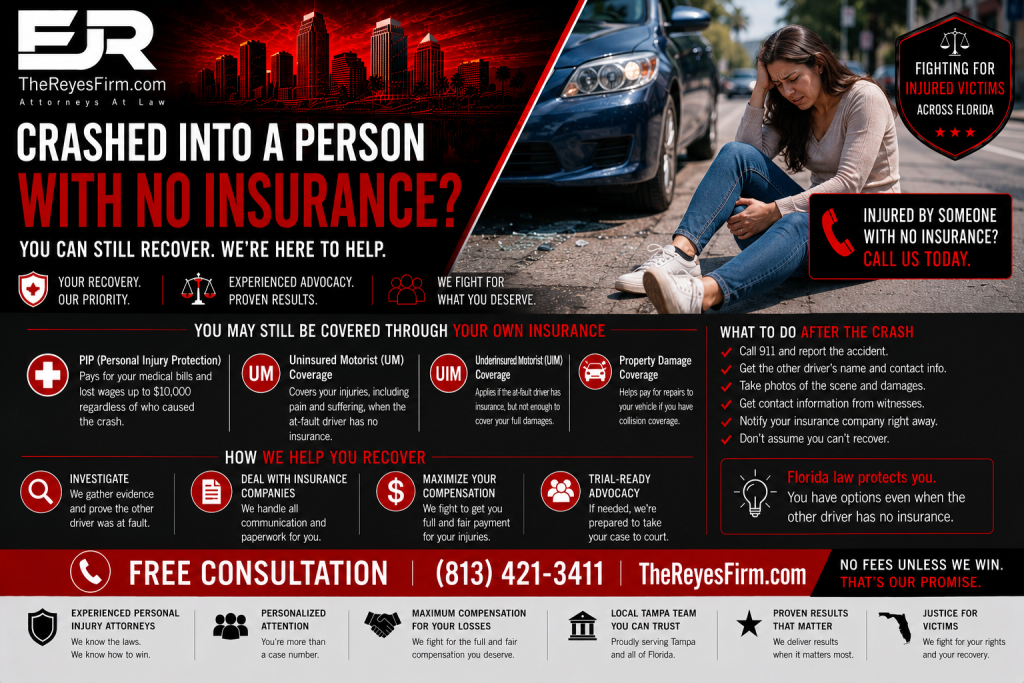
Crashed Into A Person With No Insurance?
The other driver ran the light, wrecked your car, and left you hurting. Then comes the gut punch: they have no insurance. It feels like you have no way to recover, but in Florida that is often not true. Between your own coverage and the state’s rules, you may have far more protection than you realize after a car accident with an uninsured driver. Here is how it works. The Reyes Firm Hit by an Uninsured Driver in Tampa? You may have more coverage than you think. Let us check. Had a bad day? Contact Us Now UM Coverage Your protection when the other driver has none Fla. Stat. § 627.727 In Writing UM applies unless you rejected it in writing Fla. Stat. § 627.727 $10,000 PIP pays your bills regardless of fault Fla. Stat. § 627.736 2 Years Deadline to file an injury lawsuit Fla. Stat. § 95.11 Discovering that the person who hurt you carried no insurance is one of the most frustrating moments after a crash. It feels like the responsible party gets to walk away while you are left with the bills. The good news is that Florida’s insurance system was built with this exact problem in mind, and the path to recovery usually runs through coverage you may already have. What happens if the driver who hit you has no insurance? You still have options. In Florida, being hit by an uninsured driver does not mean you are out of luck, because your recovery does not depend entirely on the other driver’s insurance. It depends first on your own coverage, which Florida’s no-fault system and uninsured motorist rules are designed to provide. This matters more here than in most states, because Florida consistently ranks among the states with the highest percentage of uninsured drivers. Being prepared for this situation is not paranoia in Florida, it is simply realistic, and the drivers who come through it best are usually the ones who understand their own policy. Does Florida’s no-fault system still cover you? Yes. Florida is a no-fault state, which means your own Personal Injury Protection coverage under Florida Statute § 627.736 pays your medical bills first, regardless of who caused the crash. Because PIP is your own coverage, it applies whether the other driver had insurance or not, as long as you seek initial medical care within 14 days of the crash. The limitation is that PIP only goes so far. It covers a portion of your medical expenses and lost wages up to a $10,000 cap, and it does not compensate you for pain and suffering. For a serious injury, PIP is a starting point, not the whole answer, which is where uninsured motorist coverage becomes essential. What is uninsured motorist coverage, and how does it help? Uninsured motorist coverage, often called UM, is the single most important protection when the at-fault driver has no insurance. It essentially steps into the shoes of that driver’s missing policy and pays for the harm they caused you, including the pain and suffering and the excess medical costs that PIP does not cover. A closely related coverage, underinsured motorist coverage, applies when the at-fault driver has some insurance but not enough to cover your injuries. There is an important wrinkle worth understanding. When you file a UM claim, you are making a claim against your own insurance company, which means your insurer is now on the other side of your claim. That can feel strange, and it is one reason these claims sometimes become contentious even though you have paid your premiums faithfully. 💡 Did You Know? You may already have uninsured motorist coverage without realizing it. Under Fla. Stat. § 627.727, an insurer generally must offer UM coverage equal to your bodily injury liability limits, and you can only reject it or choose lower limits in writing on an approved form. If you never signed such a rejection, there is a good chance you have this coverage. Source: Fla. Stat. § 627.727. What if you didn’t think you had uninsured motorist coverage? Check before you assume the worst. Because Florida law requires insurers to offer UM coverage and to obtain a written rejection if you decline it, many drivers carry this coverage even though they do not remember choosing it. The rejection form itself must carry a bold warning that you are giving up valuable protection, precisely because the state wants drivers to have it. The practical takeaway is simple: do not give up before someone reviews your actual policy. Pulling your declarations page and reading exactly what coverage you carry is one of the first things worth doing, and a lawyer can do it with you to make sure nothing is missed. What looks like a hopeless situation frequently turns out to be a covered one. 🛡️ Your Rights Under Florida Law: Under Florida Statute § 768.81, your compensation is reduced by your share of fault, and you may be barred from recovery if you are found greater than 50% responsible. When the at-fault driver is uninsured, insurers sometimes lean harder on blaming you, and an experienced Tampa injury lawyer works to keep the facts straight and your assigned fault as low as the evidence allows. Can you sue an uninsured driver personally? You can, but it is often not the most productive path. A driver who cannot afford insurance frequently cannot afford to pay a judgment either, and a court award means little if there are no assets to collect from. This is the old problem of trying to get blood from a stone, and it is why your own uninsured motorist coverage usually matters far more than a lawsuit against the individual. That said, an uninsured driver is not always the only responsible party. Sometimes another person or company shares liability, such as an employer if the driver was working, or the owner of the vehicle if someone else let them drive it. Identifying every potentially responsible party is part of what