
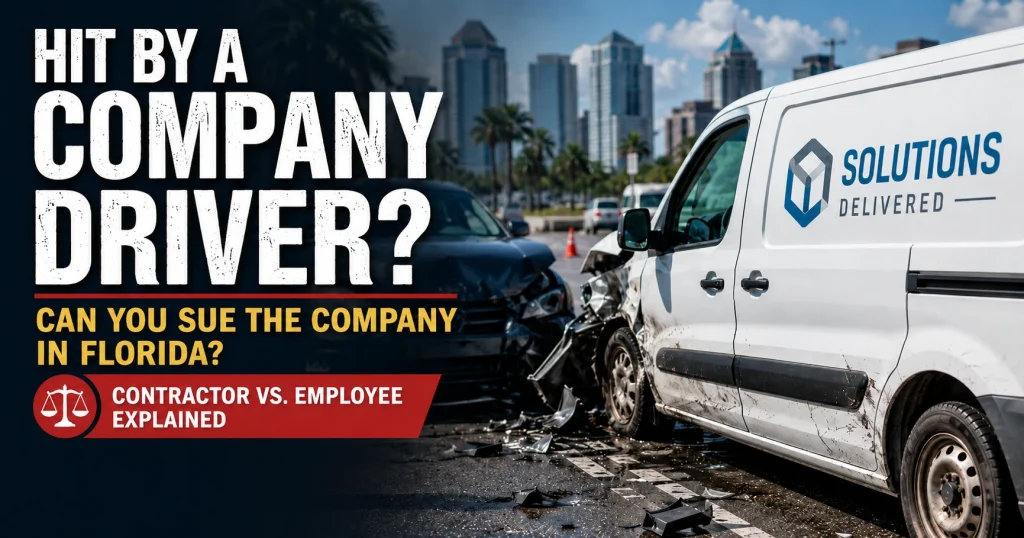
Can I Sue a Company If Their Driver Hit Me in Florida? Contractor vs. Employee Explained
What You Need to Know In Florida, you may be able to sue a company if its driver hit you, but the answer depends on the driver’s job status, what the driver was doing, and who owned or controlled the vehicle. If the driver was an employee acting within the scope of employment, the company may be liable under Florida’s respondeat superior doctrine. If the driver was labeled an independent contractor, that label does not always end the case. Florida courts may look at the company’s actual control. Florida’s Dangerous Instrumentality Doctrine may create a separate path to vehicle-owner liability when a company allows someone to drive its vehicle. Limits and exceptions can apply. Florida is a no-fault state. Your PIP coverage generally pays first. Injury claims beyond PIP may depend on whether your injuries meet Florida’s serious injury threshold. For most Florida negligence-based car accident claims arising on or after March 24, 2023, the lawsuit deadline is generally two years, not four years. Florida’s modified comparative negligence rule can bar recovery if you are found more than 50% at fault. Had a bad day? Call The Reyes Firm: 833-4 BAD DAY Use the sections below to see how each rule may affect your case. The Reyes Firm Had a Bad Day? Was There a Logo on the Vehicle? A company logo, work van, delivery marking, or app-based driver can be a clue that more than one party may be responsible after a Florida crash. Schedule Your Free Consultation If you are asking, “Can I sue a company if their driver hit me in Florida?” you are probably dealing with pain, bills, and confusing insurance calls. A crash involving a company vehicle can feel different from a regular car accident because more than one person or business may be involved. The hard part is knowing who may be responsible. Was the driver an employee? A contractor? Was the driver working at the time? Did the company own the vehicle? This guide explains how Florida law treats company driver accidents, contractor vs. employee status, PIP insurance, and company liability. It also explains why rapid evidence preservation matters in Tampa company-vehicle accident cases. Can I Sue a Company If Their Driver Hit Me in Florida? Yes, you may be able to sue a company if their driver hit you in Florida, but the answer depends on several facts. The key questions are: Was the driver an employee or an independent contractor? Was the driver working at the time of the crash? Did the company own, lease, or control the vehicle? Did the company negligently hire, supervise, or entrust the vehicle to the driver? Do your injuries allow you to step outside Florida’s no-fault PIP system? Florida is a no-fault insurance state. After many crashes, your own Personal Injury Protection coverage pays first, no matter who caused the crash. Florida PIP generally covers 80% of reasonable medical expenses and 60% of lost income, subject to policy limits and other legal rules. To pursue certain damages against the at-fault driver or company, your injuries may need to meet Florida’s serious injury threshold. This threshold may include permanent injury, major scarring, or loss of an important body function. ⚠️ Deadline Alert: For most negligence-based Florida personal injury claims arising on or after March 24, 2023, the deadline is generally two years. The prior four-year deadline should not be used for most modern Florida car accident negligence claims. Evidence such as GPS data, dashcam footage, dispatch records, app logs, and driver history files can disappear quickly. That is why early legal action matters. Source: Florida Statute § 95.11. Once you know PIP is only the first layer, the driver’s work status becomes the next issue. What Is the Difference Between an Employee and an Independent Contractor in a Florida Accident? In a Florida company vehicle accident case, the distinction between an employee and an independent contractor can affect the company’s liability. If the driver was an employee acting within the scope of employment, the company may be liable under the doctrine of respondeat superior. That legal phrase means an employer may be responsible when an employee causes harm while doing job-related work. If the driver was an independent contractor, the company may argue it is not responsible. But that label is not always the final answer. A company can call someone a “1099 contractor,” but Florida courts may still look at the actual working relationship. The more control the company had over the driver’s work, the stronger the argument that the driver was acting as an employee. Employee vs. Contractor Factors in Florida Accident Cases Factor Points Toward Employee Points Toward Contractor Control over work The company directs how the job is done The worker decides how to complete the job Vehicle ownership The company owns or leases the vehicle The worker uses their own vehicle Schedule The company sets hours, routes, or shifts Workers control their own schedule Supervision The company monitors daily performance The worker operates independently Branding Vehicle, uniform, or app strongly identifies the company The worker operates under their own business identity Payment Hourly, salary, or fixed route pay Per project, per job, or per delivery Exclusivity Works mainly for one company Works for multiple businesses Duration Ongoing relationship Short-term or project-based work No single factor decides the case. Florida courts consider the full relationship, including the contract, company control, driver autonomy, and crash facts. If the company claims the driver was a contractor, the next step is to test that claim against the evidence. What If the Company Says the Driver Was an Independent Contractor? If the company says the driver was an independent contractor, do not assume that ends your claim. That may be true in some cases. But in others, the company may still face liability based on control, ownership, or negligent conduct. Legal Theories That May Apply Misclassification or actual control. If the company controlled the driver’s routes, schedule, appearance, app activity, or delivery process, the driver