You did everything right after your car accident. You saw a doctor, you followed up, you’re trying to heal. So it comes as a shock to learn that the wrong doctor, or the right doctor with sloppy notes, can quietly sink your injury claim. Here’s how it happens, and how to protect yourself before the insurance company turns your own medical records against you.
TL;DR — QUICK SUMMARY
- Your medical records are discoverable evidence. The insurance company reads them closely and uses anything unhelpful against you.
- Poor or incomplete documentation, like a note that you “feel fine,” can undercut your claim even when you’re seriously hurt.
- In Florida, you must seek care within 14 days of a crash to keep your PIP benefits under Fla. Stat. § 627.736.
- The type of provider you see matters, both for your recovery and for how credibly your injuries are documented.
- Gaps in treatment, downplaying symptoms, and ignoring your doctor’s plan are some of the fastest ways to weaken a strong case.
The Reyes Firm
Worried Your Medical Records Could Hurt Your Claim?
Get your case reviewed before the insurance company twists your treatment against you. Had a bad day?
Can your own doctor really hurt your injury case?
Yes, and it happens more often than people expect. Not because the doctor is bad at medicine, but because a personal injury claim runs on documentation. The moment a provider writes something in your chart, it becomes part of the medical record, and that record is discoverable. The insurance company gets to read it, and it will seize on anything that helps the defense.
Think about how that plays out. A doctor focused on treating you, not on your legal case, jots down “patient reports feeling better” after one good day. To you, it was a single decent afternoon. To an insurance adjuster, it’s a quote to argue you weren’t really hurt. The record outlives the moment, and the words get used against you long after you’ve forgotten you said them.
⚠️ Deadline Warning: After a Florida crash, you must seek medical care within 14 days to keep your PIP benefits under Fla. Stat. § 627.736, and you generally have two years to file an injury lawsuit under Florida Statute § 95.11(3)(a). Miss the 14-day window and you can lose coverage no matter how hurt you are. Don’t wait.
How do your medical records become evidence against you?
Once you make a claim, your accident-related medical records are fair game. The insurer’s team combs through them line by line looking for three things: anything suggesting your injuries aren’t serious, anything suggesting they weren’t caused by the accident, and any gap that lets them argue you healed or were never really hurt.
That’s why what your doctor writes matters as much as what they treat. If the records don’t clearly connect your injuries to the crash, the insurer argues causation is missing. If they don’t capture the full picture of your pain and limitations, the insurer argues your injuries are minor. The medical chart isn’t just a treatment tool. In a claim, it’s the evidence, and weak documentation is a gift to the other side.
Watch: How doctors and documentation affect your injury case
This short video explains how the right and wrong medical choices can shape what your case is worth.
Want a clear read on where your case stands? The Reyes Firm offers a free case review.
Why does the type of doctor you see matter?
Because no single doctor is a fix-all, and the right specialist both treats you better and documents you better. A neurologist handles nerve issues. An orthopedist handles bones, joints, and muscles. A chiropractor focuses on the spine. Seeing a provider who actually matches your injury means clearer diagnoses, more credible records, and treatment that holds up under scrutiny.
In Florida, the provider also matters for your benefits. To keep your PIP coverage, your initial care within the 14-day window has to come from a qualifying provider, such as a physician, an osteopathic physician, a dentist, or a hospital. And whether you receive the full benefit or a fraction of it can hinge on a single determination, which we’ll cover next. Serious harm like spinal or nerve injuries especially needs the right specialist on record early.
💡 Did You Know? Under Florida’s PIP law, you get the full $10,000 in benefits only if a qualifying provider determines you have an “emergency medical condition” (EMC). If your initial provider decides your injuries don’t qualify as an EMC, your medical benefits are capped at just $2,500. That single determination can mean a $7,500 difference. Source: Fla. Stat. §§ 627.736, 627.732.
What medical mistakes hurt your case the most?
A few patterns do the most damage, and the good news is that all of them are avoidable once you know what to watch for:
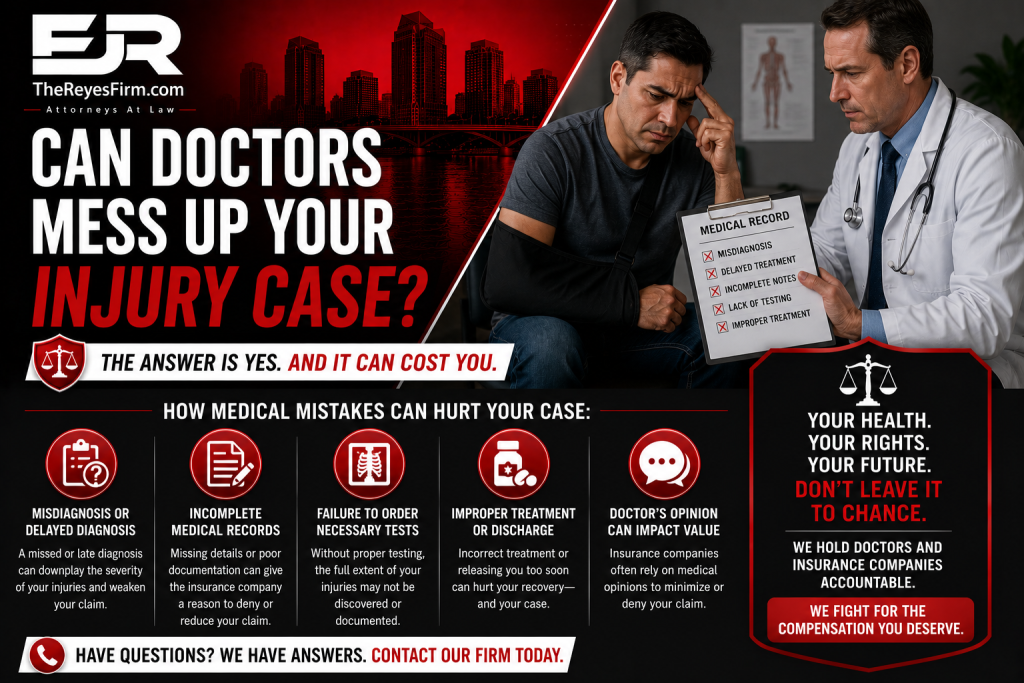
- Waiting too long to get care. Delay lets the insurer argue you weren’t badly hurt, and in Florida it can cost your PIP benefits entirely.
- Gaps in treatment. Missed or spaced-out appointments create holes the defense fills with “you must have recovered.”
- Downplaying your symptoms. Telling a doctor you’re “okay” to be polite gets written down and quoted back to you.
- Not following the treatment plan. Skipping prescribed therapy or care lets the insurer argue you made your own injuries worse.
- Seeing the wrong provider. A mismatch between your injury and your doctor weakens both your treatment and your records.
None of these mean a doctor did anything wrong medically. They’re about how the claim side reads the paper trail, and small habits at the doctor’s office can have an outsized effect on your case.
What if you had a pre-existing condition?
A prior injury or condition does not automatically end your claim. Florida law recognizes that if an accident aggravates or worsens a pre-existing condition, you can still recover for that aggravation. The catch is documentation. If your records don’t distinguish your old baseline from the new harm the crash caused, the insurer will try to blame everything on the pre-existing condition and pay nothing.
This is where good medical records and an honest, complete history protect you. A clear before-and-after picture, supported by your providers, is what separates “this was always there” from “the crash made this dramatically worse.” Hiding a prior condition backfires. Documenting it correctly is what wins.
🛡️ Your Rights Under Florida Law: Under Florida Statute § 768.81, your compensation can be reduced by your share of fault, which insurers may try to argue includes failing to follow your treatment. An experienced Tampa injury lawyer works to keep the focus on the crash that caused your harm and to stop the insurer from rewriting your medical story.
What steps protect your case at the doctor’s office?
These steps protect both your health and your claim. The order matters.
- Get care within 14 days, no matter what. See a qualifying provider promptly to protect your PIP benefits and to put your injuries on the record while the connection to the crash is clear.
- See the right specialist for your injury. Match the provider to the harm, a neurologist for nerve issues, an orthopedist for bones and joints, and so on, so your treatment and your records are both credible.
- Describe every symptom, fully and honestly. Don’t minimize pain to be polite. If it isn’t documented, it’s hard to claim later. Be thorough and consistent at every visit.
- Follow the treatment plan and keep your appointments. Consistent care closes the gaps insurers exploit and shows your injuries are real and ongoing.
- Call The Reyes Firm early. The sooner a lawyer is involved, the sooner your treatment and documentation can be steered to protect your case. Call 833-4 BAD DAY for a free consultation.
The Reyes Firm
4730 N. Habana Ave., Suite 201, Tampa, FL 33614
Phone: 833-4 BAD DAY | thereyesfirm.com
How The Reyes Firm handles your medical evidence
Your medical records can be the strongest part of your case or the weakest, and the difference often comes down to how they’re managed from day one. The insurance company is already reading your chart for ammunition. We make sure the record tells the true, complete story of how the crash hurt you.
When we handle your case, we typically:
- Make sure you get the right care fast, helping you connect with qualifying providers within the 14-day window and the specialists your injuries actually call for
- Build the causation link, working to ensure your records clearly tie your injuries to the accident rather than leaving room for doubt
- Document the full scope of your harm, so your pain, limitations, and long-term needs are captured instead of glossed over
- Address pre-existing conditions head-on, separating your old baseline from the new harm so the insurer can’t blame everything on the past
- Push back on the insurer’s spin, challenging cherry-picked notes, treatment-gap arguments, and lowball medical exams
- Handle the insurance companies for you, so you can focus on healing while we protect the evidence
No lawyer can promise an outcome. What we can promise is that we treat your medical evidence as the backbone of your case, not an afterthought. We represent injured people throughout Hillsborough County and the Tampa Bay area, we explain every step in plain language, and you can read more about your filing deadline in our guide to Florida’s statute of limitations.
Frequently asked questions about doctors and your injury case
Can my own doctor really hurt my injury case?
Yes. Not by treating you poorly, but by documenting your injuries incompletely. Your medical records are discoverable, and the insurance company uses anything unhelpful, like a note that you felt better, to argue your injuries are minor or unrelated to the crash.
Why are my medical records so important to my claim?
Because in an injury claim, the records are the evidence. They establish what you were diagnosed with, how serious it is, and whether it was caused by the accident. Strong, consistent documentation supports your claim, while gaps or careless notes give the insurer openings.
What is the Florida 14-day rule, and why does it matter?
Under Fla. Stat. § 627.736, you must receive initial medical care within 14 days of a motor vehicle accident to qualify for PIP benefits. There are generally no exceptions, even for delayed symptoms. Miss the window and you can forfeit your PIP coverage entirely, no matter how serious your injuries turn out to be.
Does the type of doctor I see affect my case?
Yes. Matching the provider to your injury, such as a neurologist for nerve damage or an orthopedist for bone and joint injuries, produces clearer diagnoses and more credible records. In Florida, your initial PIP visit also has to be with a qualifying provider for your benefits to apply.
What if I had a pre-existing condition before the accident?
You can still recover. Florida law allows compensation when an accident aggravates a pre-existing condition. The key is documentation that distinguishes your prior baseline from the new harm the crash caused. Be honest about your history, because hiding it does far more damage than disclosing it.
Can a gap in my treatment hurt my claim?
It can. Insurers point to gaps in care to argue you recovered or weren’t seriously injured. Keeping your appointments and following your treatment plan closes those gaps and shows your injuries are real and ongoing.
Is a doctor “messing up my case” the same as medical malpractice?
No. This article is about how documentation and treatment choices affect your injury claim, not about a doctor providing negligent care. If a provider’s negligence actually worsened your condition, that’s a separate medical malpractice issue with its own rules and deadlines, and you should have a lawyer evaluate it.
Should I tell my doctor about every symptom, even minor ones?
Yes. Be thorough and honest at every visit. Symptoms you don’t mention don’t get documented, and undocumented injuries are difficult to claim later. Consistency across visits also makes your records more credible.
How long do I have to file my injury claim?
For most injury claims, the deadline is two years from the date of the accident under Fla. Stat. § 95.11(3)(a). That’s separate from the 14-day PIP treatment window, which is much shorter. Both matter, so it’s best to talk to a lawyer early.

Edward Reyes, Esq. is a Florida Bar-admitted personal injury attorney and the founder of The Reyes Firm in Tampa, Florida. His practice focuses on serious injury and wrongful death cases arising from car, truck, and commercial vehicle crashes. Edward Reyes, Esq. represents injured Floridians in Tampa and throughout Hillsborough County on a contingency fee basis, meaning clients pay nothing unless the firm recovers compensation for them.
Read more about Edward Reyes.
How Can The Reyes Firm Help You?
If you’ve had a bad day — a car accident, a slip and fall, a trucking crash, or any injury that wasn’t your fault — The Reyes Firm is in your corner. Our Tampa personal injury attorneys offer free consultations and work on a contingency fee basis, which means you pay us nothing unless we win your case.
You shouldn’t have to fight the insurance companies alone. Let us fight for you.
📍 Address: 4730 N. Habana Ave., Suite 201, Tampa, FL 33614
📞 Phone: 833-4 BAD DAY
🌐 Website: Schedule your free consultation today at thereyesfirm.com
Had a bad day? Call The Reyes Firm. We’ll handle the rest.