After A Car Accident

After A Car Accident, Car accident, Car Search, Legal, Why we serve

Is your Car Damaged?

We love if we could help you with your property damage, and we do. However, the problem with property damage is that there are adjusters involved, there are people that need to go look at your car, there are people that need to fix your car and there are salvage yards and a lot of things. A lot of these companies need appointments. So, what happens is that when we call many times, we leave a voicemail and they call us back. Leave a voicemail, or let’s say they talk to us. Now, we need to coordinate with you on what your schedule is to try to figure out if we coordinate back to the insurance company to get their adjuster to look at your car or the collision center or whatever the case is. Tampa personal injury lawyer Edward Reyes represents people in Tampa and Hillsborough County, Florida who have suffered an injury in an incident or accident type of accident. Speak Directly to Me, At No Cost, Today 813.421.3411So, many times, as far as property damage goes, we can help you if you get stuck and if you have a problem, we can definitely help you, but we are not sure about your schedule. And if we do know your schedule, it’s gonna make the process shorter or much longer because we don’t know your personal schedule that way you can meet with your adjusters, the car collision place, mechanics, or rental companies. That is why it is okay to talk to adjusters only for property damage. Do not talk to them at all for injuries because again, they are trying not to pay. So, it is very important that if you talk to them about property damage, you only talk about your car, to get an appointment, to take it to an adjuster, mechanic, or body shop. If you have questions, call us at 833-4-BAD DAY (833-422-3329).   (Transcript from the video, transcribed but not reviewed)

Why insurance undervalues your pain
After A Car Accident, After an Accident, Car accident, Legal, Settlement, Why we serve

Why Insurance Company Undervalue your Pain?

You’re in real pain after your Tampa car accident, but the insurance adjuster keeps acting like it’s no big deal. They weren’t in the crash. They don’t feel your back seize up every morning. To them, you are a stack of paper, and if that paper doesn’t tell the right story, they will value your pain at close to nothing. Here’s why that happens, and how to make sure your pain is taken seriously. TL;DR — QUICK SUMMARY Insurance companies undervalue pain because it is subjective, and Florida’s no-fault law only makes them pay for it when your injury is permanent. Your PIP coverage pays 80% of medical bills and 60% of lost wages up to $10,000, but it pays nothing for pain and suffering. To recover pain and suffering from the at-fault driver, your injury must meet one of four permanency categories under Florida Statute 627.737. Gaps in treatment and old injuries are the two tools insurers use most to argue your pain is not real or not from the crash. You have two years from the crash to file a lawsuit under Florida Statute 95.11(3)(a), and consistent medical proof is what protects your claim’s value. The Reyes Firm Is the Insurance Company Downplaying Your Pain? Get your Tampa injury claim valued fairly. Had a bad day? Contact Us Now 4 Injury categories that allow pain & suffering Fla. Stat. 627.737(2) $10,000 Standard Florida PIP limit Fla. Stat. 627.736 80% Of medical bills PIP pays, none for pain Fla. Stat. 627.736 2 Years To file an injury lawsuit Fla. Stat. 95.11(3)(a) Why do insurance companies undervalue your pain after a car accident? Insurance companies undervalue your pain because pain is subjective, hard to measure, and easy to dispute, and because Florida law only forces them to pay for it under specific conditions. A broken bumper has a price tag. The ache that keeps you from lifting your child or sleeping through the night does not, so the adjuster treats it as negotiable, then looks for reasons to push its value down. The deeper problem is that the insurer only knows you on paper. It has never met you and does not feel what you feel, so it judges your pain entirely by your medical records. If those records show consistent treatment and a clear diagnosis, your pain looks real. If they show gaps, missed appointments, or no imaging, the insurer will argue you must not be hurting much at all. Understanding how that paper trail is read is the first step to protecting what your claim is actually worth. What does Florida’s no-fault system actually pay for your pain? On its own, your no-fault coverage pays nothing for pain and suffering. Florida’s Personal Injury Protection (PIP) coverage under Florida Statute § 627.736 pays 80% of your medical bills and 60% of your lost wages, up to a standard limit of $10,000, and that money covers economic losses only. Pain, suffering, mental anguish, and the loss of enjoyment of your life are non-economic damages, and you can only recover them by stepping outside the no-fault system and pursuing the at-fault driver directly. Florida does not let you do that for every injury, which is exactly the gap insurers rely on. To reach your pain and suffering, you first have to clear a legal bar called the permanency threshold. When can you recover pain and suffering in Florida? You can recover pain and suffering only when your injury meets Florida’s permanency threshold. Under Florida Statute § 627.737(2), you may pursue non-economic damages from the at-fault driver only if your injury involves one of four things: significant and permanent loss of an important bodily function, a permanent injury within a reasonable degree of medical probability, significant and permanent scarring or disfigurement, or death. The phrase that decides most cases is “permanent injury within a reasonable degree of medical probability.” Proving it usually takes more than your word. It takes the right imaging, the right specialist, and a doctor willing to state that your injury is permanent. This is why a thorough diagnosis matters so much, especially for back, neck, and spine injuries where an MRI can reveal disc damage that an X-ray misses, or for head injuries where a traumatic brain injury may need a neurologist rather than a general doctor to document. 💡 Did You Know? Under Florida’s no-fault law, you cannot recover a dollar of pain and suffering from the at-fault driver unless your injury meets one of four permanency categories in Fla. Stat. § 627.737(2), and the permanency normally has to be confirmed by a doctor to a reasonable degree of medical probability. This single requirement is why proper diagnosis can change a claim’s value dramatically. Source: Fla. Stat. § 627.737, leg.state.fl.us. Watch: Why the insurance company says you’re not really in pain In this short video, attorney Edward Reyes explains how insurers use your medical records to argue your pain isn’t serious, and what you can do about it. Tampa personal injury lawyer Edward Reyes represents people in Tampa and Hillsborough County, Florida who have suffered an injury in an incident or accident type of accident. Speak Directly to Me, At No Cost, Today 813.421.3411If an adjuster is downplaying what you’re going through, The Reyes Firm offers free consultations and can review your situation at no cost. How gaps in treatment lower the value of your pain Nothing hands an insurer more ammunition than a gap in your treatment. When weeks or months pass with no doctor visits, the adjuster’s argument writes itself: if you were really in pain, you would have kept seeing someone about it. A long delay between the crash and your care, or a stretch where you simply stopped going, becomes their reason to discount how you feel. Consistency is your best answer. Steady, documented treatment shows that your pain is ongoing and real, builds the medical record needed to prove permanency, and removes the insurer’s favorite excuse. The same urgency applies to

Auto accident claims process in Florida
After A Car Accident, Settlement

How Do Auto Accident Claims Work in Florida?

You’ve been in a crash, and now you are staring down a confusing question: whose insurance pays for what, and in what order? Florida’s system is layered, and understanding how the pieces fit together is the difference between leaving money on the table and getting everything you are owed. Here is how auto accident claims actually work in Florida, step by step, after a car accident. The Reyes Firm Confused About Your Tampa Accident Claim? Let us map out every layer of coverage for you. Had a bad day? Contact Us Now $10,000 PIP benefits, regardless of fault Fla. Stat. § 627.736 80% / 60% PIP pays of medical bills / lost wages Fla. Stat. § 627.736 UM Coverage Protects you if the other driver has none Fla. Stat. § 627.727 2 Years Deadline to file a lawsuit Fla. Stat. § 95.11 Florida is a no-fault state, which gives its auto accident claims a structure that surprises a lot of people. Instead of one insurance company simply paying for everything, different coverages handle different parts of your losses, and they come into play in a particular order. Once you see how the layers stack up, the whole process becomes far less mysterious. How do auto accident claims work in Florida? Auto accident claims in Florida work as a layered system rather than a single payout. Your own Personal Injury Protection handles your immediate medical costs regardless of fault, the at-fault driver’s bodily injury coverage handles your pain and suffering after a settlement, and your uninsured motorist coverage protects you when the responsible driver cannot. Which layers apply, and how much each pays, depends on the coverage involved and the severity of your injuries. Think of it as a chain, where each link does a specific job. Understanding what each link covers, and when it comes into play, is the key to making sure nothing that should be paid gets missed. What does your PIP cover after a crash? Your Personal Injury Protection is the first link in the chain. Under Florida Statute § 627.736, PIP pays your medical bills and a portion of your lost wages regardless of who caused the crash, which is the heart of the no-fault system. Specifically, PIP generally covers 80% of your reasonable medical expenses and 60% of your lost wages, up to a combined limit of $10,000. There are two catches worth knowing. First, you must seek initial medical care within 14 days of the crash, or you can lose your PIP benefits entirely. Second, the full $10,000 is generally available only if a medical provider determines you had an emergency medical condition; without that finding, your PIP benefits may be capped at $2,500. This is your own coverage, so it applies no matter who was at fault. How do you recover for pain and suffering? PIP does not pay for pain and suffering, so that part of your claim comes from a different link in the chain: the at-fault driver’s bodily injury liability coverage. When another driver causes your injuries, you can pursue a claim against their coverage for the human cost of the crash, including pain, suffering, and the impact on your life, and that recovery typically comes as part of a settlement rather than upfront. There is an important condition, though. In a Florida car accident, you generally cannot step outside the no-fault system to recover pain and suffering unless your injury meets a legal threshold. That is a key reason serious injuries are treated so differently from minor ones, and why proper medical documentation matters so much to the value of your claim. 💡 Did You Know? In a Florida car accident, you generally cannot recover for pain and suffering unless your injury meets a threshold such as permanent injury within a reasonable degree of medical probability, significant permanent scarring or disfigurement, or significant and permanent loss of an important bodily function. This is why the nature and permanence of your injury drives the value of your claim. Source: Fla. Stat. § 627.737(2). What if the at-fault driver has no insurance or too little? This is where the next link matters, because a great many Florida drivers are on the road with no insurance or the bare minimum. If the driver who hit you cannot cover your injuries, your own uninsured and underinsured motorist coverage under Florida Statute § 627.727 can step in to fill the gap. Here is a detail many people miss: you may have this coverage even if you do not remember buying it, because Florida requires insurers to offer it and to obtain your rejection in writing. If you never signed a written rejection, there is a good chance the coverage is on your policy. We go deeper into this in our guide on what to do when you are hit by a driver with no insurance. What happens if the crash was your fault? Even then, you are not left with nothing. Because Florida is a no-fault state, your own PIP still pays your medical bills and a portion of your lost wages regardless of who caused the crash. That is the whole point of no-fault coverage: your immediate medical needs are handled by your own policy first, no matter who was to blame. What changes when you are at fault is your ability to recover for pain and suffering, since that comes from the other driver’s coverage. For the damage to your own vehicle, your collision coverage, if you carry it, can pay for repairs regardless of fault, subject to your deductible. 🛡️ Your Rights Under Florida Law: Under Florida Statute § 768.81, your compensation is reduced by your share of fault, and you may be barred from recovery if you are found greater than 50% responsible. Because fault directly affects what you can recover, insurers work hard to assign as much of it to you as possible, and an experienced Tampa injury lawyer works to keep the facts straight. How do the

Accident Injuries & why, After A Car Accident, After an Accident, Legal, Our Community, Personal Injury, personal injury attorney, Police Interaction, Settlement, Uninsured Motorists Coverage, Why we serve

How Important is it to have a Police Report?

I have a question related to personal injury. How important is having a police report when you are making a personal injury claim? Or just reporting to your insurance company that you’ve had an accident and maybe you just felt like oh I didn’t call the police because I was in a hurry, but then later you’re reporting your insurance the damage. Can you talk a little bit about that? Yeah, that’s a great question because a lot of people don’t want to wait for the police and they just want to exchange information. It’s important for you to get a police report because you need documentation because everybody inherently is telling the truth at that time when people are around. But the moment you drive away people start lying and they start saying I didn’t say that. The person hit me, or this is how it happened. Then we run into an issue of liability and then the insurance company will deny, the at-fault party will deny coverage because they’ll say it’s not their drivers’ fault. Their driver said something different when they did the recorded statement. So, now we have the problem of we may have to file suit and go through this process. It creates something I could have taken maybe an hour. Now it takes months and months even if you even get to that point. If it’s not very clear-cut. So, it’s very important and on the same subject, we need to get this. We need to ask for a long-form. A lot of sheriffs and law enforcement they don’t actually want to do this because it’s a lot of work. But a lot of times they just want to do a quick thing if there are no injuries because people feel pain the next day. They’d always feel pain the same day unless it’s pretty substantial. Then I say feel I got hit by a truck, so the long-form it goes into deeds detail and it was like a narrative of what they write in detail of what happened in the accident and it’s all a map. Tampa personal injury lawyer Edward Reyes represents people in Tampa and Hillsborough County, Florida who have suffered an injury in an incident or accident type of accident. Speak Directly to Me, At No Cost, Today 813.421.3411In short form they don’t do any of those things. So and then, later on, we have one that the police cited that the other party at fault but because they didn’t do a long-form there the teenage driver that hit my client that my client didn’t speak English which is another problem we can talk about because they discriminate a lot towards people don’t understand the language. They took the word of a 17-year-old high school kid that wasn’t his fault after the police cited him and that they rejected liability because they said there’s no narrative on the long-form. So now we must file suit, in the end, we call the sheriff like it’s been a few months I don’t remember I did. So, it’s very important that you had a police report on a long-form. Is there any way to remedy it later on after the accident has passed several days can you call the police back at that point or what yeah what’s common practice? Yeah, we do. We call the police, we look for witnesses, we look at the actual damage the pictures to the car itself because that tells the story a lot of times because they might say whatever but in depending on how the car is dented how the impact was, there’s no way another scenario we have another one they said Oh your client, our client like but your client their phone in the car is completely damaged. So, for sure the pictures that your client hits something he’s substantial. The front end and my client have a date like they hit a pole so the pictures up a lot of witnesses and putting a little bit of pressure and we’ve been able to change my ability. But it is it’s more difficult more challenging. Yeah but this very thing is definitely an issue and that leads me to an immigration question. For more questions, call us at 833-4-BAD DAY (833-422-3329).   (Transcript from the video, transcribed but not reviewed)

Are you Getting a Fair Settlement
Accident Injuries & why, After A Car Accident, After an Accident, Car accident, Legal, Settlement, Why we serve

Are you Getting a Fair Settlement?

So, the insurance company offers you a fair settlement after you involved in an accident? It’s hard to talk about this without laughing because the insurance companies work for the insurance company. Those agents don’t work for you, instead, they work for the insurance company so they’re never going to offer you a fair settlement right off the bat without representation or without fighting them. Their job is to adjust the claims out and pay as little as possible to you for your lost wages, pain, and suffering. Tampa personal injury lawyer Edward Reyes represents people in Tampa and Hillsborough County, Florida who have suffered an injury in an incident or accident type of accident. Speak Directly to Me, At No Cost, Today 813.421.3411So, the question or myth is- do they pay you a fair settlement? No, they never pay you a fair settlement off the top. After you find them, you put force, and you show them that you’re not playing around with proper representation and then the settlement becomes fair. So, if you have any questions on this feel free to give us a call at 813.421.3411 and we’ll be more than happy to go through this process with you to help you understand how and what a fair settlement actually is. (Transcript from the video, transcribed but not reviewed)

Don't settle, get expert help
Accident Injuries & why, After A Car Accident, After an Accident, Car accident, Legal, Why we serve

Can You Settle Directly With The Insurance Company After A Car Accident?

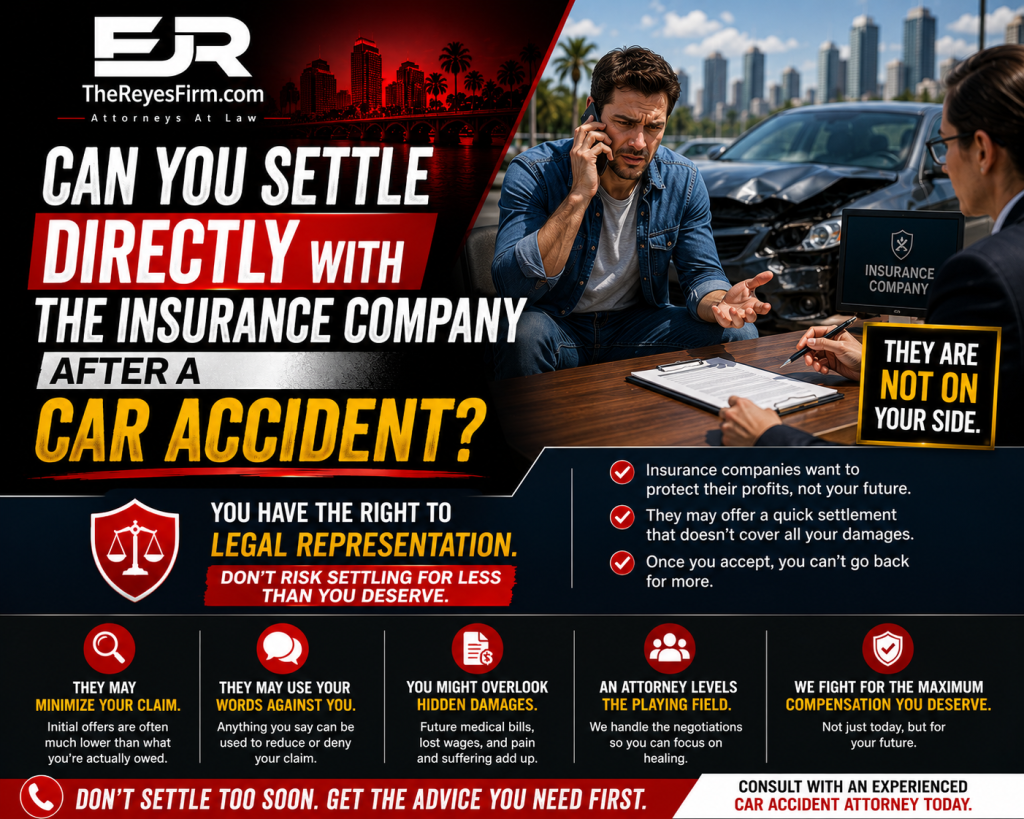
You were just going about your day. Then another driver hit you at an intersection. Now your car is damaged, your neck hurts, and the other driver’s insurance company is on the phone offering to “just work this out” with a quick check. Here’s what you need to know before you accept a dollar of it. TL;DR — QUICK SUMMARY Can you settle directly with the other driver’s insurance company? Technically yes. Should you do it alone? Almost never. The adjuster offering you money works for the insurer, and their job is to close your claim for as little as possible. Early offers rarely account for future medical care, lost wages, or injuries that surface days after the crash. Once you sign a release, you usually give up the right to ask for more, even if your condition gets worse. Under Florida Statute 95.11(3)(a), you generally have two years to file a lawsuit, but a signed release can end your claim long before that. A free consultation costs you nothing and tells you what your case is really worth before you decide. The Reyes Firm Did an Insurer Offer to “Work It Out” After a Tampa Crash? Find out what your case is really worth before you sign. Had a bad day? Contact Us Now 2 Years Florida injury filing deadline Fla. Stat. 95.11(3)(a) 14 Days Deadline to seek care for PIP benefits Fla. Stat. 627.736 50% Fault level that bars recovery in Florida Fla. Stat. 768.81 $0 Upfront cost with a contingency fee firm The Reyes Firm Can you work it out with the insurance company yourself? Technically, yes, and that’s exactly why so many people get shortchanged. Nothing in Florida law stops you from negotiating directly with the other driver’s insurer and accepting a settlement on your own. The myth isn’t whether you can. The myth is that doing it alone gets you a fair result. The person calling you is an adjuster, and the adjuster works for the insurance company. Their job is to close your claim for as little money as possible, because every dollar they save is a dollar that stays with their employer. They are friendly, they are professional, and they are negotiating against you the moment they pick up the phone. So the honest answer from The Reyes Firm, a Tampa personal injury law firm, is this: you can work it out yourself, but you usually shouldn’t, and the reason becomes obvious once you see how these offers are built. ⚠️ Deadline Warning: Under Florida Statute § 95.11(3)(a), you generally have two years from the date of your crash to file a personal injury lawsuit. But signing a settlement release ends your claim immediately, no matter how much time is left on that clock. Never sign before you know what your case is worth. Why does settling directly with the other driver’s insurer backfire? Because the first offer is almost always built around what’s visible on day one, not what your injury actually costs you over time. The dented bumper is easy to price. The herniated disc that flares up three weeks later is not, and by then you may have already cashed the check. Attorney Edward Reyes learned this firsthand. After his first car accident as a young man, someone handed him $400 and it seemed like enough. It wasn’t close. The repairs to his car ran over a thousand dollars, and the injuries he felt afterward were worth far more than that. He took the fast money before he understood the real damage, and that lesson is part of why he practices personal injury law today. That story plays out constantly. People try to handle it themselves, accept an early number to make the problem go away, and only later discover the offer didn’t cover their medical bills, their time off work, or the lasting effects of the crash. Once the release is signed, that money is final. 💡 Did You Know? Florida is a no-fault auto insurance state. Under Florida Statute § 627.736, your own Personal Injury Protection (PIP) coverage pays the first portion of your medical bills regardless of who caused the crash, up to a $10,000 minimum, but only if you seek treatment within 14 days. Settling with the other insurer doesn’t change those PIP deadlines. Source: Fla. Stat. § 627.736. Watch: Can You Work It Out With the Insurance Company? In this short video, attorney Edward Reyes busts the myth that you can simply “work it out” with the other side’s insurer, and shares the personal story that shaped how he handles these cases. If you have a settlement offer in front of you and aren’t sure what to do, The Reyes Firm offers free consultations, so you can call 833-4 BAD DAY before you respond. What is a fair settlement actually worth after a Tampa car accident? A fair settlement reflects everything the crash will cost you, not just the bills already on your kitchen table. A complete claim accounts for several categories most people overlook when they negotiate alone: Future medical care, including follow-up visits, physical therapy, imaging, and treatment for injuries that worsen over time Lost wages and lost earning capacity, covering the work you’ve already missed and any long-term limits on what you can do The full diagnosis, since soft-tissue injuries, concussions, and back injuries often don’t show their true severity for days or weeks Property damage done right, repaired or replaced at real cost, not a rounded-down estimate Pain and the disruption to your life, which an adjuster has every incentive to value at zero In a serious or catastrophic crash, the gap between the first offer and the real value of the claim can be enormous. That gap is the insurer’s profit, and it comes directly out of your recovery. 🛡️ Your Rights Under Florida Law: Under Florida Statute § 768.81, your compensation is reduced by your share of fault, and you may be barred from recovery if you are

Is your insurance company on your side
After A Car Accident, After an Accident, Legal

Is your Insurance Company really on your Side?

You were just going about your day. Then another driver ran the light and changed everything. Now you’re in pain, missing work, and the insurance company is already calling, sounding friendly and eager to “help.” Here’s what you need to know before you say another word to them. TL;DR — QUICK SUMMARY Insurance companies are businesses, and every dollar they pay you comes out of their profit, so being “on your side” is rarely their real goal. Adjusters are trained to gather statements, delay decisions, and make fast lowball offers before you know what your injuries are truly worth. Even your own insurer can fight you, but under Florida law a first-party insurer must act in good faith when handling your claim. Under Florida Statute 95.11(3)(a), you generally have two years from the date of the accident to file a personal injury lawsuit. You never have to handle the insurance company alone, and a Tampa personal injury attorney levels a fight that is otherwise stacked against you. The Reyes Firm Is the Insurance Company Pressuring You After a Tampa Accident? Get clear next steps before you accept any offer. Had a bad day? Contact Us Now 2 Years Florida injury filing deadline Fla. Stat. 95.11(3)(a) 14 Days Deadline to seek care for PIP benefits Fla. Stat. 627.736 $10,000 Florida minimum PIP coverage Fla. Stat. 627.736 $0 Upfront cost with a contingency fee firm The Reyes Firm Is your insurance company really on your side after an accident? In most cases, no, at least not in the way the commercials suggest. An insurance company is a for-profit business, and its first duty is to its shareholders and its bottom line, not to you. The friendly slogans about being in good hands or like a good neighbor are marketing, not a legal promise about how your claim will be handled. That doesn’t mean every adjuster is dishonest. Many are simply doing the job they’re trained to do, which is to resolve claims for as little as the company can reasonably pay. The problem is that their job and your recovery point in opposite directions. The less they pay you, the better they perform. The more you accept too early, the more it costs you later. At The Reyes Firm, a Tampa personal injury law firm, we see this gap between the friendly phone call and the actual offer in case after case. Understanding why it happens is the first step to protecting yourself. ⚠️ Deadline Warning: Under Florida Statute § 95.11(3)(a), you generally have two years from the date of your accident to file a personal injury lawsuit. Missing this deadline almost always means losing your right to recover anything. Don’t let an adjuster run out your clock with delays. How does an insurance company make money by paying you less? An insurer’s profit is the difference between the premiums it collects and the claims it pays out. Every claim is a cost, and reducing that cost directly increases profit. That single fact shapes almost everything an adjuster does once your file lands on their desk. This is why a claim can feel less like a conversation and more like a negotiation you didn’t agree to enter. The adjuster has handled thousands of claims. You’re handling your first. They know the value of your case, the deadlines that work against you, and the words that can quietly reduce what you’re owed. You’re focused on healing and getting your life back. None of this makes seeking insurance compensation wrong. It’s exactly what coverage exists for. It just means you should treat the process as the business transaction it is, with your own interests protected. What tactics do insurance adjusters use to reduce your payout? Adjusters rely on a predictable set of tactics, and recognizing them takes away much of their power. The most common include: The quick, friendly call. An adjuster reaches out fast, sounds sympathetic, and asks how you’re doing. Your honest “I’m okay, thanks” can later be used to argue your injuries were minor. The recorded statement. They ask to record your account “for the file.” In reality, they’re looking for anything you say that can be used to shift blame or shrink your claim. You can decline a recorded statement until you’ve spoken with a lawyer. The fast lowball offer. A check arrives before you know the full extent of your injuries. Cashing it often means signing away your right to pursue anything more, even if your condition worsens. The delay. Slow responses, repeated requests for documents, and “still reviewing” updates wear you down, especially when bills are piling up and the two-year deadline is ticking. The blame shift. They suggest you were partly at fault to cut what they owe under Florida’s comparative fault rules. Each tactic is legal. Each is also designed to serve the insurer, not you. 💡 Did You Know? Florida is a no-fault auto insurance state. Under Florida Statute § 627.736, you must seek medical treatment within 14 days of a crash to qualify for your Personal Injury Protection (PIP) benefits. Wait too long, and your own insurer can deny those benefits entirely. Source: Fla. Stat. § 627.736. Watch: Is Your Insurance Company Really on Your Side? This short video breaks down what an insurance company is actually trying to accomplish after your accident, and the simple steps that protect your claim from day one. If you have questions the video doesn’t answer, The Reyes Firm offers free consultations, so you can call 833-4 BAD DAY any time. What about your own insurance company, do they have to be fair? Your own insurer owes you more than the other driver’s does, but that doesn’t make them automatically generous. When you file a claim with your own company, this is a first-party claim, and Florida law requires your insurer to handle it in good faith. That means investigating fairly, communicating honestly, and not unreasonably denying or delaying a valid claim. When an insurer crosses that

Get the right attorney after an accident
After A Car Accident, After an Accident, FAQ, For Parents, For Teens, Legal, Pedestrian Accident, Personal Injury, personal injury attorney, Road Accidents, Settlement, Why we serve

Do you Really Need an Attorney After an Accident?

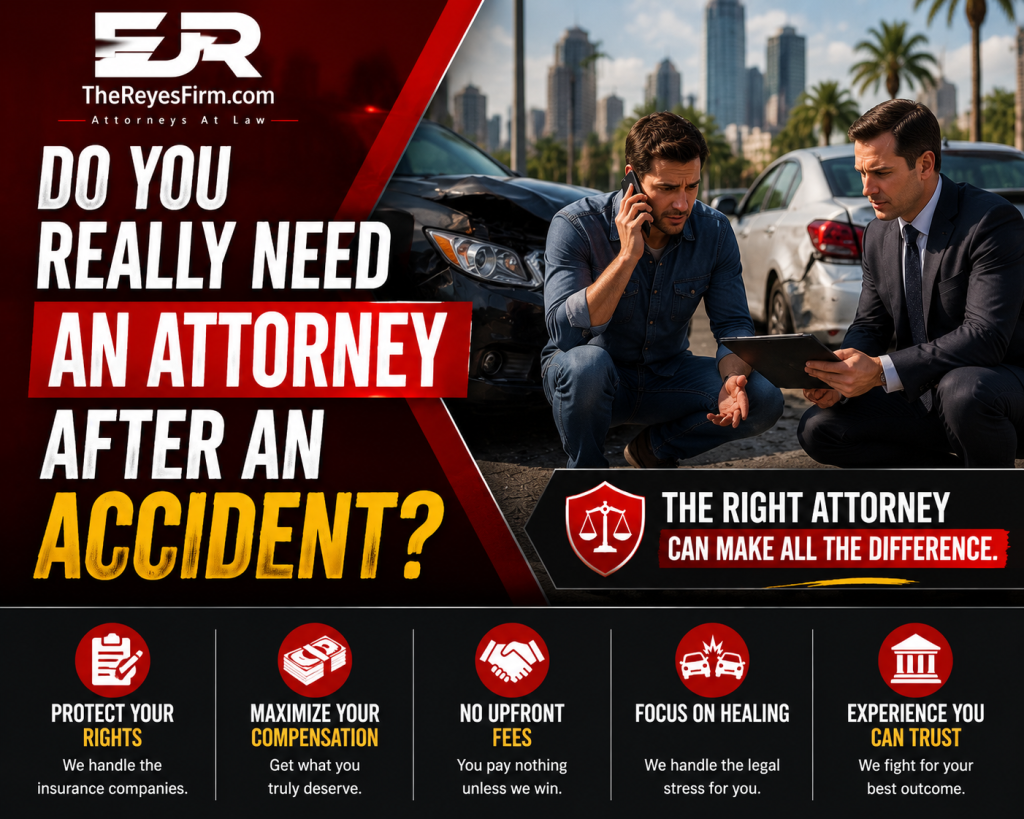
You were just going about your day. Then a car accident changed everything, and now you’re wondering whether you really need a lawyer or can just handle the insurance company yourself. Meanwhile, the adjuster who already called you sounds friendly and helpful. Here’s what you need to know before you decide to go it alone. TL;DR — QUICK SUMMARY You are not legally required to hire an attorney after an accident, but it is strongly recommended any time you’ve been injured. Insurance adjusters work for the insurance company and its policyholder, not for you, and their goal is to settle for as little as possible. An attorney levels the field by knowing the law, valuing your claim correctly, and handling the insurers so you don’t say something that hurts your case. Under Florida Statute § 95.11(3)(a), you generally have two years from the crash to file a personal injury lawsuit, so waiting too long can cost you no matter what. Most personal injury attorneys, including The Reyes Firm, work on contingency, so you pay nothing upfront and owe fees only if they recover for you. The Reyes Firm Not Sure If You Need a Lawyer? Get a free, honest answer about your accident. Had a bad day? Contact Us Now 2 Years Florida statute of limitations Fla. Stat. § 95.11(3)(a) 14 Days To seek care and keep PIP benefits Fla. Stat. § 627.736 Free Initial case consultation The Reyes Firm 50%+ Fault that bars recovery in Florida Fla. Stat. § 768.81 Do you really need an attorney after an accident in Tampa? No, you are not legally required to hire an attorney after an accident, but having one is strongly recommended any time you’ve been hurt. Think of it less as a requirement and more as a necessity, the way gum isn’t required after bad breath but is highly advisable. An attorney works in your best interest. They know when someone is trying to take advantage of you, they understand the laws that apply to your claim, and they’re ready to fight when fighting is what it takes. The other side already has trained professionals protecting their money. The question isn’t really whether you’re allowed to go it alone, but whether you should. When can you handle an accident claim without a lawyer? You can sometimes handle a claim on your own when the accident was truly minor, no one was injured, fault is clear and undisputed, and the only issue is modest property damage. In those situations, the stakes are low enough that hiring a lawyer may not change the result. The moment any of that breaks down, the calculus changes. If you were injured, if fault is in question, if multiple parties or a commercial vehicle are involved, or if the insurer is delaying or lowballing you, the value of professional help climbs fast. A free consultation is the easiest way to find out which situation you’re actually in. ⚠️ Deadline Warning: Under Florida Statute § 95.11(3)(a), you generally have two years from the date of your crash to file a personal injury lawsuit. Missing this deadline almost always means losing your right to recover anything. Don’t wait to call a lawyer. Watch: Do you really need an attorney after an accident? In this short video, Edward Reyes, Esq. explains why an attorney is less of a requirement and more of a necessity after an injury accident. If you still have questions after watching, The Reyes Firm offers a free consultation so you can talk through your specific situation with a real attorney. Why don’t insurance adjusters work in your best interest? Insurance adjusters don’t work in your best interest because they don’t work for you. The adjuster, the opposing party, and the insurance company are all working to protect their insured and their own bottom line, which means paying you as little as possible. That’s not a personal attack on adjusters; it’s their job. They’re trained negotiators who handle claims every day, while you may be doing this for the first time in your life, in pain, and under financial pressure. A friendly phone call early on is often designed to get you talking before you understand what your claim is really worth. 💡 Did You Know? You can hire an experienced Tampa injury attorney without paying anything upfront. The Reyes Firm works on a contingency fee basis, so you owe attorney fees only if the firm recovers compensation for you — which means cost is rarely a reason to face the insurance company alone. Source: The Reyes Firm fee policy. What does a personal injury attorney actually do for you? A personal injury attorney does the work that protects your recovery while you focus on healing. Rather than leaving you to guess at the process, they take over the parts that most often go wrong when people handle claims alone. In practical terms, a good attorney typically: Values your claim correctly, accounting for future medical care and long-term impact, not just the bills already in front of you Handles all communication with adjusters, so you don’t accidentally say something that gets used to reduce your payout Gathers and preserves evidence, including the police report, medical records, photos, and witness statements, before they disappear Identifies every source of coverage, including policies you may not realize apply to you Negotiates from a position of strength, and is prepared to file suit if the insurer won’t pay fairly Does a lawyer affect how much fault matters in your case? Yes, because how fault is assigned has a direct effect on what you recover, and that’s an area where representation matters. Insurers routinely try to shift blame onto the injured person to shrink what they owe. A lawyer’s job is to push back on unfair blame with the actual evidence. Even a modest reduction in your assigned share of fault can mean a meaningful difference in your recovery, which is exactly the kind of fight you don’t want to

What to Do If My Car Insurance Company Won’t Pay
Accident Injuries & why, After A Car Accident, After an Accident, Car accident, FAQ, For Parents, For Teens, Legal, Moped Accidents, Road Accidents, Settlement, Why we serve

Who is paying your medical bills if you don’t own a car or have insurance?

So what happens if you are involved in a car accident, it’s not your fault, but you don’t have insurance, but you don’t have a car? What happens then? There are a couple of things. One if you live in a household that somebody has a car and insurance you may be covered under a resident relative. Two, if you do not live in a household that someone has insurance or a car you may be covered by the person that crashed into, their auto insurance company may cover you for personal injury protection. Three, if none of those apply, you can still be covered under the other person’s policy if they have bodily injury coverage. Tampa personal injury lawyer Edward Reyes represents people in Tampa and Hillsborough County, Florida who have suffered an injury in an incident or accident type of accident. Speak Directly to Me, At No Cost, Today 813.421.3411 It won’t cover you for medical coverages as far as your personal injury protection but it will cover you for recovery for pain and suffering and then eventually it will pay back the medical expenses if you’ve incurred any. Give us a call at 813.421.3411 today. (Transcript from the video, transcribed but not reviewed)

Scroll to Top