After A Car Accident

Car accident help, we've got you covered
After A Car Accident, Car accident, Legal, Road Accidents, Uninsured Motorist Coverage, Why we serve

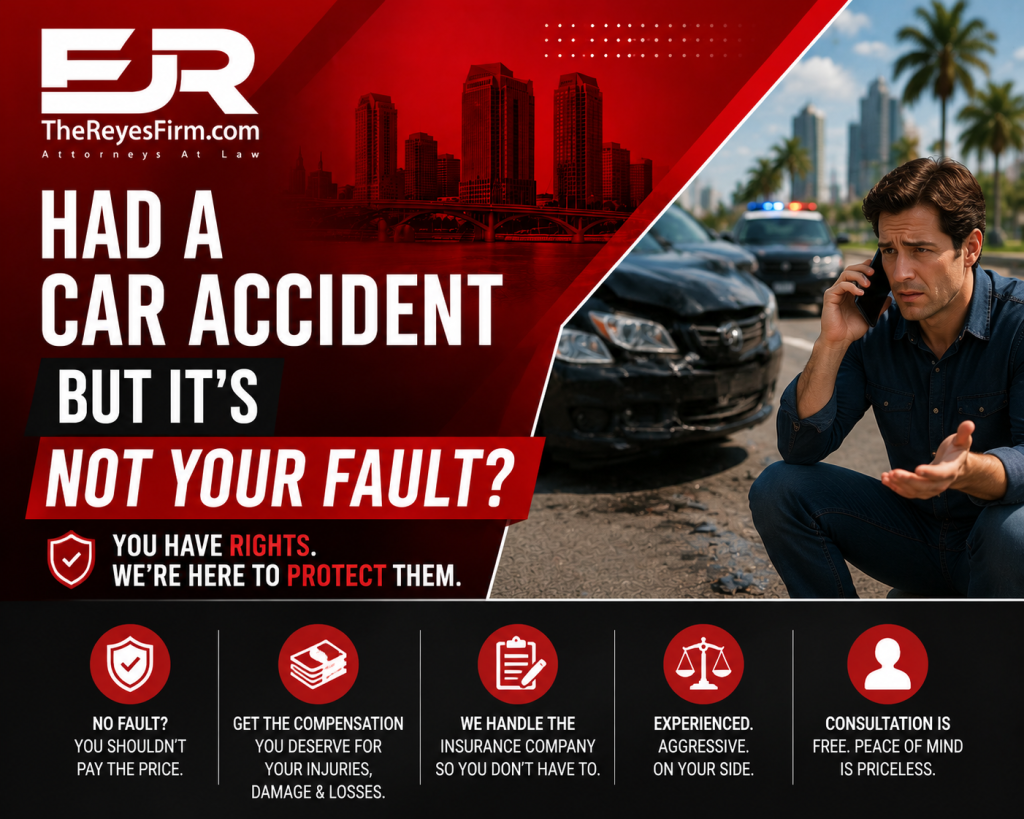
Had A Car Accident But It’s Not Your Fault?

You were just driving, walking, or biking through Tampa, doing nothing wrong. Then someone else’s mistake caused a car accident that wasn’t your fault. Now you’re hurt, worried about who pays, maybe even unsure whether your own insurance gaps will sink your claim — and the other driver’s insurer is already working to protect their interests. Here’s what you need to know before you say another word to them. TL;DR — QUICK SUMMARY If a crash wasn’t your fault, you can have a case even if you don’t carry your own insurance or weren’t in a car at all. Florida does not require drivers to carry Bodily Injury liability coverage, so whether the at-fault driver can pay for your injuries depends on what they actually carry. When the at-fault driver has no Bodily Injury coverage, your own uninsured/underinsured motorist coverage often becomes your most important source of recovery. Under Florida Statute § 95.11(3)(a), you generally have two years from the date of the crash to file a personal injury lawsuit. Florida’s comparative fault rule means partial fault reduces your recovery, but being found not at fault protects the full value of your claim. The Reyes Firm Hit in a Crash That Wasn’t Your Fault? Get clear next steps when someone else caused your wreck. Had a bad day? Contact Us Now Optional Bodily injury coverage in Florida FL Financial Responsibility Law $10,000 Florida required PIP coverage Fla. Stat. § 627.736 2 Years Florida statute of limitations Fla. Stat. § 95.11(3)(a) 50%+ Fault that bars recovery in Florida Fla. Stat. § 768.81 Do you have a case if a car accident wasn’t your fault in Tampa? Yes, if a car accident wasn’t your fault, you generally have a case against the driver who caused it. Florida law lets an injured person hold a negligent driver financially responsible for the harm they caused, whether you were behind the wheel, on foot, or on a bicycle. What changes from case to case isn’t whether you have a claim — it’s where the money to pay that claim actually comes from. That depends heavily on what insurance the at-fault driver carries and what coverage you have on your own policy. Sorting that out early is one of the most important things a lawyer does for you. Can you recover if it wasn’t your fault but you don’t have insurance? Often, yes. If the crash was caused by another driver and you were a pedestrian, a cyclist, or a scooter rider, you generally aren’t required to carry auto insurance, and you can still pursue the at-fault driver’s coverage for your injuries. It gets more complicated if you own a car and didn’t carry the Personal Injury Protection that Florida requires, because that can limit some of the benefits available to you. It doesn’t automatically erase your right to recover from the person who hurt you, but it’s exactly the kind of wrinkle you want a lawyer reviewing before you talk to any insurer. ⚠️ Deadline Warning: Under Florida Statute § 95.11(3)(a), you generally have two years from the date of your crash to file a personal injury lawsuit. Missing this deadline almost always means losing your right to recover anything. Don’t wait to call a lawyer. Watch: What to do when a crash wasn’t your fault This short video explains how recovery works after a not-at-fault crash and why the other driver’s coverage — or lack of it — makes such a difference. If you still have questions after watching, The Reyes Firm offers a free consultation so you can talk through your specific situation with a real attorney. Why doesn’t Florida require Bodily Injury coverage, and why does that matter? Florida is one of the few states that does not require most drivers to carry Bodily Injury liability coverage, which is the coverage that pays for the injuries an at-fault driver causes to other people. Drivers are required to carry Personal Injury Protection under Florida Statute § 627.736 and property damage liability, but not Bodily Injury. That matters enormously after a not-at-fault crash. If the driver who hit you carries Bodily Injury coverage, their policy can pay for your injuries even if you had no insurance of your own. If they don’t carry it, that source of money simply isn’t there, and you have to look elsewhere — which is where your own coverage comes in. 💡 Did You Know? Because Florida doesn’t require Bodily Injury liability coverage, a driver who causes your injuries may legally have no coverage to pay for them — even though the crash was entirely their fault. That’s the single biggest reason to carry uninsured/underinsured motorist coverage on your own policy. Source: Florida Financial Responsibility Law, leg.state.fl.us. What if the at-fault driver has no Bodily Injury coverage? If the at-fault driver has no Bodily Injury coverage, your own uninsured/underinsured motorist coverage often becomes your most important source of recovery. UM/UIM coverage, governed by Florida Statute § 627.727, is designed to step in exactly when the responsible driver can’t pay. This coverage can come from your own policy, and in some situations from a resident relative’s policy, even if you weren’t in a car at the time. There may also be other parties to pursue, such as an employer if the driver was working. An attorney’s job is to find every available policy so you aren’t left absorbing someone else’s mistake. Who is liable when the accident wasn’t your fault? Liability falls on whoever failed to use reasonable care, which in a not-at-fault crash is the other driver. A motorist who was speeding, distracted, ran a light, or failed to yield can be held responsible for the harm they caused, regardless of whether you carried your own insurance. In some cases more than one party shares responsibility, such as an employer whose driver was on the clock or a business that overserved an impaired driver. Identifying every responsible party matters, because each one may bring additional insurance coverage to

Car accident claims We fight back.
After A Car Accident, Car accident, Legal, Settlement, Why we serve

Car Insurance Company Won’t Pay After a Crash? | Tampa, Florida

You did everything right after your car accident. You reported the claim, you got treatment, you waited. Now the insurance company is dragging its feet, lowballing you, or flat-out refusing to pay, and you’re still in pain with bills piling up. Here’s exactly what you can do about it before you accept a penny less than your claim is worth. TL;DR — QUICK SUMMARY If a Florida insurer refuses a fair payout, you generally have two real options: reject the bad offer and negotiate, or file a lawsuit. Accepting a lowball offer is almost never the right move. Insurance adjusters are trained and paid to keep payouts low. A delay, denial, or insulting offer is a business tactic, not the final word on your case. When an insurer refuses to pay what it owes, Florida law lets you file a Civil Remedy Notice under Florida Statute § 624.155, which gives the company 60 days to fix the problem before a bad faith claim can move forward. You have two years from the date of your crash to file a personal injury lawsuit in Florida under Florida Statute § 95.11(3)(a). Waiting too long can cost you the right to recover anything. Under Florida’s no-fault system, your own PIP coverage pays first up to $10,000, but serious injuries can open the door to a claim against the at-fault driver and their insurer. The Reyes Firm Insurance Company Won’t Pay After a Tampa Crash? Get clear next steps when an adjuster delays, denies, or lowballs your claim. Had a bad day? Contact Us Now 2 Years Florida statute of limitations Fla. Stat. § 95.11(3)(a) 60 Days Insurer’s window to cure bad faith Fla. Stat. § 624.155 $10,000 Florida PIP minimum coverage Fla. Stat. § 627.736 50% Fault bar to recovery in FL Fla. Stat. § 768.81 Why won’t my car insurance company pay after a car accident? An insurance company refuses to pay because paying less is how it protects its bottom line, not because your injuries aren’t real. Whether it’s your own insurer or the at-fault driver’s, the adjuster handling your file is one of dozens of people whose job is to close claims for as little money as possible. You are one of hundreds of files on that adjuster’s desk. Some are reasonable. Others delay, deny, and dispute everything, hoping you’ll get frustrated and take whatever they offer. None of that changes what your claim is actually worth, and none of it is the final answer. Common reasons an insurer gives for not paying include disputing who was at fault, claiming your injuries existed before the crash, arguing your treatment wasn’t necessary, or simply making an offer so low it doesn’t begin to cover your medical bills and lost wages. Each of those positions can be challenged with the right evidence. What does it mean when a car insurance company acts in bad faith in Florida? Bad faith means an insurance company has failed to settle a claim fairly and honestly when it had the chance to do so. Florida law requires insurers to act in good faith toward the people they cover and toward injured claimants, and when they don’t, you may have a separate legal claim against the company itself. Under Florida Statute § 624.155, an insurer can be held liable for not attempting in good faith to settle a claim when it could and should have. Examples include ignoring clear evidence, refusing to explain a denial, or sitting on a reasonable demand without responding. Bad faith is not the same as a low offer you simply disagree with. It involves conduct that crosses the line from hard negotiation into a refusal to do what the law and the policy require. A Tampa personal injury attorney can tell you whether what you’re experiencing rises to that level. ⚠️ Deadline Warning: Under Florida Statute § 95.11(3)(a), you have two years from the date of your crash to file a personal injury lawsuit. Missing this deadline almost always means losing your right to recover anything, no matter how strong your case is. Don’t let an insurer run out the clock on you. Watch: What to do when your insurance company won’t pay in Tampa In this short video, Tampa personal injury attorney Edward Reyes explains your options when an insurer makes a bad offer or refuses to move on your claim. If an adjuster has already given you a number that doesn’t feel right, The Reyes Firm offers free consultations to review the offer before you sign anything. What is a Civil Remedy Notice and how does it pressure the insurer? A Civil Remedy Notice is a formal filing that tells Florida’s Department of Financial Services in Tallahassee that an insurance company is acting in bad faith. It is one of the strongest tools available when an insurer should have paid and hasn’t. Under Fla. Stat. § 624.155, once a Civil Remedy Notice is filed, the insurance company has 60 days to cure the violation, meaning it can pay what it owes and avoid a bad faith lawsuit. The notice gets the file in front of a supervisor and puts the company on official record. If the 60 days pass and nothing changes, the next step is usually filing a lawsuit. That decision is never automatic. We walk you through exactly what litigation involves before you commit to it, including the discovery questions both sides have to answer. 💡 Did You Know? Florida is a no-fault insurance state. Under Florida Statute § 627.736, your own Personal Injury Protection (PIP) coverage pays up to $10,000 in medical bills and lost wages regardless of who caused the crash. But PIP rarely covers a serious injury in full, and that gap is often where insurance disputes begin. Should I accept a low settlement offer or file a lawsuit? You should almost never accept a low offer when your injuries are serious and the number doesn’t cover your losses. Once you sign a release,

How to navigate insurance claims after accidents
After A Car Accident, After an Accident, Car accident

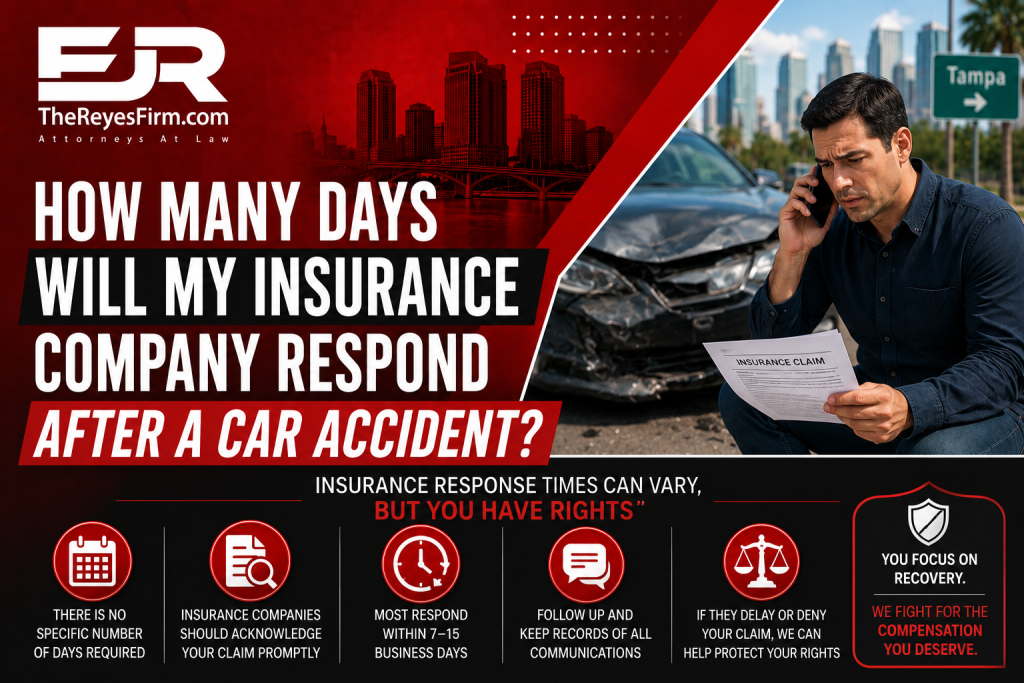
How Many Days Will My Insurance Company Respond After A Car Accident?

You were rear-ended on your way through Tampa, you did everything right, and you filed your claim. Now the days are passing with no answer, the medical bills are arriving, and you’re starting to wonder whether the insurance company is ever going to call back. Here’s exactly how long they have to respond after a Florida car accident, and what you can do when they drag their feet. TL;DR — QUICK SUMMARY Your own PIP insurer must pay or deny your claim within 30 days of receiving written notice under Florida Statute 627.736(4)(b). Insurers are expected to acknowledge a new claim promptly, generally within about 14 days, even though the full investigation takes longer. Once you and the insurer agree on a settlement, they have 20 days to pay it under Florida Statute 627.4265, or interest starts to accrue. A claim against the at-fault driver’s insurer has no fixed response deadline, which is why those claims can stall for months. You have two years from the crash to file a personal injury lawsuit under Florida Statute 95.11(3)(a), so an insurer’s delay should never push you past that line. The Reyes Firm Is the Insurance Company Ignoring You? Get clear answers about your Tampa car accident claim. Had a bad day? Contact Us Now 30 Days For your insurer to pay or deny PIP Fla. Stat. 627.736(4)(b) 20 Days To pay an agreed settlement Fla. Stat. 627.4265 14 Days To seek treatment for PIP eligibility Fla. Stat. 627.736 2 Years To file an injury lawsuit Fla. Stat. 95.11(3)(a) How many days does an insurance company have to respond after a car accident in Florida? It depends on the type of claim, but the short answer is that your own no-fault insurer must pay or deny a Personal Injury Protection (PIP) claim within 30 days, while a claim against the other driver’s insurer has no fixed deadline at all. Florida law also expects any insurer to acknowledge a new claim promptly, generally within about 14 days, even though the full investigation takes longer than that. That gap between a quick acknowledgment and a slow resolution is where most of the frustration lives. An insurer can confirm it received your claim, then take weeks or months to actually decide what it will pay. Knowing which deadline applies to your situation tells you whether the delay you’re experiencing is normal or a warning sign. How long does your own PIP insurer have to pay or deny your claim? Your own PIP insurer has 30 days to pay or deny your claim after it receives written notice of the loss. This deadline comes from Florida Statute § 627.736(4)(b), and Florida applies a “mailbox rule,” meaning the insurer complies as long as the payment is postmarked by the 30th day. There is a catch that falls on you first. To qualify for PIP benefits at all, you must seek medical treatment within 14 days of the crash. Miss that window and your insurer can deny PIP coverage entirely, no matter how serious your injuries turn out to be. If you submit your bills in pieces, the insurer gets a fresh 30 days to pay each portion as it comes in, and if it denies part of your claim over a clerical mistake, you generally have 15 days to fix and resubmit it. 💡 Did You Know? Under Florida’s no-fault law, your PIP insurer must pay or deny your claim within 30 days of receiving written notice, and the payment only needs to be postmarked by day 30 to count. Florida also requires you to seek medical treatment within 14 days of the crash to keep your PIP benefits at all. Source: Fla. Stat. § 627.736, leg.state.fl.us. What about a claim against the other driver’s insurance company? A claim against the at-fault driver’s insurer works very differently, because there is no statutory deadline forcing a third-party liability insurer to respond by a set date. Instead, the insurer only has to investigate and decide within a “reasonable” period, which gives it far more room to take its time than your own PIP carrier has. This is the kind of claim that can stretch on for months, especially when injuries are serious, fault is disputed, or a commercial policy is involved, such as in a truck or commercial vehicle crash. The lack of a hard deadline does not mean the insurer can stall forever, and it does not stop your own clock from running. Whatever the other side does, you still have a firm deadline to protect your right to sue. ⚠️ Deadline Warning: Under Florida Statute § 95.11(3)(a), you have two years from the date of your crash to file a personal injury lawsuit. Missing this deadline almost always means losing your right to recover anything. Don’t wait to call a lawyer. Watch: What to do when an insurance company delays your car accident claim This short video explains the warning signs that an insurer is stalling and the first moves that keep your claim on track. If your claim is stuck, The Reyes Firm offers free consultations and can tell you where you stand at no cost. Why do insurance companies delay responding after a car accident? Insurers delay because slowing a claim down often costs them less. The longer a claim drags, the more likely an injured person grows anxious about mounting bills and accepts a quick, low settlement just to make the waiting stop. Common tactics include requesting the same documents more than once, questioning whether your injuries really came from the crash, disputing who was at fault, and simply going quiet for long stretches. Florida follows a comparative fault rule, so one of the most common moves is trying to pin part of the blame on you in order to shrink what the insurer owes. 🛡️ Your Rights Under Florida Law: Under Florida Statute § 768.81, your compensation is reduced by your share of fault, and you may be barred from recovery if

Car Accident
Accident Injuries & why, After A Car Accident, After an Accident, Car accident, FAQ, For Parents, For Teens, Health, Injury, Legal, Settlement, Why we serve

Car Accident? What Happens Next?

So, you went through the whole process. You got treated, you went to the doctor, you did everything you’re supposed to do for your injuries and to recover. So, what happens next? Well, the doctors, the urgent care facilities, the medical doctor, the spine specialist, the MRIs, everybody else. We request the records, or they’ll send us the records for your treatment. Now that we get all the records, we can create the story of what are you and how does this accident affected your life. I have to get the medical records so we can put together a demand for settlement. Now that tells us about your medical records, that tells us a lot of things about what’s hurting you and how this has affected your life per the doctor’s perspective from what you’ve told them during your exams. Now, one of the things that we like to do as a firm- we do an impact sheet. How has the accident impacted your life, that’s the most important part because in litigation there are two parts? There are economic damages which are your heart damages meaning what did you lose as far as monetary, how much are your medical bills cost-wise. Tampa personal injury lawyer Edward Reyes represents people in Tampa and Hillsborough County, Florida who have suffered an injury in an incident or accident type of accident. Speak Directly to Me, At No Cost, Today 813.421.3411 But then there’s the whole other part of life that has affected your life or your relationship with your kids. How it has affected your life while brushing your teeth, tying your shoes, playing, doing all these things. So, we want to know the story of how it has affected you, not just the cost of treatment but how does that affect you in your life and going forward. Now that will give us a full story or a much better story to wrap it up in a pretty bow to put it in front of the insurance company so they can understand you as a person and not you as just a piece of paper. So, it’s very important to put the general damages, which is how it affected your life your actual life and the economic damages which is how much did it cost because if you’ve gone through this issue, did you miss work, did you have to go to the multiple visit, did you spend a lot of money back with gas and time mending opportunity things that you missed out. All these things are important to correctly tell the story to the adjuster from the insurance company. Now we can start the negotiations. That’s what we have to do to prepare a demand for settlement. If you have any questions, call us at 813.421.3411. (Transcript from the video, transcribed but not reviewed)

Car insurance rates after a crash
After A Car Accident, Settlement

What Affects Your Car Insurance Rates After a Crash?

You were just in a crash, and beyond the dented bumper and the sore neck, a nagging worry sets in: is this going to spike my premium? The honest answer is that it depends, and understanding what it depends on puts you in a much stronger position. Here is what actually drives your car insurance rates after a car accident in Florida, and what you can do about it. The Reyes Firm Worried About Your Rates After a Tampa Crash? Know your rights before your insurer makes a move. Had a bad day? Contact Us Now Not at Fault Rates generally should not rise for this alone Fla. Stat. § 626.9541 Your History Repeated claims matter more than one crash Insurer rating factor Your ZIP Code Where you live affects your premium Territory rating 2 Years Deadline to file an injury claim Fla. Stat. § 95.11 The fear of a rate hike after a crash is real, and it stops some people from doing things they should do, like using their own coverage or filing a legitimate claim. The truth is more nuanced than a simple yes or no. Your premium is shaped by several factors, only some of which have anything to do with the crash you were just in. Will your car insurance rates go up after a crash? It depends, and the most honest answer is yes, no, or maybe, depending on the circumstances. The outcome turns on a handful of factors: whether you were at fault, how many claims you have had, where you live, and the business decisions your insurer makes about its book of customers. A single not-at-fault crash sits at the low-risk end of that spectrum. Understanding which of these factors applies to you is the key to knowing what to expect, and to spotting an increase that should not be happening in the first place. When should your rates not go up? As a general rule, if the crash was not your fault, your premium should not increase because of it. When another driver causes the wreck, their insurance is responsible for the damage, and Florida law under Florida Statute § 626.9541 generally prohibits an insurer from surcharging you or refusing to renew your policy solely because you were in an accident, absent a good-faith finding that you were substantially at fault. A single claim, especially a not-at-fault one, also should not by itself push your rates up. We cover the specific legal protections against improper surcharges, including the situations that entitle you to a reimbursement, in depth in our guide to what happens to your rates after a car accident. That article is the place to go if you believe you have been surcharged unfairly. What factors actually make your rates rise? Several factors genuinely influence your premium, and most have to do with risk rather than any single crash: Fault and your at-fault history. Being at fault in a crash, and especially having a pattern of at-fault accidents, is the factor most likely to raise your rates. Frequency of claims. One claim is one thing. Several claims in a short span, even minor ones, signal risk to an insurer and can drive an increase. Where you live. Insurers rate by territory, so a ZIP code with high rates of accidents, theft, or vandalism can raise premiums for everyone in it, regardless of individual fault. Your driving record. Tickets, moving violations, and prior incidents all factor into how an insurer prices your policy. Coverage and vehicle changes. Adding a vehicle or a driver, changing your coverage, or switching to a more expensive car to insure can all move your premium. Notice how few of these are about a single not-at-fault accident. That is the point. A crash that was not your fault is usually a small factor compared to your overall risk profile. 💡 Did You Know? There is a difference between a surcharge and a rate increase. A surcharge is aimed at you specifically because of your accident, and Florida law limits when an insurer can impose one. A general rate increase applies to everyone in your area or risk class, and it can raise your premium even with a spotless record, because it is not tied to your individual accident at all. Why do insurers raise rates even when it’s not your fault? Here is the reality the fine print does not advertise: an insurance company is a business, and its pricing decisions serve that business. Even when you did nothing wrong, an insurer may adjust rates across a region based on claim frequency, repair costs, litigation trends, and its own financial targets. Those increases are spread across many customers, and they are not a surcharge tied to your specific crash. In some cases, repeated claims can also lead an insurer to price a customer higher or decline to renew, which is sometimes a way of steering higher-risk customers elsewhere. None of this means you did anything wrong, and it does not mean an improper surcharge is acceptable. It simply means it helps to understand the difference between a lawful business decision and a surcharge the law limits, so you know when to push back. 🛡️ Your Rights Under Florida Law: Florida law protects you from being surcharged solely because you were in a not-at-fault accident, and it lists specific situations that entitle you to have an improper surcharge reimbursed or your policy renewed. You also have the right to ask your insurer for the proof of fault behind any increase. We explain these protections in detail in our guide on your rates after a car accident. What can you do if your rates go up? You are not powerless when your premium rises. A few practical steps can protect you: Ask your insurer for the reason. You are entitled to understand why your rate changed, and to request the proof of fault behind any accident-based surcharge. Shop around. Insurers weigh the same factors differently, so a rate

I Just Had A Car Accident
Accident Injuries & why, After A Car Accident, After an Accident, Car accident, For Parents, For Teens, Health, Injury, Legal, Settlement, Why we serve

I Just Had A Car Accident, How Long Does My Case Take?

You are probably wondering, how long does my case? Your case will depend on a lot of factors. If you have big injuries and there is a low policy, many times the insurance company would not want to pay right away because they know they are putting their clients at risk. This does not mean that it’s a good position for you because depending on circumstances, that may be all that you can get. Now, there are all the things that can happen within that, but it gets a bit more complicated. The insurance company in good effort must do everything compliant with the demands of the compliant. That is the first. Next, you have big injuries, bad injuries- big policy. Yes, that sounds like a good idea, however sometimes when the policy is big, the insurance company will fight it because they have enough money to fight it. With that being said, if you bad injuries and big policy, the chances of recovery are much greater. Case scenario number three, you have little injuries, big policy. The insurance company has a lot of money to fight, so it takes much longer to settle the case. Case option number four, you have big injuries, decent policy. Now, this is a more realistic scenario. When this happens, you have bad injuries and your coverage is valued out what the injuries could be, now the insurance offer is more reasonable. Tampa personal injury lawyer Edward Reyes represents people in Tampa and Hillsborough County, Florida who have suffered an injury in an incident or accident type of accident. Speak Directly to Me, At No Cost, Today 813.421.3411 At the end of the day, the insurance company has adjusters that work for them. Their job is to adjust claims down. Their job is not to pay you, but they are trying to reduce the amount for their company. That is what they are paid to do, so do not take it personally. They do not know you; they only know what’s on paper. So, if you feel that the adjusters are not treating you fairly, that is where we have to put more pressure, we have to use techniques so they raise the offer and we may have to file a suit. By filing suit, it comes in the hands of the adjusters and goes to the hands of another person which is the litigation adjuster and an attorney. If you have questions on this, call us at 813.421.3411. (Transcript from the video, transcribed but not reviewed)

When to see a doctor after an accident
Accident Injuries & why, After A Car Accident, After an Accident, FAQ, For Parents, For Teens, Health, Injury, Traumatic injury, Why we serve

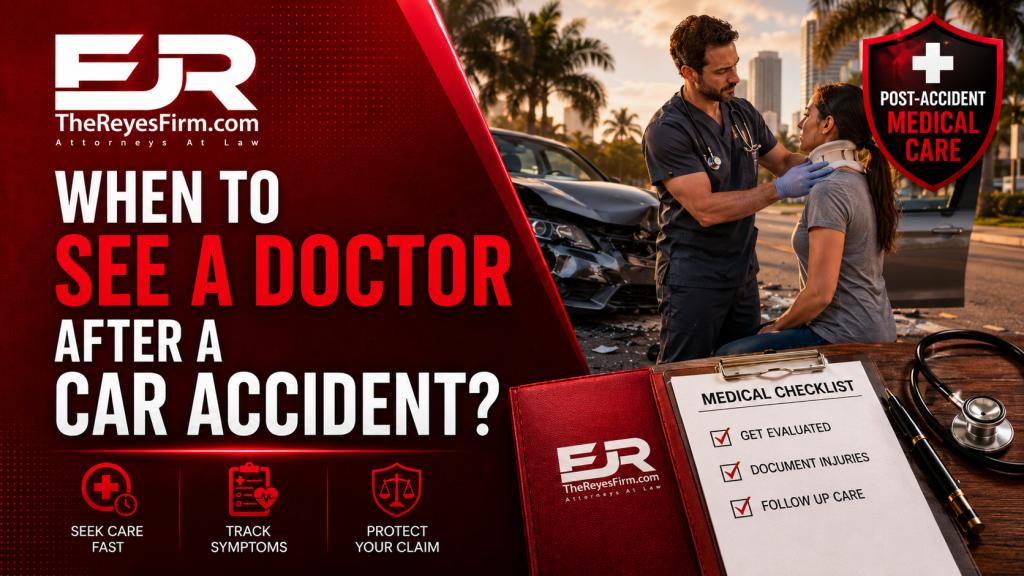
When to See A Doctor After A Car Accident?

You were just going about your day. Then a Tampa car accident changed everything. Now you’re sore but not sure if it’s “really” an injury, and the other driver’s insurance team is already working to protect their interests. Here’s what you need to know about seeing a doctor — before you say another word to them. TL;DR — QUICK SUMMARY See a doctor within 24 to 72 hours of any Florida car accident, even if you feel “fine” — adrenaline and shock routinely mask concussions, internal injuries, and soft-tissue damage. Florida’s no-fault PIP law under Florida Statute § 627.736 requires you to obtain initial medical services within 14 days of the crash or lose your $10,000 in PIP benefits entirely. Gaps in treatment are the single most common reason insurance adjusters reduce or deny a Tampa car accident claim — every missed appointment is leverage for the other side. Florida Statute § 95.11(3)(a) gives you two years from the date of the crash to file a personal injury lawsuit, but the medical record you build in the first month often decides what your case is worth. You do not have to use the at-fault driver’s “preferred” doctor; you have the right to choose your own physician and to be evaluated for delayed-onset injuries like whiplash, concussion, and disc damage. The Reyes Firm Hurt in a Tampa Car Accident? Get clear next steps before the 14-day PIP deadline. Had a bad day? Contact Us Now 14 Days FL PIP medical deadline Fla. Stat. § 627.736 $10,000 Florida PIP benefit limit Fla. Stat. § 627.736 2 Years FL statute of limitations Fla. Stat. § 95.11(3)(a) 72 Hours Delayed injury window Mayo Clinic / CDC guidance When should you see a doctor after a car accident in Tampa? You should see a doctor within 24 to 72 hours of any Florida car accident, ideally the same day. Even a “minor” crash transfers enough force to cause whiplash, concussion, internal bleeding, and soft-tissue damage that you may not feel at the scene because adrenaline and shock chemistry suppress pain signals for hours, sometimes days. By the time the discomfort actually shows up, the injury has often already begun to worsen. The honest answer most people don’t hear from the at-fault driver’s insurer: it doesn’t matter how “fine” you feel walking away. The standard medical guidance is to be evaluated as soon as possible after any collision involving airbag deployment, head impact, neck strain, abdominal contact with a seatbelt, or any loss of consciousness — and frankly, after any crash where another vehicle hit yours at speed. ⚠️ Deadline Warning: Under Florida Statute § 95.11(3)(a), you have two years from the date of your crash to file a personal injury lawsuit. But you have only 14 days to start medical treatment to keep your $10,000 in Florida PIP benefits under § 627.736. Miss the 14-day window and you lose your no-fault coverage entirely. Don’t wait to call a lawyer or a doctor. Why is the 14-day PIP rule so important after a Florida car accident? Florida is a no-fault auto insurance state, which means your own Personal Injury Protection (PIP) coverage pays the first $10,000 of your medical bills regardless of who caused the crash — but only if you obtain “initial services and care” within 14 days of the accident. This deadline is written directly into Florida Statute § 627.736 and the insurance industry enforces it strictly. Two things go wrong when people miss the 14-day deadline. First, they lose access to PIP coverage entirely, which means thousands of dollars of medical bills come out of their own pocket or get pushed onto their health insurance. Second, the gap between the crash and the first medical visit becomes the at-fault driver’s favorite argument — that you weren’t really hurt, or that the injury came from something else. The 14-day rule isn’t just an insurance technicality; it’s a legal trap for people who try to “tough it out.” What injuries are commonly missed at the scene of a Tampa car accident? The most dangerous car accident injuries are the ones that don’t show up at the scene. Emergency responders are trained to triage life-threatening trauma first, and many serious injuries simply don’t produce visible symptoms in the minutes after a crash. By the time the symptoms catch up to you, the underlying damage may be days or weeks ahead of the pain. Injuries that commonly stay hidden in the first 24 to 72 hours include: Concussion and mild traumatic brain injury — headache, brain fog, light sensitivity, sleep disruption, and memory problems often start a full day or two after impact, especially when there was no loss of consciousness Whiplash and cervical strain — neck stiffness and reduced range of motion typically peak between 24 and 72 hours, long after the adrenaline has worn off Herniated and bulging discs — radiating pain, numbness, or weakness in an arm or leg can take weeks to fully present, even though the disc injury occurred at impact Internal bleeding and organ damage — abdominal pain, lightheadedness, and bruising after a seatbelt impact can signal a life-threatening injury that needs immediate imaging Soft-tissue and ligament tears — shoulder, knee, and wrist injuries often feel like soreness at first and only declare themselves when swelling and inflammation peak Psychological injury — anxiety, intrusive thoughts, sleep disruption, and avoidance of driving are real, compensable injuries that need clinical documentation 💡 Did You Know? According to FLHSMV’s 2024 “By the Numbers” report, Florida recorded more than 395,000 crashes in 2024, with roughly 247,000 injuries reported statewide. Hillsborough County alone consistently ranks among the top three Florida counties for traffic crashes. Source: FLHSMV By the Numbers 2024, flhsmv.gov. Note: 2024 crash numbers are preliminary. Which doctor should you see first after a car accident in Tampa? The right first stop depends on what you’re feeling, but the rule of thumb is to go higher rather than lower. If there is any chance

Next steps after a car accident
After A Car Accident, After an Accident

What Is The Next Process You Have To Do After A Car Accident?

You were just driving home like any other day. Then another driver wasn’t paying attention and a car accident changed everything. Now you’re shaken, hurting, unsure what to do next, and the other driver’s insurance company is already working to protect their interests. Here’s the exact process to follow before you say another word to them. TL;DR — QUICK SUMMARY Your first moves after a crash — calling 911, getting medical care, and documenting the scene — protect both your health and your future claim. Florida is a no-fault state, so you must seek medical treatment within 14 days to keep your Personal Injury Protection benefits. Never give a recorded statement or accept a fast settlement from the other driver’s insurer before you understand your injuries. Under Florida Statute § 95.11(3)(a), you generally have two years from the date of the crash to file a personal injury lawsuit. If another driver’s negligence injured you, you may recover beyond PIP through their bodily injury liability coverage and your own uninsured motorist coverage. The Reyes Firm Hurt in a Car Accident in Tampa? Get clear next steps after a serious crash. Had a bad day? Contact Us Now 14 Days To seek care and keep PIP benefits Fla. Stat. § 627.736 $10,000 Florida minimum PIP coverage Fla. Stat. § 627.736 2 Years Florida statute of limitations Fla. Stat. § 95.11(3)(a) 50%+ Fault that bars recovery in Florida Fla. Stat. § 768.81 What is the first thing you should do after a car accident in Tampa? The first thing to do after a car accident in Tampa is make sure everyone is safe, then call 911. Even if the crash seems minor, an official police report creates a neutral record of what happened, who was involved, and that emergency responders were notified — and that record becomes one of the most important pieces of evidence in your claim. Once you’re safe and the police are on the way, your focus shifts to two things at the same time: protecting your health and protecting your case. The choices you make in the first hours and days often shape what you’re able to recover later. Can you file a claim after a car accident in Tampa, Florida? Yes, you can file a claim after a car accident in Tampa if another driver’s negligence caused or contributed to the crash. A driver who was speeding, distracted, ran a red light, or failed to yield can be held financially responsible for your medical bills, lost wages, and pain and suffering. The key is acting before the deadline passes and before evidence disappears. Vehicles get repaired, surveillance footage gets overwritten, and witness memories fade within days. The sooner a Tampa car accident lawyer starts preserving the facts, the stronger your claim tends to be. ⚠️ Deadline Warning: Under Florida Statute § 95.11(3)(a), you generally have two years from the date of your crash to file a personal injury lawsuit. Missing this deadline almost always means losing your right to recover anything. Don’t wait to call a lawyer. Watch: What to do after a car accident in Tampa This short video walks through the steps to take in the minutes and days after a crash to protect your health and your claim. If you have questions after watching, The Reyes Firm offers a free consultation so you can talk through your specific situation with a real attorney. How does Florida’s no-fault insurance work after a car accident? Florida is a no-fault state, which means your own Personal Injury Protection coverage pays first after a crash, regardless of who caused it. Under Florida Statute § 627.736, PIP covers a portion of your medical bills and lost wages up to your policy limit, commonly $10,000. There’s a critical catch: you must seek medical treatment within 14 days of the crash, or you can lose your PIP benefits entirely. And because PIP only goes so far, drivers with serious injuries often need to step outside the no-fault system and pursue the at-fault driver directly for the rest of their losses. 💡 Did You Know? Florida’s no-fault law requires you to seek medical care within 14 days of a crash to qualify for Personal Injury Protection benefits. Wait longer, and your insurer can deny PIP coverage for those injuries — even if the other driver was clearly at fault. Source: Fla. Stat. § 627.736, leg.state.fl.us. Who is liable after a car accident in Tampa? Liability after a car accident comes down to who failed to use reasonable care, and most often that’s the other driver. A motorist who was texting, tailgating, running a light, or driving impaired can be held responsible for the harm they caused. Sometimes more than one party shares fault. An employer whose driver was working at the time, a vehicle or parts manufacturer, a maintenance shop, or a government entity responsible for a dangerous road condition can all be pulled into a claim. Identifying every responsible party matters, because it often determines how much insurance coverage is actually available to pay for your injuries. 🛡️ Your Rights Under Florida Law: Under Florida Statute § 768.81, your compensation is reduced by your share of fault, and you may be barred from recovery if you are found greater than 50% responsible for your own harm. An experienced Tampa car accident lawyer works to protect the facts, challenge unfair blame, and keep your percentage of fault as low as the evidence allows. What is a car accident case worth in Tampa, Florida? There’s no flat dollar figure, because a car accident case is worth what your specific losses add up to. Two crashes that look similar on paper can settle very differently depending on the severity of the injuries and how the wreck has changed your life. The value of your claim generally reflects past and future medical treatment, lost wages and lost earning capacity, rehabilitation costs, property damage, and the physical pain and emotional toll you carry. Serious outcomes —

Who will fix your car?
After A Car Accident, Body Shops, Car accident, FAQ, Uninsured Motorists Coverage, Why we serve

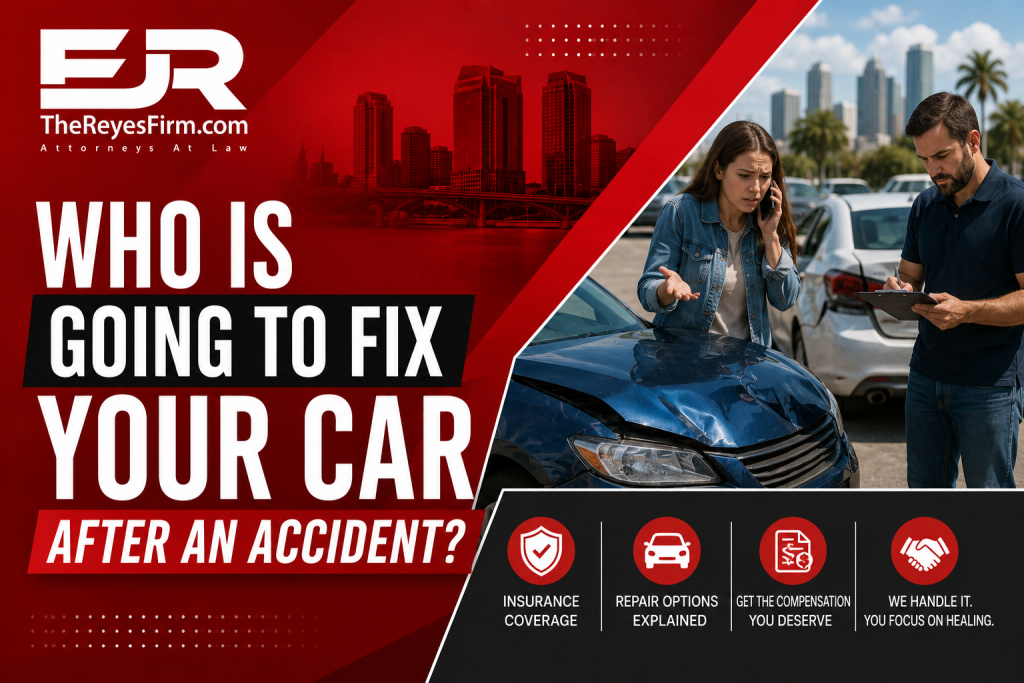
Who Is Going to Fix Your Car After an Accident?

You were just driving through Tampa, minding your own day. Then another driver’s mistake left your car damaged in a crash you didn’t cause. Now you’re staring at a wrecked vehicle, wondering how you’ll get to work, and the insurance adjusters are already deciding how little they can pay you. Here’s what you need to know before you sign anything or accept their first offer. TL;DR — QUICK SUMMARY In Florida, car repairs are paid based on fault, not no-fault — the at-fault driver’s Property Damage Liability coverage is responsible for fixing your vehicle. You have two main options: file through your own collision coverage (you pay your deductible up front) or file directly against the at-fault driver’s insurance (no deductible, but slower if liability is disputed). If you use your own collision coverage, your insurer can pursue the at-fault party and refund your deductible once it recovers — so you are not stuck paying it permanently. Florida property damage claims carry a four-year deadline under Florida Statute § 95.11(3), but any related injury lawsuit must be filed within two years under Fla. Stat. § 95.11(3)(a). Florida’s minimum Property Damage Liability coverage is only $10,000, which often will not cover repairs to a newer vehicle — so identifying every source of coverage matters. The Reyes Firm Car Damaged in a Tampa Accident That Wasn’t Your Fault? Get clear next steps on who pays to fix your car and how much you’re owed. Had a bad day? Contact Us Now $10,000 FL minimum Property Damage Liability Fla. Stat. § 627.7275 $10,000 FL minimum PIP (injuries only) Fla. Stat. § 627.736 4 Years FL property damage claim deadline Fla. Stat. § 95.11(3) 2 Years FL injury lawsuit deadline Fla. Stat. § 95.11(3)(a) Who is responsible for fixing your car after an accident in Tampa? The driver who caused the crash is responsible for the damage to your car — and in Florida, that means their Property Damage Liability insurance should pay to repair or replace your vehicle. This surprises a lot of people, because Florida is known as a “no-fault” state. No-fault only applies to your medical bills and injuries through Personal Injury Protection. When it comes to your car itself, fault still controls who pays. That distinction matters because it gives you a choice. You can route the repair through your own insurance company, or you can pursue the at-fault driver’s insurer directly. The Reyes Firm, a Tampa personal injury firm that handles crash claims across Hillsborough County and the surrounding region, sees clients pushed toward whichever option is cheaper for the insurance company — not whichever is better for you. ⚠️ Deadline Warning: If you were injured in the crash, Florida law gives you only two years to file a personal injury lawsuit under Florida Statute § 95.11(3)(a). Claims for the damage to your vehicle alone have a longer four-year window, but missing either deadline can permanently end your right to recover. Don’t wait to call a lawyer. Should you use your own insurance or the at-fault driver’s insurance to fix your car? Both options can get your car repaired, but they work very differently, and the right one depends on your coverage and how clear fault is. Here’s how each path actually plays out. Option 1 — Your own collision coverage. If you carry collision coverage, your insurer will arrange the repair quickly, often before fault is even sorted out. The catch is your deductible: you pay it up front before the work is done. The upside is speed and the freedom to choose your own repair shop rather than one the other insurer steers you toward. Option 2 — The at-fault driver’s Property Damage Liability coverage. If the other driver was clearly at fault, their insurer is legally responsible for your repairs, and you pay no deductible. The trade-off is timing. The at-fault insurer typically sends an adjuster to inspect your car before approving anything, and if they dispute who caused the crash, the repair can stall while they investigate. When liability is obvious, going through the at-fault driver’s insurer avoids your deductible entirely. When fault is contested or you need your car back fast, your own collision coverage usually gets you moving sooner. 💡 Did You Know? Florida only requires drivers to carry $10,000 in Property Damage Liability coverage under Fla. Stat. § 627.7275. On a newer vehicle, $10,000 often falls far short of the actual repair or replacement cost — which is why identifying every available source of coverage, including your own policy, can be the difference between a full repair and an out-of-pocket loss. Source: Fla. Stat. § 627.7275, leg.state.fl.us. Does Florida’s no-fault insurance cover car repairs? No — Florida’s no-fault system does not pay to fix your car. Personal Injury Protection under Florida Statute § 627.736 covers your own medical bills and a portion of lost wages regardless of who caused the crash, but it stops at injuries. The damage to your vehicle is treated as a fault-based property damage claim, separate from your PIP benefits. This is why two people in the same accident can have very different experiences. Your medical treatment runs through PIP no matter what, while the repair to your car depends entirely on proving who was responsible. Keeping those two claims straight — and making sure neither one is shortchanged — is a large part of what a Tampa car accident attorney does. Who pays if the other driver was clearly at fault? When the other driver caused the crash, their Property Damage Liability insurer owes you the cost to repair your vehicle, or its fair value if it’s totaled. If you go through your own collision coverage instead, your insurer can then pursue the at-fault party through a process called subrogation — and once it recovers, it refunds your deductible to you. So even if you pay the deductible at the shop, you are not necessarily stuck with that cost forever. You may also be owed more

Medical treatment after a crash explained
After A Car Accident, Injury

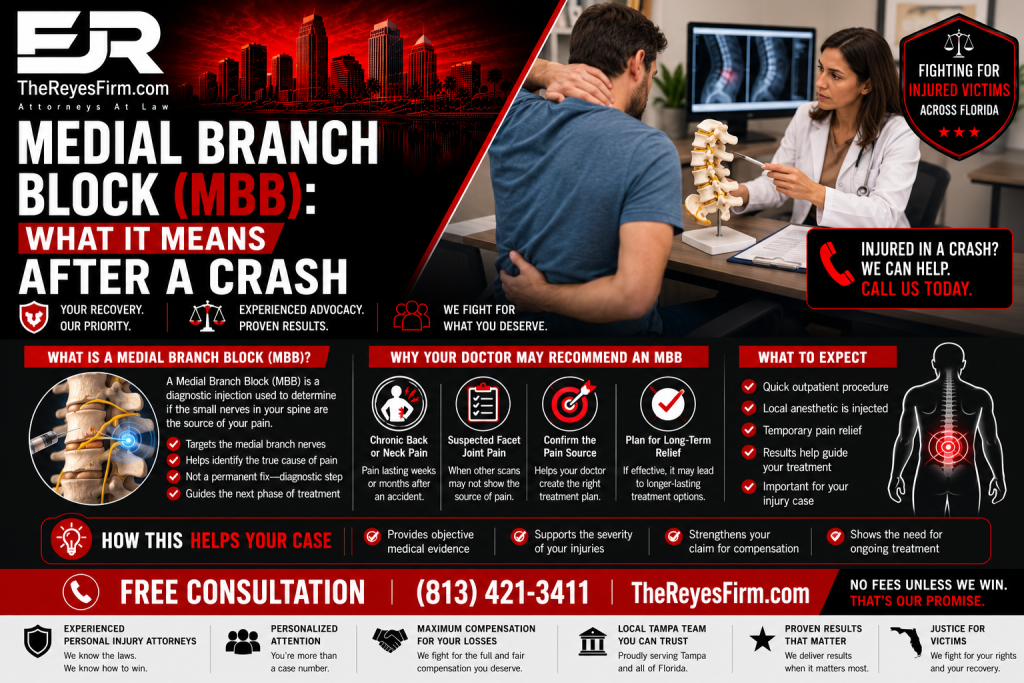
Medial Branch Block (MBB): What It Means After a Crash

Your doctor mentioned a medial branch block, and you nodded along without really knowing what it meant. If you were hurt in a crash and now face spinal injections, you deserve a clear explanation, both of the procedure and of what it means for your injury claim. Here is what an MBB is, in plain language. The Reyes Firm Facing Spinal Injections After a Tampa Crash? Make sure your treatment is documented and valued properly. Had a bad day? Contact Us Now Diagnostic An MBB helps pinpoint your pain source Facet joint nerves 6-12 Mo. Typical relief from radiofrequency ablation Varies by patient Permanent Injury finding needed for pain and suffering Fla. Stat. § 627.737(2) 2 Years Deadline to file an injury claim Fla. Stat. § 95.11 After a car accident, back and neck pain can linger long after the bruises fade. When it does, doctors often look to the small joints along the spine as a possible source, and a medial branch block is one of the main tools they use to investigate. Understanding the procedure, and why it matters beyond the exam room, helps you make informed decisions and protect your claim. What is a medial branch block (MBB)? A medial branch block is a targeted injection used to find out whether the facet joints in your spine are causing your pain, and it is a well-established procedure described by resources like Spine-Health. The facet joints are the small joints that connect your vertebrae and allow your spine to bend and twist. Tiny nerves called the medial branches carry pain signals away from these joints, and an MBB places a small amount of local anesthetic near those nerves, usually with imaging guidance to position the needle precisely. The goal at this stage is information, not a cure. By temporarily numbing the medial branch nerves, the procedure tests a simple question: if these nerves stop sending signals and your pain drops, then those facet joints are very likely the source of your pain. How does a medial branch block work as a diagnostic test? The logic is straightforward. After the anesthetic is injected, your doctor asks you to track how much your pain improves over the next several hours while the numbing lasts. Significant temporary relief points to the facet joints as the culprit. Little or no relief suggests the pain is coming from somewhere else, which is useful information too. Because the relief from the anesthetic is short-lived, an MBB is generally a diagnostic step rather than a long-term treatment. Doctors often repeat the block to confirm the result before moving on to a longer-lasting procedure. Your physician will explain how many blocks they recommend and why. What is radiofrequency ablation, and how is it different? If one or more medial branch blocks confirm that the facet joints are the source of your pain, a doctor may recommend radiofrequency ablation, sometimes called radiofrequency neurotomy. This is where the longer-lasting relief comes in. Using needles placed in the same area, the doctor passes radiofrequency energy through a small electrode to create a controlled lesion on the medial branch nerves, interrupting their ability to transmit pain signals. Think of the block as the test and the ablation as the treatment that follows a positive test. Relief from ablation commonly lasts somewhere in the range of six months to a year, though it varies from patient to patient. It is not a guaranteed or one-size-fits-all outcome, and your doctor is the right person to explain what you can realistically expect. Is a medial branch block a permanent fix? Not exactly, and it helps to understand why. Radiofrequency ablation does not remove the underlying injury. It quiets the nerves that carry the pain, and over time those nerves can regenerate, which is why relief eventually wears off and some patients repeat the procedure. That can make it feel like a temporary patch. But there is another way to look at it. These procedures buy real relief while your body works through a slow healing process, and some patients improve enough over time that they do not need to repeat them indefinitely. Whether that will be true for you depends on your specific injury and your body, and it is not something anyone can promise in advance. Your treating physician can give you the most accurate picture. 💡 Did You Know? In a Florida car accident case, you generally cannot recover for pain and suffering unless your injury meets a legal threshold, such as a permanent injury within a reasonable degree of medical probability. Diagnostic and treatment procedures like a medial branch block and radiofrequency ablation are part of how physicians document the nature and persistence of a spinal injury. Source: Fla. Stat. § 627.737(2). Why does a medial branch block matter for your injury claim? Insurance companies love to describe back and neck injuries as minor soft-tissue strains that will resolve on their own. A medial branch block cuts against that narrative in a powerful way, because it is objective and diagnostic. When a block pinpoints a specific facet joint as the source of your pain, it connects your symptoms to an identifiable injury rather than a vague complaint, which is exactly the kind of evidence that holds up under scrutiny. These procedures also carry real weight in the value of a claim. They are meaningful medical expenses, they show that your pain was serious enough to warrant an invasive intervention, and when future radiofrequency ablations are likely, the projected cost of that ongoing care can become part of your damages. For serious cases, a life care plan can help account for those future treatments. This is also closely tied to reaching maximum medical improvement, which we explain in our guide to how your case progresses during the pre-suit phase. ⚠️ Deadline Warning: Under Florida Statute § 95.11, you generally have two years from the date of your crash to file a personal injury lawsuit, even if you are still undergoing

Scroll to Top