Pedestrian Accident

Injured pedestrian lying on a crosswalk near a car after an accident, highlighting the severity of pedestrian-car collisions.
Blog, Pedestrian Accident

Pedestrian Hit by a Car? Here’s What You Should Know About Settlement Payouts

If you were hit by a car while walking, you’re not alone—and you’re probably wondering: Who will cover the costs? What kind of settlement can I expect? Unfortunately, pedestrian accidents happen far more often than most people realize. According to the Centers for Disease Control and Prevention (CDC), over 8,000 pedestrians are killed each year in crashes involving a motor vehicle—that’s about one death every 64 minutes. Florida is among the states with the highest number of these tragic incidents. Whether due to distracted drivers, poor lighting, or dangerous intersections, pedestrians face serious daily risks on our roads. At The Reyes Firm, we understand how devastating these accidents can be. Dealing with medical expenses, missed paychecks, and the emotional stress after being struck by a car can quickly become overwhelming. That’s why we’re here to walk you through what a pedestrian hit by a car settlement involves, what factors affect your payout, and how to ensure you’re not taken advantage of by insurance companies. Let’s break it down clearly—so you can focus on healing while we handle the rest. What Is a Pedestrian Hit by a Car Settlement? A settlement is the money you receive from the at-fault driver (or their insurance company) after a pedestrian accident. It helps pay for things like your medical treatment, time off work, and the emotional impact of the accident. These cases don’t always go to court; most are resolved through negotiations. But to get the right amount, you need to understand what goes into a fair settlement and why the pedestrian accident lawyer you choose can make a big difference. What’s the Average Settlement for a Pedestrian Accident? Settlements for pedestrian injuries can vary widely. Minor injury cases may resolve for tens of thousands of dollars, while severe, life-altering injuries can lead to settlements reaching hundreds of thousands—or even more. At The Reyes Firm, we’ve handled a wide range of pedestrian accident cases, including those involving broken bones, long-term disabilities, and extensive rehabilitation. While we can’t promise specific outcomes, we bring the experience, dedication, and legal skill needed to pursue the maximum compensation available based on the facts of your case. Every case is unique, and we don’t make empty promises. Instead, we focus on building strong claims backed by evidence, so you get what’s fair. What Affects the Value of a Pedestrian Accident Settlement? If you’re pursuing a pedestrian hit by a car settlement, it’s essential to understand that no two cases are identical. Several key factors will influence how much your claim might be worth, including: 1. Severity of Injuries More serious injuries typically lead to larger settlements. These may include: Traumatic brain injuries (TBI) Spinal cord injuries or paralysis Broken bones Internal bleeding or damage Disfigurement or permanent disability 2. Medical Expenses Your settlement should account for both the medical expenses you’re facing now and any care you might need down the road, including: Emergency room treatment Surgeries Physical therapy Medications In-home care and assistive equipment 3. Lost Income and Future Earning Capacity If your injuries keep you from working or limit your ability to earn in the future, you may be entitled to compensation for: Lost wages Reduced earning potential Missed job opportunities 4. Pain and Suffering This includes: Physical pain Mental anguish (like PTSD or anxiety) Loss of enjoyment of life Loss of companionship or consortium Attorneys may calculate this portion of your settlement using a multiplier approach, based on your injuries. 5. Liability and Fault Florida follows a modified comparative negligence system. This means: If the driver is 100% at fault, you may recover full compensation. If you were partially at fault (e.g., jaywalking or not using a crosswalk), your settlement may be reduced to your percentage of fault. More than 50% at fault for the accident may prevent you from receiving compensation. Let’s say you’re 30% at fault—if your total damages are $100,000, you’d be entitled to recover just $70,000. 6. Insurance Coverage How much you can recover may depend on the insurance coverage the at-fault driver has in place. If the driver doesn’t have enough insurance, you may be able to turn to your own UM/UIM policy to help cover your losses. Types of Compensation Available A full settlement should cover both economic and non-economic damages: Economic Damages Medical bills (past and future) Lost income and earning potential Rehab, therapy, and home modifications Transportation and out-of-pocket costs Non-Economic Damages Pain and suffering Emotional trauma Scarring or disfigurement Loss of companionship Punitive Damages These may be awarded in cases involving gross negligence, like: Hit-and-run accidents DUI-related crashes Reckless or intentional harm Steps to Take Immediately After Being Hit by a Car Knowing what to do immediately after a pedestrian accident can protect your health and your case: Call 911 and get emergency medical care Seek medical attention, even if symptoms seem minor. Document everything: take photos, collect witness info, and save medical records Avoid speaking to the driver’s insurance company. Call an experienced pedestrian injury attorney at The Reyes Firm. Why Choose The Reyes Firm? At The Reyes Firm, our personal injury lawyers help victims and their families by combining legal skill, compassion, and a client-first approach. ✔ Free Consultations We offer no-obligation case reviews—you’ll never pay to talk to us. ✔ No Win, No Fee You won’t owe us a thing unless we successfully recover your compensation. That’s our guarantee. ✔ Local Experience in Tampa We know how Florida’s legal system works—and how local courts and insurance companies handle these cases—so you’ll have someone on your side who truly understands the process. ✔ Full-Service Legal Support We’ll handle every step: Investigating the accident Gathering medical records and police reports Negotiating aggressively with insurers Filing a lawsuit if needed ✔ You’re Not Alone Cannot travel? We’ll come to you. Need bilingual help? We’ve got it. Need a doctor who will wait for payment? We’ll coordinate care. We go beyond legal representation—we help rebuild lives. Florida-Specific Laws You Should Know Here’s what’s essential in Florida pedestrian
After an Accident, Blog, FAQ, Injury, Legal, Our Community, Pedestrian Accident, personal injury attorney, Why we serve

Hit and Run Pedestrian Accident: What Victims Need to Know

Hit-and-run pedestrian accidents are a severe problem, leaving victims with devastating injuries and emotional trauma. When a driver flees the scene of an accident, it can make it even more difficult for victims to seek justice and receive the compensation they deserve. This blog post will provide valuable information about your rights as a hit-and-run victim. We’ll discuss the challenges of pursuing a claim, the importance of seeking legal representation, and the steps you can take to protect your future. Understanding Hit-and-Run Accidents A hit-and-run pedestrian accident happens when a driver hits a pedestrian with their vehicle and leaves the scene without offering assistance or notifying the authorities. This cowardly act not only causes significant physical and emotional harm to the victim but also has severe legal consequences for the fleeing driver. Legal Consequences for Hit-and-Run Drivers Hit-and-run accidents are treated as serious offenses with significant legal repercussions. Drivers who flee the scene face both criminal and civil penalties, including: Criminal Penalties: Misdemeanor or Felony Charges: Depending on the jurisdiction and severity of the accident, drivers may be charged with either a misdemeanor or a felony. Fines and Imprisonment: Punishments can include fines and jail time, particularly for severe injuries or fatalities. License Suspension or Revocation: Drivers may lose their driving privileges as part of their penalties. Civil Liability: Hit-and-run drivers may also be held financially accountable through civil lawsuits. Victims can pursue compensation for medical bills, lost income, property damage, and pain and suffering. The Toll on Victims Hit-and-run accidents can have life-altering consequences for victims, both physically and emotionally. Common injuries include: Broken Bones: Fractures in the limbs, pelvis, or spine. Head Injuries: Traumatic brain injuries (TBIs) can lead to long-term effects on memory, cognition, and behavior. Soft Tissue Injuries: Bruises, lacerations, and sprains. Emotional Trauma: Anxiety, depression, and post-traumatic stress disorder (PTSD) often follow such traumatic events. Additionally, victims often face financial challenges due to medical expenses, lost wages, and property damage. The emotional toll can exacerbate their struggles, making recovery even more difficult. Challenges of Hit-and-Run Accident Claims Hit-and-run pedestrian accidents present unique challenges for victims seeking compensation. Identifying the At-Fault Driver: One of the primary difficulties in hit-and-run cases is identifying the at-fault driver. With witnesses and surveillance footage, it can be easier to determine who was responsible for the accident. This can significantly hinder the investigation and subsequent legal process. Insurance Claims: Victims may need to rely on uninsured/underinsured motorist (UM/UIM) coverage to seek compensation if the at-fault driver cannot be identified. UM/UIM coverage is designed to protect policyholders in situations where the at-fault driver is uninsured or underinsured. However, the amount of compensation available through UM/UIM coverage may be limited. Legal Recourse: Despite the challenges, victims of hit-and-run accidents may still have legal options. Sometimes, it may be possible to file a lawsuit against an unknown driver. A skilled personal injury attorney can help navigate the complexities of these types of cases and explore all potential avenues for recovery. By working with an experienced attorney, victims can increase their chances of obtaining fair compensation, even without a known at-fault driver. The Role of a Pedestrian Accident Lawyer A pedestrian accident lawyer is crucial in helping victims navigate the complex legal process and seek justice. Here’s how an experienced attorney can help: Investigating the Accident: Gathering Evidence: A lawyer will meticulously gather evidence, such as police reports, medical records, and witness statements. Identifying Witnesses: They will interview witnesses to obtain firsthand accounts of the accident. Consulting Experts: In complex cases, they may consult with accident reconstruction experts to analyze the accident scene and determine liability. Filing a Claim: Paperwork and Deadlines: Attorneys will handle the paperwork and ensure timely claims filing. Communicating with Insurance Companies: They will communicate with insurance adjusters to negotiate a fair settlement. Negotiating a Settlement: Advocating for Your Rights: A lawyer will fight to ensure you receive fair compensation for your medical expenses, lost wages, pain and suffering, and property damage. Maximizing Your Compensation: They will use negotiation skills to maximize your settlement. Litigation Support: An attorney can advocate for you in court if reaching a fair settlement proves unsuccessful. They will prepare your case, argue it in court, and advocate for your best interests. Hiring a knowledgeable pedestrian accident lawyer can enhance your likelihood of a positive outcome and ensure you receive the compensation you are entitled to. Victims’ Rights in Hit-and-Run Accidents Even though hit-and-run accidents can be particularly challenging, victims still have the right to seek compensation for their injuries and damages. Potential Damages: Medical Expenses: This includes costs for emergency care, hospitalization, surgeries, medications, and ongoing medical treatment. Lost Wages: Reimbursement for earnings missed due to time off work or a diminished ability to earn income. Pain and Suffering: This covers both physical and emotional pain and suffering caused by the accident. Property Damage: If your property, such as your vehicle or personal belongings, was damaged in the accident, you may be able to recover compensation. Seeking Compensation: Uninsured/Underinsured Motorist (UM/UIM) Coverage: If the at-fault driver is uninsured or underinsured, your insurance policy’s UM/UIM coverage may provide compensation. Government Compensation Funds: Victims of hit-and-run accidents may qualify for financial assistance through government compensation programs.  For example, Florida offers resources through the Office for Victims of Crime (OVC), which provides compensation for costs related to being a crime victim.  Programs like these can offer crucial support when other avenues, such as insurance claims, fall short. Civil Lawsuit: If the at-fault driver is identified, you may be able to file a civil lawsuit to recover damages. Important Note: It is crucial to consult with a personal injury attorney to understand your rights and options. An experienced attorney can help you navigate the legal process and maximize your recovery. Preventative Measures and Road Safety Tips To reduce the risk of pedestrian accidents, it’s essential to follow these pedestrian safety tips: For Pedestrians: Utilize Crosswalks: Always cross at marked crosswalks and follow traffic signals. Look Both Ways: Before crossing,

Pedestrian safety stay alert, stay visible
Blog, FAQ, florida cities we serve, Injury, Legal, Our Community, Pedestrian Accident, personal injury attorney, Why we serve

Pedestrian Accident Causes and How to Avoid Them

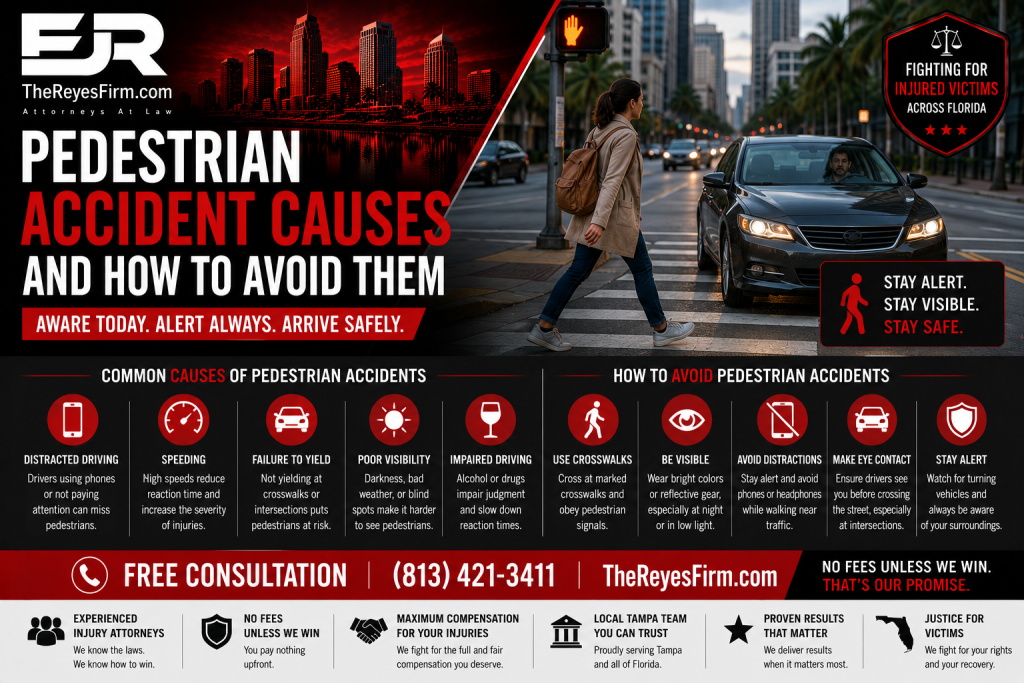
A walk across the street shouldn’t be dangerous, but for pedestrians, a single distracted or speeding driver can cause devastating harm. If a careless driver hit you or someone you love, you have rights, and Florida law is on the side of the injured. Here is what causes these crashes, how to stay safe, and what to do if a pedestrian accident turns your life upside down. The Reyes Firm Hit by a Car While Walking in Tampa? Get an advocate who fights for injured pedestrians. Had a bad day? Contact Us Now 10,013 Florida pedestrian crashes, 2022 FLHSMV 765 Florida pedestrian deaths, 2022 FLHSMV 2 Years Deadline to file an injury claim Fla. Stat. § 95.11(3)(a) 50% Fault share that bars recovery Fla. Stat. § 768.81 Pedestrians are among the most vulnerable people on the road, with none of the protection a vehicle provides. When a driver is careless, the consequences fall almost entirely on the person on foot. Understanding why these crashes happen, how Florida law protects pedestrians, and what to do afterward can make all the difference for your safety and your recovery. Can you sue a driver after a pedestrian accident in Florida? Yes, if a driver’s negligence caused your injuries, Florida law allows you to pursue compensation. Pedestrians have the right to use roads and crosswalks safely, and a driver who is distracted, speeding, impaired, or fails to yield can be held responsible for the harm they cause. A claim can cover the full cost of that harm, from medical bills to lost income and pain and suffering. Florida’s insurance rules add an important wrinkle. If you own a vehicle with Personal Injury Protection, that coverage may pay some of your medical bills even though you were on foot, on top of a claim against the at-fault driver. Sorting out every available source of compensation is one of the most valuable things a lawyer does after a pedestrian crash. ⚠️ Deadline Warning: Under Florida Statute § 95.11(3)(a), you generally have two years from the date of your crash to file a personal injury lawsuit. Missing this deadline almost always means losing your right to recover anything. Don’t wait to call a lawyer. What are the most common causes of pedestrian accidents? Most pedestrian accidents trace back to a driver’s mistake, and identifying the cause often points directly to who is at fault. The most common causes include: Distracted driving. Drivers on their phones or otherwise distracted are far more likely to miss a pedestrian in a crosswalk or at an intersection. Speeding. Higher speeds reduce a driver’s reaction time and make any collision far more severe, especially in neighborhoods and urban centers. Poor road design and visibility. Inadequate lighting, faded crosswalks, and obstructed sightlines make it harder for drivers and pedestrians to see one another. Impaired driving. Alcohol and drugs impair judgment, coordination, and reaction time, dramatically raising the risk to pedestrians. Failure to yield. Under Florida law, drivers must yield to pedestrians in crosswalks under Florida Statute § 316.130, and ignoring that duty, especially when turning left across a crosswalk, is a frequent cause of crashes. 💡 Did You Know? Florida law requires drivers to yield the right-of-way to pedestrians crossing within a crosswalk. A driver who fails to yield and strikes a pedestrian is typically at fault for the crash, and that failure can be strong evidence of negligence in your claim. Source: Fla. Stat. § 316.130. What injuries do pedestrian accidents cause? Because a pedestrian has no protection against the force of a vehicle, the injuries are often severe or life-threatening. Head trauma is among the most serious, and a traumatic brain injury can lead to lasting cognitive damage, coma, or death. A spinal cord injury can cause partial or complete paralysis, and broken bones, internal bleeding, and organ damage are common as well. When a crash causes life-altering harm, the case may rise to the level of a catastrophic injury claim, which carries higher stakes and demands careful documentation of long-term care needs. Even lower-speed collisions can leave a pedestrian with cuts, bruises, and soft-tissue injuries that require real treatment. Who is at fault, and what if you were partly to blame? Fault in a pedestrian accident usually rests with the driver, but Florida looks at the conduct of everyone involved. If you were partly at fault, perhaps by crossing outside a crosswalk, you may still recover, just with your compensation reduced by your share of responsibility. Insurers know this and often try to pin as much blame on the pedestrian as possible to lower what they pay. Florida law also requires a driver who hits a pedestrian to stop, render aid, and exchange information. A driver who flees the scene commits a hit-and-run under Florida Statute § 316.027. If you were struck by a hit-and-run or uninsured driver, your own uninsured motorist coverage may become an important source of compensation. 🛡️ Your Rights Under Florida Law: Under Florida Statute § 768.81, your compensation is reduced by your share of fault, and you may be barred from recovery if you are found greater than 50% responsible. Insurers routinely try to blame injured pedestrians, and an experienced Tampa pedestrian accident lawyer works to protect the facts and keep your assigned fault as low as the evidence allows. What damages can you recover after a pedestrian accident? A successful pedestrian accident claim can compensate you for the full range of losses the crash caused. These commonly include medical expenses for past and future treatment, surgery, medication, and therapy, along with lost wages and reduced earning capacity while you cannot work. You can also recover for pain and suffering, the physical and emotional toll of the injury, and for property damage to belongings like a phone or glasses. When a pedestrian crash is fatal, surviving family members may pursue a wrongful death claim for their losses, including loss of support and companionship and funeral expenses. The value of any claim depends on the

Blog, FAQ, florida cities we serve, For Parents, For Teens, Injury, Legal, Our Community, Pedestrian Accident, personal injury attorney, Why we serve

Pedestrian Safety for Kids: Simple Tips Every Parent Should Know

With more vehicles on the road than ever, pedestrian safety for kids is a top priority. Each year, countless young pedestrians are involved in traffic accidents, making it essential for parents to teach children safe walking habits.  Equipping your kids with the proper knowledge and skills can help them stay aware and safe on busy streets.  This guide offers practical tips to empower your children to navigate their surroundings confidently and responsibly. Teaching Children Pedestrian Safety Start Early The earlier you start teaching your children about pedestrian safety, the better. Even toddlers can learn basic safety rules, like holding your hand while crossing the street. Lead by Example Children learn by observing their parents. Consistently model safe pedestrian behavior by using crosswalks and following traffic signals. Use Kid-Friendly Language Explain safety rules in simple terms that your child can understand. For instance, instead of using the word “right of way,” try saying, “Wait until the cars have stopped.” Focus on Crosswalks and Signals Teach your child always to use crosswalks and wait for the green light before crossing the street. Explain the meaning of different traffic signals in a way they can understand. Avoid Distractions Remind your child to avoid using electronic devices like phones or tablets while walking. These distractions can impair their awareness of their surroundings. Stay Visible Encourage your child to wear bright, reflective clothing, especially when visibility is low. This makes it easier for drivers to notice them. Practicing Pedestrian Safety for Kids Through Role-Play Creating Safe Scenarios To reinforce safe pedestrian habits, create role-playing scenarios where you and your child can practice crossing streets, obeying traffic signals, and avoiding distractions. Real-World Practice Take your child to a nearby crosswalk and practice safe crossing techniques. Remind them to look left, right, then left once more before crossing. Fun and Learning Make learning fun by incorporating games and activities into your child’s pedestrian safety education. For example: Obstacle Course: Set up an obstacle course with traffic cones and markers to simulate real-life situations. Safety Bingo: Create a bingo card with safety symbols and have your child spot them during walks. By using these techniques, you can make learning about pedestrian safety engaging and effective. The Importance of Supervision and Setting a Good Example Adult Supervision Young children, especially those under 10, should always be supervised by adults when crossing streets or walking near roads. Adults should hold their children’s hands and guide them safely across intersections. Setting a Positive Example Children learn by observing their parents and caregivers. Always model safe pedestrian behavior, such as: Look Both Ways, Twice:  Before crossing, check for traffic by looking left, right, and left again. Using Crosswalks: Emphasize the importance of using crosswalks and obeying traffic signals. Avoid Distractions: Avoid using electronic devices while walking, and encourage your child to do the same. Being Mindful of Traffic: Teach your child to be aware of cars, bicycles, and other vehicles. By setting a positive example and practicing safe pedestrian habits, you can help your child develop lifelong safety skills. For additional resources on teaching pedestrian safety to kids, consider exploring the Child Pedestrian Safety Curriculum by the NHTSA. This curriculum offers practical lessons and activities designed to build safe walking habits. Additional Pedestrian Safety Tips for Kids and Parents Car Safety Proper Car Seat Usage: Ensure your child is always properly restrained in a car or booster seat appropriate for their age and size. Seat Belt Safety: Once your child is old enough, teach them always to wear a seatbelt. Stranger Safety Stranger Danger: Teach your child never to talk to or accept rides from strangers. Emergency Contacts: Make sure your child knows your phone number and the phone number of another trusted adult. Safe Places: Designate safe places, such as a store or police station, where your child can go if they feel lost or unsafe. Family Safety Rules Family Meetings: Regularly review pedestrian safety tips, establish rules, and practice emergency procedures together. Role-Playing: Role-play different scenarios, such as getting lost or encountering a dangerous situation. Reward Positive Behavior: Reward your child for following safety rules to reinforce good habits. Positive Reinforcement Verbal Praise: Praise your child for following safety rules and making good choices. Small Rewards: Consider small rewards, such as stickers or special privileges, to motivate your child. Celebrate Milestones: Celebrate your child’s progress in learning and practicing safety skills. Following these tips and setting a solid example can help your child develop lifelong safety habits. Community and School Involvement in Pedestrian Safety Community Initiatives Many communities have organizations and programs focused on road safety for kids. These initiatives often include educational campaigns, safety audits of local roads, and advocacy for safer infrastructure. School Safety Programs Schools are essential in educating children about pedestrian safety. Encourage your child’s school to implement pedestrian safety programs that include: Classroom Education: Lessons on traffic signals, crosswalks, and safe walking practices. Field Trips: Organized walks to practice safe pedestrian crossing techniques and identify hazards. Safety Drills: Regular practice of emergency procedures, such as evacuations and lockdown drills. Working with schools and community organizations can create safer environments for children and reduce the risk of pedestrian accidents. Legal Considerations and Parental Support Understanding Pedestrian Rights As a pedestrian, you and your child have the right to use public roads safely. However, it’s essential to understand your area’s specific laws and regulations. When to Seek Legal Advice Legal guidance is essential if your child is involved in a pedestrian accident. A pedestrian accident attorney can assist you throughout the legal process and strive to secure the compensation you’re entitled to. A pedestrian accident law firm like The Reyes Firm can provide expert legal counsel to protect you and your child’s rights. Common Pedestrian Accident Scenarios Vehicle-Pedestrian Accidents: These accidents can occur when a driver fails to yield to a pedestrian, speeds or is distracted. Slip and Fall Accidents: Poorly maintained sidewalks or crosswalks can lead to slip and fall accidents, especially for children. Dog

Blog, FAQ, florida cities we serve, Health, Legal, Our Community, Pedestrian Accident, Why we serve

Night Walking Safety: Essential Tips for Staying Visible and Secure

Nighttime can be a peaceful and serene time to enjoy a solitary walk. While it’s a great way to de-stress, clear your mind, and improve your overall well-being, night walking also comes with certain risks. Taking precautions ensures a safe and enjoyable walk in the dark. This blog post will provide night walking safety gear recommendations and essential tips to help you stay visible and secure during nighttime walks. Choosing Safe, Well-Lit Routes As the sun sets, so does our sense of security. While nighttime walks can be peaceful and rejuvenating, it’s essential to prioritize pedestrian safety. One of the most effective ways to do this is by carefully choosing your route. Stick to Well-Lit Paths Well-lit streets and paths are your first line of defense. The increased night visibility deters potential threats and allows you to see and be seen. When planning your route, look for areas with ample streetlights, storefront lighting, or other illumination sources. Avoid Remote Areas Isolated or dimly lit locations can be tempting targets for criminals. Stick to familiar, populated areas with plenty of foot traffic. This reduces the risk of encountering danger and provides a sense of security. You can significantly enhance your safety during nighttime outings by carefully selecting your walking route. Wearing Reflective and Visibility Gear When venturing out at night, making yourself visible to others is crucial. Reflective clothing and nighttime lighting are essential tools to ensure your safety. The Importance of Reflective Gear Reflective clothing and accessories can be a lifesaver. By reflecting light from vehicle headlights and streetlights, you are more visible to drivers and pedestrians.  Consider investing in: High-Visibility Apparel: Jackets, vests, and pants with bright colors and reflective strips can significantly improve your visibility. Reflective Accessories: Reflective bands for your wrists, ankles, or backpacks can add a layer of protection, especially when wearing darker clothing. The Benefits of Nighttime Lights Nighttime lights are another essential safety measure. By illuminating your path and making you more visible, they can help prevent pedestrian accidents and deter potential threats. Consider using: Headlamps: A headlamp provides hands-free illumination, allowing you to see where you’re going while keeping your hands free. Handheld Flashlights: A handheld flashlight is a versatile tool for signaling for help, illuminating your path, or checking your surroundings. Incorporating pedestrian safety gear, such as reflective items and nighttime lighting, into your routine can significantly reduce the risk of accidents and enhance your overall safety during nighttime walks. If you’ve been involved in a pedestrian accident, consult The Reyes Firm’s pedestrian accident lawyers to understand your rights and options for seeking compensation. Essential Safety Devices for Night Walking In addition to visibility gear and lighting, consider carrying personal safety devices to enhance your security. Personal Safety Tools A personal alarm can be a powerful deterrent to potential attackers. A simple button press can emit a loud, piercing sound to attract attention and scare off threats. Pepper spray is another effective self-defense tool. It can temporarily incapacitate an attacker, giving you time to escape or call for help. Safety Apps and Emergency Contacts Technology can also be a valuable tool for nighttime safety. Consider using safety apps that allow you to share your location with friends or family or that can automatically alert emergency services if you’re in trouble. Remember, it’s essential to have a plan in place in case of an emergency. Identify trusted contacts who you can call for help and practice your escape routes. Taking these proactive steps can significantly increase your safety during nighttime walks. Stay Aware of Your Surroundings In the hustle and bustle of modern life, it’s easy to become distracted and lose sight of our surroundings. However, staying alert and aware when walking alone at night is crucial for your safety. Avoid Distractions While it may be tempting to listen to music or scroll through your phone, these distractions can impair your senses and make you more vulnerable to potential threats. By putting away your phone and tuning into your surroundings, you can better anticipate and respond to danger. Trust Your Instincts Your instincts are powerful tools. If you feel uneasy about a particular person, place, or situation, don’t ignore it. Listen to your instincts and take action to protect yourself. This may involve changing your route, crossing the street, or seeking help from a nearby business or passerby. You can significantly enhance your safety during nighttime walks by prioritizing situational awareness and trusting your instincts. Walk in Groups When Possible Walking with a friend or in a group is one of the most effective ways to enhance your safety during nighttime outings. The presence of others can act as a powerful deterrent to potential threats. Safety in Numbers When walking in a group, you become less of an easy target. Potential attackers are more likely to target individuals who appear alone and vulnerable. By walking with others, you can reduce your risk of becoming a victim of crime. Informing Loved Ones of Your Plans Before heading out, informing a friend or family member of your plans is crucial. Share your route and expected return time, and let them know if you’ll deviate from your usual path. If you don’t return as scheduled, they can take action and alert the authorities. Consider group walks and inform loved ones of your plans to significantly enhance your safety during nighttime outings. Weather and Time Considerations The time of day and weather conditions can significantly impact your safety during nighttime walks. Therefore, choosing optimal walking times and dressing appropriately for the weather is essential. Choosing Optimal Walking Times While a late-night stroll is tempting, it is generally safer to avoid late or early hours when fewer people are around.  Although a recent Gallup report shows that 72% of Americans feel safe walking alone at night, many still believe crime rates are on the rise. FBI data, however, indicates a recent decrease in violent crime.  Even with these improvements, staying cautious in lower-traffic times can help enhance

Pedestrian Safety Tips to Prevent Accidents on Foot
Pedestrian Accident, personal injury attorney

Pedestrian Safety Tips to Prevent Accidents on Foot

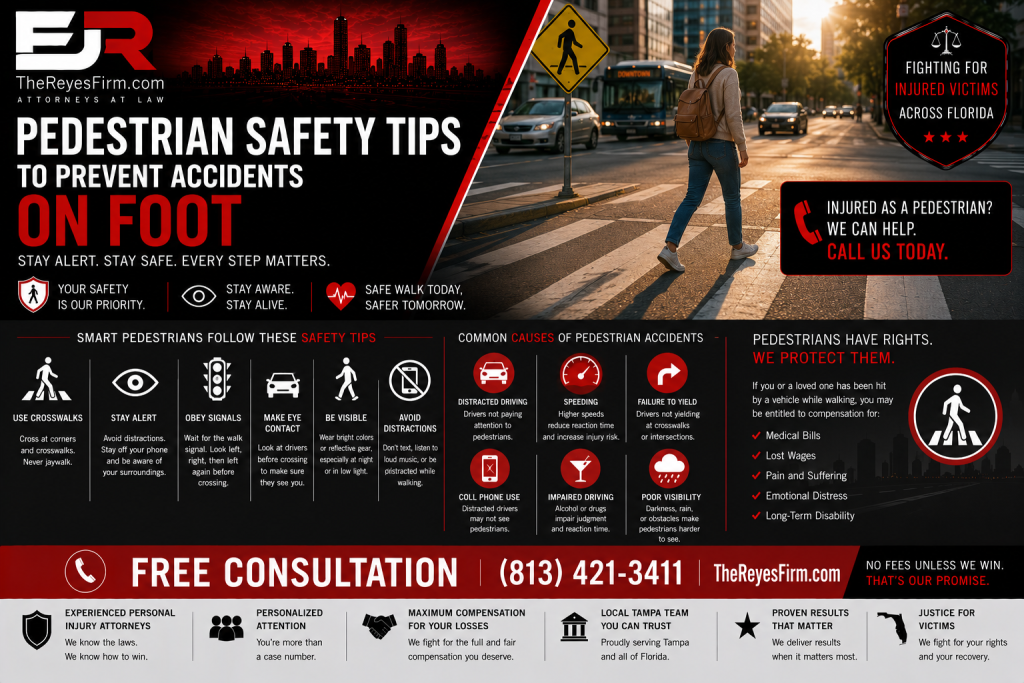
Walking is one of the simplest, healthiest things you can do, but as a pedestrian you have no protection if a driver makes a mistake. A few smart habits go a long way toward keeping every walk safe and enjoyable. These pedestrian safety tips help you prevent accidents, and if a careless driver ever causes you harm, our pedestrian accident attorneys are here to help. The Reyes Firm Hit by a Car While Walking in Tampa? You had the right of way. Let us fight for you. Had a bad day? Contact Us Now Crosswalks Cross where drivers expect you And obey signals Be Seen Bright and reflective Especially at night Stay Alert Eyes up, not on your phone Stay aware Sidewalks Use them when available Face traffic if none Most walks are uneventful and good for both body and mind. But because a person on foot has no barrier between them and a vehicle, the consequences of a collision can be severe, even at low speeds. The habits below are simple and quick to adopt, and together they meaningfully lower your risk of a pedestrian accident. Think of them as your everyday walking safety toolkit. Why does pedestrian safety matter so much? Pedestrians are among the most vulnerable people on or near the road. With no vehicle around them, a person on foot absorbs the full force of a collision, which is why even a relatively slow-moving car can cause serious injury. Common pedestrian injuries include broken bones, head and brain injuries, spinal injuries, and internal harm. That vulnerability is exactly why prevention is worth the small effort it takes. You cannot control the drivers around you, but you can greatly improve your odds by being visible, predictable, and alert. The tips that follow focus on the habits that make the biggest difference to your safety. How should you cross the street safely? Crossing is where many pedestrian accidents happen, so it deserves the most care. Whenever possible, cross at marked crosswalks or intersections, where drivers expect and look for people on foot, rather than darting out mid-block. Obey pedestrian signals and traffic lights, and even when you have the walk signal, take a moment to look left, right, and left again before stepping off the curb. Never assume a driver sees you or will stop. Make eye contact with drivers when you can, watch for turning vehicles that may not be looking your way, and be especially cautious of cars pulling out of driveways and parking lots. A few extra seconds of caution at a crossing prevents a great many collisions. 💡 Did You Know? The risk to pedestrians rises sharply after dark, when drivers have far less time to see and react. Wearing bright or reflective clothing and carrying a small light or using your phone’s flashlight at night are simple habits that make a real difference in whether a driver notices you in time. How can you stay visible to drivers? Being seen is one of your strongest defenses as a pedestrian, because many crashes happen simply because a driver did not notice the person on foot. During the day, favor bright, high-contrast clothing, and at dawn, dusk, and night, add reflective materials and carry a light. Dark clothing at night can make you nearly invisible until a driver is dangerously close. Choose your path with visibility in mind, too. Avoid crossing between parked cars or other spots where a driver would not expect a pedestrian to appear, and try to position yourself where approaching drivers have a clear line of sight to you. The goal is to give every driver the best possible chance to see and react to you in time. What habits keep you safe while walking? Where and how you walk matters as much as how you cross. Use sidewalks whenever they are available, and when there is no sidewalk, walk on the shoulder facing oncoming traffic so you can see approaching vehicles and react if needed. Stay as far from the travel lane as you safely can. Just as important is staying alert. Distraction is a growing danger for pedestrians, so keep your eyes up and avoid looking down at your phone while walking, especially when crossing. Limit headphone volume so you can hear traffic, and never walk impaired, since alcohol and drugs reduce your judgment and reaction time just as they do for drivers. Awareness is a safety tool you carry everywhere. Where and when are pedestrians most at risk? Certain places and times carry more risk, and knowing them helps you stay alert where it counts. Intersections and crossings, where the paths of people and vehicles meet, are common sites for collisions, as are parking lots, driveways, and areas with heavy turning traffic. Nighttime and low-light conditions raise the danger considerably. Some pedestrians face added risk as well. Children may not judge traffic well, and older adults may move more slowly or be more seriously hurt in a collision, so extra care and patience around them benefits everyone. Being especially watchful in these situations, both as a pedestrian and as a driver, helps prevent the crashes that are most likely to cause harm. 🛡️ When Safety Isn’t Enough: Even the most careful pedestrian cannot control a distracted, speeding, or careless driver. If a driver’s negligence caused your injury, you may be entitled to compensation, and under Florida Statute § 95.11(5)(a) you generally have two years from the crash to file a claim. Watch: Essential Pedestrian Safety Tips If you prefer to see it explained, the short video below covers essential pedestrian safety tips to help prevent accidents. And if you have been injured as a pedestrian in a crash that wasn’t your fault, The Reyes Firm offers free consultations with no obligation. Your quick pedestrian safety checklist Keep these five habits in mind every time you head out on foot. Together they meaningfully lower your risk. Cross at crosswalks and intersections. Obey signals, and look left, right, and

Commercial Vehicles, Legal, Pedestrian Accident, Why we serve

The Future of Walkable Cities

[vc_row][vc_column][vc_single_image image=”4917″ img_size=”full” alignment=”center”][/vc_column][/vc_row][vc_row][vc_column][vc_column_text] Coronavirus has people reassessing their plans for the future. Governments, too, from the local to federal levels, have had their agendas put on hold. Activists who had been pushing legislators toward investment into green infrastructure, like walkable cities, are now unsure what they will prioritize. Constituents may not want to see investment in things that aren’t directly going to the cause of stopping the virus so that they can get back to their “normal” lives. When it comes to walkable cities, the U.S. does not boast of many outside of the major ones like New York, San Francisco and Philadelphia, which are all expensive to live in even without a car. Suburban sprawl and the trend toward automobile-friendly town and cities has been part of the American narrative since cars became accessible to the masses in the early 1900s. The oil and automobile industries made sure that the car was the necessary means of transportation for middle class Americans. Now, in many places in the US, walking is a sign of poverty. Environmentalists have hoped to change that by promoting alternative means of transportation, while bringing down the number of pedestrian deaths. The city of Tampa has been high on the list of pedestrian deaths for years. Some victims have been commemorated by ghost bikes, which memorialize the site and remind drivers to keep an eye out for cyclists. Mayor Jane Castor signed on to the Vision Zero, “a strategy to eliminate all traffic fatalities and sever injuries, while increasing safe, healthy, equitable mobility for all,” according to their webiste. The plan of action includes safety projects, educational initiatives, and proactive enforcement of traffic laws. Edward Reyes, a personal injury attorney and walkable cities expert, has seen first hand how many people are affected by the city of Tampa’s lack of pedestrian-friendly infrastructure, having represented many victims of automobile-pedestrian accidents. [/vc_column_text][/vc_column][/vc_row][vc_row][vc_column][vc_single_image image=”4918″ img_size=”full” alignment=”center”][/vc_column][/vc_row][vc_row][vc_column][vc_column_text] When the nearest crosswalk is half a mile down the road, a person will often opt to jaywalk. When drivers are not accustomed to seeing pedestrians, they don’t keep a watchful eye out for them. This combination has caused pedestrian and bicycle deaths to increase year after year in Tampa Bay. Even as motor vehicle deaths have gone down, 2018 was the highest year since 1990 for pedestrian deaths in the US. There has been a growing trend in the use of e-bicycles and e-scooters. Instead of sitting in traffic alone in their cars, people are opting to zoom around on a chargeable vehicle, which is better for the environment as well as their wallets. Coronavirus has changed the way people view publicly used transportation devices, like bicycle shares. Reyes believes that COVID-19 will necessitate having sanitizing stations near e-bike and e-scooter rental areas so that customers can have peace of mind when renting. He also suggests that cities put in more locking stations for those who have their own bicycles, and to spread out bike and scooter-share rental stations to comply with social distancing. Due to the changing mindsets around travel, i.e. people are more fearful of social settings, but also want to be outside now that they are more restricted to their houses, Reyes feels that governments should encourage active transportation, perhaps even giving tax incentives to restaurants who give discounts to patrons arriving on a bicycle or scooter. Coronavirus is changing many aspects of normal life, and shifting long-held agendas. Instead of scrapping grand notions of greener, more pedestrian-friendly cities, officials should find ways to adapt these ideas to the new normal. [/vc_column_text][/vc_column][/vc_row]

Accidents
Accident Injuries & why, Car accident, Legal, Moped Accidents, Motorcycles, Pedestrian Accident, Scooter Accident, Why we serve

My Fight against those At-Fault Drivers are your Fight, too!

I would be an advocate for pedestrian safety, navigating for safer cities. For things that has to happen and change, I think to reduce the fatality rate and injuries and the damages and stuff like that. It’s more to hopefully we can see change in the future. What made you get into this in the first place? Well, my background as I mentioned earlier on, I own a doctor’s office for 13 years and from there I saw a lot of these accidents and injuries and you know a lot of them are accident-related, various forms. Sometimes they’re related to scooters, actually before it was scooters, motorcycles, mopeds, bicycles, pedestrians, and of course car accidents. Tampa personal injury lawyer Edward Reyes represents people in Tampa and Hillsborough County, Florida who have suffered an injury in an incident or accident type of accident. Speak Directly to Me, At No Cost, Today 813.421.3411the injuries were substantial in depending on the type of mode of transportation, it was worse. Of course, motorcycle accidents were substantially worse than car accidents depending on road rash and everything else. Cyclists are the same. So, later in life at 31 I decided to go to school to become an advocate for these causes. I need my associates, my bachelor’s, and my law degree. So, it was kind of a big you know, fee. I guess, you could say, right? But I know we need to change, I know we need change. I know we need to do better our state needs to be safer and that’s kind of what made me get into the law field. Give us a call at 833-4-BAD DAY (833-422-3329) for help.   (Transcript from the video, transcribed but not reviewed)

Accident Injuries & why, After an Accident, FAQ, florida cities we serve, For Parents, For Teens, Legal, Pedestrian Accident, Texting, Why we serve

Pedestrian Accidents are Happening Now More than Ever

Pedestrians and people walking are crossing the crosswalk, they’re using their cell phone they’re distracted. You may be a distracted pedestrian. Or somebody else may be a distracted pedestrian. But what happens is, that there are so many car accidents in the Florida area or Tampa Bay area, that anywhere in the United States, for that matter, that the car accidents happen because people are running red lights. Tampa personal injury lawyer Edward Reyes represents people in Tampa and Hillsborough County, Florida who have suffered an injury in an incident or accident type of accident. Speak Directly to Me, At No Cost, Today 813.421.3411The car accidents are happening because they’re not paying attention to where they need to be going. Now, if you happen to be a pedestrian crossing the crosswalk, and a car happens to run the red light, you may be injured. If you are injured and they’re not fatal and you do not live in a household that somebody has insurance, that person’s insurance, up to $10,000 of medical coverages with Florida personal injury protection, may cover you. If you have car insurance and you have a car and you just happen to be walking that day, your car insurance company may cover you because it’s for personal injury, accident-related. If you have any questions about this, feel free to give us a call at 833-4-BAD DAY (833-422-3329).   (Transcript from the video, transcribed but not reviewed)

Pedestrian & Scooter Safety
Accident Injuries & why, After an Accident, florida cities we serve, Injury, News, Pedestrian Accident, Scooter Accident, Why we serve

Bay News 9 Special Report on Pedestrian & Scooter Safety

A special report interview on pedestrian and scooter safety with Attorney Edward Reyes. Reporter: All right, have you had a chance to try out scooters yet in Tampa that a new way to get around town is still in the trial phase? Some things are going well, others maybe not so great. We’re going to go in-depth now with one of the board members of the Tampa Bay Mobility Alliance Edward Reyes. Good to have you with us, Edward. Edward Reyes: Thank you. Reporter: Nice to see you. First of all, we’ve had folks on with the Tampa Bay Mobility Alliance before. But just tell us about what the vision of that is exactly is there for. Edward Reyes: Well, the biggest thing is to help reduce human error and traffic violence because there’s so much growth that is happening in our society and there’s a lot of incidents and people are being injured so the biggest thing is to facilitate or to have a society that we have less fatalities and less or no fatalities that’s the idea of the vision zero or reduce human error as much as possible. Reporter: And we are unfortunately an area where we haven’t been as pedestrian and bicycle-friendly as we need to be we know every year we see those statistics and that’s why vision zero was formed to protect folks who want to get out and walk and now scooters you add to the mix. Let’s see the city has logged about six hundred thousand trips since the test a program began for scooters and that’s just one piece of transportation, new ways to get around and walking and riding your bike. When you add in scooters have you, you’re an attorney have you have you had folks who have had issues with these scooters have been injured or had problems. Edward Reyes: Yes, actually because scooters are so new to our society and they’re popping up everywhere, drivers are not used to having scooters on the road for one. And to think about it they were already lots of accidents are happening before the scooter before the pedestrian boom that’s happening right now because people were still crashing into cars not crashing into people because they’re still running crosswalks, they’re still making left turns without paying attention, they’re still looking down on their phones there’s still a lot of issues. The difference is that now instead of it being a car it’s a person and the damages are more significant. Yes, and we have had a lot of incidents with scooter-related accidents or violence and pedestrians as well. Reporter: If you’re on a scooter are you considered a pedestrian, or you consider the motorist? Edward Reyes: You’re still considered to be a pedestrian because you do not need a license to have a scooter and you don’t even have that insurance to have a scooter because you can pick one up uber lyft or you know the new ones that are limed and all the new scooters are coming up. You could just pay and ride. Reporter: Use your phone and come on I’ve never done it. Edward Reyes: It’s pretty fun especially when the battery dies. So the idea is that you don’t have to have insurance but there’s a double edge so that sword as well because not having insurance if you are injured you may not be covered if you know by medical coverage or anything. But the flip note to that is that if you live in a household that has insurance either yourself your own auto insurance or you live in a household that somebody has auto insurance, you may fall into that person’s policy or your own auto insurance policy if you have it. If you do not live in a household has nobody to has insurance and then the person that crashes into you will take on their personal possession for their insurance and you’ll be covered for medical coverages like that. Reporter: So, you’re covered through your auto insurance even though you’re considered a pedestrian that’s interesting. Edward Reyes: Unless there’s a writer that separates that when you buy your policy but up to now right now, you’re covered through the auto insurance. Reporter: Now there are one of the problems that they’ve had that they’re gonna work out through this pilot program or trying to is there are certain areas you’re not supposed to go like the Riverwalk places that are crowded and you don’t want to you know have scooters there and people are unfortunately still going into those areas so that’s something to work out. So, if you get into an accident where you’ve gone somewhere you weren’t supposed to go with the scooter do you have extra liability because of that? Edward Reyes: Well, it depends because like let’s say the Riverwalk, for example, there are no cars running through Riverwalk typically people are walking right, so if you’re gonna get hit you’re probably the person that hits the person walking, you’re hitting a pedestrian you know on the scooter so the liability will be personal liability, so they can sue you directly that individual can sue you as a person if they choose to do that it depends on the injuries as well. So it gets that gets a little bit dicey because I haven’t seen so far your auto insurance pick up the tab on scooter incidents because it’s not a covered vehicle under their policy whereas your auto is a cover vehicle policy, so I think that the insurance companies are it’s gonna be a fun game. Reporter: Yeah, it’s just a new element that’s you know they got to catch up to how we’re gonna handle these things. I want to just step back from scooters and just take a larger overview look at transportation and mobility as your board does in Tampa. We want to be more pedestrian-friendly, we want more sidewalks,

Scroll to Top