personal injury attorney

Accident report
After A Car Accident, After an Accident, Car accident, FAQ, florida cities we serve, Legal, personal injury attorney, Why we serve

Dover Car Accident Lawyers and Personal Injury Law Firm

What kinds of services do Dover personal injury lawyers provide for their clients? There are personal injury lawyers in Dover who can provide a number of important services. These legal professionals play a crucial role in helping individuals navigate the complexities of personal injury claims and seek compensation for their losses. Here are some of the primary services that accident lawyers provide for their clients: Legal Consultation: One of the first services an accident lawyer offers is a free initial consultation. During this meeting, the lawyer assesses the client’s case, listens to the details of the accident, and provides an initial evaluation of the potential legal options and chances of success. Investigation: Accident lawyers conduct thorough investigations to gather evidence related to the accident. This may involve collecting witness statements, obtaining accident reports, analyzing medical records, and consulting with experts to establish liability and damages. Case Evaluation: After gathering evidence, lawyers assess the strength of the case and advise clients on whether to pursue a claim or lawsuit. They provide insights into the potential compensation clients may be entitled to, which can include medical expenses, lost wages, pain and suffering, and more. Negotiation: Dover Accident lawyers are skilled negotiators who work with insurance companies and opposing parties to reach a fair settlement. They advocate on behalf of their clients, aiming to secure the maximum compensation possible without the need for a trial. Legal Representation: If negotiations fail to result in a satisfactory settlement, accident lawyers are prepared to take the case to court. They represent their clients in litigation, presenting evidence and arguments before a judge and jury to seek a favorable verdict. Legal Documentation: Accident lawyers handle all the necessary paperwork and legal documentation, such as filing court documents, drafting legal pleadings, and ensuring compliance with deadlines and legal requirements. Client Support: Throughout the legal process, accident lawyers provide emotional support and guidance to their clients. They keep clients informed about the progress of their case and address any questions or concerns that may arise. Contingency Fees: Many Dover accident attorneys work on a contingency fee basis, meaning they only get paid if they win the case. This arrangement makes legal representation accessible to individuals who may not have the means to pay upfront legal fees. Expertise: Accident lawyers have specialized knowledge and experience in personal injury law. They stay updated on relevant laws and regulations, allowing them to provide expert advice and representation tailored to each client’s unique situation. If you are injured due to the negligence of someone else, The Reyes Firm is here to help you!  Call 813-303-1201 for a FREE CONSULTATION. We can help by estimating the value of your claim, writing demand letters to negligent parties, helping you with an insurance claim, and helping you take the next steps in your personal injury claim. In summary, accident lawyers provide comprehensive services that encompass legal consultation, investigation, negotiation, litigation, and ongoing support to help their clients pursue compensation for injuries and damages sustained in accidents. Their expertise and dedication are essential in achieving favorable outcomes for those who have been harmed due to the negligence of others. Who is eligible to contact a Dover car accident lawyer and receive representation? Individuals who have been involved in a car accident and have suffered injuries or incurred damages due to someone else’s negligence are typically eligible to contact a local car accident lawyer and receive representation. Here are some key criteria that determine eligibility for seeking the services of a car accident lawyer: Involvement in a Car Accident: To be eligible for representation by a car accident lawyer, the individual must have been involved in a car accident. This could include drivers, passengers, pedestrians, or cyclists who have been injured or suffered losses as a result of the accident. Injury or Damages: Eligibility often depends on whether the accident resulted in injuries or damages. If the accident caused physical injuries, such as whiplash, fractures, or traumatic brain injuries, or property damage to the vehicle, these individuals are eligible to seek legal representation. Additionally, individuals who have incurred medical expenses, lost wages, or other financial losses due to the accident may also be eligible. Liability of Another Party: To seek legal representation, there must be a reasonable belief that the accident was primarily the fault of another party. This could be another driver, a manufacturer (in the case of defective car parts), a government entity responsible for road maintenance, or another party whose negligence contributed to the accident. Legal Time Limits (Statute of Limitations): It’s essential to contact a car accident attorney in Dover within the time frame set by the statute of limitations in the relevant jurisdiction. Statutes of limitations vary by location and type of claim but typically range from one to three years from the date of the accident. Failing to meet this deadline can result in the forfeiture of the right to pursue a legal claim. Insurance Coverage: In most cases, individuals involved in car accidents will need to deal with insurance companies. Car accident lawyers can help negotiate with insurance companies to ensure fair compensation. Therefore, eligibility may also depend on whether there is an insurance policy involved. Consultation and Case Evaluation: Most car accident lawyers offer free initial consultations. During this consultation, the lawyer will assess the details of the accident and determine whether the individual has a viable case. This evaluation helps determine eligibility for representation. Financial Considerations: Many injury attorneys in Dover work on a contingency fee basis, meaning they only get paid if they win the case. This arrangement makes legal representation accessible to individuals who may not have the financial means to pay upfront legal fees. In conclusion, individuals who have been involved in car accidents, sustained injuries or incurred damages, and believe that another party’s negligence played a role in the accident are generally eligible to contact a local Dover injury lawyer for representation. Consulting with an accident attorney in Dover early on can help clarify


Brandon car accident lawyers at your service
After A Car Accident, florida cities we serve, Legal, Personal Injury, personal injury attorney, Why we serve

Brandon Car Accident Lawyers and Personal Injury Law Firm

Brandon sits at the busy eastern edge of Hillsborough County, where I-75, the Selmon Expressway, and State Road 60 funnel thousands of drivers through town every day. With that much traffic comes a steady stream of serious crashes, and when one upends your life, the insurance company is already working against you. Here’s how a Brandon car accident lawyer can protect your rights, and how The Reyes Firm fights for injured people across Hillsborough County. TL;DR — QUICK SUMMARY Brandon’s heavy traffic on I-75, State Road 60, and the Selmon Expressway makes serious car accidents a constant risk in this part of Hillsborough County. Florida’s no-fault system pays only limited PIP benefits, and the state does not even require drivers to carry coverage for the injuries they cause. A Brandon car accident lawyer investigates your crash, handles the insurers, values your claim, and fights for the full compensation you are owed. The Reyes Firm works on a contingency fee basis, so you pay nothing up front and nothing at all unless we win your case. You generally have two years to file a claim under Florida Statute 95.11(3)(a), so it is important to act quickly. The Reyes Firm Injured in a Brandon Car Accident? Get a free review of your Hillsborough County claim. Had a bad day? Contact Us Now $0 Upfront Contingency fee, pay nothing unless you win The Reyes Firm 2 Years To file an injury claim in Florida Fla. Stat. 95.11(3)(a) $10,000 The only injury coverage Florida requires Fla. Stat. 627.736 >50% Fault share that bars your recovery Fla. Stat. 768.81 Why do you need a car accident lawyer in Brandon? You need a car accident lawyer in Brandon because the deck is stacked against you from the moment a crash happens. Brandon is one of Hillsborough County’s busiest communities, with constant traffic moving through corridors like Brandon Boulevard, Bloomingdale Avenue, US-301, and the interchanges along I-75 and the Selmon Expressway. When a wreck on any of them leaves you injured, the at-fault driver’s insurance company goes to work immediately, and its goal is to pay you as little as possible. Florida’s insurance laws make the situation even harder to navigate on your own. Between the no-fault system, comparative fault, and the rules that limit when you can recover for pain and suffering, it is easy to lose money you are entitled to simply by not knowing your rights. A lawyer levels the field, dealing with the insurers and the legal complexity so you can focus on healing. 💡 Did You Know? Florida requires drivers to carry only $10,000 in Personal Injury Protection and no bodily injury liability coverage at all. That means the driver who hits you in Brandon may legally have little or nothing available to pay for your injuries, which is one of the biggest reasons to have a lawyer find every source of coverage. Source: Fla. Stat. § 627.736. What does a Brandon car accident lawyer do for you? A good car accident lawyer does far more than file paperwork. The work usually starts with a free consultation and a full investigation of your crash, including gathering the police report, photos, witness statements, and any available video, then building the evidence needed to prove who was at fault and how badly you were hurt. From there, your lawyer handles the insurance companies so you do not have to, calculates the true value of your car accident claim including future costs, negotiates for a fair settlement, and prepares the case for trial if the insurer refuses to be reasonable. Along the way, a lawyer also protects you from common mistakes, like giving a recorded statement or accepting a lowball offer, that can quietly destroy the value of your claim. What do you have to prove after a car accident in Florida? To recover from an at-fault driver, you generally have to prove four things: that the driver owed you a duty of care, that they breached it, that the breach caused your crash, and that you suffered real damages as a result. That sounds simple, but insurers fight hard on every element, especially causation and the extent of your injuries. Florida law adds its own layers. Your own Personal Injury Protection coverage pays the first portion of your medical bills regardless of fault, but to recover pain and suffering from the at-fault driver, your injury must meet the permanency threshold under Florida Statute § 627.737. Proving these points the right way is what separates a full recovery from a shortchanged one. 🛡️ Your Rights Under Florida Law: Under Florida Statute § 768.81, your compensation is reduced by your share of fault, and you may be barred from recovery if you are found greater than 50% responsible for your own harm. An experienced Brandon car accident lawyer works to protect the facts, challenge unfair blame, and keep your percentage of fault as low as the evidence allows. Watch: What to do after a car accident in Brandon In this short video, attorney Edward Reyes walks through the first steps that protect your health and your claim after a crash in the Brandon area. If you were hurt in a Brandon crash, The Reyes Firm offers free consultations and can review your case at no cost. What types of injury cases does The Reyes Firm handle near Brandon? While car crashes are the most common reason people call, The Reyes Firm represents injury victims across the full range of accident cases in Brandon and the surrounding Hillsborough County area. That includes serious wrecks involving trucks and commercial vehicles, crashes that injure motorcycle riders, and collisions that strike pedestrians along busy roads. When a crash takes a life, our team also helps grieving families pursue a wrongful death claim. Whatever the type of accident, the underlying goal is the same: to hold the responsible party accountable and recover everything our client has lost. How much does a Brandon car accident lawyer cost? For most people, the

Accident report
After A Car Accident, After an Accident, florida cities we serve, Legal, Our Community, Personal Injury, personal injury attorney, Why we serve

Balm Car Accident Lawyers and Personal Injury Law Firm

What kinds of services do Balm personal injury lawyers provide for their clients? There are personal injury lawyers in Balm who can provide a number of important services. These legal professionals play a crucial role in helping individuals navigate the complexities of personal injury claims and seek compensation for their losses. Here are some of the primary services that accident lawyers provide for their clients: Legal Consultation: One of the first services an accident lawyer offers is a free initial consultation. During this meeting, the lawyer assesses the client’s case, listens to the details of the accident, and provides an initial evaluation of the potential legal options and chances of success. Investigation: Accident lawyers conduct thorough investigations to gather evidence related to the accident. This may involve collecting witness statements, obtaining accident reports, analyzing medical records, and consulting with experts to establish liability and damages. Case Evaluation: After gathering evidence, lawyers assess the strength of the case and advise clients on whether to pursue a claim or lawsuit. They provide insights into the potential compensation clients may be entitled to, which can include medical expenses, lost wages, pain and suffering, and more. Negotiation: Balm Accident lawyers are skilled negotiators who work with insurance companies and opposing parties to reach a fair settlement. They advocate on behalf of their clients, aiming to secure the maximum compensation possible without the need for a trial. Legal Representation: If negotiations fail to result in a satisfactory settlement, accident lawyers are prepared to take the case to court. They represent their clients in litigation, presenting evidence and arguments before a judge and jury to seek a favorable verdict. Legal Documentation: Accident lawyers handle all the necessary paperwork and legal documentation, such as filing court documents, drafting legal pleadings, and ensuring compliance with deadlines and legal requirements. Client Support: Throughout the legal process, accident lawyers provide emotional support and guidance to their clients. They keep clients informed about the progress of their case and address any questions or concerns that may arise. Contingency Fees: Many Balm accident attorneys work on a contingency fee basis, meaning they only get paid if they win the case. This arrangement makes legal representation accessible to individuals who may not have the means to pay upfront legal fees. Expertise: Accident lawyers have specialized knowledge and experience in personal injury law. They stay updated on relevant laws and regulations, allowing them to provide expert advice and representation tailored to each client’s unique situation. If you are injured due to the negligence of someone else, The Reyes Firm is here to help you!  Call 813-303-1201 for a FREE CONSULTATION. We can help by estimating the value of your claim, writing demand letters to negligent parties, helping you with an insurance claim, and helping you take the next steps in your personal injury claim. In summary, accident lawyers provide comprehensive services that encompass legal consultation, investigation, negotiation, litigation, and ongoing support to help their clients pursue compensation for injuries and damages sustained in accidents. Their expertise and dedication are essential in achieving favorable outcomes for those who have been harmed due to the negligence of others. Who is eligible to contact a Balm car accident lawyer and receive representation? Individuals who have been involved in a car accident and have suffered injuries or incurred damages due to someone else’s negligence are typically eligible to contact a local car accident lawyer and receive representation. Here are some key criteria that determine eligibility for seeking the services of a car accident lawyer: Involvement in a Car Accident: To be eligible for representation by a car accident lawyer, the individual must have been involved in a car accident. This could include drivers, passengers, pedestrians, or cyclists who have been injured or suffered losses as a result of the accident. Injury or Damages: Eligibility often depends on whether the accident resulted in injuries or damages. If the accident caused physical injuries, such as whiplash, fractures, or traumatic brain injuries, or property damage to the vehicle, these individuals are eligible to seek legal representation. Additionally, individuals who have incurred medical expenses, lost wages, or other financial losses due to the accident may also be eligible. Liability of Another Party: To seek legal representation, there must be a reasonable belief that the accident was primarily the fault of another party. This could be another driver, a manufacturer (in the case of defective car parts), a government entity responsible for road maintenance, or another party whose negligence contributed to the accident. Legal Time Limits (Statute of Limitations): It’s essential to contact a car accident attorney in Balm within the time frame set by the statute of limitations in the relevant jurisdiction. Statutes of limitations vary by location and type of claim but typically range from one to three years from the date of the accident. Failing to meet this deadline can result in the forfeiture of the right to pursue a legal claim. Insurance Coverage: In most cases, individuals involved in car accidents will need to deal with insurance companies. Car accident lawyers can help negotiate with insurance companies to ensure fair compensation. Therefore, eligibility may also depend on whether there is an insurance policy involved. Consultation and Case Evaluation: Most car accident lawyers offer free initial consultations. During this consultation, the lawyer will assess the details of the accident and determine whether the individual has a viable case. This evaluation helps determine eligibility for representation. Financial Considerations: Many injury attorneys in Balm work on a contingency fee basis, meaning they only get paid if they win the case. This arrangement makes legal representation accessible to individuals who may not have the financial means to pay upfront legal fees. In conclusion, individuals who have been involved in car accidents, sustained injuries or incurred damages, and believe that another party’s negligence played a role in the accident are generally eligible to contact a local Balm injury lawyer for representation. Consulting with an accident attorney in Balm early on can help clarify

Accident report
Accident Injuries & why, After A Car Accident, After an Accident, Body Shops, Car accident, Car Search, FAQ, florida cities we serve, Legal, Our Community, Personal Injury, personal injury attorney, Why we serve

Apollo Beach Car Accident Lawyers and Personal Injury Law Firm

What kinds of services do Apollo Beach personal injury lawyers provide for their clients? There are personal injury lawyers in Apollo Beach who can provide a number of important services. These legal professionals play a crucial role in helping individuals navigate the complexities of personal injury claims and seek compensation for their losses. Here are some of the primary services that accident lawyers provide for their clients: Legal Consultation: One of the first services an accident lawyer offers is a free initial consultation. During this meeting, the lawyer assesses the client’s case, listens to the details of the accident, and provides an initial evaluation of the potential legal options and chances of success. Investigation: Accident lawyers conduct thorough investigations to gather evidence related to the accident. This may involve collecting witness statements, obtaining accident reports, analyzing medical records, and consulting with experts to establish liability and damages. Case Evaluation: After gathering evidence, lawyers assess the strength of the case and advise clients on whether to pursue a claim or lawsuit. They provide insights into the potential compensation clients may be entitled to, which can include medical expenses, lost wages, pain and suffering, and more. Negotiation: Apollo Beach Accident lawyers are skilled negotiators who work with insurance companies and opposing parties to reach a fair settlement. They advocate on behalf of their clients, aiming to secure the maximum compensation possible without the need for a trial. Legal Representation: If negotiations fail to result in a satisfactory settlement, accident lawyers are prepared to take the case to court. They represent their clients in litigation, presenting evidence and arguments before a judge and jury to seek a favorable verdict. Legal Documentation: Accident lawyers handle all the necessary paperwork and legal documentation, such as filing court documents, drafting legal pleadings, and ensuring compliance with deadlines and legal requirements. Client Support: Throughout the legal process, accident lawyers provide emotional support and guidance to their clients. They keep clients informed about the progress of their case and address any questions or concerns that may arise. Contingency Fees: Many Apollo Beach accident attorneys work on a contingency fee basis, meaning they only get paid if they win the case. This arrangement makes legal representation accessible to individuals who may not have the means to pay upfront legal fees. Expertise: Accident lawyers have specialized knowledge and experience in personal injury law. They stay updated on relevant laws and regulations, allowing them to provide expert advice and representation tailored to each client’s unique situation. If you are injured due to the negligence of someone else, The Reyes Firm is here to help you!  Call 813-303-1201 for a FREE CONSULTATION. We can help by estimating the value of your claim, writing demand letters to negligent parties, helping you with an insurance claim, and helping you take the next steps in your personal injury claim. In summary, accident lawyers provide comprehensive services that encompass legal consultation, investigation, negotiation, litigation, and ongoing support to help their clients pursue compensation for injuries and damages sustained in accidents. Their expertise and dedication are essential in achieving favorable outcomes for those who have been harmed due to the negligence of others. Who is eligible to contact a Apollo Beach car accident lawyer and receive representation? Individuals who have been involved in a car accident and have suffered injuries or incurred damages due to someone else’s negligence are typically eligible to contact a local car accident lawyer and receive representation. Here are some key criteria that determine eligibility for seeking the services of a car accident lawyer: Involvement in a Car Accident: To be eligible for representation by a car accident lawyer, the individual must have been involved in a car accident. This could include drivers, passengers, pedestrians, or cyclists who have been injured or suffered losses as a result of the accident. Injury or Damages: Eligibility often depends on whether the accident resulted in injuries or damages. If the accident caused physical injuries, such as whiplash, fractures, or traumatic brain injuries, or property damage to the vehicle, these individuals are eligible to seek legal representation. Additionally, individuals who have incurred medical expenses, lost wages, or other financial losses due to the accident may also be eligible. Liability of Another Party: To seek legal representation, there must be a reasonable belief that the accident was primarily the fault of another party. This could be another driver, a manufacturer (in the case of defective car parts), a government entity responsible for road maintenance, or another party whose negligence contributed to the accident. Legal Time Limits (Statute of Limitations): It’s essential to contact a car accident attorney in Apollo Beach within the time frame set by the statute of limitations in the relevant jurisdiction. Statutes of limitations vary by location and type of claim but typically range from one to three years from the date of the accident. Failing to meet this deadline can result in the forfeiture of the right to pursue a legal claim. Insurance Coverage: In most cases, individuals involved in car accidents will need to deal with insurance companies. Car accident lawyers can help negotiate with insurance companies to ensure fair compensation. Therefore, eligibility may also depend on whether there is an insurance policy involved. Consultation and Case Evaluation: Most car accident lawyers offer free initial consultations. During this consultation, the lawyer will assess the details of the accident and determine whether the individual has a viable case. This evaluation helps determine eligibility for representation. Financial Considerations: Many injury attorneys in Apollo Beach work on a contingency fee basis, meaning they only get paid if they win the case. This arrangement makes legal representation accessible to individuals who may not have the financial means to pay upfront legal fees. In conclusion, individuals who have been involved in car accidents, sustained injuries or incurred damages, and believe that another party’s negligence played a role in the accident are generally eligible to contact a local Apollo Beach injury lawyer for representation. Consulting with an accident

Tampa Personal Injury Lawyer
After A Car Accident, After an Accident, Body Shops, Car accident, FAQ, florida cities we serve, Legal, Our Community, Personal Injury, personal injury attorney, Why we serve

The Unparalleled Advantages of Hiring a Personal Injury Lawyer Post-Accident

When you find yourself injured due to an unforeseen accident, dealing with the subsequent challenges can be daunting. Insurance companies, medical bills, and legal systems can be overwhelming, particularly when you are trying to recover. This is where a personal injury lawyer can prove to be your best ally, navigating you through these tumultuous waters. Introduction to Personal Injury Lawyer A Personal Injury Lawyer is a legal professional who provides representation to those who claim to have been injured, either physically or psychologically, as a result of the negligence of another person, company, government agency, or any entity. They specialize in an area known as tort law, which includes private or civil wrongs or injuries, including defamation and actions for bad faith breach of contract. Expert Legal Assistance Accidents come unannounced, leaving you in situations you are mostly unprepared for. A personal injury lawyer can provide expert legal assistance, helping you understand the complexities of the law and making the legal process much more manageable. Their extensive knowledge of law ensures that you can avoid common pitfalls and receive the compensation you deserve. Professional Assessment of Damages An accurate assessment of damages is crucial in personal injury cases. Lawyers possess the experience and insight to evaluate all aspects of the injury and its repercussions. They consider not only immediate medical expenses but also long-term medical costs, loss of earnings, and emotional distress, ensuring that the compensation claimed is comprehensive and just. Negotiation Skills When dealing with insurance companies, negotiation is crucial. A personal injury lawyer acts as your advocate, leveraging their skills to ensure that you receive a fair settlement. Their ability to negotiate effectively with insurance adjusters and opposing counsel can significantly increase your compensation, maximizing the value of your claim. Stress Reduction Facing an accident is stressful enough, let alone dealing with insurance and legal proceedings. Having a personal injury lawyer to handle these aspects can alleviate significant stress, allowing you to focus on recovery. They deal with the bureaucracy, paperwork, and legal communications, shielding you from the unnecessary burden. Court Representation If negotiations fail, a personal injury lawyer can take your case to court. They can handle every aspect of the trial, presenting your case in the most compelling way possible, increasing the likelihood of a favorable judgment. Their extensive experience in litigation ensures that your rights are protected and your case is properly presented. Time-saving Navigating the legal landscape can be time-consuming. Hiring a personal injury lawyer means less time wasted on legal procedures and more time focused on your well-being and recovery. From gathering evidence to consulting with medical experts, your attorney will manage every detail efficiently. Improved Chances of High Compensation Lawyers understand the subtleties of personal injury law and use this knowledge to secure the best possible compensation for your injuries. By establishing the negligence of the responsible party and proving the extent of the damages, they can substantially increase the amount of compensation you receive. Ethical and Objective Support Personal injury lawyers provide objective and ethical support when emotions are high. Their professional standpoint allows them to present the facts of the case without bias, ensuring that your injury’s true impact is understood and considered. Securing Your Rights and Well-being In the aftermath of an accident, a personal injury lawyer is an indispensable asset, securing your rights and representing your interests. They navigate the intricacies of the legal system, negotiate with insurance companies, and ensure that you receive the compensation you deserve. With their expertise, you can rest assured that every aspect of your claim is being handled professionally and efficiently, allowing you to focus on your recovery and well-being. So, if you find yourself a victim of an accident, seeking the services of a personal injury lawyer should be your foremost priority. Remember, it’s crucial to select an experienced and knowledgeable personal injury lawyer, considering their specialization, experience, and track record, to ensure optimal representation and outcome in your case. If you or a loved one has been injured in an accident due to someone else’s negligence, do not hesitate to consult with a qualified personal injury lawyer immediately. Secure your rights and get the compensation you rightly deserve. Find the best legal representation now!

Florida law firm consultation promo
Legal, personal injury attorney

Why Are Attorneys So Expensive? Florida Contingency Fees

You were hurt in a crash that wasn’t your fault, the medical bills are stacking up, and now you’re wondering how you could possibly afford a lawyer on top of everything else. Here’s the part most people don’t realize until they ask: in a personal injury case, you almost never pay an attorney out of pocket, and the insurance company is counting on you not knowing that. The Reyes Firm Worried You Can’t Afford a Lawyer After an Injury? We work on contingency. No fee unless we win. Had a bad day? Contact Us Now $0 Upfront cost to hire on contingency No win, no fee 33⅓% Standard pre-suit injury fee The Florida Bar, Rule 4-1.5 40% Fee once a lawsuit is filed The Florida Bar, Rule 4-1.5 2 Years Florida injury filing deadline Fla. Stat. 95.11(3)(a) How much does a personal injury lawyer cost in Tampa? In most personal injury cases, hiring a lawyer costs you nothing up front and nothing out of your own pocket. The Reyes Firm, like most personal injury firms, works on a contingency fee. That means the firm’s fee is a percentage of the money it recovers for you, and if there is no recovery, you owe no attorney’s fee at all. The firm only gets paid when you get paid. This is the opposite of how you pay most professionals. There is no hourly bill arriving every month and no large retainer to write a check for before anyone will return your call. The lawyer takes on the financial risk of the case, advancing the work and often the costs, and gets compensated only if the case succeeds. For someone who is hurt, out of work, and facing medical bills, that structure is the entire point. ⚠️ Deadline Warning: Under Florida Statute § 95.11(3)(a), you have two years from the date of your injury to file a personal injury lawsuit. A contingency fee removes the cost barrier, but it can’t undo a missed deadline. Once the two years pass, you almost always lose the right to recover anything. Don’t wait to call a lawyer. What is a contingency fee, and how does it actually work? A contingency fee is an agreement where your attorney’s payment is contingent on winning, meaning it depends on the outcome. Instead of paying by the hour, you agree that your lawyer receives an agreed-upon percentage of whatever they recover for you, whether through a settlement or a verdict. If they recover nothing, the fee is zero. Here is how it plays out in practice. Say your case settles and the firm’s agreed fee is one-third. The settlement check comes in, case costs are accounted for under the terms of your written agreement, the firm’s percentage is calculated, and you receive the rest. Everything is laid out in the contingency fee contract you sign at the start, so there are no surprise invoices later. You always have the right to read that agreement carefully and ask questions before you sign. 💡 Did You Know? In a Florida personal injury case, you generally do not pay your attorney by the hour. Under The Florida Bar’s contingency fee rules (Rule 4-1.5), the fee is a percentage of what is recovered, and if there is no recovery, you owe no attorney’s fee. Source: Rules Regulating The Florida Bar, Rule 4-1.5(f), floridabar.org. Watch: Why are personal injury attorneys “expensive”? This short explainer breaks down why contingency percentages look the way they do and what you actually take home. Still have questions about fees? The Reyes Firm answers them for free at 833-4 BAD DAY, with no obligation to hire. Why are the fees set at 33⅓% and 40%? The percentages are not random, and individual firms do not invent them. The Florida Bar sets the maximum contingency fee schedule for personal injury cases under Rule 4-1.5, and that schedule is built around the stage and size of the case. Generally, the presumed limits are 33⅓% of any recovery up to $1 million before a lawsuit is filed, rising to 40% once a lawsuit has been filed and the defense has answered, because litigation demands far more attorney time, expert involvement, and risk. The schedule also slides down as recoveries grow larger, with lower percentages applied to the portions of a recovery above $1 million and above $2 million, and an appeal can add a small additional percentage. The reason the numbers can feel high is the risk on the other side of them. The firm fronts the work, the investigation, and frequently the expert and filing costs, sometimes for a year or more, with no guarantee of recovering a dime. The percentage reflects that gamble. When the case value is significant, those same fees pay for the muscle needed to fight an insurer that will spend heavily to pay you as little as possible. The damages a strong case can reach, such as lost earning capacity, are exactly what that investment is built to protect. 🛡️ Your Rights Under Florida Law: Under the Rules Regulating The Florida Bar, every contingency fee agreement must be in writing and signed, and you have three business days after signing to cancel it. You also have the right to discuss the percentage, to bargain over it, and to speak with other lawyers before committing. A reputable firm explains all of this before you ever sign. Fees versus costs: what else comes out of a settlement? The attorney’s percentage is the fee, but it is not the only line item in a case, and confusing the two is where a lot of frustration comes from. “Costs” are the actual out-of-pocket expenses needed to build your case, and they are separate from the lawyer’s fee. Typical case costs include court filing fees, charges for obtaining medical and police records, postage and copying, accident reconstruction, and expert witness fees, which can be substantial in a serious truck or commercial vehicle case. In most personal injury arrangements the firm advances

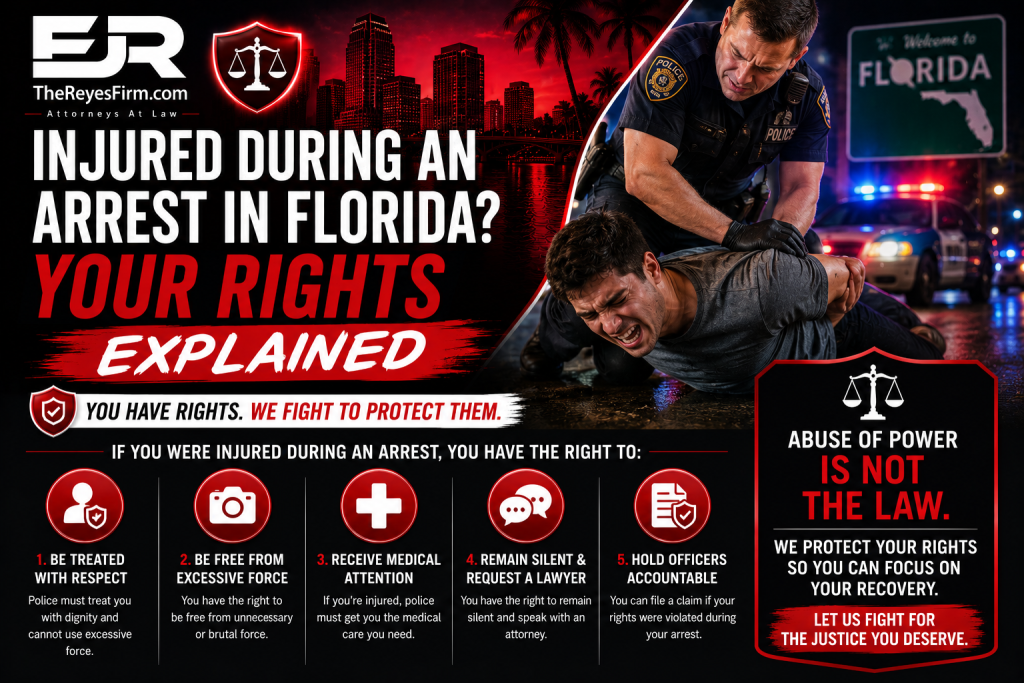
Injured during an arrest in Florida
Accident Injuries & why, Legal, Personal Injury, personal injury attorney, Police Interaction

Injured During an Arrest in Florida? Your Rights Explained

You were being arrested, and something went too far. Now you’re hurt, maybe seriously, and you’re not sure whether the law is on your side. Here’s what most people don’t realize: even during an arrest, police can only use force that’s reasonable, and if an officer crossed that line and left you injured, you may have a civil claim, no matter what you were charged with. TL;DR — QUICK SUMMARY Police may use only objectively reasonable force to make an arrest. Force that goes beyond what the situation calls for can be unlawful. If an officer used excessive force and injured you, you may have a civil claim, separate from any criminal case, even if you were charged. Two main paths exist: a federal civil rights claim under 42 U.S.C. § 1983 and a Florida state-law claim for battery. These cases face real hurdles, including qualified immunity and special rules for suing a government agency under Fla. Stat. § 768.28. Deadlines are strict and vary by claim type, so getting legal advice quickly is critical. The Reyes Firm Injured During an Arrest in Tampa? Find out if police used more force than the law allows. Had a bad day? Contact Us Now Reasonable Force standard for any arrest Graham v. Connor § 1983 Federal civil rights claim path 42 U.S.C. § 1983 4 Years Deadline for a battery claim Fla. Stat. § 95.11(3)(o) $0 Upfront cost on contingency Pay nothing unless you recover Can the police use any amount of force to arrest you? No. An officer making an arrest is allowed to use force, but only the amount that’s reasonable under the circumstances. This comes from the Fourth Amendment, and the U.S. Supreme Court spelled out the standard in Graham v. Connor: police force is judged by “objective reasonableness,” looking at factors like how serious the suspected crime was, whether the person posed an immediate threat, and whether they were actively resisting or trying to flee. The key word is reasonable. An officer can use enough force to safely make an arrest. What they cannot do is use force that’s out of proportion to what’s actually happening. When that line gets crossed and someone is hurt, the injury can become the basis for a civil claim, no matter how the criminal side plays out. ⚠️ Deadline Warning: Excessive-force claims run on strict deadlines that depend on the type of claim. A Florida battery claim generally must be filed within four years under Florida Statute § 95.11, federal civil rights claims have their own deadline, and claims against a government agency require written notice even sooner. Don’t wait to talk to a lawyer. What counts as excessive force during an arrest? Excessive force is force that goes beyond what a reasonable officer would use in the same situation. There’s no single checklist, because it always depends on the facts, but some situations raise serious red flags: striking or using a weapon on someone who is already restrained or compliant, continuing force after a person has stopped resisting, or using force wildly disproportionate to a minor offense. The injuries tell part of the story. Excessive force can cause broken bones, head trauma, spinal and brain injuries, and worse. When the force used doesn’t match the threat the person actually posed, and that force causes real harm, it may support a claim, even though an arrest was being made. Does resisting arrest mean the police can do whatever they want? No. This is one of the biggest misconceptions. Resisting arrest is a crime in Florida, and the safest course is always to comply and challenge the arrest later in court rather than physically resist. But the fact that someone resisted does not give officers unlimited authority to use force. Even when a person resists, the force used must stay proportional to the threat. Officers are still required to stop using force once the resistance ends. That means two things can be true at once. A person can be charged with resisting arrest and still have been the victim of excessive force. The criminal charge and the civil excessive-force claim are separate questions, decided under different standards. One does not automatically cancel out the other. 💡 Did You Know? Your civil claim for excessive force is separate from your criminal case and uses a different standard of proof. A criminal conviction requires proof beyond a reasonable doubt, while a civil claim generally only requires showing it’s more likely than not that the force was unreasonable. That’s why you can sometimes pursue a civil claim even when the criminal case resolves differently. Source: Graham v. Connor; 42 U.S.C. § 1983. What kind of claim can you bring if police injured you? There are generally two paths, and sometimes both apply to the same incident: A federal civil rights claim under 42 U.S.C. § 1983. This is the main tool for excessive-force cases. It lets you sue when a government official violates your constitutional rights, here, your Fourth Amendment right to be free from unreasonable force. These cases are usually filed in federal court, and you can seek compensation for your injuries, lost income, pain, and attorney fees. A Florida state-law claim for battery. Excessive force can also be a battery under state law. Battery is an intentional tort, which carries a four-year filing deadline that was not shortened by Florida’s 2023 tort reform. Which path fits, and whether you pursue one or both, depends on the facts and on who’s responsible, an individual officer, a department, or a government entity. That choice has major consequences for deadlines and procedure, which is exactly why these cases need a lawyer’s eye early. What makes these cases hard, and what about suing the government? Excessive-force cases are winnable, but they’re not easy, and it helps to know the obstacles going in. The biggest is qualified immunity, a doctrine that shields officers from personal liability unless their conduct violated a “clearly established” constitutional right. In practice, it

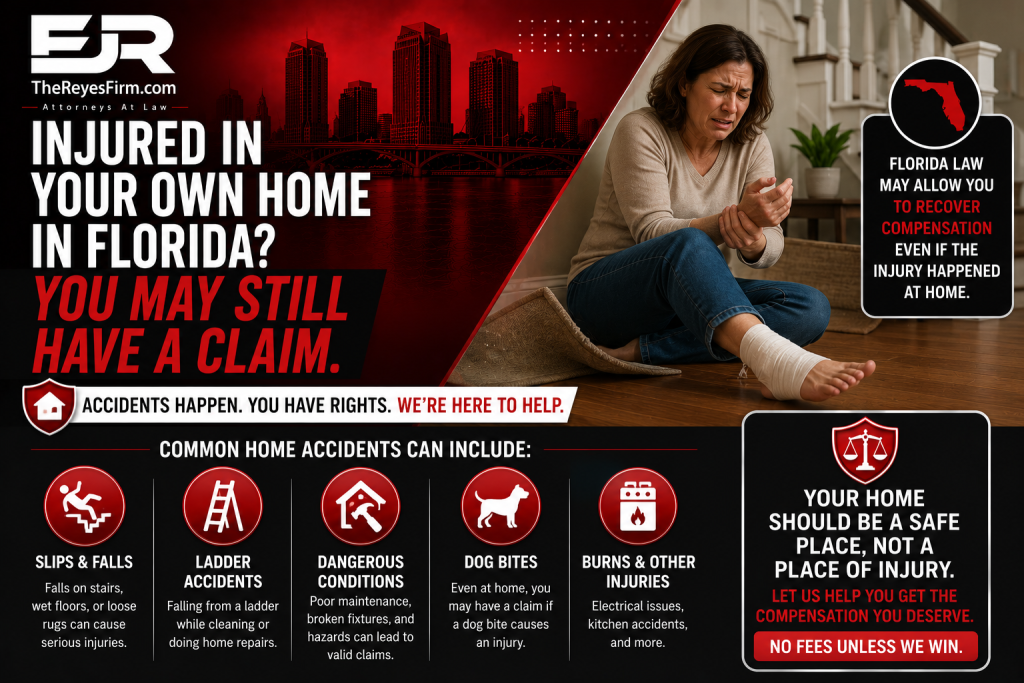
Injured at home Know your rights.
Legal, Personal Injury, personal injury attorney, Real Estate, Settlement

Injured in Your Own Home in Florida? You May Still Have a Claim

You were just at home, the one place you’re supposed to be safe. Then a fall or a hidden hazard changed your day, and now you’re hurt and wondering whether anything can even be done. Here’s the part most people don’t realize: being injured in your own home does not automatically mean no one else is responsible. TL;DR — QUICK SUMMARY You can still have a personal injury claim even if you were hurt inside your own home. It depends on who caused the hazard. Common at-fault parties include a landlord who ignored a known problem, the maker of a defective product, or a contractor whose bad work left a danger behind. Under Florida’s comparative fault law, being partly at fault reduces your recovery, and being more than 50% at fault can bar it entirely (Fla. Stat. § 768.81). Most injury claims must be filed within two years under Fla. Stat. § 95.11(3)(a), and defective-product cases carry their own deadlines. The Reyes Firm reviews how you were hurt for free and works on contingency, so you pay nothing unless the firm recovers for you. The Reyes Firm Hurt in Your Own Home in Tampa? Find out if someone else is responsible for your injury. Had a bad day? Contact Us Now 2 Years Deadline to file most injury claims Fla. Stat. § 95.11(3)(a) 51% Fault bar to recovery Fla. Stat. § 768.81 12 Years Product liability repose limit Fla. Stat. § 95.031(2)(b) $0 Upfront cost on contingency Pay nothing unless you recover Can you really have a claim if you were injured in your own home? Yes, you can, and this surprises a lot of people. The fact that an injury happened inside your own house doesn’t end the question of who’s responsible. It starts it. The real issue is what caused the injury and whether someone else’s negligence played a role. If it did, you may have a valid claim even though you were standing on your own property. Every case turns on its facts. Did you simply lose your footing, or was there a dangerous condition someone else should have fixed? Did a product fail? Did a contractor leave a hazard behind? Those answers decide whether a third party shares the blame. The point is that “it happened at home” is not a reason to assume you’re out of luck, it’s a reason to have a lawyer look at how it happened. ⚠️ Deadline Warning: Under Florida Statute § 95.11(3)(a), you generally have two years from the date of injury to file a personal injury lawsuit. Evidence of a home hazard, like a defective part or an unrepaired condition, can disappear fast. Don’t wait to call a lawyer. Who else can be liable when you’re hurt at home in Florida? More parties than you’d think. When a dangerous condition you didn’t create causes your injury, the person or company responsible for that condition may be on the hook. The most common at-fault parties in home injury cases include: A landlord. If you rent and your landlord failed to fix a known hazard or maintain the property, that failure can make them liable for your injuries. A product manufacturer or seller. If a defective appliance, tool, ladder, or other product malfunctioned and hurt you, the maker, distributor, or retailer may be responsible under Florida product liability law. A contractor or repair company. If someone did work in your home and left behind a danger, like an exposed nail, a faulty install, or unfinished repairs, their negligence can support a claim. A service provider. Delivery workers, utility crews, cleaners, or others who create a hazard in your home can be liable for injuries that result. A serious fall or a malfunctioning product can cause real harm, from broken bones to spinal cord and brain injuries. When that harm traces back to someone else’s negligence, the law gives you a path to hold them accountable. Watch: What happens if you’re injured in your own home? This short video breaks down when an injury at home can still lead to a valid claim and who might be responsible. Still not sure whether your situation qualifies? The Reyes Firm offers a free case review to walk through exactly how you were hurt. What if you rent and your landlord ignored a hazard? If you were injured in a rental because your landlord failed to address a known danger, you may have a strong claim. Landlords in Florida have a duty to keep their properties reasonably safe and to handle repairs they’re responsible for. When a landlord knows about a problem, a broken stair, a faulty railing, a leak that creates a slipping hazard, and does nothing, that inaction can be negligence. This is exactly the situation the law is built for. If you reported an issue, the timeline of your complaints and the landlord’s response, or lack of one, becomes powerful evidence. Save your messages, repair requests, and any photos. They help prove the landlord knew and failed to act. 💡 Did You Know? Your own homeowner’s or renter’s insurance liability coverage is generally designed to protect you if a guest is hurt on your property, not to pay you for injuries you suffer from your own actions. When a third party like a landlord, manufacturer, or contractor is at fault, compensation usually comes from their insurance, which is why identifying the responsible party early matters so much. What if a defective product or a contractor’s bad work caused it? Defective products and negligent repairs are two of the most common reasons people get seriously hurt at home. If a product was unreasonably dangerous because of a design flaw, a manufacturing defect, or a failure to warn, you may be able to pursue the manufacturer, distributor, or retailer, even though the injury happened in your living room. These cases can involve their own filing deadlines and a separate statute of repose under Fla. Stat. § 95.031, so prompt legal review is important.

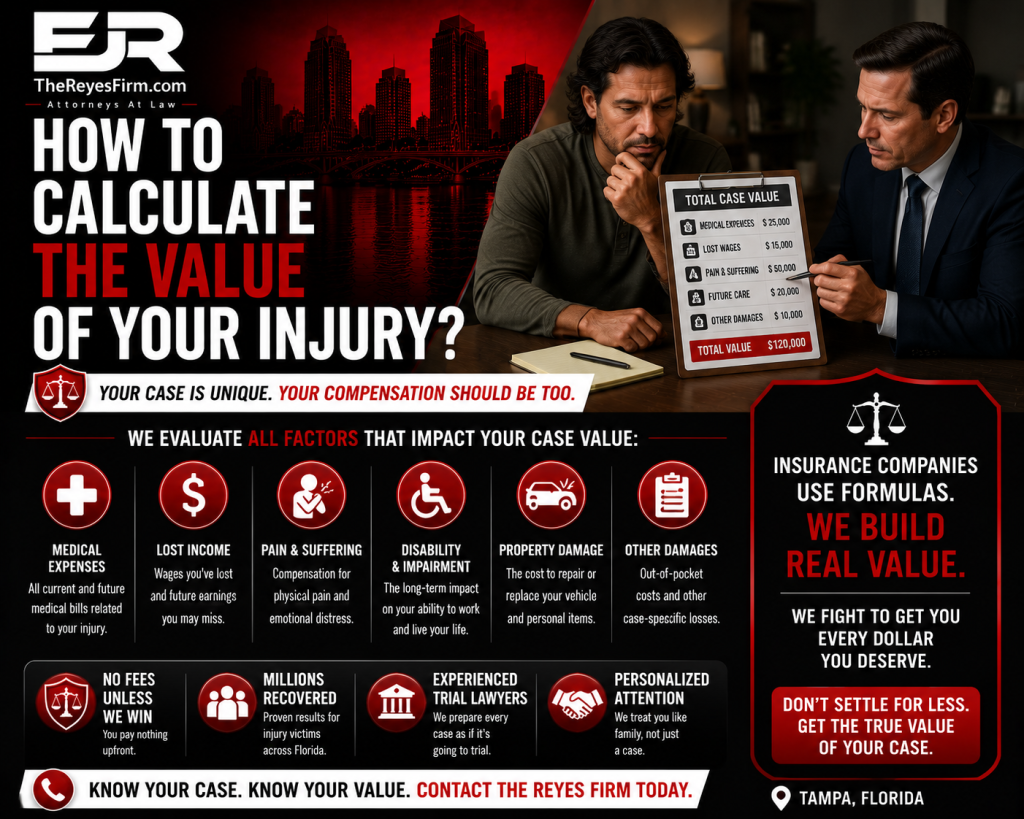
Know your case, know your value
After A Car Accident, Health, Legal, Migraines, Personal Injury, personal injury attorney, Settlement, Traumatic injury

How To Calculate The Value of Your Injury?

After a serious Tampa accident, one question outweighs almost every other: how much is my case actually worth? Put a number too high and the insurer stops taking you seriously. Settle for too little and you are stuck paying for an injury that was never your fault. Here’s how the value of an injury claim is really calculated in Florida, and what quietly raises or lowers that number. TL;DR — QUICK SUMMARY Your claim’s value is the sum of your economic damages and your non-economic damages, then adjusted for your share of fault and the available insurance. Economic damages are documentable losses like medical bills, lost wages, and future care; non-economic damages cover pain, suffering, and lost quality of life. Most insurers start with the multiplier method, adding up your medical bills and multiplying by a number, usually between 1.5 and 5, based on how serious your injury is. In Florida you can only recover pain and suffering from an at-fault driver if your injury meets the permanency threshold under Florida Statute 627.737. Comparative fault and insurance policy limits can shrink what you actually collect, and you have two years to file under Florida Statute 95.11(3)(a). The Reyes Firm Wondering What Your Case Is Worth? Get an honest valuation of your Tampa injury claim. Had a bad day? Contact Us Now 1.5 to 5 Common multiplier applied to your damages Industry standard No Cap On pain and suffering in most FL injury cases Florida law >50% Your fault share that bars recovery Fla. Stat. 768.81 2 Years To file an injury lawsuit Fla. Stat. 95.11(3)(a) How do you calculate the value of a personal injury claim? You calculate the value of an injury claim by adding together two kinds of damages, your economic losses and your non-economic losses, and then adjusting that total for real-world factors like your share of fault and the insurance coverage available. There is no single official formula a court hands you, but insurance companies and experienced attorneys both start from a recognized method and refine it based on the facts of your case. The goal of these damages is to make you whole, meaning to put you back, as much as money can, in the position you would have been in if the injury had never happened. Getting the number right matters in both directions. Aim too high and the insurer assumes you are not serious about settling. Accept too little and you are left covering costs that should have been someone else’s responsibility. What are economic, or special, damages? Economic damages are the losses you can put a receipt to. They include your past and future medical bills, your lost wages, your reduced earning capacity if you cannot work the way you used to, the property damage to your vehicle, and out-of-pocket costs like medication and travel to appointments. In a Florida auto case, your own Personal Injury Protection coverage pays the first portion of these medical bills before you pursue the at-fault party for the rest. The piece people most often undervalue is the future. A catastrophic injury can require surgeries, therapy, and care for years or even a lifetime, and all of that belongs in your claim. Counting only the bills you have already received is one of the fastest ways to settle for far less than your case is worth. What are non-economic, or general, damages? Non-economic damages compensate you for harm that has no invoice: physical pain, mental anguish, the loss of enjoyment of your life, disfigurement, and the strain an injury puts on your relationships. These losses are real, but because they are subjective, they are the hardest part of a claim to value and the part insurers fight the most. In Florida there is an important gate. You can only recover non-economic damages from an at-fault driver if your injury meets the permanency threshold under Florida Statute § 627.737, which generally requires a permanent injury such as a spinal cord injury or a traumatic brain injury. The good news is that Florida does not cap pain and suffering in typical injury cases, so when the threshold is met, the value of these damages is limited by the evidence, not by an arbitrary ceiling. 💡 Did You Know? In a Florida car accident, you cannot recover pain and suffering from the at-fault driver unless your injury meets the permanency threshold in Fla. Stat. § 627.737. When it does, Florida places no cap on non-economic damages in ordinary injury cases, so the value is driven by the strength of your medical evidence. Source: Fla. Stat. § 627.737, leg.state.fl.us. How does the multiplier method work? The multiplier method is the most common starting point for valuing pain and suffering. An adjuster or attorney adds up your economic damages, focusing on your medical bills, and multiplies that total by a number, usually between 1.5 and 5. A minor injury with a full recovery sits near the bottom of that range, while a severe, permanent injury sits near the top, and the result is an estimate of your non-economic damages that gets added to your economic losses. A second approach, the per diem method, assigns a set dollar amount for each day you live with your injury, which works better for shorter-term injuries than for lifelong ones. Both are only starting points. This is also why the free calculators you find online are unreliable, because they cannot weigh permanency, fault, your future prognosis, or the specific facts that move the multiplier up or down. Watch: How injury value is calculated In this short video, attorney Edward Reyes breaks down how the value of an injury claim is calculated and the mistakes that leave money on the table. If you want a clear, honest read on what your case is worth, The Reyes Firm offers free consultations at no cost to you. How do fault and insurance limits change what you actually collect? Two factors can separate what your claim is worth from

Settle your case privately today
Accident Injuries & why, After A Car Accident, Legal, personal injury attorney, Settlement, Why we serve

Can you settle your case privately?

You finally got the call. The car accident case settled, and a check is coming. Now you’re wondering who has to know, and whether anyone can take a piece of it. Here’s the truth about settling your injury case privately in Florida, and the liens that don’t disappear just because the deal is quiet. TL;DR — QUICK SUMMARY Most Florida personal injury cases settle before a lawsuit is ever filed, which means there’s no public court record of the payout. A “private” settlement usually means two things: it’s resolved pre-suit, and the agreement includes a confidentiality clause. Private does not mean untouchable. Liens for medical care, health insurance, Medicare, Medicaid, and even past-due child support can still attach to your settlement. Government liens like Medicare and Medicaid generally must be paid first, and they’re protected by federal and Florida law. Most liens are negotiable. An attorney identifies them, fights to reduce them, and resolves them before your money is disbursed. The Reyes Firm Worried About Who Gets a Cut of Your Settlement? Get clear answers about liens, confidentiality, and your net recovery. Had a bad day? Contact Us Now Pre-Suit Stage where most cases resolve No public court record Confidential Common private settlement clause Settlement agreement term Paid First Priority for Medicare & Medicaid Federal & Fla. law 2 Years Florida deadline to file a claim Fla. Stat. § 95.11(3)(a) What does it mean to settle your case privately? Settling privately usually means two things. First, your case resolves before anyone files a lawsuit, so there’s no public court file documenting the amount you received. Second, the settlement agreement often includes a confidentiality clause that legally bars both sides from disclosing the terms. Put together, that’s what most people mean when they ask about a “private” settlement: a quiet, pre-suit resolution that doesn’t end up in the public record. This is the most common way personal injury cases end. The vast majority settle in the pre-suit phase, before a complaint is ever filed in court. The upside is real. You avoid the time, stress, and public exposure of litigation, and there’s no court docket broadcasting what you were paid. Can you settle a personal injury case without going to court in Florida? Yes. You absolutely can settle without going to court, and most people do. A claim can be negotiated and resolved directly with the at-fault party’s insurance company, and a signed settlement and release ends the matter without a judge, a courtroom, or a public trial. That said, there’s a catch worth understanding. Settling pre-suit only works if both sides reach an agreement before your filing deadline runs out. If negotiations stall and your time is running low, the only way to protect your claim is to file the lawsuit. You can read more about that clock in our guide to Florida’s statute of limitations, but the short version is this: don’t let a slow private negotiation quietly run out your right to sue. ⚠️ Deadline Warning: Under Florida Statute § 95.11(3)(a), you generally have two years from the date of your injury to file a lawsuit. Private settlement talks do not pause this clock. If a deal isn’t done in time, you must file suit to protect your claim. Don’t wait to call a lawyer. Does a private settlement stay completely secret? Not entirely, and this is where people get caught off guard. A confidentiality clause keeps the terms private between you and the other side, but it does not erase legal obligations attached to your money. If someone has a valid legal claim against your settlement, called a lien, that claim survives no matter how quiet the deal is. So while your neighbor or your coworkers won’t find out what you were paid, certain parties with a legal right to repayment can. The most common are healthcare providers, health insurers, government programs, and, in some cases, an agency collecting past-due child support. A private settlement protects your privacy. It does not protect you from obligations the law says you owe. Watch: How private settlements really work This short video walks through what a private settlement means and how liens can affect what you actually take home. Have a question the video didn’t cover? The Reyes Firm offers a free case review so you understand your settlement before you sign anything. What liens can attach to your injury settlement? A lien is a legal right to claim money from your settlement before it reaches your pocket. Several types can apply at once, and they’re paid in a specific order. The most common liens in Florida injury cases include: Medical and hospital liens. Providers who treated you, including hospitals and ambulance companies, can secure a lien for their bills, sometimes under Florida statutes and sometimes by contract when you signed intake paperwork. Letters of protection. If a doctor agreed to treat you and wait for payment until your case resolved, that agreement is a contractual lien paid out of your settlement. Health insurance subrogation. If your private health insurer paid accident-related bills, it may have a right to be reimbursed from your recovery. Medicare and Medicaid. Federal and Florida law require these programs to be repaid for accident-related care. Government liens like these generally get paid first. Child support. If you’re behind on child support, the obligation can attach to your settlement, which we’ll cover in detail below. Here’s the good news that often gets lost: most of these liens are negotiable. An experienced attorney requests itemized documentation, challenges inflated or unreasonable charges, and works to reduce what comes out of your settlement, so you keep as much of your recovery as possible. 💡 Did You Know? Under the federal Medicare Secondary Payer Act, Medicare must be repaid for accident-related care out of your settlement, and failing to handle it correctly can lead to penalties or collections. A smart settlement plan often holds funds in trust until the final lien amount is confirmed, so your check doesn’t get

Scroll to Top