What families should know after a serious highway collision
What You Should Know
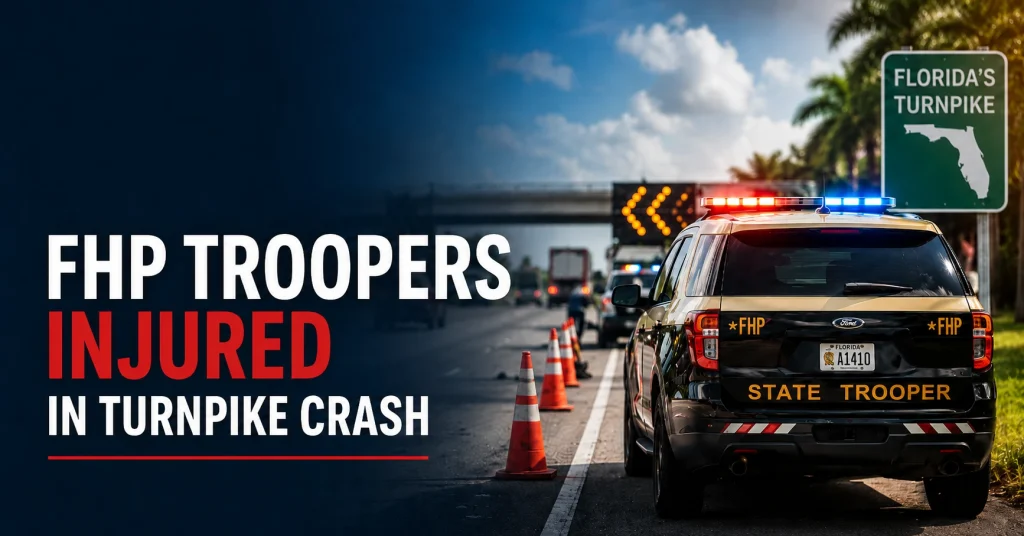
Two Florida Highway Patrol troopers were seriously injured in a multi-vehicle crash on Florida’s Turnpike in Medley, according to CBS Miami. The crash reportedly happened around 10:40 a.m. on June 15, 2026, in the northbound lanes near Northwest 106th Street.
CBS reported that an FHP Chevy pickup towing a trailer and a marked FHP cruiser had pulled onto the emergency shoulder after the trailer became disabled with a flat tire. FHP said a black Cadillac SUV veered off the roadway and crashed into the FHP cruiser, which then hit one trooper standing outside near the trailer. Another trooper inside the vehicle was also injured.
Early reports do not always explain the full cause of a crash. In serious highway collisions, investigators may consider vehicle movement, driver behavior, roadway conditions, shoulder use, emergency lighting, tire issues, vehicle maintenance, and available video or electronic evidence.
Florida’s Move Over law may also matter in crashes involving emergency vehicles or disabled vehicles on the roadside. FLHSMV explains that drivers must move over for emergency, service, utility, and disabled vehicles stopped on the side of the road, or slow down if moving over is not safe.
At The Reyes Firm, we know how quickly a serious crash can leave families with medical concerns, insurance questions, and uncertainty about what comes next. This article explains what we know, why crashes like this matter, and what families should understand under Florida law.
What Happened in the Florida Turnpike Crash?
According to CBS Miami, two Florida Highway Patrol troopers were seriously injured in a crash on Florida’s Turnpike in Medley on Monday morning, June 15, 2026. The reported location was in the northbound lanes near Northwest 106th Street.
CBS reported that a silver FHP Chevy pickup truck was towing a trailer and was being followed by a marked FHP cruiser. The trailer reportedly became disabled with a flat tire, and both FHP vehicles pulled onto the emergency shoulder.
FHP said a black Cadillac SUV veered off the roadway and crashed into the FHP cruiser. The cruiser then struck a trooper standing outside near the trailer. Another trooper sitting inside the vehicle was also injured.
Traffic was impacted on both sides of Florida’s Turnpike. CBS reported that a medical helicopter landed on the roadway to transport an injured trooper from the scene, and northbound traffic was diverted onto Northwest 74th Street.
At the time of the report, no other information had been released. This article does not assume fault beyond what has been reported.
Where Did the Crash Happen?
According to CBS Miami, the crash happened in the northbound lanes of Florida’s Turnpike near Northwest 106th Street in Medley, Miami-Dade County. The map below shows the general area of the reported crash location. Exact crash locations may vary based on the final crash report.
What Do We Know About the Crash?
Based on the CBS Miami report, we know the following:
- The crash occurred on Florida’s Turnpike in Medley.
- The reported location was near Northwest 106th Street.
- Two FHP troopers were seriously injured.
- An FHP pickup towing a trailer and a marked FHP cruiser had pulled onto the emergency shoulder after a flat tire.
- FHP said a black Cadillac SUV veered off the roadway and struck the FHP cruiser.
- One trooper was outside near the trailer.
- One trooper was inside the vehicle.
- A medical helicopter responded to the scene.
- No further information was released in the CBS report.
What we do not know from the report is just as important as what we do.
The report does not state whether impairment, distraction, speed, mechanical issues, roadway conditions, visibility, or another factor caused the SUV to leave the roadway. Those issues may be investigated depending on the evidence.
Early reports do not always explain the full cause. A full legal investigation may require crash reconstruction, witness interviews, bodycam or dashcam review, emergency response records, roadway evidence, and vehicle inspection.
Why Can This Type of Crash Be So Serious?
Highway shoulder crashes are especially dangerous because people outside vehicles have little protection.
When a vehicle is stopped on the shoulder, the people nearby may include law enforcement officers, road workers, tow operators, stranded drivers, passengers, or emergency responders. They are often close to moving traffic. At highway speeds, even a brief lane departure can cause catastrophic injuries.
This type of crash may be serious because:
- Vehicles may be traveling at highway speeds.
- Stopped vehicles may have limited escape space.
- A person standing outside a vehicle can be directly exposed.
- A secondary impact can occur when one vehicle is pushed into another person or object.
- Emergency response may require lane closures, helicopter transport, and traffic diversion.
Florida recognizes the danger of roadside incidents through its Move Over law. FLHSMV states that drivers must move over a lane for emergency, service, utility, and disabled vehicles stopped on the roadside, or slow down to 20 mph below the posted speed limit if moving over is not safe.
FLHSMV also states that as of January 1, 2025, Florida’s Move Over law applies to vehicles stopped on the side of the road with hazard lights, emergency flares, or visible emergency signage, including disabled vehicles and vehicles with a flat tire.
This does not mean every roadside crash has the same legal outcome. It means investigators may carefully examine whether a driver had the time, space, and visibility, and a legal obligation, to move over or slow down.
What Makes a Truck or Commercial Vehicle Crash Different?
The CBS report does not say that a private trucking company or commercial carrier caused this crash. It describes an FHP pickup towing a trailer, a marked FHP cruiser, and a black Cadillac SUV.
Still, many serious Florida highway crashes involve work vehicles, fleet vehicles, trailers, delivery vans, government vehicles, construction trucks, or commercial vehicles. When that happens, the investigation can become more complex than a typical passenger vehicle crash.
A truck, trailer, fleet, or commercial vehicle crash may involve:
- More than one insurance policy
- A vehicle owner separate from the driver
- Employer or agency involvement
- Maintenance records
- Driver qualification records
- GPS or telematics data
- Dashcam footage
- Dispatch records
- Trailer inspection records
- Tire condition and repair history
- Possible government entity issues, depending on the vehicle involved
If a vehicle was being used for work, possible liable parties may include the driver, vehicle owner, employer, maintenance provider, trailer owner, parts manufacturer, or another driver, depending on the evidence.
That does not mean a company, employer, or agency is automatically responsible. Liability depends on facts such as who owned the vehicle, who controlled the driver, what the driver was doing, whether the vehicle was properly maintained, and whether a safety rule was violated.
What Should Families Do After a Serious or Fatal Crash in Florida?
After a serious crash, families are often overwhelmed. Medical updates, hospital decisions, missed work, transportation issues, and insurance calls can all happen at once.
Here are practical steps that may help protect the family and the legal claim.
1. Get Medical Care and Follow Treatment Instructions
In serious injury cases, the medical record matters. Follow-up care can help doctors understand the full extent of the injury and document how the crash affected the injured person.
Even if the first medical update seems limited, symptoms can change. Pain, dizziness, confusion, numbness, emotional distress, and mobility issues should be reported to medical providers.
2. Save Every Document
Families should keep copies of:
- Crash reports
- Hospital paperwork
- Discharge instructions
- Medical bills
- Insurance letters
- Photos and videos
- Vehicle repair estimates
- Work absence records
- Funeral or burial expenses if the crash becomes a wrongful death matter
3. Avoid Guessing About Fault
Serious crashes often involve multiple factors. A family should not feel pressured to explain what happened before the investigation is complete.
Early reports do not always explain the full cause. Depending on the evidence, the investigation may consider driver behavior, speed, distraction, impairment, roadway conditions, mechanical failure, vehicle positioning, emergency lighting, and visibility.
4. Be Careful With Insurance Statements
Insurance companies may ask for recorded statements soon after a crash. Even honest comments can later be taken out of context.
Before giving a recorded statement, it may be helpful to speak with a Florida personal injury attorney who can explain the process and help protect the claim.
5. Ask About Evidence Preservation Quickly
Some evidence can disappear fast. Dashcam footage may be overwritten. Commercial vehicle data may be deleted. Roadway debris may be cleared. Witnesses may become harder to find.
A legal team can send preservation letters and begin investigating before key evidence is lost.
Who May Be Liable After This Type of Crash?
Possible liable parties may include different people or entities, depending on the evidence.
In a serious roadway crash, the investigation may consider:
The Driver of a Vehicle Involved
If evidence shows a driver failed to stay in a lane, failed to move over when required, drove distracted, drove impaired, or otherwise acted carelessly, that driver may be investigated as a possible responsible party.
This must be proven with evidence. A news report alone is not the same as a legal finding.
A Vehicle Owner
If the driver did not own the vehicle, the vehicle owner’s role may need to be reviewed. Ownership, permission, insurance coverage, and vehicle maintenance may matter.
An Employer or Company
If a driver was working at the time of the crash, an employer or company may be investigated. The key question is whether the driver was acting within the scope of work and whether any company-level conduct contributed to the crash.
Possible company-level issues may include hiring, training, supervision, scheduling, maintenance, or vehicle safety policies.
A Maintenance Provider
If a tire failure, brake issue, lighting problem, or mechanical defect played a role, a maintenance company may be investigated.
This does not mean a maintenance company is automatically liable. Records, inspections, repair history, and expert review may be needed.
A Product Manufacturer
If a defective tire, vehicle component, trailer part, or safety system contributed to the crash, a manufacturer or distributor may be investigated.
These cases often require technical evidence and expert analysis.
A Government Entity
If a government vehicle, roadway design issue, or public agency is involved, special rules may apply. Claims involving government entities can have unique notice requirements and limitations.
Families should speak with an attorney quickly when any public vehicle or agency may be involved.
What Evidence Matters Most?
Evidence can determine whether a claim is strong, disputed, or incomplete.
Important evidence may include:
Crash Report and Scene Documentation
The crash report can identify the vehicles, drivers, witnesses, location, and preliminary findings. It may not answer every legal question, but it is an important starting point.
Photos and Videos
Photos of vehicle damage, roadway marks, shoulder position, debris, warning lights, weather, lane closures, and injuries can be important.
Video may come from:
- Dashcams
- Body cameras
- Traffic cameras
- Nearby businesses
- Toll facilities
- News helicopters
- Witness cell phones
Vehicle Data
Modern vehicles may store useful data. Depending on the vehicle, this may include speed, braking, steering, seatbelt use, airbag deployment, and impact timing.
Maintenance and Inspection Records
If a tire, trailer, or mechanical issue is involved, maintenance records may be critical.
In the reported Turnpike crash, CBS stated that the FHP trailer became disabled with a flat tire before the vehicles pulled onto the emergency shoulder. That fact does not establish legal fault, but it may explain why the vehicles were stopped and why investigators may review vehicle positioning, trailer condition, warning lights, and shoulder safety.
Medical Records
Medical records connect the crash to the injury. They can also show the severity, treatment plan, future care needs, and long-term impact.
Witness Statements
Witnesses may help explain how the crash happened, how vehicles were moving, whether lights were activated, and whether traffic conditions affected driver decisions.
Cell Phone and Distraction Evidence
If distraction is suspected, phone records and app activity may become relevant. This type of evidence usually requires a proper legal process.
How Does Florida Comparative Fault Affect Serious Crash Claims?
Florida uses a modified comparative fault system in many negligence cases.
Under Florida Statute § 768.81, contributory fault can reduce damages in proportion to the claimant’s percentage of fault. The statute also states that, in negligence actions covered by the statute, a party found greater than 50 percent at fault for their own harm may not recover damages, with an exception for medical negligence cases.
This matters because serious crash cases often involve disputes over fault.
Insurance companies may argue that another driver, a vehicle owner, a maintenance company, or another party contributed to the crash. A careful investigation can help identify what actually happened and how the fault should be evaluated.
Comparative fault does not mean a case is over just because fault is disputed. It means evidence matters.
What If a Serious Crash Becomes a Wrongful Death Case?
The CBS report states that two FHP troopers were seriously injured. It does not report a death.
However, because serious highway crashes can sometimes become fatal cases, families should understand the basic Florida wrongful death rules.
Florida Statute § 95.11 provides a two-year deadline for wrongful death actions. The same statute also lists a two-year deadline for negligence actions.
Florida Statute § 768.21 explains categories of damages that may be awarded in a wrongful death case, including lost support and services, loss of companionship and protection for certain survivors, mental pain and suffering for certain survivors, and qualifying medical or funeral expenses.
Wrongful death cases are not only about what happened in the crash. They also involve questions about who may bring the claim, who qualifies as a survivor under Florida law, what losses can be included, and what evidence is needed to connect the death to the incident.
Because these rules are specific, families should speak with a licensed Florida attorney about their situation.
How The Reyes Firm Handles These Cases
At The Reyes Firm, we understand that families need answers after a serious crash. They need someone to explain the process in plain language, protect important evidence, and communicate with insurance companies so they are not left handling everything alone.
When our team handles a serious crash case, we may:
- Review the crash report and available public records
- Investigate the scene and roadway layout
- Look for dashcam, traffic camera, or business surveillance footage
- Identify all insurance policies that may apply
- Send evidence preservation letters
- Review medical records and injury documentation
- Investigate vehicle ownership and employment relationships
- Examine whether commercial, fleet, trailer, or government vehicle issues are involved
- Work with experts when a crash reconstruction or technical review is needed
- Prepare the case as if it may need to be litigated
No attorney can guarantee a result. What we can do is take the case seriously, move quickly, and help families understand their legal options under Florida law.
FAQ
What happened in the Florida Turnpike crash involving FHP troopers?
CBS Miami reported that two Florida Highway Patrol troopers were seriously injured in a multi-vehicle crash on Florida’s Turnpike in Medley near Northwest 106th Street on June 15, 2026. FHP said a black Cadillac SUV veered off the roadway and crashed into an FHP cruiser after FHP vehicles had pulled onto the emergency shoulder because of a trailer flat tire.
Did the CBS report say who was at fault?
The CBS report stated what FHP said happened, but it did not report a final legal finding of fault. Fault may depend on evidence such as vehicle data, witness statements, roadway conditions, driver behavior, warning lights, and crash reconstruction.
Why are shoulder crashes so dangerous?
Shoulder crashes are dangerous because people outside vehicles have little protection from highway-speed traffic. First responders, tow operators, law enforcement officers, and stranded motorists can be seriously injured if another vehicle leaves the travel lane.
What is Florida’s Move Over Law?
Florida’s Move Over law requires drivers to move over for certain stopped vehicles on the roadside when it is safe to do so. If moving over is not safe, FLHSMV states that drivers must slow down to 20 mph below the posted speed limit.
Can a serious crash involve more than one liable party?
Yes. Depending on the evidence, possible liable parties may include a driver, vehicle owner, employer, maintenance provider, product manufacturer, government entity, or another party. Liability is not automatic and must be proven.
What evidence should be preserved after a serious highway crash?
Important evidence may include crash reports, photos, videos, dashcam footage, traffic camera footage, vehicle data, maintenance records, medical records, witness statements, and insurance documents.
What is the deadline for a Florida wrongful death claim?
Florida Statute § 95.11 provides a two-year deadline for wrongful death actions. Because deadlines can depend on the facts, families should speak with a licensed Florida attorney as soon as possible.
What damages may be considered in a Florida wrongful death case?
Florida Statute § 768.21 identifies categories of wrongful death damages, which may include lost support and services, certain survivor losses, mental pain and suffering for certain survivors, and qualifying medical or funeral expenses.
Does Florida comparative fault affect serious crash cases?
Yes. Under Florida Statute § 768.81, fault can reduce damages, and a party found greater than 50 percent at fault for their own harm may not recover damages in negligence actions covered by the statute, except for medical negligence cases.
Should families speak with an attorney after a serious crash?
Families may want to speak with an attorney if the crash caused serious injuries, involved multiple vehicles, involved a commercial or government vehicle, required hospitalization, or raised questions about insurance coverage, evidence preservation, or fault.

Edward Reyes, Esq., is the founder of The Reyes Firm and is admitted to The Florida Bar. He focuses his practice on serious personal injury and wrongful death cases, including commercial vehicle, truck, and company-operated vehicle crashes that cause catastrophic harm to Florida families. Attorney Reyes represents clients in Tampa, Hillsborough County, Pasco County, Hernando County, and surrounding communities.
Read more about Edward Reyes.
How Can The Reyes Firm Help You?
If your family lost someone in a truck crash or serious crash, you should not have to search for answers alone. These cases can involve insurance carriers, electronic evidence, safety rules, and multiple possible defendants.
The Reyes Firm can help investigate what happened, preserve key evidence, communicate with insurance companies, and explain your legal options under Florida law.
Had a bad day? Call The Reyes Firm at
833-4 BAD DAY.
📍 Address: 4730 N. Habana Ave., Suite 201, Tampa, FL 33614
Legal Disclaimer: This article is provided for general informational purposes only and does not constitute legal advice. The information in this article does not create an attorney-client relationship. Every case is unique, and past results do not guarantee future outcomes. If you have been involved in a crash or have lost a family member in a commercial vehicle accident, please consult with a licensed Florida attorney about your specific situation.