Moments after a crash, your phone starts ringing with insurance calls, and it is easy to say the wrong thing to the wrong company without realizing it. Which insurer should you talk to, what should you say, and who can you politely shut down? Getting this right in the first days protects your claim. Here is what you need to know about notifying the insurance company after an accident in Florida.
The Reyes Firm
Insurance Calling After Your Tampa Crash?
Know what to say before you pick up. Had a bad day?
The hours after a crash are chaotic, and insurance companies know it. That is often when their adjusters reach out, while you are shaken, in pain, and unsure of your rights. Understanding the simple difference between the insurer you should call and the one you can decline puts you back in control of those conversations.
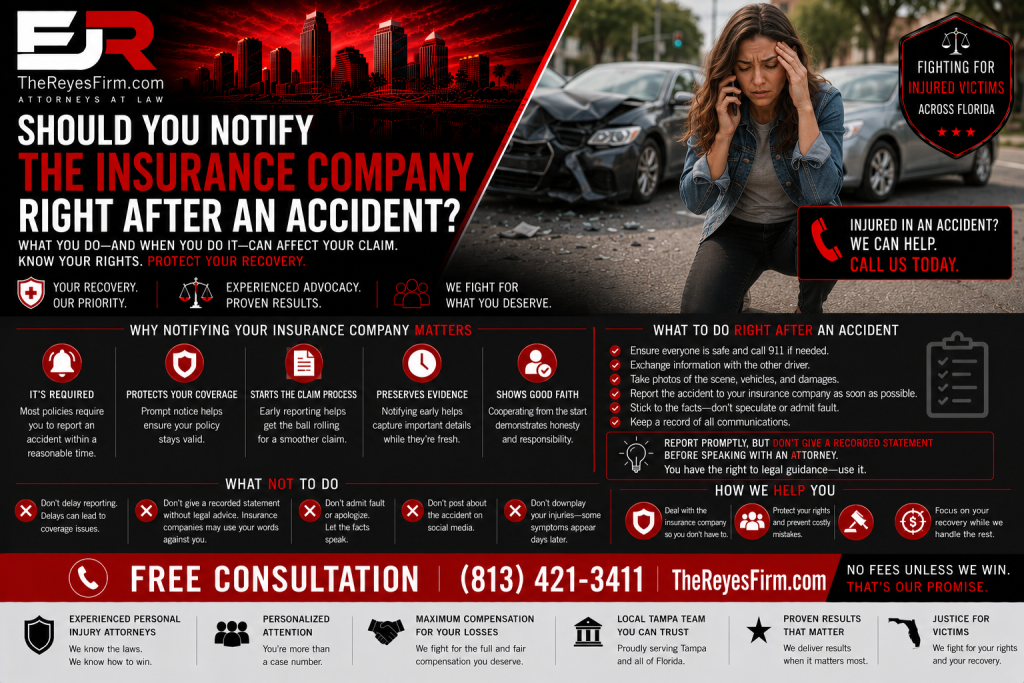
Should you notify the insurance company right after an accident?
Yes, you should notify your own insurance company promptly after a crash. Reporting the accident starts your claim and creates an official record, and just as importantly, your policy almost certainly requires you to do it. The key is understanding that “notify the insurance company” means your own insurer, which is very different from the other driver’s insurer.
That distinction is the whole point of this article. You have obligations to your own insurance company, and you have protections when it comes to the other side’s. Confusing the two is one of the most common and costly mistakes people make right after an accident.
Why should you notify your own insurance company?
There are three good reasons. First, nearly every auto policy contains a cooperation and notice provision that requires you to report an accident promptly, and failing to do so can give your insurer a reason to dispute coverage later. Second, reporting starts your claim and, in Florida, is tied to accessing your Personal Injury Protection benefits under Florida Statute § 627.736, which pay for your initial medical care regardless of fault.
Third, your own insurer stands behind you if a claim is made against you. Whether or not the crash was your fault, notifying your insurer puts the accident on record so the company can step in and protect you if the other party pursues a claim. That protection is part of what you pay for.
💡 Did You Know? Even if the accident was your fault, your own insurance company generally has a duty to defend you against claims covered by your policy. That means if someone makes a claim against you, your insurer can provide the defense, which is a core part of what your liability coverage is for, and one more reason to notify your own insurer promptly.
What should you tell your own insurance company?
Keep it factual and simple. Your insurer needs the basic information to open your claim: that an accident happened, when and where it occurred, who was involved, and the other driver’s information. Providing those facts is exactly what starting a claim requires.
What you should avoid is just as important. Do not guess about who was at fault or volunteer opinions about how the crash happened, because you may not have the full picture, and speculation can come back to hurt you. Do not downplay your injuries by saying you feel fine, since many injuries appear days later, and do not exaggerate them either. Stick to what you know for certain, and let the facts speak.
Do you have to talk to the other driver’s insurance company?
No, and this is where your protections come in. You are generally not required to give the at-fault driver’s insurance company a recorded statement, and you should be very cautious about doing so. That insurer’s job is to pay as little as possible, and a recorded statement gives them material to twist, take out of context, or use to argue that your injuries are minor or that you were partly to blame.
If the other insurer contacts you, you can simply get the claim number for your records and decline to give a detailed or recorded statement. You do not owe the other side an account of the crash, and politely declining is well within your rights.
⚠️ Important Warning: The at-fault driver’s insurer may call soon after the crash, sounding friendly and eager to help you. Remember that you are generally not required to give them a recorded statement, and anything you say can be used to minimize or deny your claim. Get the claim number, stay polite, and refer them to your lawyer rather than discussing the crash or your injuries.
What should you do if the other insurer calls you?
Handle it calmly and briefly. You can be courteous without giving the other insurer what it is looking for. In practice, that means taking down the claim number and the adjuster’s contact information, then declining to provide a recorded statement or to discuss fault, the details of the crash, or the extent of your injuries.
The simplest and safest response is to let them know that your attorney will be in touch, and then end the call. Once you have a lawyer, all of this communication can go through your lawyer, so you never have to worry about saying the wrong thing to someone whose goal is to reduce your recovery.
🛡️ Your Rights Under Florida Law: Under Florida Statute § 768.81, your compensation is reduced by your share of fault. This is exactly why what you say to insurers matters so much, because an offhand apology or a guess about what happened can be treated as an admission and used to shift fault onto you. Careful, limited communication protects your recovery.
Why does what you say to insurers matter so much?
Because insurance claims turn heavily on fault, and fault is influenced by what people say in those early conversations. A casual “I’m sorry, I didn’t see you” at the scene, or a guess to an adjuster that you “might have been going a little fast,” can be recorded and later used to assign you a share of blame you may not actually deserve. In a system where your recovery drops as your assigned fault rises, those words carry real weight.
This is not about hiding anything or being dishonest. It is about not speculating, not volunteering conclusions you are not qualified to make in the chaos after a crash, and not letting an adjuster steer you into statements that hurt you. The rates you pay are also protected in certain situations, a topic we cover in our guide to what happens to your rates after a car accident, but protecting your claim starts with careful communication.
Watch: Should You Notify the Insurance Company Right After an Accident?
If you prefer to hear it explained, the short video below covers whether and how to notify the insurance company after an accident.
When you are ready to talk through your own situation, The Reyes Firm offers free consultations with no obligation.
What should you do about insurance right after a crash?
These five steps protect your coverage and your claim at the same time. The order matters.
- Notify your own insurance company promptly. Report the accident to start your claim and satisfy your policy’s notice requirement. Do not put this off.
- Stick to the facts with your own insurer. Give the basic details needed to open the claim, but do not guess about fault or say you feel fine when injuries may still appear.
- Do not give the other insurer a recorded statement. Get the claim number for your records, and politely decline to discuss the crash or your injuries.
- Write down the claim numbers and adjuster details. Keep your insurance information organized so nothing slips through the cracks.
- Call The Reyes Firm before any detailed conversations. We can handle the insurers for you from the start. Call 833-4 BAD DAY for a free consultation.
The Reyes Firm
4730 N. Habana Ave., Suite 201, Tampa, FL 33614
Phone: 833-4 BAD DAY | thereyesfirm.com
How The Reyes Firm handles insurance communication for you
One of the most immediate reliefs of hiring a lawyer is that you no longer have to field insurance calls yourself. We take that burden off you, throughout Tampa and Hillsborough County.
When we take on your case, we typically:
- Handle communication with the insurers, so you never have to worry about saying the wrong thing to an adjuster
- Make sure your own claim is properly opened, including getting your PIP benefits started so your medical care is covered
- Deal with the other driver’s insurer directly, shutting down recorded-statement requests and fault-shifting tactics
- Protect you from admissions, so an offhand comment does not become a reason to reduce your recovery
- Coordinate every coverage that applies, from your PIP to the at-fault driver’s liability coverage to your own uninsured motorist coverage, as we explain in our overview of how auto accident claims work
- Handle claims involving an uninsured driver, which we cover in our guide on being hit by a driver with no insurance
No lawyer can promise an outcome. What we can promise is that we manage the insurance side of your case carefully, explain every step in plain language, and keep the pressure off you so you can focus on recovering.
Frequently asked questions about notifying insurance after a crash
Should I notify my insurance company after an accident?
Yes. You should notify your own insurance company promptly, because your policy generally requires prompt notice and reporting starts your claim. This is separate from the other driver’s insurer, which you are not obligated to give a detailed statement to.
Do I have to talk to the other driver’s insurance company?
No. You are generally not required to give the at-fault driver’s insurer a recorded statement. You can take down the claim number for your records and decline to discuss the crash or your injuries, then refer them to your lawyer.
What should I tell my own insurance company?
Provide the basic facts needed to open your claim, such as when and where the crash happened and who was involved. Avoid guessing about fault, and do not say you feel fine or exaggerate your injuries, since injuries can appear later.
Will my insurer defend me even if the crash was my fault?
Generally, yes. Your own insurance company typically has a duty to defend you against claims covered by your policy, regardless of fault. That defense is part of what your liability coverage provides, which is a key reason to notify your insurer promptly.
What happens if I don’t report the accident to my insurer?
Failing to report promptly can violate your policy’s notice and cooperation requirements, which may give your insurer a reason to dispute coverage. Reporting the accident protects both your claim and your coverage.
Can what I say to an insurer hurt my claim?
Yes. Under Fla. Stat. § 768.81, your recovery is reduced by your share of fault, so an offhand apology or a guess about what happened can be treated as an admission and used against you. Careful, factual communication protects your claim.
Should I give a recorded statement?
Generally not to the other driver’s insurer, and it is wise to speak with a lawyer before giving one to anyone. A recorded statement can be used to minimize your claim, and you are usually not required to provide one to the at-fault party’s insurance company.
How long do I have to file a claim after a crash?
Notifying your insurer promptly is separate from the lawsuit deadline. Under Fla. Stat. § 95.11, you generally have two years from the date of the crash to file a personal injury lawsuit, a deadline shortened from four years in March 2023.

Edward Reyes, Esq. is a Florida Bar-admitted personal injury attorney and the founder of The Reyes Firm in Tampa, Florida. He represents people injured by the negligence of others in cases involving car accidents, truck crashes, and other serious injuries throughout Tampa and the surrounding counties. Edward Reyes, Esq. handles personal injury claims on a contingency fee basis, meaning clients pay nothing unless the firm recovers compensation for them.
Read more about Edward Reyes.
How Can The Reyes Firm Help You?
If you’ve had a bad day, whether a car accident, a slip and fall, a trucking crash, or any injury that wasn’t your fault, The Reyes Firm is in your corner. Our Tampa personal injury attorneys offer free consultations and work on a contingency fee basis, which means you pay us nothing unless we win your case.
You shouldn’t have to fight the insurance companies alone. Let us fight for you.
📍 Address: 4730 N. Habana Ave., Suite 201, Tampa, FL 33614
📞 Phone: 833-4 BAD DAY
🌐 Website: Schedule your free consultation today at thereyesfirm.com
Had a bad day? Call The Reyes Firm. We’ll handle the rest.
The information in this blog post is for general informational purposes only and does not constitute legal advice. Insurance policy terms and obligations vary, and the statutes described here contain conditions and exceptions not fully summarized above. Reading this article does not create an attorney-client relationship with The Reyes Firm. Every case is unique. If you have been injured in a car accident that wasn’t your fault, consult a licensed Florida personal injury attorney about your specific situation.