Accident Injuries & why

Car accident legal guidance infographic
Accident Injuries & why, Uninsured Motorist Coverage

What happens if you get in a car accident without insurance?

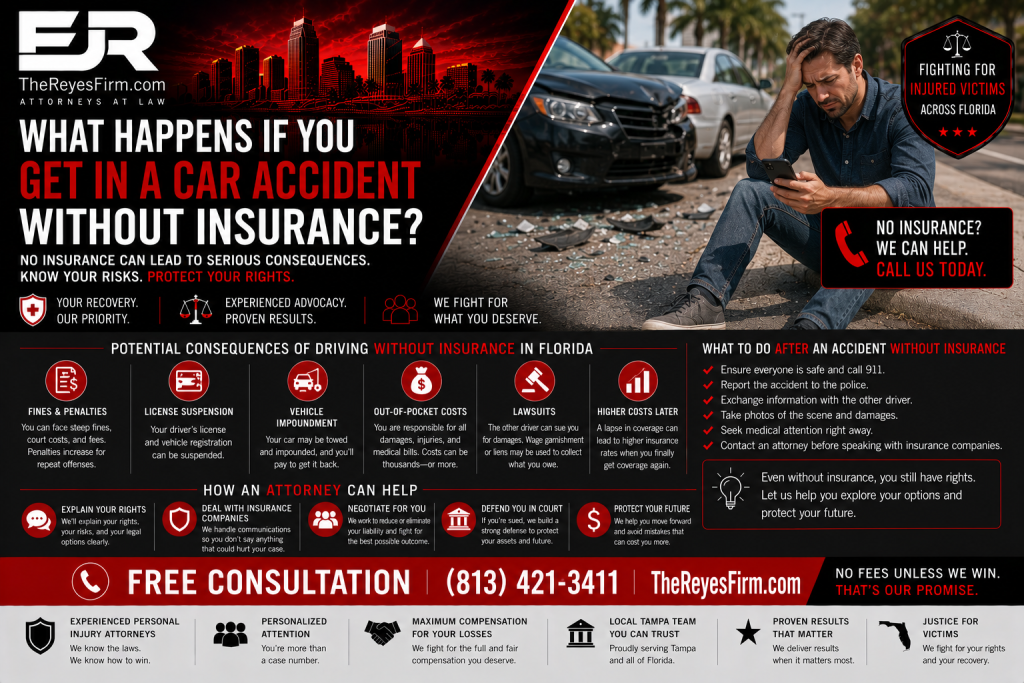
You’ve been in a crash, and now you are staring down a confusing question: whose insurance pays for what, and in what order? Florida’s system is layered, and understanding how the pieces fit together is the difference between leaving money on the table and getting everything you are owed. Here is how auto accident claims actually work in Florida, step by step, after a car accident. The Reyes Firm Confused About Your Tampa Accident Claim? Let us map out every layer of coverage for you. Had a bad day? Contact Us Now $10,000 PIP benefits, regardless of fault Fla. Stat. § 627.736 80% / 60% PIP pays of medical bills / lost wages Fla. Stat. § 627.736 UM Coverage Protects you if the other driver has none Fla. Stat. § 627.727 2 Years Deadline to file a lawsuit Fla. Stat. § 95.11 Florida is a no-fault state, which gives its auto accident claims a structure that surprises a lot of people. Instead of one insurance company simply paying for everything, different coverages handle different parts of your losses, and they come into play in a particular order. Once you see how the layers stack up, the whole process becomes far less mysterious. How do auto accident claims work in Florida? Auto accident claims in Florida work as a layered system rather than a single payout. Your own Personal Injury Protection handles your immediate medical costs regardless of fault, the at-fault driver’s bodily injury coverage handles your pain and suffering after a settlement, and your uninsured motorist coverage protects you when the responsible driver cannot. Which layers apply, and how much each pays, depends on the coverage involved and the severity of your injuries. Think of it as a chain, where each link does a specific job. Understanding what each link covers, and when it comes into play, is the key to making sure nothing that should be paid gets missed. What does your PIP cover after a crash? Your Personal Injury Protection is the first link in the chain. Under Florida Statute § 627.736, PIP pays your medical bills and a portion of your lost wages regardless of who caused the crash, which is the heart of the no-fault system. Specifically, PIP generally covers 80% of your reasonable medical expenses and 60% of your lost wages, up to a combined limit of $10,000. There are two catches worth knowing. First, you must seek initial medical care within 14 days of the crash, or you can lose your PIP benefits entirely. Second, the full $10,000 is generally available only if a medical provider determines you had an emergency medical condition; without that finding, your PIP benefits may be capped at $2,500. This is your own coverage, so it applies no matter who was at fault. How do you recover for pain and suffering? PIP does not pay for pain and suffering, so that part of your claim comes from a different link in the chain: the at-fault driver’s bodily injury liability coverage. When another driver causes your injuries, you can pursue a claim against their coverage for the human cost of the crash, including pain, suffering, and the impact on your life, and that recovery typically comes as part of a settlement rather than upfront. There is an important condition, though. In a Florida car accident, you generally cannot step outside the no-fault system to recover pain and suffering unless your injury meets a legal threshold. That is a key reason serious injuries are treated so differently from minor ones, and why proper medical documentation matters so much to the value of your claim. 💡 Did You Know? In a Florida car accident, you generally cannot recover for pain and suffering unless your injury meets a threshold such as permanent injury within a reasonable degree of medical probability, significant permanent scarring or disfigurement, or significant and permanent loss of an important bodily function. This is why the nature and permanence of your injury drives the value of your claim. Source: Fla. Stat. § 627.737(2). What if the at-fault driver has no insurance or too little? This is where the next link matters, because a great many Florida drivers are on the road with no insurance or the bare minimum. If the driver who hit you cannot cover your injuries, your own uninsured and underinsured motorist coverage under Florida Statute § 627.727 can step in to fill the gap. Here is a detail many people miss: you may have this coverage even if you do not remember buying it, because Florida requires insurers to offer it and to obtain your rejection in writing. If you never signed a written rejection, there is a good chance the coverage is on your policy. We go deeper into this in our guide on what to do when you are hit by a driver with no insurance. What happens if the crash was your fault? Even then, you are not left with nothing. Because Florida is a no-fault state, your own PIP still pays your medical bills and a portion of your lost wages regardless of who caused the crash. That is the whole point of no-fault coverage: your immediate medical needs are handled by your own policy first, no matter who was to blame. What changes when you are at fault is your ability to recover for pain and suffering, since that comes from the other driver’s coverage. For the damage to your own vehicle, your collision coverage, if you carry it, can pay for repairs regardless of fault, subject to your deductible. 🛡️ Your Rights Under Florida Law: Under Florida Statute § 768.81, your compensation is reduced by your share of fault, and you may be barred from recovery if you are found greater than 50% responsible. Because fault directly affects what you can recover, insurers work hard to assign as much of it to you as possible, and an experienced Tampa injury lawyer works to keep the facts straight. How do the


Motorcycle Accidents Are Different Than Car Accidents
Accident Injuries & why, After an Accident, Car accident, Injury, Legal, Motorcycles, Uninsured Motorist Coverage, Why we serve

Motorcycle Accidents Are Different Than Car Accidents

Motorcycle accidents are traumatic and the reason why because you don’t have the bumper in a car or airbags to protect you from the impact of a vehicle. In fact, many times you are thrown off your motorcycle and there are major injuries due to do the road rash. Many times, when this happens you have to undergo serious treatment and serious therapy and it’s pretty tragic. In Florida, it is not required for you to wear a helmet, however, it is highly recommended that you wear a helmet for many reasons. One, for your health, to protect your head from a higher impact from traumatic brain injury and on the legal side, the civil side to protect yourself. But also, if you do not have your helmet on, a lot of times what happens is that the insurance company on the other side, the at-fault party’s insurance company will try to deduct the injuries that you have in your head or brain and say anything that your helmet could have protected. Tampa personal injury lawyer Edward Reyes represents people in Tampa and Hillsborough County, Florida who have suffered an injury in an incident or accident type of accident. Speak Directly to Me, At No Cost, Today 813.421.3411This is because their stance is, if you had your helmet on, you should have been protected from the impacts or reduce the injuries and damage. It’s very important that you wear your helmet. It is very important that you are safe while keeping your distance from other vehicles. But if you are involved in a motorcycle accident and you are not at fault or even if you are at fault we can still help. It all depends on the facts and the case itself. If you have any questions on this feel free to give us a call at 833-422-3329. (Transcript from the video, transcribed but not reviewed)

Are you Getting a Fair Settlement
Accident Injuries & why, After A Car Accident, After an Accident, Car accident, Legal, Settlement, Why we serve

Are you Getting a Fair Settlement?

So, the insurance company offers you a fair settlement after you involved in an accident? It’s hard to talk about this without laughing because the insurance companies work for the insurance company. Those agents don’t work for you, instead, they work for the insurance company so they’re never going to offer you a fair settlement right off the bat without representation or without fighting them. Their job is to adjust the claims out and pay as little as possible to you for your lost wages, pain, and suffering. Tampa personal injury lawyer Edward Reyes represents people in Tampa and Hillsborough County, Florida who have suffered an injury in an incident or accident type of accident. Speak Directly to Me, At No Cost, Today 813.421.3411So, the question or myth is- do they pay you a fair settlement? No, they never pay you a fair settlement off the top. After you find them, you put force, and you show them that you’re not playing around with proper representation and then the settlement becomes fair. So, if you have any questions on this feel free to give us a call at 813.421.3411 and we’ll be more than happy to go through this process with you to help you understand how and what a fair settlement actually is. (Transcript from the video, transcribed but not reviewed)

Don't settle, get expert help
Accident Injuries & why, After A Car Accident, After an Accident, Car accident, Legal, Why we serve

Can You Settle Directly With The Insurance Company After A Car Accident?

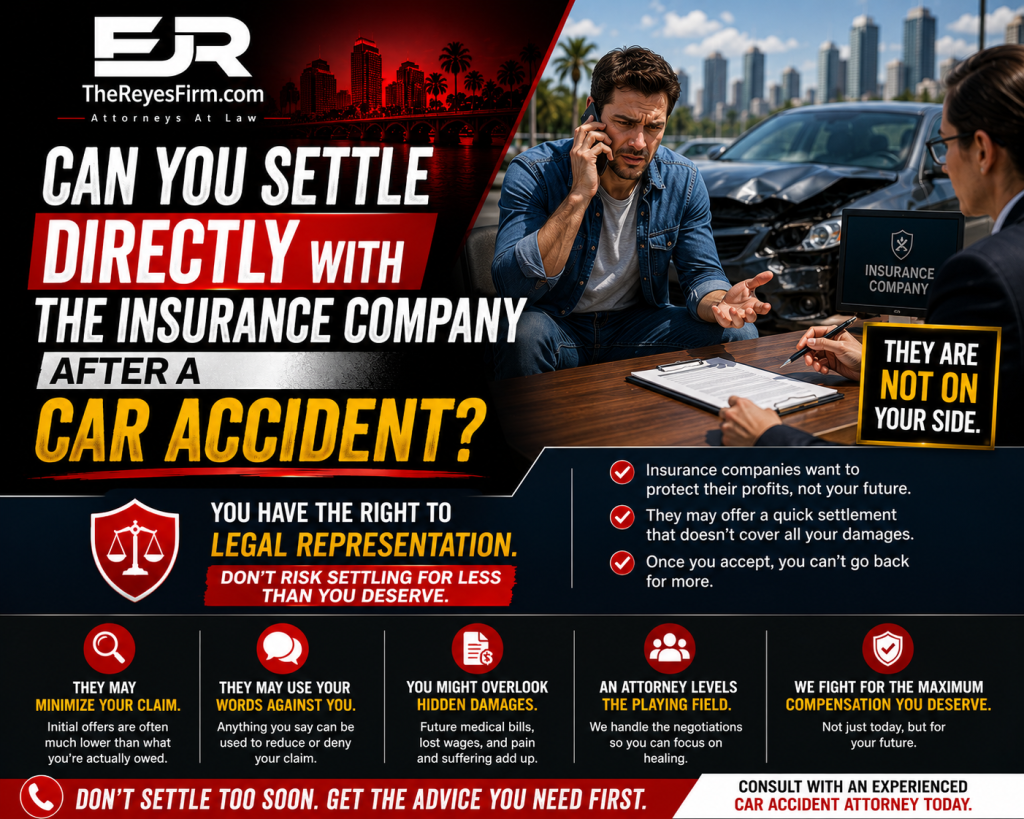
You were just going about your day. Then another driver hit you at an intersection. Now your car is damaged, your neck hurts, and the other driver’s insurance company is on the phone offering to “just work this out” with a quick check. Here’s what you need to know before you accept a dollar of it. TL;DR — QUICK SUMMARY Can you settle directly with the other driver’s insurance company? Technically yes. Should you do it alone? Almost never. The adjuster offering you money works for the insurer, and their job is to close your claim for as little as possible. Early offers rarely account for future medical care, lost wages, or injuries that surface days after the crash. Once you sign a release, you usually give up the right to ask for more, even if your condition gets worse. Under Florida Statute 95.11(3)(a), you generally have two years to file a lawsuit, but a signed release can end your claim long before that. A free consultation costs you nothing and tells you what your case is really worth before you decide. The Reyes Firm Did an Insurer Offer to “Work It Out” After a Tampa Crash? Find out what your case is really worth before you sign. Had a bad day? Contact Us Now 2 Years Florida injury filing deadline Fla. Stat. 95.11(3)(a) 14 Days Deadline to seek care for PIP benefits Fla. Stat. 627.736 50% Fault level that bars recovery in Florida Fla. Stat. 768.81 $0 Upfront cost with a contingency fee firm The Reyes Firm Can you work it out with the insurance company yourself? Technically, yes, and that’s exactly why so many people get shortchanged. Nothing in Florida law stops you from negotiating directly with the other driver’s insurer and accepting a settlement on your own. The myth isn’t whether you can. The myth is that doing it alone gets you a fair result. The person calling you is an adjuster, and the adjuster works for the insurance company. Their job is to close your claim for as little money as possible, because every dollar they save is a dollar that stays with their employer. They are friendly, they are professional, and they are negotiating against you the moment they pick up the phone. So the honest answer from The Reyes Firm, a Tampa personal injury law firm, is this: you can work it out yourself, but you usually shouldn’t, and the reason becomes obvious once you see how these offers are built. ⚠️ Deadline Warning: Under Florida Statute § 95.11(3)(a), you generally have two years from the date of your crash to file a personal injury lawsuit. But signing a settlement release ends your claim immediately, no matter how much time is left on that clock. Never sign before you know what your case is worth. Why does settling directly with the other driver’s insurer backfire? Because the first offer is almost always built around what’s visible on day one, not what your injury actually costs you over time. The dented bumper is easy to price. The herniated disc that flares up three weeks later is not, and by then you may have already cashed the check. Attorney Edward Reyes learned this firsthand. After his first car accident as a young man, someone handed him $400 and it seemed like enough. It wasn’t close. The repairs to his car ran over a thousand dollars, and the injuries he felt afterward were worth far more than that. He took the fast money before he understood the real damage, and that lesson is part of why he practices personal injury law today. That story plays out constantly. People try to handle it themselves, accept an early number to make the problem go away, and only later discover the offer didn’t cover their medical bills, their time off work, or the lasting effects of the crash. Once the release is signed, that money is final. 💡 Did You Know? Florida is a no-fault auto insurance state. Under Florida Statute § 627.736, your own Personal Injury Protection (PIP) coverage pays the first portion of your medical bills regardless of who caused the crash, up to a $10,000 minimum, but only if you seek treatment within 14 days. Settling with the other insurer doesn’t change those PIP deadlines. Source: Fla. Stat. § 627.736. Watch: Can You Work It Out With the Insurance Company? In this short video, attorney Edward Reyes busts the myth that you can simply “work it out” with the other side’s insurer, and shares the personal story that shaped how he handles these cases. If you have a settlement offer in front of you and aren’t sure what to do, The Reyes Firm offers free consultations, so you can call 833-4 BAD DAY before you respond. What is a fair settlement actually worth after a Tampa car accident? A fair settlement reflects everything the crash will cost you, not just the bills already on your kitchen table. A complete claim accounts for several categories most people overlook when they negotiate alone: Future medical care, including follow-up visits, physical therapy, imaging, and treatment for injuries that worsen over time Lost wages and lost earning capacity, covering the work you’ve already missed and any long-term limits on what you can do The full diagnosis, since soft-tissue injuries, concussions, and back injuries often don’t show their true severity for days or weeks Property damage done right, repaired or replaced at real cost, not a rounded-down estimate Pain and the disruption to your life, which an adjuster has every incentive to value at zero In a serious or catastrophic crash, the gap between the first offer and the real value of the claim can be enormous. That gap is the insurer’s profit, and it comes directly out of your recovery. 🛡️ Your Rights Under Florida Law: Under Florida Statute § 768.81, your compensation is reduced by your share of fault, and you may be barred from recovery if you are

Pedestrian & Scooter Safety
Accident Injuries & why, After an Accident, florida cities we serve, Injury, News, Pedestrian Accident, Scooter Accident, Why we serve

Bay News 9 Special Report on Pedestrian & Scooter Safety

A special report interview on pedestrian and scooter safety with Attorney Edward Reyes. Reporter: All right, have you had a chance to try out scooters yet in Tampa that a new way to get around town is still in the trial phase? Some things are going well, others maybe not so great. We’re going to go in-depth now with one of the board members of the Tampa Bay Mobility Alliance Edward Reyes. Good to have you with us, Edward. Edward Reyes: Thank you. Reporter: Nice to see you. First of all, we’ve had folks on with the Tampa Bay Mobility Alliance before. But just tell us about what the vision of that is exactly is there for. Edward Reyes: Well, the biggest thing is to help reduce human error and traffic violence because there’s so much growth that is happening in our society and there’s a lot of incidents and people are being injured so the biggest thing is to facilitate or to have a society that we have less fatalities and less or no fatalities that’s the idea of the vision zero or reduce human error as much as possible. Reporter: And we are unfortunately an area where we haven’t been as pedestrian and bicycle-friendly as we need to be we know every year we see those statistics and that’s why vision zero was formed to protect folks who want to get out and walk and now scooters you add to the mix. Let’s see the city has logged about six hundred thousand trips since the test a program began for scooters and that’s just one piece of transportation, new ways to get around and walking and riding your bike. When you add in scooters have you, you’re an attorney have you have you had folks who have had issues with these scooters have been injured or had problems. Edward Reyes: Yes, actually because scooters are so new to our society and they’re popping up everywhere, drivers are not used to having scooters on the road for one. And to think about it they were already lots of accidents are happening before the scooter before the pedestrian boom that’s happening right now because people were still crashing into cars not crashing into people because they’re still running crosswalks, they’re still making left turns without paying attention, they’re still looking down on their phones there’s still a lot of issues. The difference is that now instead of it being a car it’s a person and the damages are more significant. Yes, and we have had a lot of incidents with scooter-related accidents or violence and pedestrians as well. Reporter: If you’re on a scooter are you considered a pedestrian, or you consider the motorist? Edward Reyes: You’re still considered to be a pedestrian because you do not need a license to have a scooter and you don’t even have that insurance to have a scooter because you can pick one up uber lyft or you know the new ones that are limed and all the new scooters are coming up. You could just pay and ride. Reporter: Use your phone and come on I’ve never done it. Edward Reyes: It’s pretty fun especially when the battery dies. So the idea is that you don’t have to have insurance but there’s a double edge so that sword as well because not having insurance if you are injured you may not be covered if you know by medical coverage or anything. But the flip note to that is that if you live in a household that has insurance either yourself your own auto insurance or you live in a household that somebody has auto insurance, you may fall into that person’s policy or your own auto insurance policy if you have it. If you do not live in a household has nobody to has insurance and then the person that crashes into you will take on their personal possession for their insurance and you’ll be covered for medical coverages like that. Reporter: So, you’re covered through your auto insurance even though you’re considered a pedestrian that’s interesting. Edward Reyes: Unless there’s a writer that separates that when you buy your policy but up to now right now, you’re covered through the auto insurance. Reporter: Now there are one of the problems that they’ve had that they’re gonna work out through this pilot program or trying to is there are certain areas you’re not supposed to go like the Riverwalk places that are crowded and you don’t want to you know have scooters there and people are unfortunately still going into those areas so that’s something to work out. So, if you get into an accident where you’ve gone somewhere you weren’t supposed to go with the scooter do you have extra liability because of that? Edward Reyes: Well, it depends because like let’s say the Riverwalk, for example, there are no cars running through Riverwalk typically people are walking right, so if you’re gonna get hit you’re probably the person that hits the person walking, you’re hitting a pedestrian you know on the scooter so the liability will be personal liability, so they can sue you directly that individual can sue you as a person if they choose to do that it depends on the injuries as well. So it gets that gets a little bit dicey because I haven’t seen so far your auto insurance pick up the tab on scooter incidents because it’s not a covered vehicle under their policy whereas your auto is a cover vehicle policy, so I think that the insurance companies are it’s gonna be a fun game. Reporter: Yeah, it’s just a new element that’s you know they got to catch up to how we’re gonna handle these things. I want to just step back from scooters and just take a larger overview look at transportation and mobility as your board does in Tampa. We want to be more pedestrian-friendly, we want more sidewalks,

Seek medical attention after a crash
Accident Injuries & why, personal injury attorney

Do you Need to Seek Medical Attention for Minor Accidents?

The crash felt minor. You walked away, your car has a dent, and you feel basically fine, so why see a doctor? Here is the problem: after a crash, “fine” is one of the least reliable feelings there is, and in Florida, waiting to find out can quietly cost you your coverage. Here is what you need to know about seeking medical attention after a minor car accident, and the 14-day deadline that makes it urgent. The Reyes Firm Was Your Tampa Crash Really That Minor? Don’t let a 14-day deadline pass you by. Had a bad day? Contact Us Now 14 Days Deadline to seek care and keep PIP Fla. Stat. § 627.736(1)(a) 24-72 Hrs When hidden injuries often appear Adrenaline and inflammation $10,000 PIP benefits you can lose by waiting Fla. Stat. § 627.736 2 Years Separate deadline to file a lawsuit Fla. Stat. § 95.11 It is completely understandable to want to shake off a minor crash and get on with your day. Nobody wants to spend an afternoon in a doctor’s office over a little fender bender. But the human body has a way of hiding injuries in the hours after a collision, and Florida’s insurance rules add a hard deadline that turns a wait-and-see approach into a real risk. Do you need to seek medical attention after a minor accident? In most cases, yes, you should get checked out even when the accident felt minor and you feel fine afterward. The reason is simple: the way you feel in the minutes and hours after a crash is often not an accurate picture of whether you were actually hurt. What seems minor at the scene can turn out to be a real injury a couple of days later. Getting evaluated does two things at once. It protects your health by catching injuries early, and in Florida it protects your ability to have your medical care paid for, because of a deadline many people have never heard of. Why don’t you feel hurt right after a crash? Because your body is protecting you in the moment. A crash triggers a surge of adrenaline and stress hormones that put you into a heightened state, and in that state pain is masked so you can function. As those hormones wear off over the following hours and days, the pain that was hidden begins to surface. Many people genuinely feel fine at the scene and wake up stiff and hurting two mornings later. Inflammation adds to the delay. When soft tissues, joints, and nerves are injured, the body’s inflammatory response builds gradually and often peaks a day or two after the crash. That is why a delay in symptoms is normal rather than a sign that nothing is wrong. 💡 Did You Know? Adrenaline can mask serious injuries for hours or days after a crash. Medical authorities such as the Mayo Clinic and Cleveland Clinic note that whiplash and concussion symptoms in particular often take time to appear, which is exactly why feeling fine at the scene is not a reliable reason to skip a checkup. What is Florida’s 14-day rule? Florida’s 14-day rule is one of the most important things to understand after any crash. Under Florida Statute § 627.736, you must seek initial medical care within 14 days of a motor vehicle accident to be eligible for Personal Injury Protection benefits, the coverage that pays a portion of your medical bills regardless of who caused the crash. The consequence of missing that window is real. If you do not see a doctor within 14 days, you can lose access to your PIP benefits for that crash, which means the coverage you pay for every month may not pay for your injuries. That is why waiting to see whether a “minor” injury gets better on its own is a gamble, because the clock is running whether you feel hurt yet or not. ⚠️ Deadline Warning: Under Fla. Stat. § 627.736(1)(a), you must obtain initial medical services and care within 14 days of your crash to keep your PIP benefits. This deadline runs from the date of the accident, not from the day your symptoms appear, so an injury that first hurts on day 15 can leave you without PIP coverage. Do not wait to get checked. Does missing the 14-day window bar your entire claim? This is where it is important to be precise, because the 14-day rule is often misunderstood. Missing the 14-day window primarily affects your PIP benefits, the no-fault coverage on your own policy. It does not automatically erase every possible claim you might have. If another driver caused the crash and you suffered a serious injury, you may still be able to pursue a claim against that at-fault driver, which operates under Florida’s separate two-year deadline for filing a lawsuit under Florida Statute § 95.11. That said, missing the 14-day window still does real damage. You lose your PIP coverage, and a gap in treatment gives the insurance company its favorite argument, that if you were really hurt, you would have seen a doctor sooner. So while all is not necessarily lost if you missed the window, the far safer course is never to miss it in the first place. If you already have, it is worth speaking with a lawyer about what options remain. What counts as a “minor” injury that might not be minor? Some of the most common crash injuries are exactly the ones that feel minor at first. Whiplash and other soft-tissue injuries often start as mild stiffness and worsen over days. A concussion can occur even in a low-speed crash and may show up as headaches, fog, or dizziness rather than obvious trauma. Back and disc injuries can begin as a dull ache and develop into radiating pain as inflammation sets in. Because these injuries can be deceptive, a professional evaluation is worth far more than a self-assessment at the scene. Our guide to where injuries come from after

Pain and suffering compensation guide
Accident Injuries & why, After an Accident, Car accident, FAQ, Health, Injury, Legal, Settlement

Should I Get Paid for Pain and Suffering? | Tampa, FL

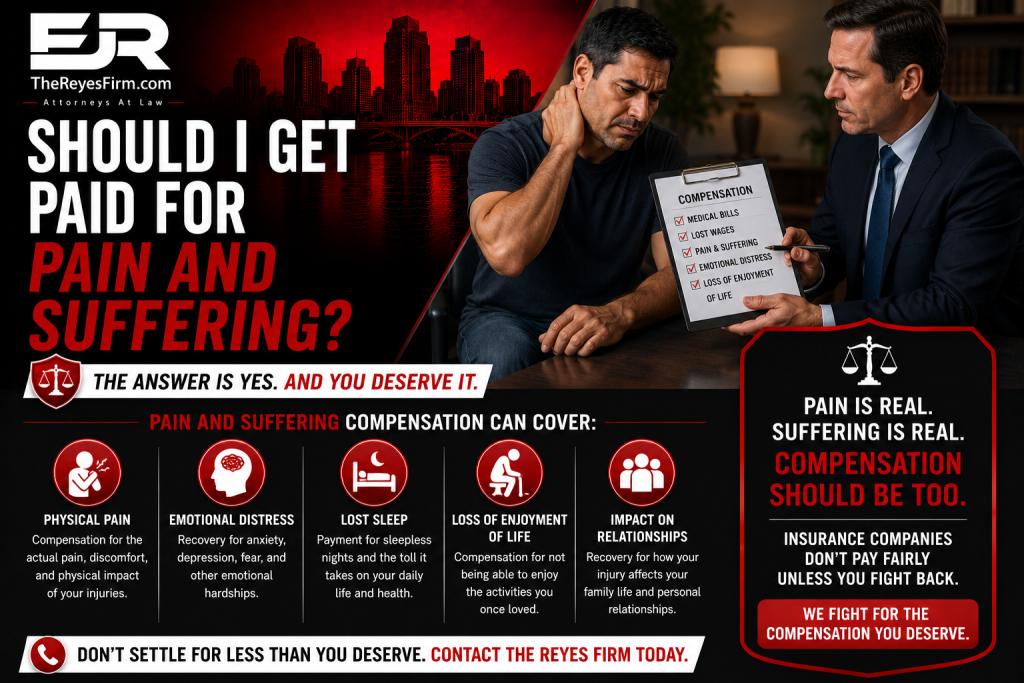
You’re in real pain. The medical bills are only part of it — you can’t sleep, you can’t do the things you used to love, and a car accident you didn’t cause turned your daily life upside down. So can you actually be paid for that suffering, not just your bills? Here’s how pain and suffering compensation works in Florida. TL;DR — QUICK SUMMARY Yes, you can recover money for pain and suffering after a Florida crash that wasn’t your fault, but only if your injuries clear Florida’s serious-injury threshold. Pain and suffering is a type of non-economic damage. It covers physical pain, mental anguish, loss of enjoyment of life, and inconvenience, on top of your medical bills and lost wages. Florida’s no-fault system means your own PIP pays your first $10,000 in bills regardless of fault, but pain and suffering generally comes from the at-fault driver once you meet the injury threshold under Florida Statute § 627.737. There’s no fixed formula. The value depends on the severity and permanence of your injuries, your treatment, and how the crash has changed your life. You have two years from the date of your crash to file a personal injury lawsuit under Florida Statute § 95.11(3)(a). Uninsured/underinsured motorist coverage can also be a source of recovery if the at-fault driver has no insurance. The Reyes Firm Hurt and in Pain After a Tampa Crash? Find out what your pain and suffering claim may be worth. Had a bad day? Contact Us Now 2 Years Florida statute of limitations Fla. Stat. § 95.11(3)(a) $10,000 Florida PIP minimum coverage Fla. Stat. § 627.736 4 Ways To meet FL injury threshold Fla. Stat. § 627.737(2) 50% Fault bar to recovery in FL Fla. Stat. § 768.81 Can you get paid for pain and suffering after a Florida car accident? Yes, you can be compensated for pain and suffering, as long as the crash wasn’t your fault and your injuries are serious enough to clear Florida’s threshold. Whether it actually happens depends on the facts: how badly you were hurt, whether the at-fault driver had insurance, and whether they have assets to reach if they didn’t. If you’re in genuine pain, you should be able to recover for that pain, for the loss of enjoyment of life, for time you couldn’t work, and for the damage to your vehicle. That’s the principle. In practice, it doesn’t happen automatically, which is why how you handle your claim matters so much. One of the biggest obstacles is uninsured drivers. Florida has a high number of people driving without adequate coverage, which is exactly why carrying uninsured/underinsured motorist coverage on your own policy is one of the smartest protections you can have. ⚠️ Deadline Warning: Under Florida Statute § 95.11(3)(a), you have two years from the date of your crash to file a personal injury lawsuit. Wait too long and you can lose the right to recover anything for your pain and suffering, no matter how badly you were hurt. Don’t let the clock run out. What counts as pain and suffering in a Florida injury claim? Pain and suffering is a category of non-economic damages, meaning losses that don’t come with a receipt. Unlike a medical bill or a paycheck stub, these harms are real but harder to put a dollar figure on, which is exactly why insurers fight them. In a Florida injury claim, pain and suffering can include physical pain from your injuries, mental anguish and emotional distress, loss of enjoyment of life, inconvenience and disruption to your routine, and the lasting effect of scarring or disfigurement. A serious back or neck injury that limits you for years carries very different value than a sprain that heals in weeks. These damages sit on top of your economic damages, which cover medical bills, future treatment, lost wages, and lost earning capacity. Together they make up the full value of your claim. Watch: Should you get paid for pain and suffering in Tampa? In this short video, Tampa personal injury attorney Edward Reyes explains when you can recover for pain and suffering after a Florida crash and what factors affect it. If you’re hurting and unsure whether your injuries qualify, The Reyes Firm offers a free case review to walk you through where you stand. How does Florida’s injury threshold affect pain and suffering? Florida’s injury threshold is the gateway to recovering pain and suffering from an at-fault driver. Because Florida is a no-fault state, your own Personal Injury Protection (PIP) coverage pays your first medical bills regardless of who caused the crash, but PIP does not pay for pain and suffering. To step outside no-fault and pursue non-economic damages from the at-fault driver, your injury generally has to meet the serious-injury threshold in Florida Statute § 627.737. That statute recognizes injuries involving significant and permanent loss of an important bodily function, permanent injury within a reasonable degree of medical probability, significant and permanent scarring or disfigurement, or death. Whether your injury clears that threshold is often the central fight in a Florida case. Strong medical documentation and the right expert opinions are what move an injury from “soft tissue” in the insurer’s eyes to a permanent, compensable harm. 💡 Did You Know? Florida’s PIP system pays up to $10,000 in medical bills and lost wages no matter who caused the crash under Fla. Stat. § 627.736 — but PIP never pays for pain and suffering. Those damages only become available once your injury meets the threshold in Fla. Stat. § 627.737. How is pain and suffering calculated in Florida? There is no fixed formula for pain and suffering in Florida. Two cases with similar bills can settle for very different amounts depending on how the injuries affect each person’s life, which is why a number pulled from an online calculator means little. In practice, the value turns on factors like the severity and permanence of your injuries, the length and intensity of your treatment, whether you’ll

What to Do If My Car Insurance Company Won’t Pay
Accident Injuries & why, After A Car Accident, After an Accident, Car accident, FAQ, For Parents, For Teens, Legal, Moped Accidents, Road Accidents, Settlement, Why we serve

Who is paying your medical bills if you don’t own a car or have insurance?

So what happens if you are involved in a car accident, it’s not your fault, but you don’t have insurance, but you don’t have a car? What happens then? There are a couple of things. One if you live in a household that somebody has a car and insurance you may be covered under a resident relative. Two, if you do not live in a household that someone has insurance or a car you may be covered by the person that crashed into, their auto insurance company may cover you for personal injury protection. Three, if none of those apply, you can still be covered under the other person’s policy if they have bodily injury coverage. Tampa personal injury lawyer Edward Reyes represents people in Tampa and Hillsborough County, Florida who have suffered an injury in an incident or accident type of accident. Speak Directly to Me, At No Cost, Today 813.421.3411 It won’t cover you for medical coverages as far as your personal injury protection but it will cover you for recovery for pain and suffering and then eventually it will pay back the medical expenses if you’ve incurred any. Give us a call at 813.421.3411 today. (Transcript from the video, transcribed but not reviewed)

Car Accident
Accident Injuries & why, After A Car Accident, After an Accident, Car accident, FAQ, For Parents, For Teens, Health, Injury, Legal, Settlement, Why we serve

Car Accident? What Happens Next?

So, you went through the whole process. You got treated, you went to the doctor, you did everything you’re supposed to do for your injuries and to recover. So, what happens next? Well, the doctors, the urgent care facilities, the medical doctor, the spine specialist, the MRIs, everybody else. We request the records, or they’ll send us the records for your treatment. Now that we get all the records, we can create the story of what are you and how does this accident affected your life. I have to get the medical records so we can put together a demand for settlement. Now that tells us about your medical records, that tells us a lot of things about what’s hurting you and how this has affected your life per the doctor’s perspective from what you’ve told them during your exams. Now, one of the things that we like to do as a firm- we do an impact sheet. How has the accident impacted your life, that’s the most important part because in litigation there are two parts? There are economic damages which are your heart damages meaning what did you lose as far as monetary, how much are your medical bills cost-wise. Tampa personal injury lawyer Edward Reyes represents people in Tampa and Hillsborough County, Florida who have suffered an injury in an incident or accident type of accident. Speak Directly to Me, At No Cost, Today 813.421.3411 But then there’s the whole other part of life that has affected your life or your relationship with your kids. How it has affected your life while brushing your teeth, tying your shoes, playing, doing all these things. So, we want to know the story of how it has affected you, not just the cost of treatment but how does that affect you in your life and going forward. Now that will give us a full story or a much better story to wrap it up in a pretty bow to put it in front of the insurance company so they can understand you as a person and not you as just a piece of paper. So, it’s very important to put the general damages, which is how it affected your life your actual life and the economic damages which is how much did it cost because if you’ve gone through this issue, did you miss work, did you have to go to the multiple visit, did you spend a lot of money back with gas and time mending opportunity things that you missed out. All these things are important to correctly tell the story to the adjuster from the insurance company. Now we can start the negotiations. That’s what we have to do to prepare a demand for settlement. If you have any questions, call us at 813.421.3411. (Transcript from the video, transcribed but not reviewed)

Scroll to Top