Blog

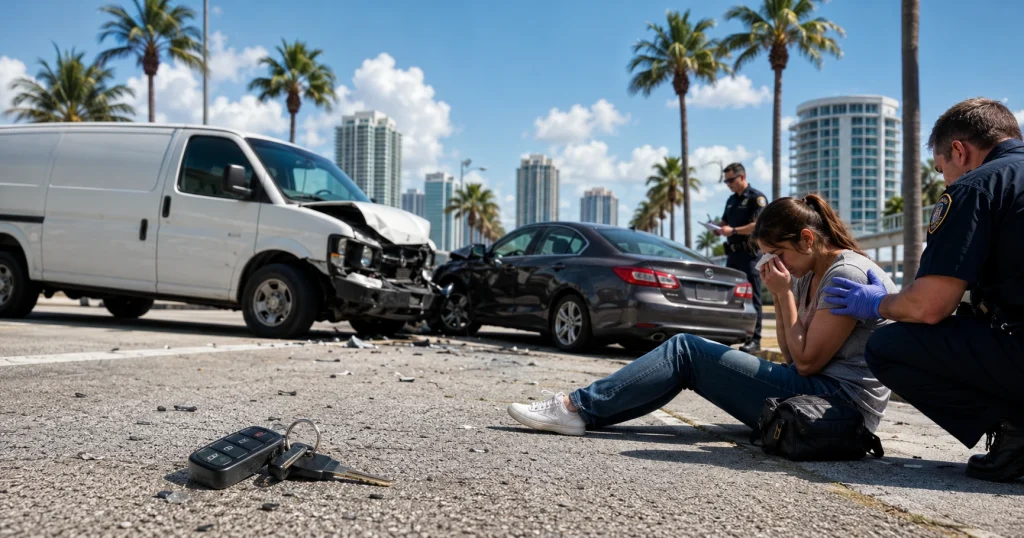
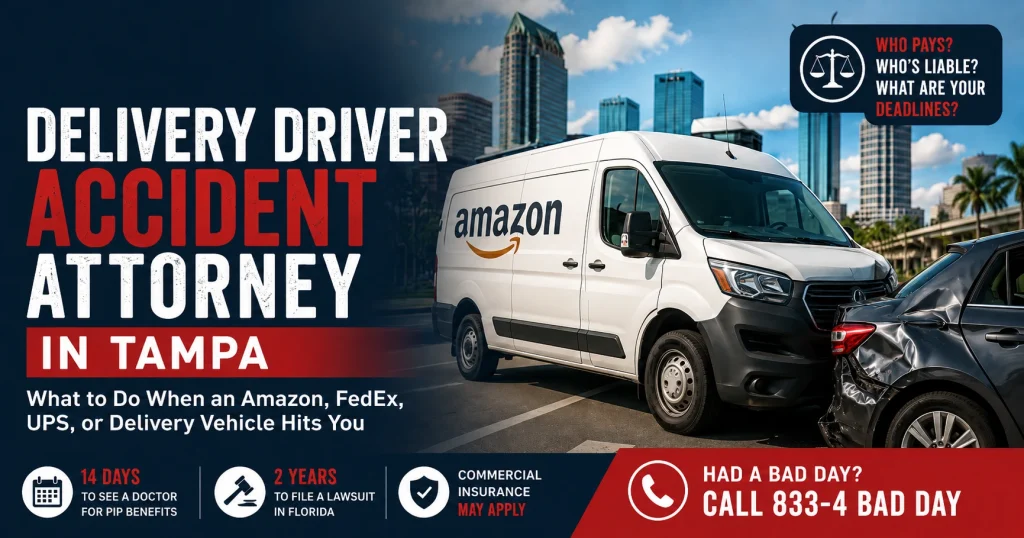
Delivery driver accident attorney in Tampa featured image showing a delivery van crash with a passenger car, for The Reyes Firm personal injury blog.
Blog, Commercial Vehicles, Company-Caused Car Accidents

Delivery Driver Accident Attorney in Tampa: What to Do After a Delivery Vehicle Crash

If you are looking for a delivery driver accident attorney Tampa after a crash, you may be hurt, stressed, and unsure which insurance company to trust.  Delivery vehicle cases can become confusing fast. Amazon, FedEx, UPS, USPS, and gig delivery crashes may involve contractors, app records, company policies, and multiple layers of insurance.  The Reyes Firm can review the crash, explain who may be responsible, and help protect key evidence before it disappears. The Reyes Firm Had a Bad Day? Was There a Logo on the Vehicle? A company logo, van number, driver uniform, delivery app, or package label may help identify who is responsible after a crash involving an Amazon, FedEx, UPS, or other delivery vehicle. Schedule Your Free Consultation What Should You Know First After a Delivery Driver Accident in Tampa? If a delivery vehicle hits you in Tampa, your case may involve more than the driver’s personal insurance. Depending on the facts, the claim may involve a delivery company, a contractor, a vehicle owner, a commercial insurance policy, or several layers of coverage.  Here are the first things to know: Delivery vehicle accidents are often more complex than ordinary car accidents.  Amazon, FedEx, UPS, USPS, and gig delivery crashes can involve different insurance rules. Florida PIP benefits may help pay initial medical expenses, but you must get qualifying medical care within 14 days. Florida’s current negligence statute of limitations is generally two years. Evidence such as dashcam footage, GPS data, route logs, and driver app records can disappear quickly. The Reyes Firm offers free consultations and handles injury cases on a contingency fee basis. No attorney’s fees are owed unless compensation is recovered for you. Costs and case expenses are handled in accordance with the written fee agreement. Had a bad day? Call The Reyes Firm at 833-4 BAD DAY. Once you know the basics, the next step is understanding who may pay for your injuries.  Who Pays for Your Injuries After a Delivery Driver Accident in Tampa? After a delivery driver accident in Tampa, payment may come from several sources. These may include your own Personal Injury Protection coverage, the delivery driver’s insurance, the vehicle owner’s insurance, a contractor’s policy, or a commercial policy connected to the delivery company.  Florida is a no-fault state for many motor vehicle injury claims. That means your own PIP coverage may apply first, no matter who caused the crash.  Florida’s PIP statute provides up to $10,000 in combined medical and disability benefits. Medical payment rules depend on timely care and whether a qualifying provider finds an emergency medical condition.  For serious injuries, PIP may not be enough. Delivery crashes can involve commercial coverage if the driver was working. The driver may also have been using a company vehicle, a contractor-owned van, or a delivery app.  A Tampa delivery vehicle injury claim may involve: The delivery driver The driver’s employer or contractor The company that owned, leased, or controlled the vehicle A delivery platform or parent company, depending on control and the facts A third-party maintenance company Another negligent driver Florida also recognizes comparative fault. That means your payment can be reduced if you share blame. Under Florida Statute 768.81, your compensation can be reduced by your percentage of fault. A party found more than 50% at fault for their own harm generally may not recover damages in a negligence action.  🛡️ Your Rights Under Florida Law: Do not assume you have no case just because an insurance adjuster says you were partly responsible. Fault can be disputed, crash reports may miss important facts, and delivery-vehicle cases often require deeper investigation. Knowing who may pay helps you see why the delivery company’s role matters so much.  Can You Sue Amazon, FedEx, UPS, or Another Delivery Company After a Crash? You may be able to bring a claim against a delivery company, contractor, vehicle owner, or commercial insurer after a crash. Whether Amazon, FedEx, UPS, USPS, or another company can be held responsible depends on the driver’s employment status, vehicle ownership, insurance coverage, and the level of control the company had over the delivery.  Each delivery model is different: Amazon delivery accidents may involve Delivery Service Partners, Amazon Flex drivers, contractor-owned vans, or app-based delivery records. FedEx accidents may involve different rules depending on whether the driver worked with FedEx Ground, FedEx Express, or an independent service provider. UPS delivery truck crashes often involve company employees, but the facts still matter. USPS crashes usually involve federal claim procedures and strict notice rules. DoorDash, Instacart, Uber Eats, and other gig delivery platforms may offer app-based insurance that varies based on driver status. The logo on the vehicle is not the end of the investigation. It is the beginning.  An attorney may look for: Driver employment or contractor records Delivery route logs GPS data App activity Dispatch communications Vehicle ownership documents Insurance policies Training and safety records Dashcam or onboard camera footage If you were hit by a delivery vehicle, avoid assuming the driver is the only responsible party. In many cases, the key question is who controlled the delivery work at the time of the crash.  Once you know who may be responsible, your next move is to protect your health and your evidence.  Still have questions? Call The Reyes Firm at 833-4 BAD DAY. The consultation is free, and there’s no obligation.  What Should You Do in the First 14 Days After a Delivery Vehicle Crash? After a delivery vehicle crash in Tampa, get medical care quickly and report the crash. Document evidence, avoid recorded statements to the delivery company’s insurer, and speak with a lawyer before signing anything.  Florida’s PIP statute requires initial medical services and care within 14 days after a motor vehicle accident. The statute also limits reimbursement to $2,500 if no qualifying provider finds an emergency medical condition.  Use this checklist: Get medical care as soon as possible. Do not wait to “see if it gets better.” Pain, concussions, back injuries, and soft tissue injuries can worsen over time.

Featured image showing a Florida truck accident legal deadline with a semi truck crash scene, calendar, and personal injury claim documents for a blog about the Florida statute of limitations for truck accidents.
Blog, Traumatic injury, Truck Accidents

How Long Do You Have to File a Truck Accident Lawsuit in Florida?

What You Need to Know For most Florida truck accident injury claims, you generally have 2 years from the date of the crash to file a lawsuit. Florida Statute § 95.11 now sets a 2-year filing deadline for negligence claims, including most personal injury claims arising from truck crashes. Here are the key points: Truck accident injury lawsuits in Florida are usually subject to a 2-year statute of limitations. The 2-year rule generally applies to crashes that happened on or after March 24, 2023, after Florida House Bill 837 took effect. Crashes before March 24, 2023, may fall under the prior 4-year deadline, depending on the facts. Wrongful death claims generally have a separate 2-year deadline. Claims involving government vehicles may require special written notice before a lawsuit can be filed under Florida Statute § 768.28. Filing an insurance claim does not stop the lawsuit deadline. Had a bad day? Call The Reyes Firm at 833-4 BAD DAY. The next section explains why this deadline matters before insurance talks drag on. Introduction After a truck crash, you may be dealing with pain, medical bills, missed work, and calls from insurance companies. The last thing you may think about is a legal deadline. But the Florida statute of limitations for truck accidents may already be running. That can create a serious problem. If too much time passes, you may lose your right to file a lawsuit, even when the truck driver or trucking company caused the crash.  This guide explains how long you have to file, when the clock usually starts, what exceptions may apply, and why acting early can protect your claim.  Once you know the deadline, the next step is knowing which version of Florida law applies to your crash.  How Long Do I Have to File a Truck Accident Lawsuit in Florida? In most Florida truck accident cases, you have 2 years from the date of the crash to file a personal injury lawsuit.  Florida Statute § 95.11 applies a 2-year deadline to actions founded on negligence. In plain English, negligence means someone failed to use reasonable care and caused harm.  Truck accident claims are usually negligence claims because they often involve careless driving, unsafe trucking practices, poor maintenance, or other failures that caused injury. This deadline may apply to claims against: The truck driver The trucking company A maintenance company A cargo-loading company A broker or other responsible company Another driver who contributed to the crash Florida’s deadline changed in 2023. House Bill 837 reduced the deadline for many negligence claims from 4 years to 2 years. The law took effect on March 24, 2023.  Important Deadline Warning If your crash happened on or after March 24, 2023, the 2-year deadline generally applies. If your crash happened before March 24, 2023, the prior 4-year deadline may apply. You should not assume that without legal review.  A few days can make a major difference. If you are unsure which deadline applies, speak with a Florida truck accident attorney as soon as possible. The date of your crash matters, but so does the date the legal clock starts. When Does the 2-Year Clock Start After a Truck Crash? In most truck accident cases, the clock starts on the date of the crash.  It usually does not start when: You finish medical treatment You find out your injury is permanent The insurance company denies your claim Settlement talks break down You realize the trucking company may be responsible This is one of the most common mistakes injured people make. They focus on getting treatment, repairing their vehicle, and returning to work. Months pass before they realize the legal clock has been running the whole time. Filing an insurance claim also does not pause the statute of limitations. A lawsuit must be filed in court before the deadline expires. Still have questions? Call The Reyes Firm at 833-4 BAD DAY. The consultation is free, and there’s no obligation.  Missing that court deadline can change the entire case, no matter how strong the facts are.  What Happens If I Miss the Florida Truck Accident Filing Deadline? If you miss the statute of limitations, the court may dismiss your lawsuit. In many cases, that means you lose the right to seek compensation through the court system. That can happen even if: The truck driver was clearly at fault Your injuries are catastrophic You have strong evidence You were still negotiating with the insurance company You did not know the deadline applied Insurance companies understand these deadlines. If the deadline passes, they may have little reason to continue settlement talks.  💡 Did You Know? Filing an insurance claim is not the same as filing a lawsuit. The insurance process can continue while your court deadline keeps running. That is why it is important to treat the statute of limitations as a hard deadline, not a flexible timeline. Some cases have special rules, but those rules can be easy to misunderstand.  Watch: How Long Does a Lawsuit Take in Florida? In this video, The Reyes Firm explains how Florida’s 2-year statute of limitations applies in many civil injury cases and what may happen after a lawsuit is filed. This can help you understand why filing on time matters after a serious crash. Are There Exceptions to the Florida Truck Accident Statute of Limitations? Yes, but exceptions are limited and highly fact-specific. You should not rely on an exception unless a Florida attorney has reviewed your case. Some deadlines may be shorter, more complex, or tied to special notice rules. In plain English, that means your case may have extra steps before you can sue.  Wrongful Death After a Fatal Truck Crash If a loved one dies because of a truck accident, the family may have a wrongful death claim. In Florida, wrongful death claims generally must be filed within 2 years from the date of death.  This date may be different from the crash date if the injured person survived for days, weeks, or

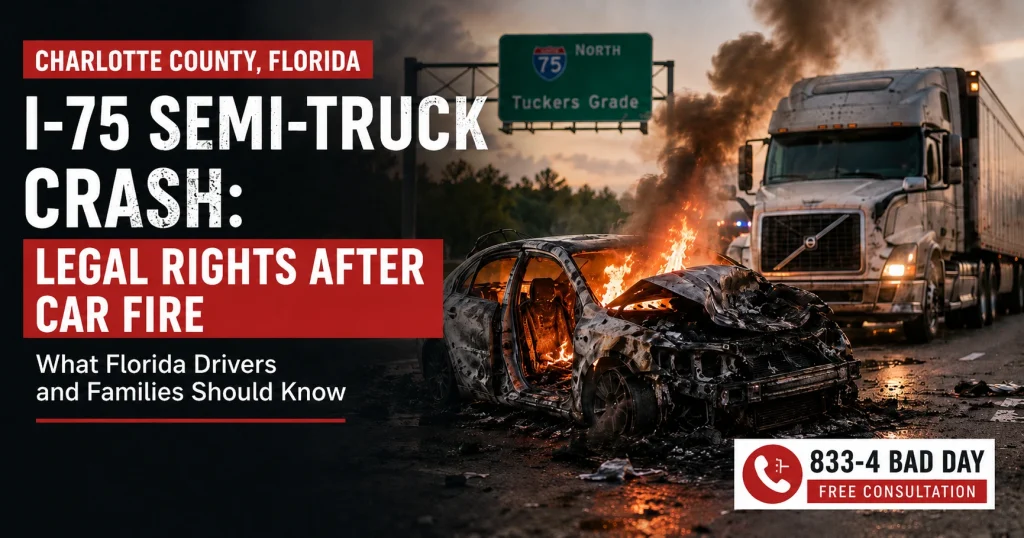
Featured image showing a semi-truck crash and vehicle fire on I-75 near Tuckers Grade in Charlotte County, Florida, for an article about legal rights after a Florida truck accident.
Blog, News, Truck Accidents

A Car Burst Into Flames on I-75. Here’s What Florida Drivers Should Know

What You Need to Know A Toyota Corolla caught fire after a collision with a Volvo semi-trailer on I-75 in Charlotte County on June 2, 2026. The Florida Highway Patrol reported that the Toyota driver had minor injuries and was taken to a hospital. The crash remains important because semi-truck crashes can involve more evidence, more insurance coverage, and more legal questions than a typical car accident. Florida generally gives injury victims two years to file a negligence lawsuit under Florida Statute § 95.11. If you were hurt in a truck crash on I-75 or anywhere in Florida, The Reyes Firm offers free consultations. Had a bad day? Call us. 833-4 BAD DAY. What Happened in the I-75 Semi-Truck Crash in Charlotte County? The crash happened before 5 a.m. on June 2, 2026, on northbound I-75 in Charlotte County, just south of Tucker’s Grade. The Florida Highway Patrol reported that a 26-year-old man was driving a Toyota Corolla when the vehicle veered left and collided with a Volvo semi-trailer traveling in the center lane. After impact, the Toyota went off the road, entered a tree line, and caught fire. The driver was taken to a hospital with minor injuries, and the semi driver was not injured. That early report does not answer every legal question. In a serious truck-related crash, the first report may explain what happened at the scene, but it may not explain why it happened, whether any outside factor contributed, or what evidence needs to be preserved. That is why a semi-truck crash should be reviewed quickly, even when the first injury report says “minor injuries.” Approximate Incident Location The reported crash occurred on northbound I-75 in Charlotte County, just south of Tucker’s Grade. This map is provided for general location context only and may not mark the exact crash site. Why Are Semi-Truck Crashes Different From Regular Car Accidents? A semi-truck crash is different from a regular car accident because commercial vehicles are subject to more rules, more records, and often more insurance coverage. Florida law makes certain commercial motor vehicle owners and drivers subject to federal safety rules under Florida Statute § 316.302. Those rules may involve driver hours, vehicle maintenance, inspections, and safety records. In plain English, this means a truck crash case may involve evidence that does not exist in a normal two-car crash, such as: Driver logs Black box or Event Data Recorder data Electronic Logging Device records Maintenance records Inspection reports Dispatch records Dashcam footage Company safety policies The most important evidence in a truck crash can disappear quickly if no one acts to preserve it. That does not mean the truck driver or trucking company is automatically at fault. It means the case should be investigated carefully before insurance companies decide the story for you. Could a Car Fire Affect a Personal Injury Claim? Yes. A vehicle fire can affect a personal injury claim because it may create injuries beyond the first impact. A person who escapes a burning vehicle may later experience symptoms from burns, smoke exposure, shock, soft tissue injuries, back injuries, neck injuries, or emotional trauma. Some symptoms do not appear right away. A car fire may also affect the evidence. The vehicle itself may be damaged or destroyed, making it harder to review impact points, defects, or post-crash conditions. That is another reason early documentation matters. ⏳ Important Deadline: Under Florida Statute § 95.11, most negligence-based personal injury lawsuits in Florida must be filed within two years. Some exceptions may apply depending on the facts, so injured people should speak with a Florida personal injury attorney as soon as possible. For a crash that happened on June 2, 2026, the general two-year deadline would be June 2, 2028. Waiting can make the case harder because evidence fades, witnesses become harder to locate, and records may be lost. Who May Be Liable After a Florida Semi-Truck Crash? Liability after a Florida semi-truck crash depends on the evidence. In some cases, the truck driver may be responsible. In other cases, the trucking company, truck owner, maintenance provider, cargo loader, or another driver may have played a role. In some crashes, more than one party may share fault. Florida truck crash cases often look at questions such as: Was the truck driver following safety rules? Was the truck properly maintained? Did the trucking company keep proper records? Was the driver fatigued or distracted? Did road conditions, lighting, or another vehicle contribute? Was the injured driver’s vehicle affected by a mechanical issue? Did the first crash report leave out important details? Florida also follows comparative negligence rules, which means fault can be divided among more than one party. Because of that, a careful investigation matters. You should not assume the first version of the crash story is the final legal answer. 📊 Did You Know? FLHSMV’s 2024 preliminary “By the Numbers” report listed 46,651 commercial motor vehicle crashes in Florida and 315 fatalities connected to those crashes. Still have questions? Call The Reyes Firm at 833-4 BAD DAY. The consultation is free, and there’s no obligation. What Should You Do After a Truck Crash on I-75? After a truck crash, your first priority is medical care. Even if you feel lucky to walk away, get checked by a doctor. Pain, swelling, concussion symptoms, back injuries, and emotional trauma can show up later. After medical care, take these steps: Save all crash-related documents. Keep the crash report number, hospital records, discharge papers, prescriptions, photos, repair estimates, and insurance letters. Do not give a recorded statement without legal advice. Insurance adjusters may ask questions in a way that limits your claim later. Write down what you remember. Include the time, road conditions, lighting, vehicle positions, traffic flow, and anything unusual before impact. Preserve photos and videos. Save dashcam footage, cellphone photos, traffic camera information, and witness contact details. Contact a lawyer familiar with truck crash cases. Commercial vehicle cases often require fast action to preserve black box data, driver logs, and

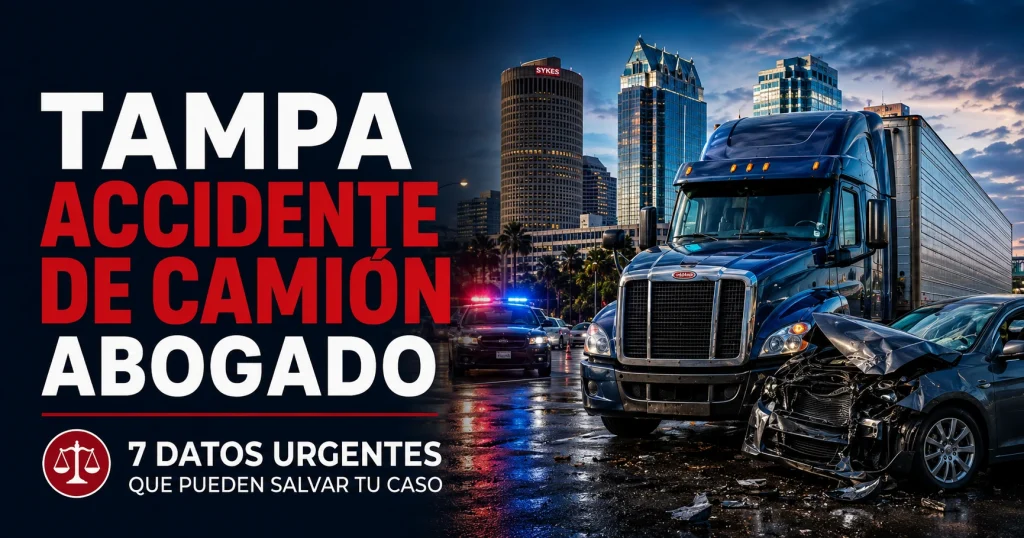
Abogado de accidentes de camiones en Tampa para víctimas de choques con semirremolques y vehículos comerciales.
Blog, Spanish, Truck Accidents

Abogado de Accidentes de Camiones en Tampa: 7 Datos Urgentes que Pueden Salvar Tu Caso

Respuesta Rápida: ¿Qué Debes Hacer Después de un Accidente de Camión en Tampa? Después de un accidente de camión en Tampa, busca atención médica, llama al 911, documenta la escena, evita dar una declaración grabada a la aseguradora de la empresa de camiones, y contacta a un abogado de accidentes de camiones en Tampa rápidamente para que evidencia clave como datos de la caja negra, registros del dispositivo de registro electrónico, grabaciones de cámara de tablero, bitácoras de mantenimiento y registros de despacho puedan ser preservados. Un choque que involucra un semirremolque (camión de 18 ruedas), camión de caja, camión de reparto, camión volquete u otro vehículo comercial no se maneja como un accidente de auto regular. Estos casos frecuentemente involucran regulaciones federales de camiones, múltiples partes responsables, compañías de seguros corporativas y evidencia que puede desaparecer rápidamente. ¿Tuviste un mal día? Llama a The Reyes Firm: 833-4 BAD DAY. 7 Cosas que Debes Saber Ahora Mismo Florida registró 46,651 choques de vehículos motorizados comerciales en 2024, según datos preliminares del FLHSMV. Los choques con vehículos comerciales pueden involucrar a más de una parte responsable, incluyendo al conductor, la empresa de camiones, el intermediario, el cargador, la empresa de mantenimiento o el fabricante de piezas. Las empresas de camiones y sus aseguradoras frecuentemente comienzan a investigar de inmediato después de un choque. Evidencia como datos de la caja negra, registros ELD, datos de GPS, grabaciones de cámara de tablero, registros de despacho y bitácoras de mantenimiento puede eliminarse, sobreescribirse o perderse si no se preserva rápidamente. La mayoría de los reclamos por lesiones personales basados en negligencia en Florida deben presentarse dentro de dos años según el Estatuto de Florida § 95.11. La ley de negligencia comparativa modificada de Florida puede impedir la recuperación si se determina que eres más del 50% culpable de tu propio daño. Un abogado de accidentes de camiones en Tampa puede actuar rápidamente para preservar evidencia, identificar a todas las partes responsables y protegerte de las tácticas de las compañías de seguros. The Reyes Firm ¿Te Lastimaste en un Accidente de Camión en Tampa? Obtén los próximos pasos claros después de un choque grave con un vehículo comercial. ¿Tuviste un mal día? Programa una Consulta Gratuita No lo viste venir. Un momento estabas conduciendo por la I-275, incorporándote a la I-75 cerca de Brandon, viajando por la I-4, o avanzando por el tráfico de Tampa. Luego un camión lo cambió todo. Ahora puede que estés lidiando con citas médicas, dolor, trabajo perdido, daños al vehículo, llamadas del seguro y preguntas que tu familia no puede responder. El ajustador de seguros de la empresa de camiones puede que ya esté llamando. Su equipo puede que ya esté recopilando declaraciones, revisando daños y protegiendo los intereses de la empresa. Por eso el tiempo importa. Un abogado de accidentes de camiones en Tampa de The Reyes Firm puede ayudar a equilibrar la situación. Manejamos casos graves de accidentes de vehículos comerciales para personas en Tampa, Riverview, Brandon, Plant City, las comunidades de South Shore y todo el Condado de Hillsborough. Nuestro equipo sabe cómo funcionan las investigaciones de accidentes de camiones, qué evidencia importa y cómo las leyes federales y de Florida pueden afectar tu caso. Los grandes despachos frecuentemente están construidos para manejar miles de casos. The Reyes Firm está construida para tomar los difíciles con enfoque, urgencia y atención personal. Cuando un camión de 18 ruedas, un camión de reparto, un camión de caja o un vehículo comercial te choca, no necesitas un nombre famoso. Necesitas un abogado local que entienda la ley de vehículos comerciales, se mueva rápido para proteger la evidencia y prepare tu caso como si pudiera necesitar ir a juicio. Esta guía explica qué hace que los casos de accidentes de camiones en Tampa sean diferentes, qué evidencia puede desaparecer, quién puede ser responsable y qué pasos pueden ayudar a proteger tu reclamo. 🛡️ Importante: La mayoría de los reclamos por lesiones personales basados en negligencia en Florida deben presentarse dentro de dos años según el Estatuto de Florida § 95.11. Para muchos choques después del 24 de marzo de 2023, la HB 837 redujo el plazo general de negligencia de cuatro años a dos años. Esperar demasiado puede poner en riesgo tu derecho a compensación. ¿Por Qué un Caso de Accidente de Camión en Tampa Es Diferente a un Choque de Auto? Los casos de accidentes de camiones son diferentes porque frecuentemente involucran regulaciones federales de seguridad, demandados corporativos, límites de seguro más altos y evidencia que puede estar controlada por la empresa de camiones. Un choque con un camión no es simplemente un accidente de auto más grande. Es un caso legal más complejo. Cuando un camión comercial choca contra un vehículo de pasajeros, el conductor puede no ser la única parte responsable. La empresa de camiones puede haber contratado a un conductor inseguro, no haber mantenido el camión, ignorado problemas de inspección o impuesto horarios de entrega poco realistas. Un intermediario, cargador, empresa de mantenimiento o fabricante de piezas también puede compartir responsabilidad, dependiendo de la causa del choque. Los camiones comerciales deben seguir las reglas de la Administración Federal de Seguridad de Transportistas Motorizados sobre horas de servicio, calificaciones del conductor, inspecciones, mantenimiento, pruebas de drogas y alcohol, aseguramiento de carga y registro electrónico. Cuando una empresa o conductor viola esas reglas, esa violación puede convertirse en evidencia importante en tu caso. Edward Reyes, Esq., y el equipo de The Reyes Firm saben cómo investigar estos casos más allá del informe del accidente. Analizamos al conductor, a la empresa, la ruta, los registros, el vehículo y las decisiones que pusieron ese camión en la carretera. Mira: Por Qué los Accidentes de Camiones Son Diferentes a los Accidentes de Auto Regulares Los casos de accidentes de camiones involucran reglas diferentes, vehículos más pesados, distancias de frenado más largas y preguntas de responsabilidad más complejas. Este video explica por qué los choques con camiones comerciales requieren un enfoque legal

Tampa company vehicle crash scene involving borrowed car and injured victim pursuing negligent entrustment claim, for illustrative purposes only
Blog, Commercial Vehicles, Company-Caused Car Accidents

Negligent Entrustment in Florida: 5 Ways to Prove Owner Liability

In Florida, negligent entrustment means a vehicle owner may be liable if they gave a car, truck, or company vehicle to someone they knew, or reasonably should have known, was unsafe to drive. This can apply to parents, employers, private vehicle owners, and businesses that allow an unfit driver behind the wheel. Most people think of handing over car keys as an ordinary moment. A parent tosses the keys to a teenager heading to practice. A business owner assigns a work truck before the morning route. A friend lets someone drive home after dinner because it seems easier in the moment. But when the wrong person is allowed behind the wheel, that ordinary decision can change someone else’s life. A crash can take away the morning commute, the weekend baseball game, the family road trip, or the simple freedom of driving yourself where you need to go. The injury is not the whole story. The life interrupted is. That is why negligent entrustment matters in Florida. This legal claim focuses on whether the vehicle owner knew or should have known that the driver was unsafe before granting them access to the car, truck, company vehicle, or work vehicle. If you were hit by a borrowed car, company vehicle, work truck, or family vehicle in Tampa, Riverview, Brandon, Plant City, or anywhere in Hillsborough County, the driver may not be the only person responsible. The person or business that gave the driver access to the vehicle may also need to be investigated. Had a bad day? Call The Reyes Firm at 833-4 BAD DAY. The Reyes Firm Hit by Someone Who Should Never Have Had the Keys? A borrowed car, company vehicle, work truck, or family vehicle can raise bigger liability questions. Had a bad day? Schedule Your Free Consultation What You Need to Know In Florida, the person who handed over the keys may be legally responsible, not just the driver who caused the crash. Negligent entrustment means the owner gave a vehicle to someone they knew or should have known was not safe to drive. This can apply to parents who let unsafe teens drive, employers who ignore dangerous driving records, and anyone who gives keys to someone visibly impaired. Florida also has a strong vehicle owner liability rule known as the dangerous instrumentality doctrine, which may apply separately from negligent entrustment. In most Florida negligence cases, you have two years from the date of the crash to file a lawsuit under Fla. Stat. § 95.11(5)(a). Some exceptions may apply, but waiting can put your claim at serious risk. What Is Negligent Entrustment in Florida?  Negligent entrustment is a legal claim that may hold a vehicle owner responsible for giving a car, truck, or company vehicle to someone who is unsafe to drive. Negligent entrustment focuses on the owner’s conduct. It asks whether the owner knew, or reasonably should have known, that the driver was unfit to operate the vehicle safely. This is different from a basic claim against the driver. In a standard car accident claim, the focus is usually on what the driver did wrong. In a negligent entrustment claim, the focus expands to the person or business that allowed that driver to use the vehicle in the first place. Examples may include: A parent allowing an unlicensed teen to drive A business assigning a company vehicle to an employee with a dangerous driving record A vehicle owner lending a car to someone who appears intoxicated A company failing to check driving records before giving an employee access to a work truck A fleet owner ignoring repeated safety complaints about a driver If you were hit by a borrowed car, company vehicle, delivery van, work truck, or commercial vehicle in Tampa, Riverview, Brandon, Plant City, or anywhere in Hillsborough County, negligent entrustment may be an important legal issue to investigate. The Reyes Firm investigates every angle of liability from day one. That includes the driver, the vehicle owner, the employer, and any person or business that may have allowed an unsafe driver behind the wheel. When Does Negligent Entrustment Apply After a Florida Crash?  Negligent entrustment may apply when a vehicle owner gives access to a driver who is unlicensed, intoxicated, reckless, medically impaired, inexperienced, or has a history of dangerous driving. The central question is simple: Did the owner know, or should the owner have known, that this person was not safe to drive? Negligent entrustment may apply when the driver had warning signs, such as: A suspended or revoked license Prior DUI history Prior reckless driving citations Prior crashes Repeated speeding violations Visible intoxication before driving Lack of driving experience Underage driving without a valid license Known health or medical issues affecting safe driving Prior safety complaints from customers, coworkers, family members, or supervisors This issue often appears in company vehicle crashes, teen driver crashes, family vehicle crashes, borrowed car crashes, delivery vehicle crashes, and commercial fleet accidents. That distinction matters because the at-fault driver may have limited insurance. A negligent entrustment claim may reveal additional insurance coverage, company liability, or other responsible parties. ⚠️ Warning: Florida Has a Short Deadline for Negligence Claims In most Florida negligence cases, the deadline to file a lawsuit is two years from the date of the crash under Florida Statute § 95.11(5)(a). Some exceptions may apply, but waiting can put your claim at serious risk. If you believe negligent entrustment may have played a role in your crash, call The Reyes Firm at 833-4 BAD DAY. What Are the 5 Elements of Negligent Entrustment in Florida?  To prove negligent entrustment in Florida, you generally need to show that the owner gave the driver access to the vehicle, the driver was unfit, the owner knew or should have known the driver was unfit, the unfitness contributed to the crash, and you suffered damages. 1. Entrustment The owner gave the driver permission, access, or control of the vehicle. This can be direct, such as handing over the keys. It

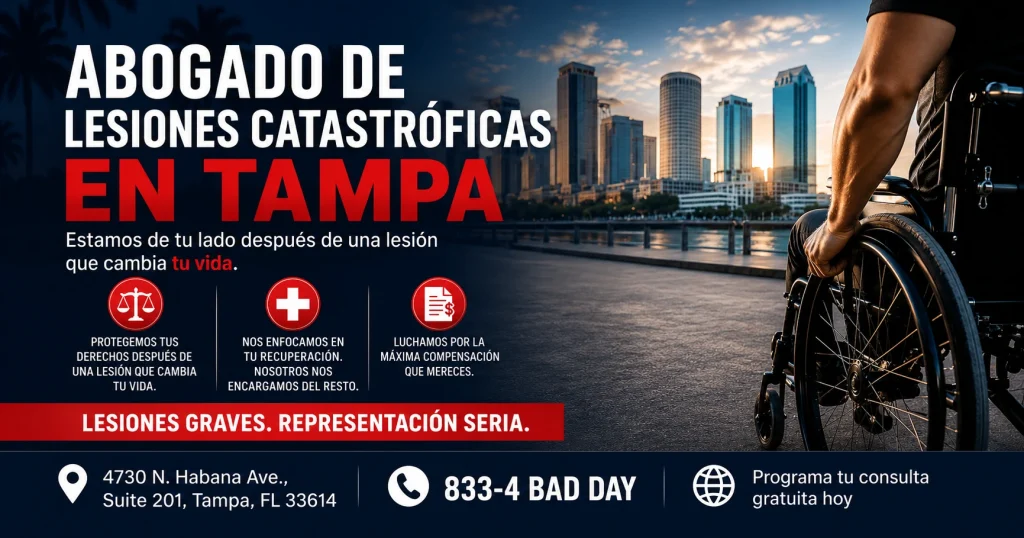
Abogado de lesiones catastróficas en Tampa con imagen de una persona en silla de ruedas frente al skyline de Tampa, destacando apoyo legal después de una lesión grave.
Blog, Catastrophic Injury

Abogado de Lesiones Catastróficas en Tampa: Ayuda Después de una Lesión que Cambia Tu Vida

Lo Que Necesitas Saber Una lesión catastrófica puede cambiar tu salud, tus ingresos, tu independencia y tu vida familiar en un solo momento. Las lesiones catastróficas comunes incluyen lesiones cerebrales traumáticas, lesiones de médula espinal, amputaciones, quemaduras graves, daño a órganos y discapacidad permanente. Los casos de lesiones catastróficas frecuentemente requieren planes de cuidado de por vida, expertos médicos, especialistas vocacionales, reconstrucción de accidentes y preparación legal lista para juicio. La mayoría de las demandas por lesiones personales basadas en negligencia en Florida deben presentarse dentro de los 2 años según el Estatuto de Florida § 95.11(5)(a). La regla de culpa comparativa modificada de Florida puede impedir la recuperación si se determina que eres más del 50% culpable en casos de negligencia cubiertos. ¿Tuviste un mal día? Llámanos. 833-4 BAD DAY. The Reyes Firm ¿Te Lastimaste con una Lesión Catastrófica en Tampa? Obtén los próximos pasos claros después de una lesión que cambia tu vida. ¿Tuviste un mal día? Contáctanos Ahora Una lesión grave puede convertir un día normal en una vida completamente diferente. Puede que estés sentado junto a una cama de hospital. Puede que estés tratando de entender un diagnóstico. Puede que estés escuchando palabras como parálisis, lesión cerebral, amputación o discapacidad permanente por primera vez. Un abogado de lesiones catastróficas en Tampa en quien las familias confían puede ayudar a proteger tus derechos mientras te concentras en tu atención médica. En The Reyes Firm, ayudamos a personas en Tampa y las comunidades de South Shore que han sido lesionadas en accidentes, en propiedades inseguras, por vehículos comerciales o por empresas negligentes. Los casos de lesiones catastróficas no son reclamos de rutina. Frecuentemente involucran cirugías futuras, atención a largo plazo, pérdida de capacidad de ingresos, planificación de cuidado de por vida, y compañías de seguros que empiezan a construir su defensa desde temprano. The Reyes Firm sirve a Tampa, Riverview, Brandon, Plant City, y comunidades de todo el Condado de Hillsborough desde 4730 N. Habana Ave., Suite 201, Tampa, FL 33614. Llama al 833-4 BAD DAY para una consulta gratuita. ¿Qué Califica como Lesión Catastrófica en Florida? Una lesión catastrófica es una lesión grave que cambia permanentemente cómo vives, trabajas, te mueves, piensas, te comunicas o te cuidas a ti mismo. Estas lesiones van mucho más allá de una recuperación corta. Frecuentemente requieren tratamiento médico a largo plazo, planificación de atención futura y prueba experta de cómo la lesión afecta tu vida. Las lesiones catastróficas comunes incluyen: Lesiones cerebrales traumáticas Lesiones de médula espinal Parálisis Amputaciones Quemaduras graves Daño a órganos Fracturas complejas Pérdida de visión o audición Discapacidad permanente Lesiones fatales que dan lugar a reclamos por muerte injusta Florida no usa un solo estatuto de lesiones personales para definir cada lesión catastrófica. En casos reales, la pregunta clave es práctica. ¿La lesión cambió permanentemente tu vida, tu trabajo o tu capacidad de cuidarte a ti mismo? Si la respuesta es sí, tu caso necesita más que simples facturas médicas. Puede requerir médicos, planificadores de cuidado de por vida, economistas, expertos vocacionales y especialistas en reconstrucción de accidentes. ⚠️ Advertencia: El Plazo de 2 Años de Florida: La mayoría de las demandas por lesiones personales basadas en negligencia en Florida deben presentarse dentro de los 2 años según el Estatuto de Florida § 95.11(5)(a). Este plazo puede afectar los casos de lesiones catastróficas después de accidentes, caídas, incidentes en propiedades inseguras y otros reclamos por negligencia. Esperar demasiado puede poner en riesgo tu caso porque la evidencia puede desaparecer, los testigos pueden mudarse y las grabaciones de video pueden eliminarse. ¿Qué Causa Lesiones Catastróficas en Tampa? Las lesiones catastróficas en Tampa frecuentemente ocurren cuando un accidente, una caída, un incidente laboral o una condición insegura crea una fuerza violenta en el cuerpo. Las carreteras de alta velocidad, el tráfico comercial, la actividad de construcción y las zonas peatonales concurridas pueden aumentar el riesgo de lesiones que cambian la vida en Tampa y el Condado de Hillsborough. Las causas comunes incluyen: Accidentes de carro en la I-4, I-75, I-275 y las vías locales de Tampa Choques con semirremolques y vehículos comerciales Choques con vehículos de reparto Accidentes de motocicleta Choques con peatones y ciclistas Accidentes de construcción Condiciones peligrosas en propiedades Productos defectuosos Negligencia médica Los accidentes de vehículos motorizados siguen siendo una de las fuentes más claras de daño catastrófico. La NHTSA reportó que 39,254 personas fallecieron en choques de tráfico en Estados Unidos en 2024, con una tasa de mortalidad de 1.19 muertes por cada 100 millones de millas recorridas por vehículos. En Tampa, las lesiones graves frecuentemente ocurren a lo largo de corredores rápidos y congestionados. La I-275, I-75, I-4, Dale Mabry Highway, Hillsborough Avenue, Fowler Avenue, y las rutas que sirven a Brandon, Riverview, Plant City y las comunidades de South Shore pueden presentar riesgos graves de accidentes. 📊 ¿Sabías Que? El FLHSMV reportó 381,210 choques de tráfico registrables en Florida en 2024, con 3,184 personas fallecidas en choques de vehículos. El mismo informe del FLHSMV registró 46,651 choques de vehículos motorizados comerciales y 315 fallecidos. Fuente: FLHSMV By the Numbers 2024. ¿Quién Puede Ser Responsable de una Lesión Catastrófica en Tampa? Más de una persona o empresa puede ser responsable de una lesión catastrófica en Tampa. Un caso grave frecuentemente requiere una investigación más profunda sobre conductores, empleadores, dueños de propiedades, contratistas, fabricantes y cobertura de seguro. El objetivo es identificar a cada parte cuyas acciones contribuyeron a la lesión. Dependiendo del caso, las partes responsables pueden incluir: Un conductor negligente Una empresa de camiones Una empresa de reparto Un empleador Un dueño de propiedad Un operador de negocio Un contratista de construcción Una empresa de mantenimiento Una empresa de carga Un fabricante de productos Una entidad gubernamental, en casos limitados Esto importa porque los daños por lesiones catastróficas pueden ser muy altos. La atención futura, la pérdida de ingresos y la discapacidad a largo plazo pueden costar mucho más de lo que una sola póliza de seguro puede cubrir. Por ejemplo,

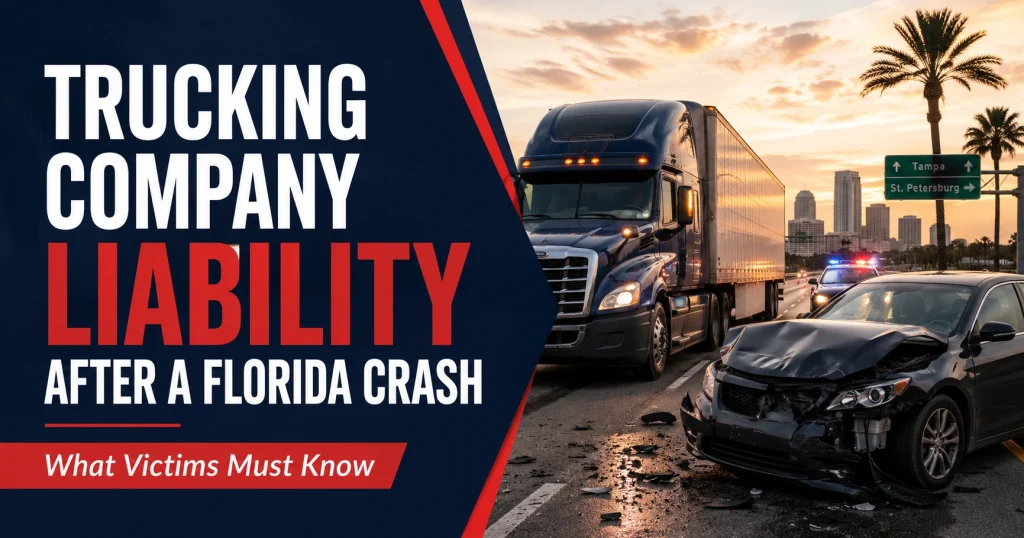
Tampa Florida commercial truck crash scene with semi-truck and damaged passenger vehicle, for illustrative purposes only
Blog, Truck Accidents

Trucking Company Liability After a Florida Crash: What Victims Must Know

WHAT YOU NEED TO KNOW In Florida, you may be able to sue the trucking company, not just the driver, after a serious commercial truck crash. Trucking company liability in Florida crash cases often involves driver conduct, company safety failures, vehicle ownership, and federal trucking rules. Key evidence, such as ELD data, black box data, dashcam video, and maintenance records, can disappear quickly without a preservation letter. Florida recorded 46,651 commercial motor vehicle crashes and 315 fatalities in 2024, according to preliminary FLHSMV data. Under Florida Statute §95.11(5)(a), most negligence lawsuits must be filed within 2 years. Had a bad day? Call The Reyes Firm. 833-4 BAD DAY.  The Reyes Firm Hurt in a Truck Crash in Tampa? Learn who may be liable and what steps you can take to protect your case. Had a bad day? Schedule Your Free Consultation You didn’t expect to be here. One moment, you were driving home on I-275, and the next, a fully loaded 18-wheeler changed everything. The pain is real. The bills are already coming. The insurance calls may already feel overwhelming. In a trucking company liability Florida crash case, the driver may not be the only party responsible. The company that hired the driver, owned or controlled the truck, set the route, handled maintenance, or ignored safety rules may also be legally responsible. The moment a crash happens on I-4, I-75, I-275, or another Tampa road, the trucking company’s insurance team starts protecting its side. You need someone protecting you just as fast. Can You Sue a Trucking Company in Florida After a Crash? Yes. You can sue a trucking company after a Florida crash if the driver was working for the company or if the company’s own failures helped cause the wreck. These cases often involve vicarious liability, negligent hiring, poor supervision, unsafe maintenance, or violations of federal trucking regulations. Vicarious liability means one party may be responsible for another person’s actions. In truck accident cases, this often means the company may be responsible if its driver caused the crash while doing job-related work. A trucking company may also be liable for its own choices. This can include hiring an unsafe driver, keeping a dangerous driver on the road, skipping maintenance, ignoring hours-of-service limits, or failing to train drivers. A Tampa truck accident attorney can help preserve evidence before the trucking company’s systems overwrite key data. That matters because truck crash cases often depend on company records, not just what happened at the crash scene. ⚠️ Warning: Under Florida Statute §95.11(5)(a), most negligence lawsuits must be filed within 2 years. This includes many Florida personal injury claims. If you miss the deadline, you may lose your right to seek compensation, even if the trucking company caused the crash. Source: Florida Statutes. What Is Florida’s Dangerous Instrumentality Doctrine? Florida’s Dangerous Instrumentality Doctrine can make a vehicle owner legally responsible when that owner allows someone else to operate the vehicle and that person causes harm through negligent driving. In truck crash cases, this rule may matter when a carrier, owner, or related company controlled the commercial vehicle. The doctrine is not just about bad hiring. It focuses on ownership, permission, and control. If a company owned the truck or had legal control over it, that fact may help establish liability. This rule can also matter when a company tries to shift blame by calling the driver an independent contractor. Florida courts may look beyond the label and examine who controlled the truck, the route, the load, and the work. Commercial truck cases in Tampa often involve layered business structures. A carrier may lease equipment. A driver may work under a contract. A broker may arrange the shipment. That’s why the full ownership and control chain must be investigated. How Can FMCSA Violations Help Prove Trucking Company Negligence? FMCSA violations can serve as strong evidence of negligence in a Florida truck accident case. If a trucking company breaks federal safety rules and that violation contributes to a crash, those records may help show that the company failed to act safely. The Federal Motor Carrier Safety Administration regulates many parts of commercial trucking. These rules cover hours of service, driver qualification files, drug and alcohol testing, inspection duties, maintenance records, cargo securement, and insurance requirements. Common violations that may support a trucking company negligence claim include: Hours-of-service violations: The company allowed or pressured the driver to stay behind the wheel too long. Missing or altered ELD records: The company failed to track driving time or failed to preserve required records. Driver qualification problems: The company hired or kept a driver who did not meet safety standards. Maintenance failures: The company allowed a truck with unsafe brakes, tires, lights, or steering parts onto the road. Cargo securement failures: The company or loading party failed to secure cargo safely. Federal rules require motor carriers to keep ELD records and supporting documents for 6 months. Federal maintenance rules also require certain vehicle maintenance records to be kept for 1 year and for 6 months after the vehicle leaves the carrier’s control.  💡 Did You Know? NHTSA’s 2023 Large Trucks Fact Sheet reported that 70% of people killed in large-truck crashes were occupants of other vehicles, not the truck itself. That is why these cases often involve serious injuries to people in passenger cars. Source: NHTSA CrashStats. Why Does Evidence Preservation Matter After a Florida Truck Crash? Evidence preservation matters because key trucking records can disappear, get overwritten, or become harder to obtain soon after a crash. A preservation letter tells the trucking company, insurer, and related parties to save the records that may prove what happened. This letter is also called a litigation hold letter. It should demand preservation of black box data, ELD logs, dashcam footage, driver qualification files, drug and alcohol testing records, inspection records, maintenance records, dispatch messages, and load documents. Important truck crash evidence may include: Evidence Type Why It Matters ELD records Shows driving time, rest breaks, and possible fatigue Black

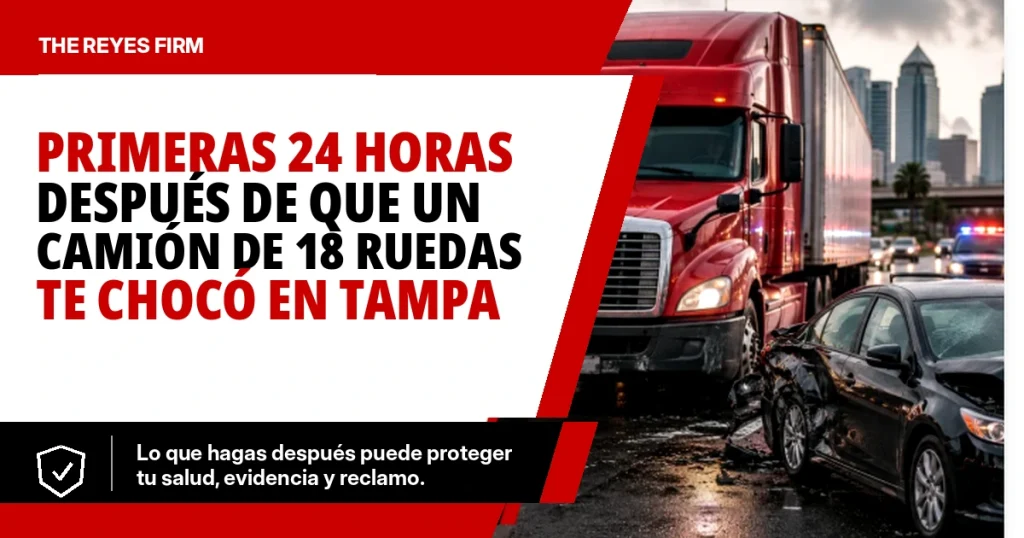
Imagen destacada en español de The Reyes Firm sobre qué hacer en las primeras 24 horas después de que un camión de 18 ruedas te chocó en Tampa, con un camión rojo y un auto dañado en la escena del choque.
Blog, Spanish, Truck Accidents

Qué Hacer en las Primeras 24 Horas Después de Que un Camión de 18 Ruedas Te Chocó en Tampa

Lo Que Necesitas Saber Llama al 911 primero y muévete a un lugar seguro si puedes. Busca atención médica dentro de los 14 días para proteger los beneficios PIP de Florida. Toma fotos, videos, nombres de testigos, logos del camión, placas y condiciones de la vía. No admitas culpa ni des una declaración grabada antes de hablar con un abogado. ¿Tuviste un mal día? Llámanos. 833-4 BAD DAY. Estás en estado de shock. Tu carro está dañado. El tráfico sigue moviéndose a tu alrededor en la I-4, I-75, I-275, o en una calle concurrida de Tampa, y el conductor del camión puede que ya esté llamando a su despachador. Si un camión de 18 ruedas te chocó en Tampa, las primeras 24 horas importan. Lo que hagas ahora puede proteger tu salud, tu reclamo de seguro, y evidencia clave antes de que desaparezca. Los casos de accidentes de camiones se mueven rápido. La empresa de camiones, su aseguradora y su equipo legal pueden empezar a proteger su versión de los hechos de inmediato. Tú necesitas proteger la tuya con la misma rapidez. The Reyes Firm ¿Tuviste un Mal Día? ¿Había un logo en el camión? Un logo de empresa, número DOT, o marcación en el remolque puede ayudar a identificar quién puede ser responsable después de un choque con un camión de 18 ruedas en Tampa. Programa Tu Consulta Gratuita ¿Qué Debes Hacer Primero Después de Que un Camión de 18 Ruedas Te Chocó en Tampa? Tu primer paso después de un choque con un camión de 18 ruedas en Tampa es llamar al 911, moverte a un lugar seguro si puedes, y pedir ayuda médica. Un informe del accidente, la respuesta de emergencia y los registros médicos tempranos pueden convertirse en evidencia importante más adelante. La ley de Florida requiere que se completen ciertos informes de accidentes después de choques que cumplan los requisitos. Mantén la calma y enfócate en tu seguridad primero. Si tu carro está bloqueando el tráfico y puedes moverte sin empeorar tus lesiones, busca un lugar más seguro. Si sientes dolor, mareos, adormecimiento, presión en el pecho o confusión, quédate donde estás y espera ayuda. Pregúntale al oficial que responda cómo obtener el informe del accidente después. Los informes de accidentes de Florida frecuentemente incluyen detalles del seguro, información del vehículo y hechos básicos del choque que pueden ayudar a tu caso. La ley de Florida también exige que los formularios de informe de accidentes incluyan los números de póliza de seguro y los nombres de las aseguradoras de los vehículos involucrados en choques reportables. ⚠️ Advertencia: La Regla de los 14 Días de Florida: Si te lesionaste en un accidente de camión en Tampa, no esperes para recibir atención médica. El Estatuto de Florida § 627.736 exige servicios médicos iniciales dentro de los 14 días después de un accidente de vehículo motorizado para que apliquen los beneficios médicos PIP. Esperar demasiado puede afectar tanto tu salud como tu reclamo. ¿Qué Evidencia Debes Recopilar en las Primeras 24 Horas? Debes recopilar fotos, videos, nombres de testigos, detalles del camión, logos de la empresa, condiciones de la vía, y todo lo que muestre cómo ocurrió el choque. En un accidente de camión de 18 ruedas en Tampa, la evidencia puede desaparecer rápidamente una vez que el camión se va, la carga se mueve, comienzan las reparaciones, o los datos electrónicos se sobreescriben. Si puedes documentar la escena de forma segura, captura: Daños a todos los vehículos La cabina del camión, el remolque, la placa, el número DOT y el logo de la empresa Marcas de frenado, escombros, vidrios rotos y derrames de líquidos Semáforos, zonas de construcción y marcas de carriles Condiciones climáticas, de iluminación y del pavimento Nombres y números de teléfono de testigos Nombres de los oficiales de policía e información del informe No dependas únicamente de la empresa de camiones para preservar la evidencia. Los choques con camiones frecuentemente involucran dispositivos de registro electrónico, datos de GPS, grabaciones de cámara de tablero, registros de mantenimiento, informes de inspección, archivos de calificación del conductor, registros de carga y datos de la caja negra. Las primeras 24 horas no se tratan solo de tomar fotos. Se trata de asegurarte de que se aplique la presión legal correcta a las empresas correctas antes de que se pierda la evidencia. The Reyes Firm ¿Te Lastimaste en un Accidente de Camión de 18 Ruedas en Tampa? Obtén los próximos pasos claros después de un choque grave con un camión. ¿Tuviste un mal día? Contáctanos Ahora ¿Debes Ver a un Médico Aunque Te Sientas Bien? Debes ver a un médico después de que un camión de 18 ruedas te choque, aunque al principio te sientas bien. El shock y la adrenalina pueden ocultar el dolor durante horas. Los registros médicos también conectan tus lesiones con el choque, lo cual importa cuando una compañía de seguros cuestiona más adelante la causa o gravedad de tus lesiones. Los síntomas tardíos comunes después de un accidente de camión en Tampa incluyen: Dolor en el cuello Dolor de espalda Dolores de cabeza Dolor en los hombros Adormecimiento u hormigueo Mareos Problemas de memoria Dolor abdominal Ansiedad o problemas para dormir Los beneficios PIP de Florida pueden ayudar a pagar parte de tus facturas médicas después de un accidente de vehículo motorizado, pero la regla de los 14 días importa. Según el Estatuto de Florida § 627.736, la atención médica inicial debe ocurrir dentro de los 14 días después del accidente para que apliquen los beneficios médicos PIP. 📊 ¿Sabías Que? El FLHSMV reportó 46,651 choques de vehículos motorizados comerciales en Florida en 2024, con 315 fallecidos. Esas cifras muestran por qué los choques con vehículos comerciales requieren pasos rápidos de atención médica, respuesta legal y preservación de evidencia. ¿Qué Debes Evitar Decir Después de un Choque con un Camión de 18 Ruedas en Tampa? Debes evitar admitir culpa, especular sobre lo que pasó, disculparte de una manera que suene a reconocimiento de

Featured image for a Tampa truck accident insurance offer article showing a damaged semi-truck, insurance offer document, and legal claim messaging, for illustrative purposes only.
Blog, Commercial Vehicles, Truck Accidents

How to Tell If Your Tampa Truck Accident Case Is Worth More Than the Insurance Offer

What You Need to Know The first insurance offer may not include your future medical care, lost income, pain, or long-term injury needs. A Tampa truck accident insurance offer can be too low when the trucking company’s records haven’t been reviewed. Black box data, driver logs, maintenance files, cargo records, and company safety policies can change the value of your case. Florida law can affect your claim, especially if the insurance company tries to blame you for the crash. Had a bad day? Call The Reyes Firm at 833-4 BAD DAY. A truck accident can turn your life upside down in seconds. One moment you’re driving through Tampa, and the next you’re dealing with pain, medical bills, missed work, and calls from an insurance adjuster. If you received a Tampa truck accident insurance offer, you may feel pressure to take it and move on. But an early offer may not show what your case is really worth, especially when a commercial truck, delivery vehicle, 18-wheeler, or company vehicle caused the crash. At The Reyes Firm, we help injured people in Tampa and the South Shore communities understand what the insurance company may be leaving out. Our office is located at 4730 N. Habana Ave., Suite 201, Tampa, FL 33614, and our team handles truck and commercial vehicle cases across Tampa, Riverview, Brandon, Plant City, and communities across Hillsborough County. Quick Answer: A Tampa truck accident case may be worth more than the insurance offer if the offer does not include future medical care, lost income, trucking company negligence, black box data, driver logs, or long-term injury costs. Before signing anything, have the offer reviewed by a Tampa truck accident lawyer. Why Would the Insurance Offer Be Lower Than Your Truck Accident Case Is Worth? A truck accident insurance offer may be lower than your case is worth because the insurer may not have counted your full medical needs, future care, lost income, pain, or commercial trucking evidence. Early offers often arrive before the full injury story is clear and before key company records are secured. Truck accident claims are different from regular car accident claims. A crash on I-4, I-75, or I-275 may involve a driver, trucking company, cargo company, maintenance vendor, delivery contractor, or multiple insurance policies. The insurance company may look only at the first few medical bills. That can miss the real impact of the crash. Your case may be worth more if you have: Ongoing pain Surgery recommendations Missed work Reduced earning ability Permanent injury Emotional distress Future treatment needs A trucking company’s safety failure Florida had 381,210 codeable traffic crashes in 2024, according to FLHSMV’s 2024 By the Numbers report. The same report states that Florida Highway Patrol troopers worked 1,649 of the state’s 2,962 fatal crashes that year. 📊 Did You Know? FMCSA’s 2024 Pocket Guide reported 5,476 fatal crashes involving large trucks and buses in 2022. FMCSA also reported 114,000 injury crashes involving large trucks that same year. What are the 7 Signs Your Tampa Truck Accident Insurance Offer May Be Too Low? Your truck accident offer may be too low if it was made quickly, ignores future care, pressures you to sign a release, or fails to include trucking company evidence. In Tampa truck accident cases, the first offer may protect the insurer more than it protects your recovery. Here are 7 warning signs. 1. You Still Need Medical Treatment You should be careful with any offer made before your treatment is complete. You may still need imaging, injections, therapy, surgery, or follow-up care. Once you settle, you usually can’t come back later for more money. 2. The Offer Only Covers Current Bills A fair truck accident settlement should look beyond today’s bills. It should also consider future treatment, lost earning capacity, long-term pain, and the injury’s impact on daily life. A low offer often looks only at what has already been billed. 3. The Adjuster Is Pushing You to Settle Fast Fast pressure is a red flag. The insurance company may want you to settle before you talk to a Tampa truck accident lawyer. You don’t have to sign anything before you understand your rights. 4. The Trucking Company Records Haven’t Been Reviewed Truck cases often need more evidence than car accident cases. Driver logs, inspection records, black box data, and maintenance files can show what really happened. If those records haven’t been reviewed, the offer may be missing major facts. 5. The Crash Involved a Commercial Vehicle A semi-truck, box truck, dump truck, delivery van, rideshare vehicle, or company truck can involve more than one responsible party. That can increase the available insurance and the value of the claim. The insurer may not explain that clearly. 6. They Blame You Without Proof Insurance companies may argue you were speeding, distracted, or partly at fault. That matters in Florida because fault can reduce or block recovery. A lawyer can test those claims against the actual evidence. 7. The Release Gives Up All Future Claims A settlement release can close your case forever. If you sign before knowing the full value of your injuries, you may give up the right to seek more compensation later. Never treat a release like a simple receipt. How Can You Compare the Insurance Offer to the Real Case Value? You can compare the insurance offer to the actual case value by checking what the offer includes and what it excludes. A fair Tampa truck accident settlement should account for medical care, future losses, trucking evidence, fault disputes, and every responsible party, not just the first bills sent to the insurer. What the Insurance Offer May Include What the Real Case Value May Include Current medical bills Current and future medical care Basic wage loss Lost income and reduced earning ability Vehicle damage Pain, suffering, and long-term limitations Driver’s version of events Black box data, driver logs, and witness statements One insurance policy Multiple liable parties and commercial insurance coverage A quick payment Full review of

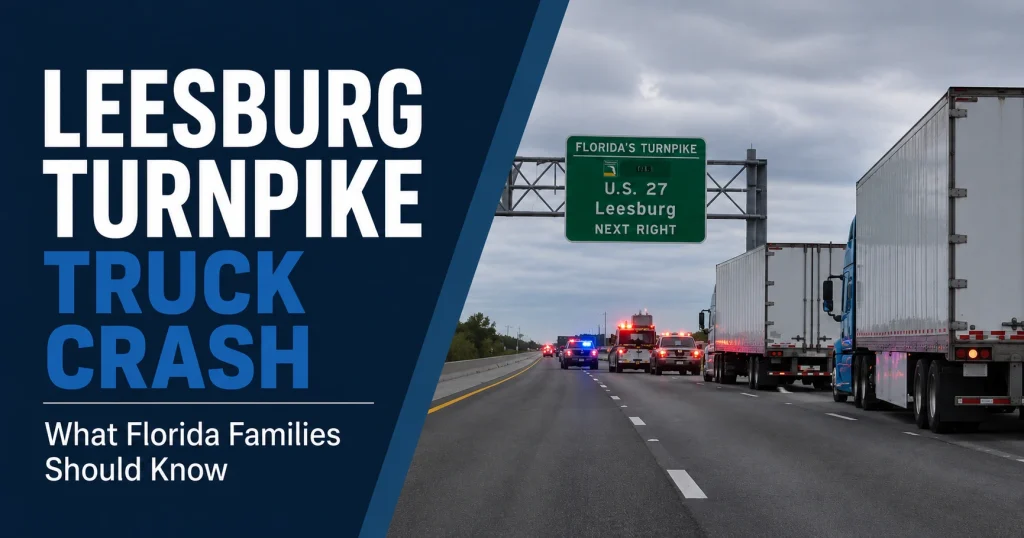
Featured image for an article about a reported semi-truck crash on southbound Florida’s Turnpike near U.S. 27 in Leesburg, Florida, explaining what families should know after a serious commercial vehicle crash.
Blog, News, Truck Accidents

Leesburg Florida Turnpike Semi-Truck Crash: What Families Should Know After a Serious Commercial Vehicle Crash

Quick Summary A crash involving multiple semi-trucks was reported on the southbound Florida Turnpike in Leesburg, just before the U.S. 27 exit in Lake County. According to WESH, the Florida Highway Patrol reported that two people were taken to the hospital, including one person with serious injuries, and the crash remains under investigation. Early reports do not always explain the full cause of a crash, especially when multiple commercial vehicles, roadway debris, and lane closures are involved. For families, this type of crash matters because commercial vehicle cases can involve more evidence than those involving typical passenger vehicle crashes. Depending on the evidence, investigators may review driver actions, vehicle movement, electronic data, maintenance records, company safety practices, and roadway conditions. What Happened in the Leesburg, Florida, Turnpike Crash? According to WESH, a crash involving multiple semi-trucks blocked lanes on Florida’s Turnpike in Leesburg early Thursday morning, May 28, 2026. The crash was reported in the southbound lanes just before the U.S. 27 exit in Lake County. WESH reported that the Florida Highway Patrol said a semi-truck on the shoulder was trying to merge into the outside lane when it moved into the direct path of another semi-truck. FHP said the two semi-trucks collided, and two additional semi-trucks later hit debris from the crash. Two people were taken to the hospital, including one person who suffered serious injuries, according to the report. The crash blocked two right southbound lanes for several hours before the roadblock was cleared. WESH reported that the crash remains under investigation. At this stage, this article does not assume fault or make any final legal conclusion. The facts may change as investigators review the scene, witness statements, vehicle data, and other evidence. Crash Location: Florida’s Turnpike Southbound Near U.S. 27 in Leesburg The crash was reported on the southbound Florida Turnpike near the U.S. 27 exit in Leesburg, Lake County, Florida. What Do We Know About the Crash? Based on the published report, we know the following: The crash happened on the southbound Florida Turnpike in Leesburg. The location was reported just before the U.S. 27 exit in Lake County. Multiple semi-trucks were involved. FHP reported that one semi-truck was moving from the shoulder toward the outside lane. FHP reported that two semi-trucks collided. Two additional semi-trucks reportedly hit debris from the crash. Two people were taken to the hospital. One person reportedly suffered serious injuries. The crash remained under investigation. What we do not know from the early report is equally important. The report does not provide final findings about liability, driver speed, following distance, mechanical condition, visibility, fatigue, maintenance, company policies, or whether any safety regulation was violated. That is why careful wording matters. Early reports can describe what was observed or initially reported, but they do not always explain the full cause. Why Can This Type of Crash Be So Serious? Crashes involving semi-trucks can be especially serious due to the size and weight of these vehicles. When multiple trucks are involved, the danger can increase quickly because a single collision can create debris, sudden lane blockages, secondary impacts, and limited space for other drivers to react. In this reported crash, WESH stated that two additional semi-trucks hit debris after the first collision. That detail matters because debris fields can create a chain of events that investigators may need to reconstruct carefully. A truck crash investigation may consider: Where each truck was positioned before impact Whether a vehicle was stopped, moving, merging, or changing lanes Whether hazard lights or warning devices were used Whether drivers had enough time and distance to react Whether traffic, weather, lighting, or road conditions played a role Whether any mechanical or maintenance issue contributed Whether the debris was avoidable under the circumstances Each of these questions depends on evidence. It is not enough to assume what happened from the first news report. What Makes a Truck or Commercial Vehicle Crash Different? A commercial truck crash can be different from a regular car crash because more parties, records, and safety rules may be involved. In a passenger vehicle crash, the investigation may focus mainly on the drivers and the vehicles. In a semi-truck crash, the investigation may also involve the trucking company, driver qualification records, electronic logging data, maintenance history, dispatch records, cargo records, and company safety practices. Federal rules also require certain commercial drivers and motor carriers to keep hours-of-service records. Electronic logging devices, often called ELDs, synchronize with the vehicle engine to record driving time and help track hours-of-service data, according to the Federal Motor Carrier Safety Administration. Under federal regulations, ELDs automatically record data such as date, time, commercial motor vehicle location information, engine hours, and vehicle miles. That type of information may matter after a serious crash because it can help investigators understand vehicle movement, driver activity, and timing. It does not automatically prove fault, but it may help answer important questions. Related Video: What Should You Do After a Semi-Truck Accident? Truck accidents are rarely simple. This video from The Reyes Firm explains why a semi-truck crash may involve the driver, the trucking company, maintenance issues, and multiple insurance policies, depending on the evidence. Note: This video provides general information about semi-truck accident claims in Florida. It does not discuss the Leesburg crash specifically or determine who was at fault. What Should Families Do After a Serious or Fatal Crash in Florida? After a serious commercial vehicle crash, families are often left with medical questions, insurance calls, vehicle damage, missing information, and emotional stress. The first priority should always be medical care and safety. When possible, families should also try to protect information that may later become important. Practical steps may include: Get medical care immediately.Catastrophic injuries can worsen over time. Medical records also help document what happened after the crash. Request the crash report when available.A crash report may provide initial information about the vehicles, drivers, location, and investigating agency. Save photos, videos, and messages.Keep images of the vehicles, roadway, injuries, debris, insurance
Scroll to Top