Car accident

Car accident help, we've got you covered
After A Car Accident, Car accident, Legal, Road Accidents, Uninsured Motorist Coverage, Why we serve

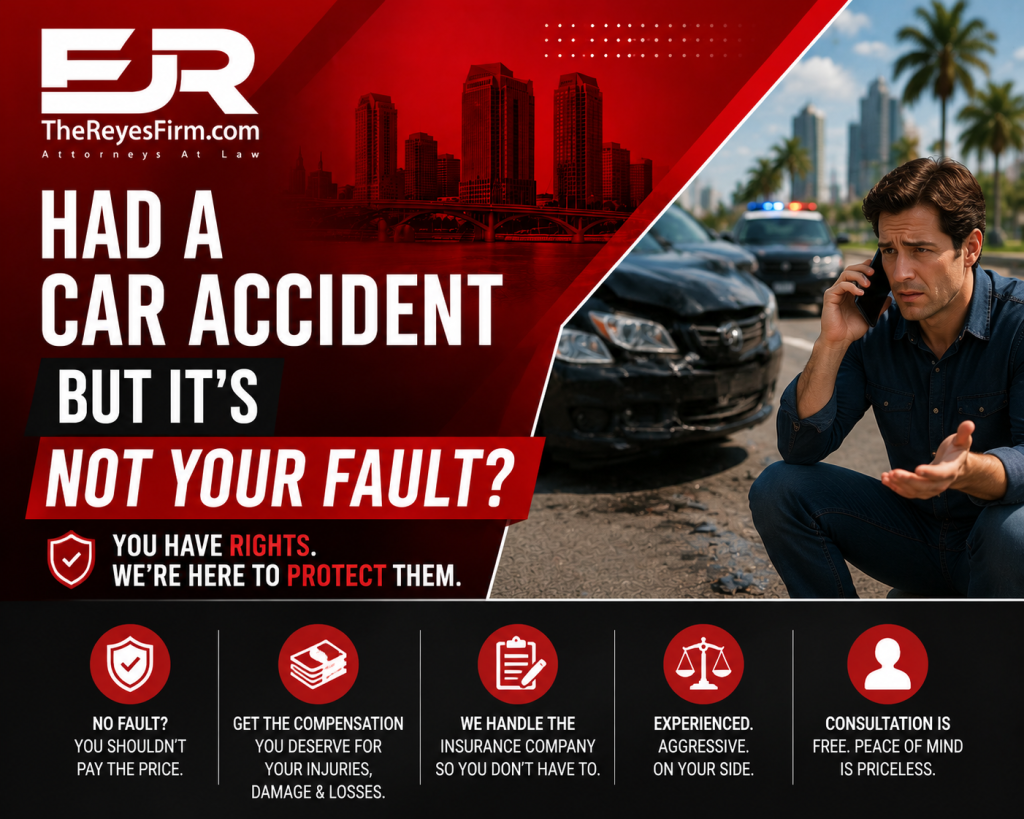
Had A Car Accident But It’s Not Your Fault?

You were just driving, walking, or biking through Tampa, doing nothing wrong. Then someone else’s mistake caused a car accident that wasn’t your fault. Now you’re hurt, worried about who pays, maybe even unsure whether your own insurance gaps will sink your claim — and the other driver’s insurer is already working to protect their interests. Here’s what you need to know before you say another word to them. TL;DR — QUICK SUMMARY If a crash wasn’t your fault, you can have a case even if you don’t carry your own insurance or weren’t in a car at all. Florida does not require drivers to carry Bodily Injury liability coverage, so whether the at-fault driver can pay for your injuries depends on what they actually carry. When the at-fault driver has no Bodily Injury coverage, your own uninsured/underinsured motorist coverage often becomes your most important source of recovery. Under Florida Statute § 95.11(3)(a), you generally have two years from the date of the crash to file a personal injury lawsuit. Florida’s comparative fault rule means partial fault reduces your recovery, but being found not at fault protects the full value of your claim. The Reyes Firm Hit in a Crash That Wasn’t Your Fault? Get clear next steps when someone else caused your wreck. Had a bad day? Contact Us Now Optional Bodily injury coverage in Florida FL Financial Responsibility Law $10,000 Florida required PIP coverage Fla. Stat. § 627.736 2 Years Florida statute of limitations Fla. Stat. § 95.11(3)(a) 50%+ Fault that bars recovery in Florida Fla. Stat. § 768.81 Do you have a case if a car accident wasn’t your fault in Tampa? Yes, if a car accident wasn’t your fault, you generally have a case against the driver who caused it. Florida law lets an injured person hold a negligent driver financially responsible for the harm they caused, whether you were behind the wheel, on foot, or on a bicycle. What changes from case to case isn’t whether you have a claim — it’s where the money to pay that claim actually comes from. That depends heavily on what insurance the at-fault driver carries and what coverage you have on your own policy. Sorting that out early is one of the most important things a lawyer does for you. Can you recover if it wasn’t your fault but you don’t have insurance? Often, yes. If the crash was caused by another driver and you were a pedestrian, a cyclist, or a scooter rider, you generally aren’t required to carry auto insurance, and you can still pursue the at-fault driver’s coverage for your injuries. It gets more complicated if you own a car and didn’t carry the Personal Injury Protection that Florida requires, because that can limit some of the benefits available to you. It doesn’t automatically erase your right to recover from the person who hurt you, but it’s exactly the kind of wrinkle you want a lawyer reviewing before you talk to any insurer. ⚠️ Deadline Warning: Under Florida Statute § 95.11(3)(a), you generally have two years from the date of your crash to file a personal injury lawsuit. Missing this deadline almost always means losing your right to recover anything. Don’t wait to call a lawyer. Watch: What to do when a crash wasn’t your fault This short video explains how recovery works after a not-at-fault crash and why the other driver’s coverage — or lack of it — makes such a difference. If you still have questions after watching, The Reyes Firm offers a free consultation so you can talk through your specific situation with a real attorney. Why doesn’t Florida require Bodily Injury coverage, and why does that matter? Florida is one of the few states that does not require most drivers to carry Bodily Injury liability coverage, which is the coverage that pays for the injuries an at-fault driver causes to other people. Drivers are required to carry Personal Injury Protection under Florida Statute § 627.736 and property damage liability, but not Bodily Injury. That matters enormously after a not-at-fault crash. If the driver who hit you carries Bodily Injury coverage, their policy can pay for your injuries even if you had no insurance of your own. If they don’t carry it, that source of money simply isn’t there, and you have to look elsewhere — which is where your own coverage comes in. 💡 Did You Know? Because Florida doesn’t require Bodily Injury liability coverage, a driver who causes your injuries may legally have no coverage to pay for them — even though the crash was entirely their fault. That’s the single biggest reason to carry uninsured/underinsured motorist coverage on your own policy. Source: Florida Financial Responsibility Law, leg.state.fl.us. What if the at-fault driver has no Bodily Injury coverage? If the at-fault driver has no Bodily Injury coverage, your own uninsured/underinsured motorist coverage often becomes your most important source of recovery. UM/UIM coverage, governed by Florida Statute § 627.727, is designed to step in exactly when the responsible driver can’t pay. This coverage can come from your own policy, and in some situations from a resident relative’s policy, even if you weren’t in a car at the time. There may also be other parties to pursue, such as an employer if the driver was working. An attorney’s job is to find every available policy so you aren’t left absorbing someone else’s mistake. Who is liable when the accident wasn’t your fault? Liability falls on whoever failed to use reasonable care, which in a not-at-fault crash is the other driver. A motorist who was speeding, distracted, ran a light, or failed to yield can be held responsible for the harm they caused, regardless of whether you carried your own insurance. In some cases more than one party shares responsibility, such as an employer whose driver was on the clock or a business that overserved an impaired driver. Identifying every responsible party matters, because each one may bring additional insurance coverage to

Car accident claims We fight back.
After A Car Accident, Car accident, Legal, Settlement, Why we serve

Car Insurance Company Won’t Pay After a Crash? | Tampa, Florida

You did everything right after your car accident. You reported the claim, you got treatment, you waited. Now the insurance company is dragging its feet, lowballing you, or flat-out refusing to pay, and you’re still in pain with bills piling up. Here’s exactly what you can do about it before you accept a penny less than your claim is worth. TL;DR — QUICK SUMMARY If a Florida insurer refuses a fair payout, you generally have two real options: reject the bad offer and negotiate, or file a lawsuit. Accepting a lowball offer is almost never the right move. Insurance adjusters are trained and paid to keep payouts low. A delay, denial, or insulting offer is a business tactic, not the final word on your case. When an insurer refuses to pay what it owes, Florida law lets you file a Civil Remedy Notice under Florida Statute § 624.155, which gives the company 60 days to fix the problem before a bad faith claim can move forward. You have two years from the date of your crash to file a personal injury lawsuit in Florida under Florida Statute § 95.11(3)(a). Waiting too long can cost you the right to recover anything. Under Florida’s no-fault system, your own PIP coverage pays first up to $10,000, but serious injuries can open the door to a claim against the at-fault driver and their insurer. The Reyes Firm Insurance Company Won’t Pay After a Tampa Crash? Get clear next steps when an adjuster delays, denies, or lowballs your claim. Had a bad day? Contact Us Now 2 Years Florida statute of limitations Fla. Stat. § 95.11(3)(a) 60 Days Insurer’s window to cure bad faith Fla. Stat. § 624.155 $10,000 Florida PIP minimum coverage Fla. Stat. § 627.736 50% Fault bar to recovery in FL Fla. Stat. § 768.81 Why won’t my car insurance company pay after a car accident? An insurance company refuses to pay because paying less is how it protects its bottom line, not because your injuries aren’t real. Whether it’s your own insurer or the at-fault driver’s, the adjuster handling your file is one of dozens of people whose job is to close claims for as little money as possible. You are one of hundreds of files on that adjuster’s desk. Some are reasonable. Others delay, deny, and dispute everything, hoping you’ll get frustrated and take whatever they offer. None of that changes what your claim is actually worth, and none of it is the final answer. Common reasons an insurer gives for not paying include disputing who was at fault, claiming your injuries existed before the crash, arguing your treatment wasn’t necessary, or simply making an offer so low it doesn’t begin to cover your medical bills and lost wages. Each of those positions can be challenged with the right evidence. What does it mean when a car insurance company acts in bad faith in Florida? Bad faith means an insurance company has failed to settle a claim fairly and honestly when it had the chance to do so. Florida law requires insurers to act in good faith toward the people they cover and toward injured claimants, and when they don’t, you may have a separate legal claim against the company itself. Under Florida Statute § 624.155, an insurer can be held liable for not attempting in good faith to settle a claim when it could and should have. Examples include ignoring clear evidence, refusing to explain a denial, or sitting on a reasonable demand without responding. Bad faith is not the same as a low offer you simply disagree with. It involves conduct that crosses the line from hard negotiation into a refusal to do what the law and the policy require. A Tampa personal injury attorney can tell you whether what you’re experiencing rises to that level. ⚠️ Deadline Warning: Under Florida Statute § 95.11(3)(a), you have two years from the date of your crash to file a personal injury lawsuit. Missing this deadline almost always means losing your right to recover anything, no matter how strong your case is. Don’t let an insurer run out the clock on you. Watch: What to do when your insurance company won’t pay in Tampa In this short video, Tampa personal injury attorney Edward Reyes explains your options when an insurer makes a bad offer or refuses to move on your claim. If an adjuster has already given you a number that doesn’t feel right, The Reyes Firm offers free consultations to review the offer before you sign anything. What is a Civil Remedy Notice and how does it pressure the insurer? A Civil Remedy Notice is a formal filing that tells Florida’s Department of Financial Services in Tallahassee that an insurance company is acting in bad faith. It is one of the strongest tools available when an insurer should have paid and hasn’t. Under Fla. Stat. § 624.155, once a Civil Remedy Notice is filed, the insurance company has 60 days to cure the violation, meaning it can pay what it owes and avoid a bad faith lawsuit. The notice gets the file in front of a supervisor and puts the company on official record. If the 60 days pass and nothing changes, the next step is usually filing a lawsuit. That decision is never automatic. We walk you through exactly what litigation involves before you commit to it, including the discovery questions both sides have to answer. 💡 Did You Know? Florida is a no-fault insurance state. Under Florida Statute § 627.736, your own Personal Injury Protection (PIP) coverage pays up to $10,000 in medical bills and lost wages regardless of who caused the crash. But PIP rarely covers a serious injury in full, and that gap is often where insurance disputes begin. Should I accept a low settlement offer or file a lawsuit? You should almost never accept a low offer when your injuries are serious and the number doesn’t cover your losses. Once you sign a release,

How to navigate insurance claims after accidents
After A Car Accident, After an Accident, Car accident

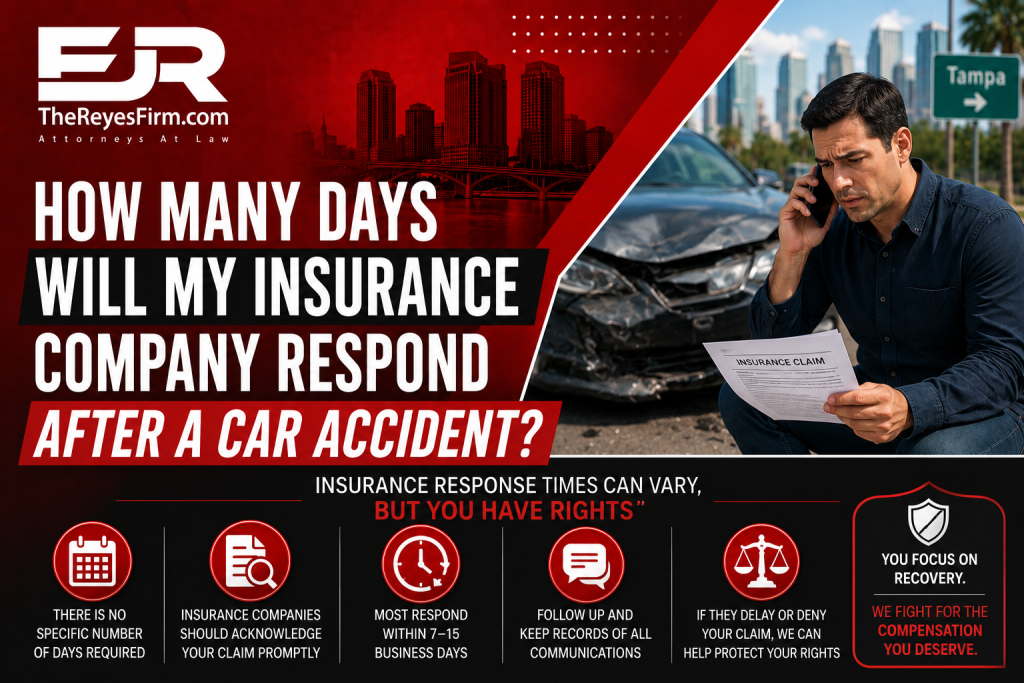
How Many Days Will My Insurance Company Respond After A Car Accident?

You were rear-ended on your way through Tampa, you did everything right, and you filed your claim. Now the days are passing with no answer, the medical bills are arriving, and you’re starting to wonder whether the insurance company is ever going to call back. Here’s exactly how long they have to respond after a Florida car accident, and what you can do when they drag their feet. TL;DR — QUICK SUMMARY Your own PIP insurer must pay or deny your claim within 30 days of receiving written notice under Florida Statute 627.736(4)(b). Insurers are expected to acknowledge a new claim promptly, generally within about 14 days, even though the full investigation takes longer. Once you and the insurer agree on a settlement, they have 20 days to pay it under Florida Statute 627.4265, or interest starts to accrue. A claim against the at-fault driver’s insurer has no fixed response deadline, which is why those claims can stall for months. You have two years from the crash to file a personal injury lawsuit under Florida Statute 95.11(3)(a), so an insurer’s delay should never push you past that line. The Reyes Firm Is the Insurance Company Ignoring You? Get clear answers about your Tampa car accident claim. Had a bad day? Contact Us Now 30 Days For your insurer to pay or deny PIP Fla. Stat. 627.736(4)(b) 20 Days To pay an agreed settlement Fla. Stat. 627.4265 14 Days To seek treatment for PIP eligibility Fla. Stat. 627.736 2 Years To file an injury lawsuit Fla. Stat. 95.11(3)(a) How many days does an insurance company have to respond after a car accident in Florida? It depends on the type of claim, but the short answer is that your own no-fault insurer must pay or deny a Personal Injury Protection (PIP) claim within 30 days, while a claim against the other driver’s insurer has no fixed deadline at all. Florida law also expects any insurer to acknowledge a new claim promptly, generally within about 14 days, even though the full investigation takes longer than that. That gap between a quick acknowledgment and a slow resolution is where most of the frustration lives. An insurer can confirm it received your claim, then take weeks or months to actually decide what it will pay. Knowing which deadline applies to your situation tells you whether the delay you’re experiencing is normal or a warning sign. How long does your own PIP insurer have to pay or deny your claim? Your own PIP insurer has 30 days to pay or deny your claim after it receives written notice of the loss. This deadline comes from Florida Statute § 627.736(4)(b), and Florida applies a “mailbox rule,” meaning the insurer complies as long as the payment is postmarked by the 30th day. There is a catch that falls on you first. To qualify for PIP benefits at all, you must seek medical treatment within 14 days of the crash. Miss that window and your insurer can deny PIP coverage entirely, no matter how serious your injuries turn out to be. If you submit your bills in pieces, the insurer gets a fresh 30 days to pay each portion as it comes in, and if it denies part of your claim over a clerical mistake, you generally have 15 days to fix and resubmit it. 💡 Did You Know? Under Florida’s no-fault law, your PIP insurer must pay or deny your claim within 30 days of receiving written notice, and the payment only needs to be postmarked by day 30 to count. Florida also requires you to seek medical treatment within 14 days of the crash to keep your PIP benefits at all. Source: Fla. Stat. § 627.736, leg.state.fl.us. What about a claim against the other driver’s insurance company? A claim against the at-fault driver’s insurer works very differently, because there is no statutory deadline forcing a third-party liability insurer to respond by a set date. Instead, the insurer only has to investigate and decide within a “reasonable” period, which gives it far more room to take its time than your own PIP carrier has. This is the kind of claim that can stretch on for months, especially when injuries are serious, fault is disputed, or a commercial policy is involved, such as in a truck or commercial vehicle crash. The lack of a hard deadline does not mean the insurer can stall forever, and it does not stop your own clock from running. Whatever the other side does, you still have a firm deadline to protect your right to sue. ⚠️ Deadline Warning: Under Florida Statute § 95.11(3)(a), you have two years from the date of your crash to file a personal injury lawsuit. Missing this deadline almost always means losing your right to recover anything. Don’t wait to call a lawyer. Watch: What to do when an insurance company delays your car accident claim This short video explains the warning signs that an insurer is stalling and the first moves that keep your claim on track. If your claim is stuck, The Reyes Firm offers free consultations and can tell you where you stand at no cost. Why do insurance companies delay responding after a car accident? Insurers delay because slowing a claim down often costs them less. The longer a claim drags, the more likely an injured person grows anxious about mounting bills and accepts a quick, low settlement just to make the waiting stop. Common tactics include requesting the same documents more than once, questioning whether your injuries really came from the crash, disputing who was at fault, and simply going quiet for long stretches. Florida follows a comparative fault rule, so one of the most common moves is trying to pin part of the blame on you in order to shrink what the insurer owes. 🛡️ Your Rights Under Florida Law: Under Florida Statute § 768.81, your compensation is reduced by your share of fault, and you may be barred from recovery if

Car Accident
Accident Injuries & why, After A Car Accident, After an Accident, Car accident, FAQ, For Parents, For Teens, Health, Injury, Legal, Settlement, Why we serve

Car Accident? What Happens Next?

So, you went through the whole process. You got treated, you went to the doctor, you did everything you’re supposed to do for your injuries and to recover. So, what happens next? Well, the doctors, the urgent care facilities, the medical doctor, the spine specialist, the MRIs, everybody else. We request the records, or they’ll send us the records for your treatment. Now that we get all the records, we can create the story of what are you and how does this accident affected your life. I have to get the medical records so we can put together a demand for settlement. Now that tells us about your medical records, that tells us a lot of things about what’s hurting you and how this has affected your life per the doctor’s perspective from what you’ve told them during your exams. Now, one of the things that we like to do as a firm- we do an impact sheet. How has the accident impacted your life, that’s the most important part because in litigation there are two parts? There are economic damages which are your heart damages meaning what did you lose as far as monetary, how much are your medical bills cost-wise. Tampa personal injury lawyer Edward Reyes represents people in Tampa and Hillsborough County, Florida who have suffered an injury in an incident or accident type of accident. Speak Directly to Me, At No Cost, Today 813.421.3411 But then there’s the whole other part of life that has affected your life or your relationship with your kids. How it has affected your life while brushing your teeth, tying your shoes, playing, doing all these things. So, we want to know the story of how it has affected you, not just the cost of treatment but how does that affect you in your life and going forward. Now that will give us a full story or a much better story to wrap it up in a pretty bow to put it in front of the insurance company so they can understand you as a person and not you as just a piece of paper. So, it’s very important to put the general damages, which is how it affected your life your actual life and the economic damages which is how much did it cost because if you’ve gone through this issue, did you miss work, did you have to go to the multiple visit, did you spend a lot of money back with gas and time mending opportunity things that you missed out. All these things are important to correctly tell the story to the adjuster from the insurance company. Now we can start the negotiations. That’s what we have to do to prepare a demand for settlement. If you have any questions, call us at 813.421.3411. (Transcript from the video, transcribed but not reviewed)

I Just Had A Car Accident
Accident Injuries & why, After A Car Accident, After an Accident, Car accident, For Parents, For Teens, Health, Injury, Legal, Settlement, Why we serve

I Just Had A Car Accident, How Long Does My Case Take?

You are probably wondering, how long does my case? Your case will depend on a lot of factors. If you have big injuries and there is a low policy, many times the insurance company would not want to pay right away because they know they are putting their clients at risk. This does not mean that it’s a good position for you because depending on circumstances, that may be all that you can get. Now, there are all the things that can happen within that, but it gets a bit more complicated. The insurance company in good effort must do everything compliant with the demands of the compliant. That is the first. Next, you have big injuries, bad injuries- big policy. Yes, that sounds like a good idea, however sometimes when the policy is big, the insurance company will fight it because they have enough money to fight it. With that being said, if you bad injuries and big policy, the chances of recovery are much greater. Case scenario number three, you have little injuries, big policy. The insurance company has a lot of money to fight, so it takes much longer to settle the case. Case option number four, you have big injuries, decent policy. Now, this is a more realistic scenario. When this happens, you have bad injuries and your coverage is valued out what the injuries could be, now the insurance offer is more reasonable. Tampa personal injury lawyer Edward Reyes represents people in Tampa and Hillsborough County, Florida who have suffered an injury in an incident or accident type of accident. Speak Directly to Me, At No Cost, Today 813.421.3411 At the end of the day, the insurance company has adjusters that work for them. Their job is to adjust claims down. Their job is not to pay you, but they are trying to reduce the amount for their company. That is what they are paid to do, so do not take it personally. They do not know you; they only know what’s on paper. So, if you feel that the adjusters are not treating you fairly, that is where we have to put more pressure, we have to use techniques so they raise the offer and we may have to file a suit. By filing suit, it comes in the hands of the adjusters and goes to the hands of another person which is the litigation adjuster and an attorney. If you have questions on this, call us at 813.421.3411. (Transcript from the video, transcribed but not reviewed)

Who will fix your car?
After A Car Accident, Body Shops, Car accident, FAQ, Uninsured Motorists Coverage, Why we serve

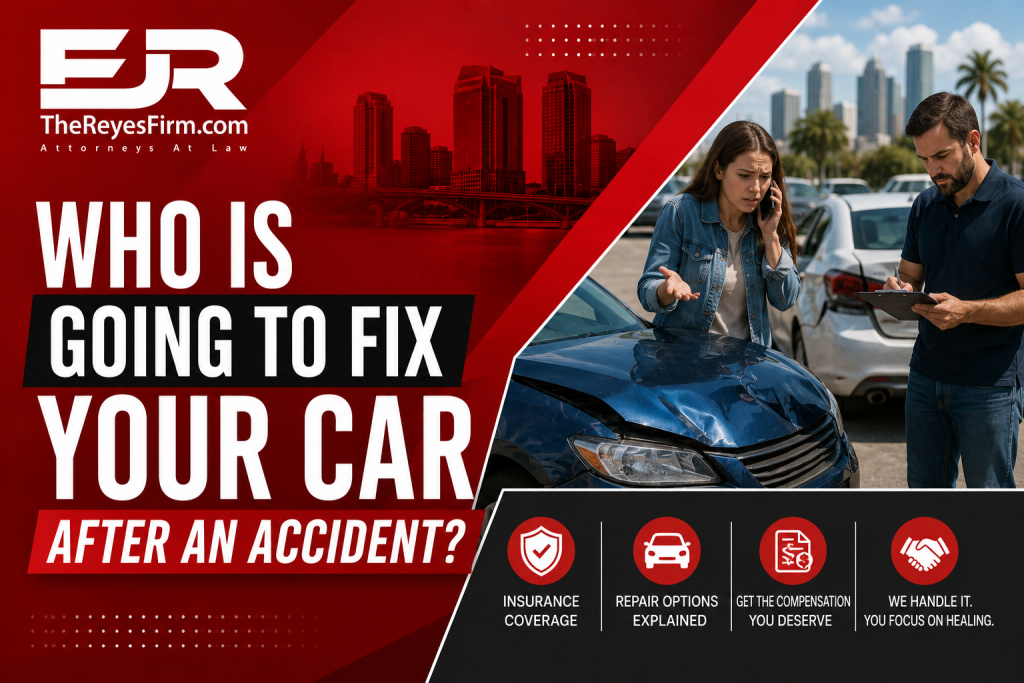
Who Is Going to Fix Your Car After an Accident?

You were just driving through Tampa, minding your own day. Then another driver’s mistake left your car damaged in a crash you didn’t cause. Now you’re staring at a wrecked vehicle, wondering how you’ll get to work, and the insurance adjusters are already deciding how little they can pay you. Here’s what you need to know before you sign anything or accept their first offer. TL;DR — QUICK SUMMARY In Florida, car repairs are paid based on fault, not no-fault — the at-fault driver’s Property Damage Liability coverage is responsible for fixing your vehicle. You have two main options: file through your own collision coverage (you pay your deductible up front) or file directly against the at-fault driver’s insurance (no deductible, but slower if liability is disputed). If you use your own collision coverage, your insurer can pursue the at-fault party and refund your deductible once it recovers — so you are not stuck paying it permanently. Florida property damage claims carry a four-year deadline under Florida Statute § 95.11(3), but any related injury lawsuit must be filed within two years under Fla. Stat. § 95.11(3)(a). Florida’s minimum Property Damage Liability coverage is only $10,000, which often will not cover repairs to a newer vehicle — so identifying every source of coverage matters. The Reyes Firm Car Damaged in a Tampa Accident That Wasn’t Your Fault? Get clear next steps on who pays to fix your car and how much you’re owed. Had a bad day? Contact Us Now $10,000 FL minimum Property Damage Liability Fla. Stat. § 627.7275 $10,000 FL minimum PIP (injuries only) Fla. Stat. § 627.736 4 Years FL property damage claim deadline Fla. Stat. § 95.11(3) 2 Years FL injury lawsuit deadline Fla. Stat. § 95.11(3)(a) Who is responsible for fixing your car after an accident in Tampa? The driver who caused the crash is responsible for the damage to your car — and in Florida, that means their Property Damage Liability insurance should pay to repair or replace your vehicle. This surprises a lot of people, because Florida is known as a “no-fault” state. No-fault only applies to your medical bills and injuries through Personal Injury Protection. When it comes to your car itself, fault still controls who pays. That distinction matters because it gives you a choice. You can route the repair through your own insurance company, or you can pursue the at-fault driver’s insurer directly. The Reyes Firm, a Tampa personal injury firm that handles crash claims across Hillsborough County and the surrounding region, sees clients pushed toward whichever option is cheaper for the insurance company — not whichever is better for you. ⚠️ Deadline Warning: If you were injured in the crash, Florida law gives you only two years to file a personal injury lawsuit under Florida Statute § 95.11(3)(a). Claims for the damage to your vehicle alone have a longer four-year window, but missing either deadline can permanently end your right to recover. Don’t wait to call a lawyer. Should you use your own insurance or the at-fault driver’s insurance to fix your car? Both options can get your car repaired, but they work very differently, and the right one depends on your coverage and how clear fault is. Here’s how each path actually plays out. Option 1 — Your own collision coverage. If you carry collision coverage, your insurer will arrange the repair quickly, often before fault is even sorted out. The catch is your deductible: you pay it up front before the work is done. The upside is speed and the freedom to choose your own repair shop rather than one the other insurer steers you toward. Option 2 — The at-fault driver’s Property Damage Liability coverage. If the other driver was clearly at fault, their insurer is legally responsible for your repairs, and you pay no deductible. The trade-off is timing. The at-fault insurer typically sends an adjuster to inspect your car before approving anything, and if they dispute who caused the crash, the repair can stall while they investigate. When liability is obvious, going through the at-fault driver’s insurer avoids your deductible entirely. When fault is contested or you need your car back fast, your own collision coverage usually gets you moving sooner. 💡 Did You Know? Florida only requires drivers to carry $10,000 in Property Damage Liability coverage under Fla. Stat. § 627.7275. On a newer vehicle, $10,000 often falls far short of the actual repair or replacement cost — which is why identifying every available source of coverage, including your own policy, can be the difference between a full repair and an out-of-pocket loss. Source: Fla. Stat. § 627.7275, leg.state.fl.us. Does Florida’s no-fault insurance cover car repairs? No — Florida’s no-fault system does not pay to fix your car. Personal Injury Protection under Florida Statute § 627.736 covers your own medical bills and a portion of lost wages regardless of who caused the crash, but it stops at injuries. The damage to your vehicle is treated as a fault-based property damage claim, separate from your PIP benefits. This is why two people in the same accident can have very different experiences. Your medical treatment runs through PIP no matter what, while the repair to your car depends entirely on proving who was responsible. Keeping those two claims straight — and making sure neither one is shortchanged — is a large part of what a Tampa car accident attorney does. Who pays if the other driver was clearly at fault? When the other driver caused the crash, their Property Damage Liability insurer owes you the cost to repair your vehicle, or its fair value if it’s totaled. If you go through your own collision coverage instead, your insurer can then pursue the at-fault party through a process called subrogation — and once it recovers, it refunds your deductible to you. So even if you pay the deductible at the shop, you are not necessarily stuck with that cost forever. You may also be owed more

E- Scooter and Car Accidents
Accident Injuries & why, Car accident, FAQ, florida cities we serve, For Parents, For Teens, Injury, Road Accidents, Scooter Accident, Uninsured Motorists Coverage, Why we serve

E- Scooter and Car Accidents: The Difference Between the Two

Scooters are fun. Scooters are growing. You see scooters now on every corner. In fact, in every area in Florida especially in every major city in Florida, you’ll see scooters growing in popularity amongst every age group. Scooters are unique because you do not need insurance and you do not need a license and you do not need a helmet. Tampa personal injury lawyer Edward Reyes represents people in Tampa and Hillsborough County, Florida who have suffered an injury in an incident or accident type of accident. Speak Directly to Me, At No Cost, Today 813.421.3411 With all that being said, if you’re involved in a scooter accident and you don’t have a helmet on the insurance company that’s protecting their client that’s the at-fault party can and will reduce the damages to your head if the helmet would have reduced the damages. If you do not own a car you can be covered by the person that crashed into you, the at-fault party’s personal injury protection for your medical, your lost wages and we can submit a claim against that party for the pain and suffering that they’ve caused you. Call us now for more information. (Transcript from the video, transcribed but not reviewed)

Traumatic Brain Injury
Accident Injuries & why, After A Car Accident, After an Accident, Car accident, FAQ, For Parents, For Teens, Health, Injury, Migraines, Personal Injury, Why we serve

Traumatic Brain Injury how is it Caused?

When you have the whiplash, motion, either side to side or forward, there’s a liquid, and you can, of course, you know a lot more than I do. We just help people recover from their injuries. But, a liquid inside that protects the brain a little bit but, because of the impact, it crashes back and forth into the skull walls, but if you can just kind of elaborate more on what you’ve seen on the traumatic brain injuries. Well, the brain is swimming in the fluid. There is a number of structures that are anchoring the brain down to the neck, et cetera. And those are the structures that tend to be stretched by the motion of the brain inside the skull. In this, deceleration injuries, you’re going at 80 miles per hour and all of a sudden, you’re at zero miles per hour. Traumatic Brain Injury Your brain wants to keep going. And when it does, it stretches a big number of possible structures inside your skull that can cause the traumatic brain injury. It could be even bleeding from that. Now, and I’ve heard the statistic, and I don’t know how true this is, 70 to 80% of CT scans miss traumatic brain injury, cause CT only shows if there’s hemorrhaging or blood in the brain, but, have you heard anything of each, CT scan has a very low sensitivity for traumatic brain injury, unless there is a bleed, which is, thankfully, not very common because of how strong the skull is. You don’t see evidence of traumatic brain injury in a CT scan, which is what is typically performed in ERs. What do we see, what are common, if somebody was out there, what are the common symptoms, I guess, I would ask, if somebody said, and, you know, we’ve heard, “I just don’t feel right”, or, “I feel dizzy.” What have you found is the most common symptoms, what do you, traumatic brain injury.⁣ Time of the Accident Well, the patient would have an initial loss of consciousness at the time of the accident and then when they come back they, as you said, they don’t feel right, they feel dizzy, they feel this vertigo-like everything is moving around. They can have a severe headache. And then, which is the most concerning, is that these symptoms may dissipate initially, and then they would start having chronic symptoms of traumatic brain injury which would even include emotional liability, problems like that, yeah.⁣ Tampa personal injury lawyer Edward Reyes represents people in Tampa and Hillsborough County, Florida who have suffered an injury in an incident or accident type of accident. Speak Directly to Me, At No Cost, Today 813.421.3411 So, a lot of times, focusing, maybe connecting with loved ones, you know, vertigo, standing up, mood swings, okay, stuff like that. Yeah, cause a lot of people, I think that they’re not really thinking about this traumatic brain injury issue, but it is happening, because even at low impacts, we’ve seen that it does affect people’s mood, they just don’t feel right, in the field. They feel off, that we’ve heard. They don’t understand what is happening. Nobody’s told them they could have a traumatic brain injury. And they just can’t back to their lives and they don’t know why. Call 813.421.3411 for more information. (Transcript from the video, transcribed but not reviewed)

Car accidents are the Most Common Accidents
After A Car Accident, Blog, Car accident, florida cities we serve, For Parents, For Teens, Injury, Legal, mass transit, Our Community, Ride Sharing, Road Accidents, Why we serve

Car accidents are the Most Common Accidents

Accidents are the most common forms of incidents on the road. Just in Hillsborough County, there’s close to 3,000 car accidents, per day, in Polk, Pasco, Pinellas. In almost every other county, there is an average of 2,000 to 25, to 3,000 car accidents per day. Even though that number sounds staggering, there are hundreds of thousands of cars on the road every single day. So, the more cars that are on the road, the greater the risk of car accidents happening. Car accidents, many times on bumper-to-bumper traffic, between eight in the morning till six p.m., are typically non-fatal accidents when they’re on regular roads. Car accidents, when they’re on the interstate, because of the higher speeds, there are fewer accidents but they’re typically more fatal than other incidents that are on local roads. Car accidents, if the person that crashed into you, could’ve avoided the accident, due to their negligence of speeding, following to close, careless driving, they would be the one at fault. Florida is a no-clause state, which that means if you’re involved in a car accident, your insurance company covers you for your injuries, and your medical payments up to $10,000 if it’s an emergency medical condition. You do not need to go to the hospital to get the emergency medical condition, you may have to see a physician, or a doctor, or a chiropractic doctor, to evaluate you and then eventually you will have to go to an MD, or a DO, or something like that. MD, which is a medical doctor, and DO is also a form of a medical doctor, as well. To qualify from the $2500 that the insurance company caps you up to the $10,000 of insurance benefits. Car accidents, when the person that crashes into you, if they have bodily injury coverages, that’s the part that helps us, as a law firm, help you recover for your injuries, pain, and suffering, and loss of enjoyment. If the person that crashes into you has non-sufficient insurance or no insurance, if you carry uninsured motorist on your policy, that uninsured motorist will cover you for any offset that the other side did not have. Tampa personal injury lawyer Edward Reyes represents people in Tampa and Hillsborough County, Florida who have suffered an injury in an incident or accident type of accident. Speak Directly to Me, At No Cost, Today 813.421.3411 For example, if you had a, if the person that crashed into you had a $10,000 bodily injury policy, and your injuries are worth $30,000, but you had a $20,000 uninsured motorist policy, that $10,000 would pay for the at-fault party, the person that caused the accident, and the $20,000 would pay for your insurance to make you whole. Not always does it make you whole, because many times if that’s the case, you may not have enough uninsured motorist, or they have enough bodily injury coverage that you don’t have to even impact your own policy. Every case is a little bit different, every auto accident is a little bit different. Auto accidents, it’s easier to find liability when it’s a rear-end collision, however, there are cases where there are T-bone collisions, there are cases where there’s making left-turn collisions, cases where people are making U-turns. So, every case is a little bit different. If you have any questions about auto accidents, feel free to reach out to us, it’s 813-421-3411. (Transcript from the video, transcribed but not reviewed)

The Most Common Rear-End Type Injuries
Accident Injuries & why, After A Car Accident, After an Accident, Car accident, FAQ, For Parents, For Teens, Health, Injury, Personal Injury, Road Accidents, Scooter Accident, Slip and fall, Teen Accidents, Traumatic injury, Why does this hurt, Why we serve

The Most Common Rear-End Type Injuries

Whenever you get a person that got rear-ended, what are the most common injuries that you find from those types of accidents? Spine injuries to the neck. So what we call the cervical spine in the neck is very frequently injured and it presents with a variety of symptoms sometimes with very severe headaches, neck pain, pain in the shoulders. Tampa personal injury lawyer Edward Reyes represents people in Tampa and Hillsborough County, Florida who have suffered an injury in an incident or accident type of accident. Speak Directly to Me, At No Cost, Today 813.421.3411 Sometimes these patients even have something called vertigo where the patient feels dizzy and the world around them turns constantly. It’s not that uncommon to see that in a rear-ending injury. Now when you mentioned spinal injuries, ’cause there are different types of spinal injuries as well and different things that affect the disc, just walk us through what specifically do you find, herniations? Call us at 813.421.3411 for more information. (Transcript from the video, transcribed but not reviewed)

Scroll to Top