Commercial Vehicles

vehicle with a logo accident lawyer Tampa, company vehicle accident lawyer Tampa, Tampa commercial vehicle accident lawyer, Florida logo vehicle accident claim, work vehicle accident attorney Tampa
Blog, Commercial Vehicles, Company-Caused Car Accidents

Hit by a Company Vehicle With a Logo in Tampa? Here Is What To Do

What You Need to Know A crash with a company vehicle is not the same as a regular car accident. The driver, employer, vehicle owner, maintenance company, or another business may share fault. Some commercial vehicle cases involve federal and Florida safety rules. Evidence can disappear fast, including dashcam footage, driver records, GPS data, and repair logs. You should get medical care, report the crash, and speak with a lawyer before the insurance company controls the story. Had a bad day? Call The Reyes Firm at 833-4 BAD DAY. A company vehicle accident lawyer Tampa residents trust can help when a crash involves a work truck, delivery van, service vehicle, rideshare car, or any vehicle with a business logo. These cases often move fast because the company and its insurer may start protecting themselves right away. You may be in pain. You may not know who owns the vehicle. You may only remember the logo, color, or company name on the door. That detail matters. The Reyes Firm helps injured people in Tampa and the South Shore communities understand what to do after a crash with a business vehicle. Our office is located at 4730 N. Habana Ave., Suite 201, Tampa, FL 33614, and we serve Tampa, Riverview, Brandon, Plant City, and communities across Hillsborough County. Why Is a Company Vehicle Accident Different From a Regular Car Crash? A company vehicle crash can involve more parties, more insurance coverage, and more evidence than a regular car accident. The driver may have been working, the company may own the vehicle, and business records may show what really happened before the crash. A logo on the vehicle is a clue. It may show that the driver was acting on behalf of a business at the time of the wreck. Common company vehicles include: Delivery vans Plumbing, HVAC, or electrical trucks Landscaping trucks Construction vehicles Food service vehicles Box trucks Cargo vans Rideshare or fleet vehicles Branded pickup trucks Company vehicle crashes need careful investigation from the start. These cases may involve business insurance, driver records, vehicle maintenance logs, GPS data, and other evidence that can disappear quickly. 📊 Did you know? FLHSMV’s preliminary 2024 data reported 46,651 commercial motor vehicle crashes in Florida, with 315 fatalities. These are not minor insurance claims. Many involve serious injuries, lost work, and complex fault issues. What Should You Do After a Crash With a Logo Vehicle? After a crash with a company vehicle, protect your health first. Call 911, get medical care, take photos, save the company name, and avoid giving a recorded statement before you understand your rights. The company may already have adjusters working on the claim. Try to collect: What to Save Why It Matters Company name or logo Helps identify the business or vehicle owner License plate Helps confirm the vehicle Driver name Helps connect the driver to the company Photos of the vehicle Shows branding, damage, and road position Witness names Helps prove what happened Police report number Helps track the official crash record Your medical records Connects your injuries to the crash Do not rely only on what the driver says at the scene. Some drivers may claim they were “off the clock.” Others may say the vehicle was personal. A lawyer can review employment records, dispatch logs, GPS data, and insurance coverage. Who Can Be Responsible for a Company Vehicle Accident in Florida? More than one person or company may be responsible for a crash involving a company vehicle. The driver may be at fault, but the employer, vehicle owner, maintenance provider, cargo loader, or contractor may also be involved, depending on the facts. Possible responsible parties include: The company driver The driver’s employer The vehicle owner A leasing company A maintenance or repair company A company that loaded cargo A dispatch or logistics company Another negligent driver This matters because crashes involving company vehicles often involve business insurance, fleet policies, and corporate defense teams. The insurance company may try to limit the case to the driver only. That can leave out important parties. What Evidence Needs To Be Preserved Right Away? Company vehicle cases require rapid evidence preservation because key evidence may be deleted, overwritten, repaired, or lost. A lawyer can send preservation letters that require the company to retain records related to the crash, the driver, and the vehicle. Important evidence may include: Dashcam video GPS or route data Driver logs Delivery app records Dispatch records Maintenance logs Inspection reports Hiring and training files Cell phone records Vehicle repair records Insurance policies Prior safety complaints ⚠️ Warning: Florida law generally gives injured people two years to file a negligence lawsuit. Some deadlines can be shorter, especially when government vehicles or special claims rules are involved. Do not wait to protect your case. How Do Federal and Florida Rules Affect a Commercial Vehicle Accident? Federal and Florida safety rules may apply when a crash involves a commercial motor vehicle, a large truck, an interstate carrier, hazardous materials, or certain regulated business vehicles. Florida Statute § 316.302 applies federal motor carrier rules to many commercial motor vehicles operating in Florida. That can affect the case because the company may have duties tied to: Driver qualifications Hours of service Vehicle inspections Maintenance Cargo securement Drug and alcohol testing Safety records Driver supervision Not every logo vehicle is a federally regulated truck. A small local business car may be handled differently than a box truck or tractor-trailer. Still, the business connection can change the investigation and insurance strategy. NHTSA’s 2024 overview reported 5,340 people killed in crashes involving large trucks nationwide, and most of those deaths involved people outside the large truck. That is one reason serious commercial vehicle cases require detailed crash investigation. 🛡️ Your rights: Florida uses modified comparative negligence. Under Florida Statute § 768.81, your recovery can be reduced by your percentage of fault, and a person found more than 50% at fault may not recover damages in most negligence cases. Evidence matters because insurers often
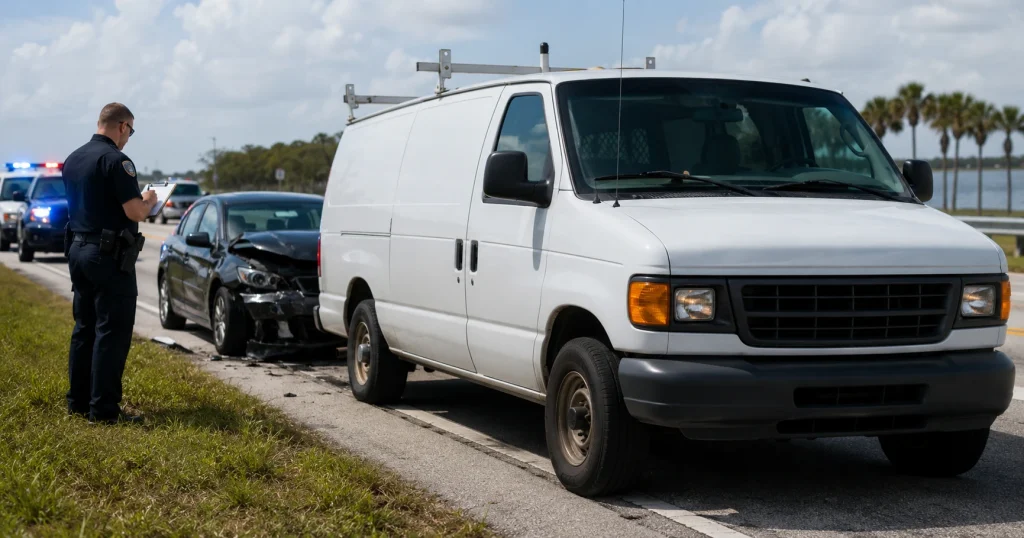
Unmarked white work van involved in a Florida roadside crash investigation with police at the scene, for illustrative purposes only.
Blog, Commercial Vehicles, Company-Caused Car Accidents

When the Company Vehicle That Hit You Has No Logo: How to Trace Employer Liability in Florida

What You Need to Know A company vehicle does not need a logo for a Florida employer to be looked into.  Liability means legal responsibility, and it may depend on ownership, permission, business use, insurance, and driver status.  The license plate, VIN, crash report, GPS data, work orders, and photos can help trace the employer. Florida deadlines and fault rules can affect your right to recover compensation. The Reyes Firm helps injured people in Tampa identify who may be responsible after serious vehicle crashes. Had a bad day? Call The Reyes Firm at 833-4 BAD DAY. Company vehicle no logo employer liability Florida means a business may still be legally responsible for a crash, even when the car, van, or truck has no visible branding. Liability means legal responsibility. The problem is proof. The company may deny the vehicle was used for work. The insurer may blame only the driver.  At The Reyes Firm, we help injured people in Tampa look past the missing logo. We trace the vehicle, the driver, the employer, and the applicable insurance.  Does a Company Vehicle Need a Logo for Employer Liability in Florida? No. A Florida company vehicle does not need a business logo to face liability after a crash. The key questions are who owned or controlled the vehicle, who allowed the driver to use it, and if the driver was serving a work purpose. A logo is not the proof that controls the claim.  A logo can help identify a company. But no logo does not end the case. Florida claims often focus on: The vehicle owner. The driver’s employer. The driver’s job task. The driver’s permission to use the vehicle. The insurance policy covering the vehicle. The company’s control over the driver or route. Logo vs No Logo Liability Matrix Crash fact Does the logo decide liability? What matters more The company owns the vehicle No Title, registration, permission, and insurance The driver was making a delivery No Route, dispatch records, app data, and work orders The driver was going to a jobsite No Work schedule, job location, and employer instructions The driver was using a personal car for work No Reimbursement, job purpose, and employer control The company removed its logo No Ownership, use, permission, and evidence The vehicle had tools or cargo No Photos, witness statements, and business records That is why the next step is tracing who owned the vehicle and why it was on the road. How Do You Trace the Employer Behind an Unmarked Company Vehicle? You trace an unmarked company vehicle by connecting the plate, VIN, insurance card, crash report, driver identity, route, cargo, tools, uniform, dispatch records, GPS data, and job records. The sooner this proof is saved, the harder it is for a company or insurer to deny the work link.  The license plate and VIN can help identify the vehicle owner.  Start with what you can safely gather at the scene. Take photos of the vehicle from all sides. Take a photo of the license plate. Ask for the driver’s license and insurance information. Look for tools, equipment, cargo, labels, uniforms, badges, or delivery items. Get witness names and phone numbers. Save dashcam, doorbell, or business camera leads. Write down anything the driver said about work, a route, or a customer. FLHSMV is Florida’s official source for crash records. Crash reports may take up to 10 days to become available. FLHSMV says some crashes must be reported to law enforcement. This includes crashes with injury, death, hit-and-run, DUI, wrecker removal, a commercial motor vehicle, or apparent damage of at least $500.  Evidence Map for an Unmarked Company Vehicle Accident Evidence Why it matters Who may have it License plate Helps trace registration and ownership Police, FLHSMV, insurer VIN Confirms the exact vehicle Vehicle, report, repair records Insurance card May reveal a commercial policy Driver, insurer Crash report Lists drivers, vehicles, witnesses, and insurers Law enforcement, FLHSMV GPS data Shows route, speed, stops, and timing Employer, fleet vendor Dispatch records Shows the driver was on a work task Employer, app, contractor Work orders Connects the trip to a job Employer, customer Tools or cargo Supports business use Photos, witnesses Uniform or badge Links driver to a company Photos, witnesses Texts or calls May show employer direction Driver, employer Once you know what to save, the next issue is how Florida law treats the claim.  What Florida Laws Affect an Unmarked Company Vehicle Crash Claim? Florida law can affect your claim through filing deadlines, fault rules, PIP benefits, commercial vehicle definitions, and insurance rules. PIP means personal injury protection. It is the first layer of car insurance benefits in many Florida crashes. Florida deadlines and fault rules can change the value of your case.  Florida Rules People Often Confuse Rule Plain-English meaning Why it matters Two-year deadline Negligence and wrongful death actions generally must be filed within two years Waiting can hurt your right to sue 14-day PIP rule Initial medical care is generally needed within 14 days for PIP medical benefits Delayed care can affect benefits Greater than 50% fault rule A party greater than 50% at fault generally cannot recover damages Insurance companies may try to shift blame Commercial vehicle definition Some vehicles are commercial based on use, weight, passengers, or hazardous material A plain vehicle may still be commercial Commercial insurance minimums Heavier commercial vehicles may need higher liability coverage More coverage may be available   ⚠️ Warning Box: Florida Deadline: Florida Statute § 95.11 gives a two-year deadline for actions based on negligence and wrongful death. Do not wait for the company or insurance carrier to finish looking into the crash before you protect your claim. Florida’s PIP law provides up to $10,000 in medical and disability benefits. It also requires initial care within 14 days of the crash to qualify for medical benefits.  Florida defines certain commercial motor vehicles by use, weight, passengers, or hazardous material. This can include vehicles used in commerce to move people or cargo. 

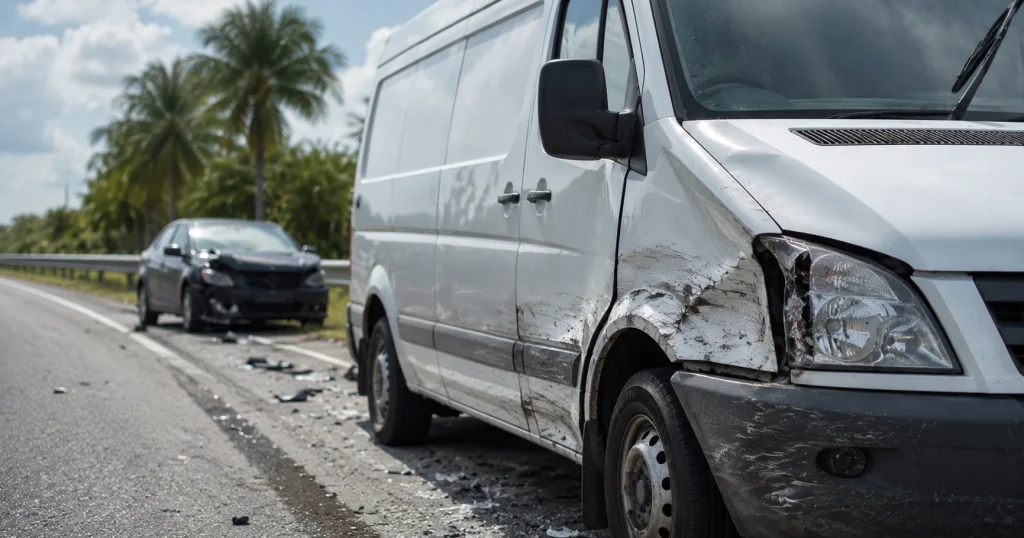
FedEx-style delivery truck near a damaged car on a Florida roadway after a commercial vehicle crash, for illustrative purposes only.
Blog, Commercial Vehicles

Can You Sue FedEx After an Accident in Florida?

What You Need to Know You may be able to sue FedEx or another FedEx-connected party after a Florida crash. The right defendant may be the driver, FedEx, a contractor, the vehicle owner, or another company. FedEx delivery crashes often involve commercial insurance, route records, GPS data, and contractor agreements. Florida law gives most injury victims two years to file a negligence lawsuit. Do not give a recorded statement before you understand your rights. Had a bad day? Call The Reyes Firm at 833-4 BAD DAY. If a FedEx truck hit you in Florida, do not wait to figure out who pays. If you are asking whether you can sue FedEx after an accident in Florida, the answer is yes, but the right claim may not be straightforward. A FedEx crash can involve a driver, a route contractor, a commercial policy, a delivery company, and fast-moving insurance teams. The Reyes Firm helps injured people in Tampa understand what happened, preserve key evidence, and take the next step. Call The Reyes Firm at 833-4 BAD DAY if you were hurt in a FedEx truck accident in Tampa, on I-4, I-75, I-275, or anywhere in Florida. The Reyes Firm Hit by a FedEx Truck in Florida? Get clear next steps after a delivery truck crash. Had a bad day? Contact Us Now Can you sue FedEx after a crash in Florida? Yes, you may be able to sue FedEx or a FedEx-affiliated party after a crash in Florida if the driver, route contractor, vehicle owner, maintenance provider, or delivery company caused your injuries. The key is identifying who controlled the driver, who owned the vehicle, and which insurance policy applies. A FedEx logo on the vehicle matters, but it does not answer every legal question. Some FedEx routes involve service providers that handle pickups and deliveries, drivers, vehicles, and day-to-day operations. FedEx’s own contractor information states that service providers may employ their own personnel and use their own vehicles. Your case may involve claims against: The FedEx driver A local FedEx service provider or contractor Federal Express or another FedEx entity The vehicle owner A maintenance company Another driver who contributed to the crash The claim turns on control, conduct, insurance, and evidence. That is why a FedEx truck accident in Tampa should be investigated fast. ⚠️ Warning: Florida lawsuit deadline: Under Florida Statute § 95.11, most negligence-based personal injury lawsuits must be filed within two years. Waiting can also allow FedEx route data, dashcam footage, driver logs, and vehicle records to disappear. Why are FedEx accident cases different from regular car accidents? FedEx accident cases can involve multiple companies because many FedEx-branded delivery routes are handled by service providers. That means the driver, a local contractor, FedEx, a fleet owner, or a maintenance company may all need to be investigated before anyone accepts blame. This is different from a typical two-car crash. A delivery truck case may involve: Issue Why it matters Driver status The driver may be an employee or a contractor. Route records Delivery deadlines, stops, and GPS data may show pressure or unsafe driving. Vehicle ownership The truck may be owned by FedEx, a contractor, or another company. Maintenance history Poor brakes, tires, lights, or mirrors may support your claim. Insurance layers Commercial policies may apply in addition to basic auto insurance. FedEx and its insurers may know the business structure before you do. They may also contact you early. Do not guess. Do not sign a release. Do not give a recorded statement before speaking with a Florida personal injury attorney. Watch: Why FedEx Delivery Truck Accident Claims Are Different A crash with a FedEx, Amazon, or other delivery truck is not handled like a normal car accident. Commercial policies, contractor relationships, and company insurance teams can complicate these cases. In this video, The Reyes Firm explains what injured people in Tampa should know after a delivery truck crash. If you were hurt in a delivery truck accident in Tampa, call The Reyes Firm at 833-4 BAD DAY for a free consultation. What evidence matters after a FedEx delivery truck crash? The most important evidence includes the crash report, photos, medical records, witness information, driver identity, vehicle number, route data, GPS records, dashcam footage, inspection records, and maintenance records. Many of these records are controlled by companies, not injured people, so quick preservation matters. Try to collect what you safely can at the scene: Photos of the FedEx vehicle, logo, plate, and truck number Photos of your car, injuries, debris, skid marks, and road conditions The driver’s name, employer, and insurance information Witness names and phone numbers The exact crash location Names of responding law enforcement officers Any nearby cameras from stores, homes, or traffic systems Florida crash reports can also help identify insurance information and involved parties. Florida Statute §316.066 requires that certain crash reports be completed and submitted after qualifying crashes, including those involving injury, death, DUI, hit-and-run, disabled vehicles, or commercial motor vehicles. 💡 Did you know? FLHSMV’s preliminary 2024 crash snapshot listed 46,651 commercial motor vehicle crashes in Florida, with 315 fatalities. That includes more than FedEx trucks, but it shows how serious commercial vehicle crashes are across Florida. How does Florida insurance law affect a FedEx accident claim? Florida no-fault insurance may cover some of your first medical bills and lost wages through your own Personal Injury Protection coverage. But serious FedEx crash injuries may also support a claim against the at-fault driver, contractor, FedEx-related entity, or another responsible party. Florida Statute §627.736 governs required PIP benefits. PIP can help after many vehicle crashes, but it does not always cover the full harm caused by a serious commercial vehicle crash. In a FedEx accident claim, damages may include: Emergency care Hospital bills Surgery Physical therapy Lost income Loss of earning capacity Pain and suffering Future medical care Wrongful death damages for surviving family members 🛡️ Your Rights: Comparative fault in Florida: Florida Statute § 768.81 allows fault to be divided among parties.

Personal car and commercial van involved in a Florida crash, illustrating commercial vs personal insurance issues after an accident.
Blog, Commercial Vehicles

Commercial vs. Personal Insurance After a Florida Crash: Who Pays?

What You Need to Know Quick answer: In a Florida crash involving commercial vs. personal insurance, your own PIP coverage may help with initial medical bills while the responsible insurer is identified. If the other driver was working, driving a company vehicle, or making a delivery, a commercial policy may also apply. Florida generally requires drivers with four-wheel vehicles to carry Personal Injury Protection (PIP) and Property Damage Liability (PDL) coverage. Your own PIP may cover part of your medical bills no matter who caused the crash. A commercial policy may apply if the at-fault driver was working, delivering goods, or transporting goods, or was driving a business-owned vehicle. Florida’s 14-day PIP rule matters. If you wait too long to get medical care, you may lose important benefits. More than one insurance company may be responsible, which is why identifying all applicable policies matters after a serious crash. The Reyes Firm Had a Bad Day? Was There a Logo on the Vehicle? A company logo, DOT number, delivery app, or work-related trip can help determine whether commercial insurance may apply after a crash in Florida. Schedule Your Free Consultation You’re Hurt and the Insurance Picture Already Feels Like a Mess You were hit in Tampa, and now the insurance situation feels confusing. The driver handed you a personal insurance card, but the vehicle had a company logo. Or maybe the driver said they were “just running an errand,” but they were actually making a delivery. That confusion is common after a commercial vs personal insurance Florida crash. It also matters because the applicable policy can affect how medical bills, lost income, property damage, and future care are handled. The Reyes Firm helps injured people in Tampa and across Hillsborough County navigate complex insurance issues after serious crashes. Our office is located at 4730 N. Habana Ave., Suite 201, Tampa, FL 33614, and we serve Tampa, Riverview, Brandon, Plant City, and nearby communities along I-4, I-75, and I-275. Who Pays After a Commercial vs Personal Insurance Florida Crash? In Florida, your own PIP coverage may help pay initial medical benefits after a crash, no matter who caused it. FLHSMV explains that PIP covers 80% of necessary and reasonable medical expenses up to $10,000 for a covered injury, while PDL pays for damage to another person’s property caused by the insured driver or someone driving the insured vehicle. After that, the bigger question is liability. If the other driver was using the vehicle for personal reasons, their personal auto policy may be the main liability policy. But if the driver was working, making deliveries, driving a company vehicle, hauling equipment, transporting goods, or acting within the scope of employment, a commercial policy may also apply. That can change the entire claim. A commercial vehicle accident claim may involve: The individual driver’s personal auto policy The employer’s commercial auto policy A business owner’s general liability or umbrella policy A delivery company or rideshare platform policy The vehicle owner’s insurance A contractor, subcontractor, or logistics company policy Your own uninsured/underinsured motorist coverage, if available The key point is simple: the insurance card handed to you at the crash scene may not tell the whole story. If your crash involved a company car, delivery van, work truck, or other business vehicle, our guide on commercial vehicle accident lawyer Florida explains how these claims are investigated and why identifying every possible policy matters. What Is the Difference Between Personal and Commercial Auto Insurance in Florida? Personal auto insurance usually covers ordinary personal driving. Commercial auto insurance usually covers vehicles used for work or business. That sounds simple, but real crashes are often more complicated. A pickup truck may be personally owned but used for a work errand. A delivery driver may use a personal vehicle while logged into an app. A company vehicle may be driven after hours. Each fact can affect which insurer must respond. Insurance Type Usually Applies When Common Examples Personal auto insurance The driver used the car for personal reasons Grocery run, school pickup, commuting, personal errands Commercial auto insurance The vehicle was used for business Company van, box truck, contractor vehicle, delivery truck Mixed-use situation A personal vehicle was used for work Food delivery, rideshare, job-site travel, employee errand Multiple-policy situation More than one party may be connected to the trip Employer, vehicle owner, platform, contractor, motor carrier Florida also has added insurance requirements for certain commercial motor vehicles. Under Florida Statute § 627.7415, covered commercial motor vehicles must carry higher combined bodily injury and property damage coverage based on vehicle weight: $50,000, $100,000, or $300,000 per occurrence depending on the gross vehicle weight category. Federal rules can require even higher limits for certain motor carriers. Under 49 CFR Part 387, covered for-hire interstate property carriers and hazardous-material carriers must maintain minimum levels of financial responsibility. FMCSA regulations include minimum public liability limits that may reach $750,000, $1,000,000, or $5,000,000 depending on the type of carriage and cargo. That is why “commercial vs personal insurance” is not just a technical detail. It can affect whether there is enough coverage for hospital bills, surgery, future treatment, lost income, and long-term disability. What If the Driver Used a Personal Car for Work? A personal car can still trigger a commercial insurance question if the driver was working at the time of the crash. This happens often with food delivery drivers, rideshare drivers, contractors, and employees running errands between job sites. The vehicle’s title does not decide the case. What the driver was doing at the time of the crash matters. In some cases, the driver’s personal insurer may deny or limit the claim because the car was being used for work. In others, an employer, delivery platform, or commercial policy may provide separate coverage that applies on top of the personal policy. When a worker causes a crash while performing job duties, the case may involve employer liability for a company car accident. The key questions often include whether the driver was

Featured image for a blog about delivery company insurance limits in Florida, showing a delivery driver, delivery van, insurance policy checklist, and The Reyes Firm branding.
Blog, Commercial Vehicles, Company-Caused Car Accidents

Delivery Company Insurance Limits in Florida: What Crash Victims Need to Know

Florida does not have a single insurance limit for every delivery company accident. Coverage depends on the driver’s status, the company’s role, the vehicle type, and whether a delivery was active. Understanding delivery company insurance limits florida means looking beyond the driver’s personal policy and identifying every possible commercial, platform, employer, and vehicle-owner policy. Key Takeaways Coverage depends on driver status. Active deliveries may trigger more coverage. Personal policies may deny claims. Fast investigation matters. Important: Delivery Accident Insurance Can Be Disputed After a Florida delivery accident, insurance coverage may depend on whether the driver was offline, waiting for an order, picking up food or packages, or actively delivering. Before giving a recorded statement or accepting a settlement, it may help to speak with a delivery driver accident attorney in Tampa who can review all possible insurance policies. What Are Delivery Company Insurance Limits in Florida? Delivery company insurance limits in Florida are the maximum amounts an insurance policy may pay after a crash. These limits can come from several sources. They may include the driver’s personal auto policy, a delivery platform policy, a commercial auto policy, or a company-owned vehicle policy. In serious injury cases, more than one policy may apply. In our experience handling personal injury cases in Florida, delivery crashes often involve coverage disputes. The insurance company may argue that the driver was not working. The delivery company may argue that the driver was an independent contractor. The personal insurer may argue that business use was excluded. That is why the first question is not only “Who caused the crash?” It is also “What was the driver doing at that exact moment?” Does Florida Require One Insurance Limit for Every Delivery Driver? No. Florida does not set a universal insurance limit for every delivery driver. The required coverage depends on the vehicle and the business model. Florida generally requires vehicles with current Florida registration to carry at least $10,000 in Personal Injury Protection and $10,000 in Property Damage Liability coverage. PIP covers certain medical expenses regardless of fault, and PDL covers damage to another person’s property. This is a starting point only. It may not be enough after a serious delivery accident. Some commercial vehicles must carry higher coverage. Florida law requires certain heavier commercial vehicles to carry combined bodily injury and property damage liability coverage based on weight. The minimums listed in Florida law include $50,000, $100,000, or $300,000 per occurrence, depending on gross vehicle weight. For larger vehicles subject to federal motor carrier rules, Florida law points to federal financial responsibility requirements. What Insurance May Apply After a Delivery Accident? Several insurance policies may apply after a delivery accident. The answer depends on the facts. Common coverage sources include: Possible Coverage Source When It May Apply Driver’s personal auto policy Personal driving or limited covered use Delivery platform policy Active delivery or app-based work Employer commercial policy An employee using a company vehicle Vehicle owner policy Borrowed, leased, or company-owned vehicle UM/UIM coverage The at-fault driver is uninsured or underinsured Health insurance or MedPay Medical bills after PIP are exhausted The key issue is timing. A driver may have different coverage while offline, logged in, waiting for an order, driving to pickup, or delivering to the customer. Our legal team at The Reyes Firm looks for app records, dispatch logs, GPS data, delivery receipts, driver statements, and insurance disclosures. These records can show which policy should respond. Does the Driver’s Personal Insurance Cover Delivery Work? Sometimes, but not always. Many personal auto policies limit or exclude business delivery use. Florida’s rideshare law recognizes this problem as it applies to transportation network companies. It requires written disclosure that a driver’s own auto policy might not provide coverage while the driver is logged on or engaged in a prearranged ride. Delivery cases can create similar disputes. A driver may believe they are covered. The personal insurer may disagree after learning the driver was delivering food, groceries, or packages. This is why crash victims should not rely only on the driver’s insurance card. The card may not tell the full story. What If the Driver Was Working for DoorDash? DoorDash may provide third-party liability coverage during an active delivery. DoorDash states that its third-party liability insurance may cover up to $1,000,000 for bodily injury and property damage to other parties in most states during an active delivery. DoorDash describes an active delivery as the period from accepting an offer through drop-off. It also states that this coverage does not cover damage to the Dasher’s own vehicle. This distinction matters. If the driver was only logged into the app and waiting, coverage may be disputed. If the driver had accepted an order, stronger coverage may be available. A delivery receipt, app screenshot, order history, or subpoenaed platform data may help prove the driver’s status. What If the Driver Was Working for Uber Eats? Uber may provide coverage depending on the driver’s app status. Uber states that when a driver is online and available, third-party liability coverage may apply in at least the following amounts: $50,000 per person, $100,000 per accident for injuries, and $25,000 for property damage. Uber’s insurance page applies to rideshare and delivery drivers. It also explains that extra coverage may depend on state law and driver status. For crash victims, the important question is simple. Was the driver offline, online, waiting, picking up, or actively delivering? The answer can affect available insurance. What if the driver were delivering for Amazon Flex? Amazon Flex may provide commercial auto coverage during eligible delivery activity. Amazon states that its Commercial Auto Insurance Policy includes $1,000,000 in auto liability coverage, uninsured motorist or underinsured motorist coverage, and other coverage. This does not mean every Amazon-related crash has the same coverage. Amazon delivery cases can involve Flex drivers, delivery service partners, rented vans, box trucks, or other business entities. The vehicle type matters. The driver’s employment status matters. The delivery route and app records matter. Our legal team at The Reyes

Featured image for The Reyes Firm showing a delivery van and passenger car crash in Tampa with driver log and route details, illustrating how employer liability may be investigated when a driver may have been on the clock.
Blog, Commercial Vehicles, Company-Caused Car Accidents

How to Find Out If the Driver Who Hit You Was On the Clock

In Florida, you can find out whether a driver was on the clock by reviewing the crash report, vehicle ownership, insurance details, route data, dispatch records, GPS or telematics records, time sheets, and employer policies. The key issue is whether the driver was acting within the scope of their work. Key Takeaways The police report is a starting point, but it may not tell the full story. A company logo, uniform, delivery app, work truck, or commercial insurance policy can be an early clue. Dispatch logs, GPS data, telematics records, time sheets, and delivery records may show whether the driver was working. An attorney can send preservation letters quickly so important records are not deleted or overwritten. If a lawsuit becomes necessary, records may be obtained through discovery or subpoenas. Whether the driver was “on the clock” may affect whether an employer, vehicle owner, or commercial insurance policy is a party to the claim. Why This Question Matters After a Tampa Crash After a crash, one of the most important questions is simple: Was the driver working when they hit you? That answer can change the direction of the entire injury claim. If the driver was doing work for an employer, making a delivery, traveling between job sites, or driving a company vehicle for business purposes, the claim may involve more than the driver’s personal auto insurance. This comes up often in Tampa and Hillsborough County, especially along I-4, I-75, I-275, Brandon, Riverview, Plant City, Seffner, Gibsonton, Apollo Beach, Ruskin, Wimauma, Lithia, and Palm River. Work trucks, delivery vans, rideshare vehicles, construction vehicles, and company cars are on the road every day. If a work vehicle, delivery van, company car, or commercial truck caused your crash, our Commercial Vehicle Accident Lawyer Tampa page explains how these cases are investigated and what evidence may matter. Finding out whether the driver was on the clock early can help preserve evidence, identify the right insurance coverage, and determine whether an employer or vehicle owner may be legally responsible. How Do You Find Out If the Driver Was Working? Start with the crash report, but do not stop there. The police report may list a company name, commercial vehicle information, insurance details, vehicle ownership, or notes about the driver’s job. It may also mention a logo, a work van, a delivery vehicle, or other details observed at the scene. However, the crash report is usually only the beginning. It may not include the driver’s schedule, route, job assignment, app activity, or internal company records. Records That May Show the Driver Was On the Clock Evidence What It May Show Police crash report Company name, vehicle owner, insurance information, or commercial vehicle details Vehicle registration Whether the vehicle was owned by a company, employer, or commercial fleet Insurance documents Whether a personal or commercial policy may apply Dispatch records Whether the driver had an active job, delivery, or service call GPS or telematics data Where the vehicle was before, during, and after the crash Delivery app records Whether the driver was logged in, assigned a route, or completing an order Time sheets or payroll records Whether the driver was clocked in or being paid at the time Employer vehicle policies Whether the driver was authorized to use the vehicle Phone records or work messages Whether the driver was communicating with a supervisor, dispatcher, or customer Witness photos or videos Company logos, uniforms, cargo, tools, or work-related activity If the company will not voluntarily provide these records, an attorney can send a preservation letter and, if litigation becomes necessary, seek records through discovery or subpoenas. Why Does It Matter Whether the Driver Was On the Clock? It matters because the claim may involve employer liability. Under the legal doctrine commonly called respondeat superior, an employer may be responsible for an employee’s negligence when the employee was acting within the course and scope of employment. In plain English, that means the company may be responsible if the driver was doing work for the company when the crash happened. Florida also recognizes the dangerous instrumentality doctrine, which can make a vehicle owner responsible when they allow someone else to drive their vehicle, and that driver causes a crash. In a crash involving a company vehicle, this may raise questions about both the driver and the vehicle owner. This does not mean every crash involving a work vehicle automatically creates employer liability. The facts matter. A driver may be in a company vehicle but still using it for a personal errand. A driver may also be in a personal vehicle but still performing work duties. The issue is not just whether the driver had a job. The issue is whether the driver was acting for the employer at the time of the crash. Florida Commercial Vehicle Crash Context Commercial and work vehicles are a major part of Florida traffic. FLHSMV’s 2024 By the Numbers report recorded 46,651 commercial motor vehicle crashes and 315 fatalities involving commercial motor vehicle crashes. The report also notes that the 2024 crash numbers were preliminary. For injured people and families, those numbers matter because commercial vehicle cases often involve evidence that regular car accident claims do not. That may include driver logs, GPS data, company safety policies, maintenance records, hiring records, and commercial insurance coverage. ⚠️ WARNING: Florida’s Filing Deadline Florida generally gives injured people two years to file a negligence lawsuit after a crash. The deadline usually starts on the date of the crash, not the date treatment ends. Some cases may have different deadlines, especially if a government vehicle, workers’ compensation issue, or wrongful death claim is involved. What If the Employer Says the Driver Was Off the Clock? That is a common defense. An employer may argue that the driver was on a personal errand, off the assigned route, commuting, or engaged in something unrelated to work. In some cases, this is called a “frolic and detour” issue. The difference can be important: Situation Why It Matters The driver was

Featured image for a guide on Florida delivery company insurance limits, showing a delivery van in Tampa with insurance policy graphics and The Reyes Firm branding.
Blog, Commercial Vehicles

Florida Delivery Company Insurance Limits: What Tampa Crash Victims Should Know

What You Need to Know Florida delivery company insurance limits can vary widely depending on the vehicle, driver, company, and delivery status. Florida PIP benefits are generally limited to $10,000, while Florida property damage financial responsibility is commonly $10,000 for registered motor vehicles. Heavier commercial delivery vehicles may need higher insurance limits under Florida Statute § 627.7415. DoorDash, Uber Eats, Amazon Flex, and similar platforms may provide coverage only during certain delivery periods. If a delivery driver’s insurance is not enough, other possible coverage sources may include platform coverage, commercial policies, umbrella coverage, or your own uninsured/underinsured motorist coverage. The Reyes Firm Had a Bad Day? Was There a Logo on the Vehicle? A company logo, delivery app sticker, DOT number, or van marking may help determine which insurance policy applies after a crash involving a Tampa delivery vehicle. Schedule Your Free Consultation Florida delivery company insurance limits can range from basic state-required coverage to $1 million or more, depending on the driver, vehicle, company, platform, and delivery status at the time of the crash. That matters because the logo on a delivery vehicle does not always tell you which insurance policy will actually respond. After a delivery vehicle accident in Tampa, many injured people assume the company must have enough insurance to cover medical bills, lost income, and long-term care. Sometimes that is true. Other times, the driver may be using a personal vehicle, a personal auto policy, or app-based coverage that only applies during certain parts of the delivery process. This guide explains how Florida delivery driver insurance limits work, why app status matters, and what injured people in Tampa, Brandon, Riverview, Plant City, and Hillsborough County should know before speaking with an insurance company. What Is the Minimum Insurance a Florida Delivery Driver Must Carry? In Florida, ordinary registered vehicles generally must carry Personal Injury Protection (PIP) and property damage financial responsibility. Florida’s PIP statute provides required personal injury protection benefits, while Florida Statute § 324.022 requires owners or operators of registered motor vehicles to maintain the ability to respond for $10,000 in property damage liability in any one crash. That is the problem in many delivery accident cases. A $10,000 policy limit can disappear quickly after a serious crash. Emergency care, imaging, physical therapy, surgery, lost wages, and vehicle damage can exceed basic insurance limits within days or weeks. ⏳ Important Florida Deadline: In most Florida negligence cases, you generally have two years to file a lawsuit. Some exceptions may apply, and deadlines can depend on the facts of the case, so it is best to get legal guidance early. Florida Delivery Insurance Limits at a Glance Vehicle or Delivery Setup Possible Minimum or Coverage Issue Personal car used for delivery May have only basic Florida coverage unless the driver has added delivery or commercial coverage Food delivery app driver Coverage often depends on whether the driver accepted an order Amazon Flex driver Amazon states its commercial auto policy includes $1 million in auto liability coverage during covered delivery activity Delivery van under 26,000 pounds May not fall into the higher commercial weight tiers under § 627.7415 Commercial vehicle 26,000 to 34,999 pounds $50,000 per occurrence under § 627.7415 Commercial vehicle 35,000 to 43,999 pounds $100,000 per occurrence under § 627.7415 Commercial vehicle 44,000 pounds or more $300,000 per occurrence under § 627.7415 Interstate freight carrier Federal rules may require higher limits, commonly starting at $750,000 for certain for-hire interstate property carriers Florida Statute § 627.7415 sets higher minimum coverage levels for commercial motor vehicles based on gross vehicle weight, including $50,000, $100,000, and $300,000 tiers. Federal financial responsibility rules may also apply to certain interstate motor carriers, with minimum limits listed in 49 C.F.R. § 387.9. How Much Insurance Must a Commercial Delivery Vehicle Carry in Florida? Florida Statute § 627.7415 sets higher liability requirements for certain commercial motor vehicles based on gross vehicle weight. The statute requires: $50,000 per occurrence for commercial motor vehicles weighing at least 26,000 pounds but less than 35,000 pounds $100,000 per occurrence for commercial motor vehicles weighing at least 35,000 pounds but less than 44,000 pounds $300,000 per occurrence for commercial motor vehicles weighing 44,000 pounds or more This is important because not every delivery vehicle is treated the same. A large box truck may be subject to higher commercial limits. A sedan used for food delivery may not be. A branded van may have a company policy, but the actual coverage still depends on ownership, employment status, policy exclusions, and what the driver was doing at the time of the crash. Do DoorDash, Uber Eats, and Amazon Flex Provide Insurance in Florida? Yes, many gig platforms provide some form of insurance, but coverage is usually tied to the driver’s app status. DoorDash states that in “All Other US States,” its third-party auto liability insurance applies during the “Delivery Service” Period. DoorDash also explains that drivers must maintain their own primary auto insurance with minimum limits required by local law. DoorDash’s own insurance basics page also says coverage may apply up to $1 million during an active delivery in most states, subject to policy terms and exclusions. Uber states that coverage changes depending on whether the driver is offline, online and available, or en route/on a trip. Uber lists at least $50,000 per person, $100,000 per accident, and $25,000 in property damage while online and available, and at least $1 million while en route or on a trip. Amazon Flex states that its commercial auto insurance policy includes $1 million in auto liability coverage, uninsured/underinsured motorist coverage, and other coverage features. 🚚 Why Delivery Status Matters: Insurance coverage may change depending on whether the driver was offline, waiting for an order, or actively completing a delivery. That single fact can affect which policy may apply after a crash. Why Is App Status So Important After a Delivery Accident? A delivery crash investigation often starts with one key question: What was the driver doing at the exact time of

Featured image showing a semi-truck on a highway with fatigue and hours-of-service violation graphics, illustrating truck driver fatigue risks in Tampa, Florida.
Blog, Commercial Vehicles, Truck Accidents

Hours-of-Service Violations and Driver Fatigue: What Tampa Crash Victims Need to Know

Hours-of-service violations and driver fatigue can turn a normal drive into a serious Tampa truck crash. You may be left with pain, missed work, medical bills, and questions about why the truck driver never stopped in time. That stress can grow when the trucking company or insurer moves quickly. They may already be reviewing records, protecting their side, and looking for ways to shift blame. You deserve to know whether the driver stayed on the road too long, skipped rest, or worked under an unsafe schedule. These rules exist because tired truck drivers can put everyone around them at risk. The Reyes Firm Hurt in a Tampa Truck Accident? If driver fatigue or hours-of-service violations may have played a role, get clear next steps. Had a bad day? Schedule a Free Consultation What You Need to Know Federal hours-of-service rules limit how long many commercial truck drivers can drive before they must rest. Driver fatigue can slow reaction time, reduce focus, and increase the risk of serious truck crashes. ELD data, GPS records, fuel receipts, and dispatch records may help show whether a driver stayed on the road too long. Florida generally gives injured people 2 years to file a negligence lawsuit, but key evidence in a truck crash may disappear much sooner. Had a bad day? Call The Reyes Firm at 833-4 BAD DAY. Bottom line: If a tired truck driver caused your crash, early evidence preservation can make a major difference. These points explain why timing, records, and safety rules matter after a truck crash in Tampa. What Are Hours-of-Service Rules? Hours-of-service rules are federal safety rules that limit how long certain truck drivers may drive and work before taking required rest. The Federal Motor Carrier Safety Administration, or FMCSA, enforces these rules. For many property-carrying truck drivers, FMCSA rules include an 11-hour driving limit after 10 consecutive hours off duty, a 14-hour driving window after coming on duty, a 30-minute break requirement after 8 cumulative hours of driving, and 60/70-hour weekly limits.  HOS Rule What It Means Why It Matters in a Crash Claim 11-hour driving limit A driver may drive up to 11 hours after 10 straight hours off duty. A violation may suggest the driver stayed behind the wheel too long. 14-hour on-duty window A driver generally may not drive beyond the 14th hour after coming on duty. This can show whether the driver was working beyond a safe shift. 30-minute break rule A driver must take a break after 8 total hours of driving without a qualifying break. Skipped breaks may support a fatigue-related theory of the crash. 60/70-hour weekly limit A driver may not drive once they reach certain weekly on-duty limits. This can reveal a pattern of overwork before the crash. These rules can matter in crashes on I-75, I-4, I-275, the Selmon Expressway, U.S. 301, Dale Mabry Highway, and other Tampa-area roads where commercial trucks move through heavy traffic. When these rules are broken, the next question is how fatigue affects the driver behind the wheel. Why Does Driver Fatigue Make Truck Crashes More Dangerous? Fatigue is not just feeling sleepy. It can affect a driver’s ability to notice danger, react quickly, make safe choices, and control a large vehicle. Delayed reaction time: A tired truck driver may see danger too late, brake too late, or fail to respond to slowing traffic. Lane drift: Fatigue can make it harder for a driver to stay centered in a lane, especially on highways like I-75, I-4, and I-275. Poor judgment: A fatigued driver may follow too closely, misjudge traffic gaps, or make unsafe lane changes. Microsleep: A driver can briefly fall asleep without realizing it, even while moving at highway speed. Did You Know? FMCSA’s Large Truck Crash Causation Study reported that 13% of truck drivers in the study were coded as fatigued at the time of the crash. That risk becomes more serious when the vehicle is an 18-wheeler, box truck, dump truck, delivery truck, or other commercial vehicle. A fully loaded truck needs more time and distance to stop than a passenger car. When fatigue delays reaction time, the result can be a severe rear-end crash, an underride crash, a jackknife crash, a rollover, or a multi-vehicle collision. Once fatigue becomes a possible cause, investigators usually look for specific rule violations. Still have questions? Call The Reyes Firm at 833-4 BAD DAY. The consultation is free, and there’s no obligation. What Are Common HOS Violations After a Truck Crash? Hours-of-service violations can appear in different ways. Some are obvious. Others require a close review of electronic records, dispatch data, and supporting documents. Common HOS Violation What It May Show Driving beyond the 11-hour limit The driver may have stayed on the road longer than allowed. Driving after the 14-hour window The driver may have continued driving after a long workday. Skipping the 30-minute break The driver may not have taken the required rest during the route. Misusing personal conveyance The driver may have marked work-related driving as off-duty time. Editing or falsifying logs The records may not match the driver’s actual route or hours. A single violation does not automatically prove every part of a claim. However, it can become important evidence when it helps explain how the crash happened. It may also show whether the driver or carrier failed to follow safety rules. Those violations matter even more when Florida law connects them to your injury claim. Florida Laws That May Affect Your Truck Accident Claim Florida truck crash claims can involve multiple laws simultaneously. These laws may affect safety rules, filing deadlines, fault arguments, and early insurance benefits. Florida Law Plain-English Meaning Why It Matters Fla. Stat. § 316.302 Florida applies many federal commercial motor vehicle safety rules to commercial vehicles on Florida roads. A violation of a safety rule may help show that a truck driver or carrier failed to exercise reasonable care. Fla. Stat. § 95.11 Most Florida negligence lawsuits must be filed within 2 years.

Featured image for a Tampa company vehicle accident injuries blog showing a company van crash scene, an injured person with neck pain, and injury-related legal topics.
Blog, Catastrophic Injury, Commercial Vehicles, Company-Caused Car Accidents

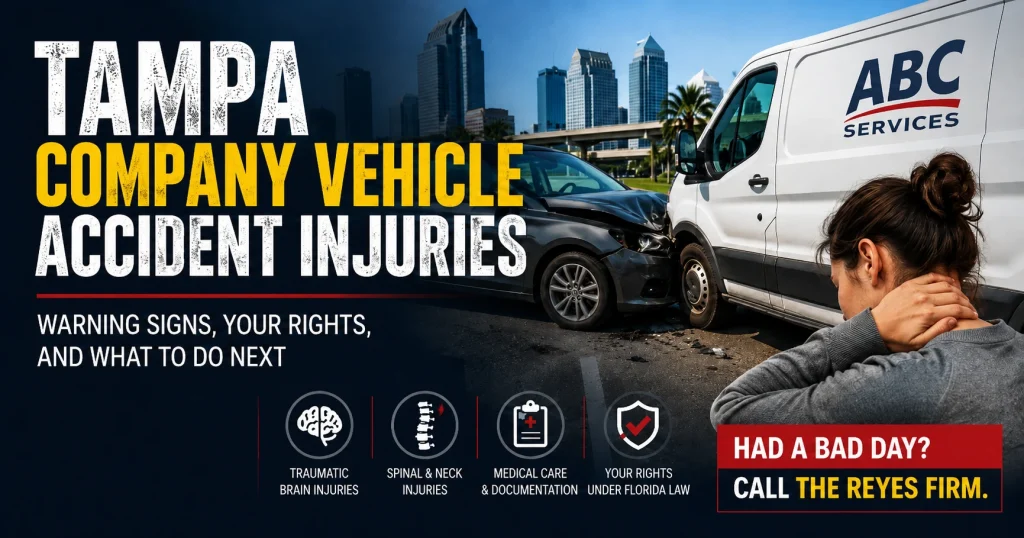
Tampa Company Vehicle Accident Injuries: 4 Common Types

Quick Answer The most common Tampa company vehicle accident injuries include whiplash, traumatic brain injury, spinal injury, and PTSD. These injuries may not show up right away. They can still affect your medical care, work, daily life, and injury claim.  The key points below explain what you should know first.  What You Need to Know Whiplash, traumatic brain injury, spinal damage, and PTSD are common after crashes involving delivery vans, work trucks, rideshare vehicles, service vehicles, and commercial trucks. Preliminary 2024 FLHSMV data listed 46,651 commercial motor vehicle crashes in Florida, with 315 fatalities.  Florida PIP benefits generally require that initial medical care be obtained within 14 days of a motor vehicle accident.  Florida negligence claims are generally subject to a two-year deadline under Fla. Stat. § 95.11.  If you were injured by a company vehicle in Tampa, your case may involve the driver, employer, vehicle owner, insurance company, or another responsible party. The Reyes Firm Had a Bad Day? Was There a Logo on the Vehicle? A company name, logo, DOT number, app record, or trailer marking can help identify who may be responsible after a Tampa company vehicle crash. Schedule Your Free Consultation After a crash involving a Tampa company vehicle, injuries can feel confusing and unfair. Your neck may hurt days later. You may feel foggy, anxious, or unable to drive without fear.  The problem is that insurance companies may treat delayed pain as if it were not serious. They may also question whether the company, the driver, or another party is responsible.  This guide explains four injuries we often see after company vehicle crashes: whiplash, traumatic brain injury, spinal injury, and PTSD. It also explains why immediate medical care and clear records matter for your claim.  Before looking at the legal side, it helps to understand the injuries that often appear first.  What Injuries Are Most Common After a Tampa Company Vehicle Crash? The most common catastrophic injuries after a Tampa company vehicle crash include whiplash, TBI, spinal injury, and PTSD. These injuries often appear after crashes with delivery vans, work trucks, rideshare vehicles, utility vehicles, and commercial trucks.  Company vehicles are often larger, heavier, or used under work pressure. A smaller car can take the worst of the impact when a company pickup, van, box truck, or semi-truck causes a crash.  The injury you suffer may depend on: The size and weight of the company vehicle The speed of impact The type of crash How your body moved during impact Any prior medical issues How quickly you received medical care We built this injury hub so you can find the condition that matches your symptoms. These injuries matter, but the type of vehicle can also change the legal path. Why Are Company Vehicle Injury Claims Different? Company vehicle injury claims are different because they may involve more than one responsible party. The driver may have caused the crash. The company, vehicle owner, contractor, or insurer may also play a role.  For example, a Tampa company vehicle crash may raise these questions: Was the driver working at the time? Did the business own the vehicle? Was the driver an employee or a contractor? Did the company train or screen the driver? Did poor vehicle maintenance play a role? Was the driver rushing for work? Which insurance policy applies? These questions matter because they can affect insurance coverage and case strategy.  A company vehicle crash is not always a simple driver-versus-driver case. It may require business records, insurance policies, vehicle data, driver logs, app records, and repair history.  Once the responsible parties are clear, the next step is proving what the crash did to your body.  Why Does Whiplash Need Medical Documentation Right Away? Whiplash needs fast medical documentation because insurance companies often dismiss it as “just soreness.” Without early medical records, an adjuster may argue that your pain came from something else. Whiplash happens when your head and neck snap forward and backward too fast. This movement can strain muscles, stretch ligaments, irritate nerves, and worsen disc problems.  Symptoms may include: Neck stiffness Headaches Shoulder pain Upper back pain Reduced range of motion Tingling or numbness Dizziness Pain that appears 24 to 72 hours later The key is not to wait. If your neck hurts after a crash, get checked as soon as you can. Florida PIP benefits generally require that initial care be provided within 14 days of the crash. Warning: Do Not Wait Too Long to Get Medical Care Florida’s PIP law generally requires initial medical care within 14 days after a motor vehicle accident. Waiting too long may affect your insurance benefits. It may also make your injury claim harder to prove. See Florida Statute § 627.736. Neck pain is the only injury that insurers may downplay after a crash involving a company vehicle.  Still have questions? Call The Reyes Firm at 833-4 BAD DAY. The consultation is free, and there’s no obligation.  How Serious Is a Traumatic Brain Injury From a Commercial Vehicle Crash? A traumatic brain injury from a commercial vehicle crash can be serious, even without a visible head wound. A sudden crash can cause your brain to move inside your skull.  The CDC lists motor vehicle crashes as one common cause of traumatic brain injuries. A TBI can affect your medical care, work, and daily life.  TBI symptoms may appear right away. They may also develop over time. The CDC notes that some mild TBI symptoms can change during recovery. Some people notice mood or sleep changes later.  Possible TBI symptoms include: Headaches Confusion Memory gaps Trouble concentrating Dizziness Light or sound sensitivity Mood changes Nausea Sleep problems Feeling “foggy” Trouble returning to work A brain injury can affect your work, family, and future care needs. Tell your doctor about every symptom, even if it feels minor.  Did You Know? A traumatic brain injury does not always require a direct hit to the head. A hard jolt or sudden stop may still affect how the brain works. Brain injuries can be hard

Featured image for The Reyes Firm blog about whether you can sue a company if their driver hit you in Florida, showing a company vehicle crash and contractor vs. employee liability topic.
Blog, Commercial Vehicles, Company-Caused Car Accidents

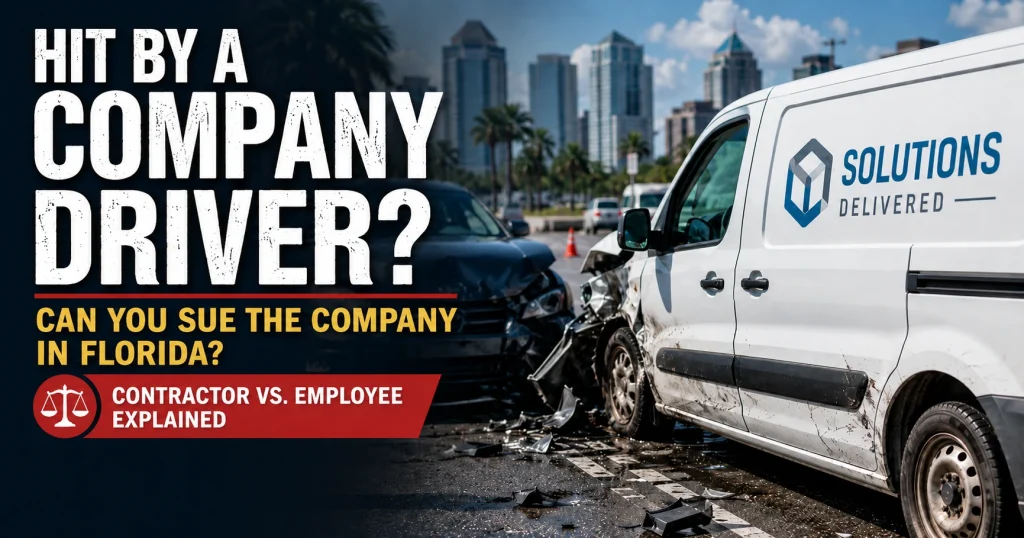
Can I Sue a Company If Their Driver Hit Me in Florida? Contractor vs. Employee Explained

What You Need to Know In Florida, you may be able to sue a company if its driver hit you, but the answer depends on the driver’s job status, what the driver was doing, and who owned or controlled the vehicle.  If the driver was an employee acting within the scope of employment, the company may be liable under Florida’s respondeat superior doctrine.  If the driver was labeled an independent contractor, that label does not always end the case. Florida courts may look at the company’s actual control.  Florida’s Dangerous Instrumentality Doctrine may create a separate path to vehicle-owner liability when a company allows someone to drive its vehicle. Limits and exceptions can apply. Florida is a no-fault state. Your PIP coverage generally pays first. Injury claims beyond PIP may depend on whether your injuries meet Florida’s serious injury threshold.  For most Florida negligence-based car accident claims arising on or after March 24, 2023, the lawsuit deadline is generally two years, not four years.  Florida’s modified comparative negligence rule can bar recovery if you are found more than 50% at fault.  Had a bad day? Call The Reyes Firm: 833-4 BAD DAY Use the sections below to see how each rule may affect your case.  The Reyes Firm Had a Bad Day? Was There a Logo on the Vehicle? A company logo, work van, delivery marking, or app-based driver can be a clue that more than one party may be responsible after a Florida crash. Schedule Your Free Consultation If you are asking, “Can I sue a company if their driver hit me in Florida?” you are probably dealing with pain, bills, and confusing insurance calls. A crash involving a company vehicle can feel different from a regular car accident because more than one person or business may be involved.  The hard part is knowing who may be responsible. Was the driver an employee? A contractor? Was the driver working at the time? Did the company own the vehicle?  This guide explains how Florida law treats company driver accidents, contractor vs. employee status, PIP insurance, and company liability. It also explains why rapid evidence preservation matters in Tampa company-vehicle accident cases.  Can I Sue a Company If Their Driver Hit Me in Florida? Yes, you may be able to sue a company if their driver hit you in Florida, but the answer depends on several facts. The key questions are:  Was the driver an employee or an independent contractor? Was the driver working at the time of the crash? Did the company own, lease, or control the vehicle? Did the company negligently hire, supervise, or entrust the vehicle to the driver? Do your injuries allow you to step outside Florida’s no-fault PIP system? Florida is a no-fault insurance state. After many crashes, your own Personal Injury Protection coverage pays first, no matter who caused the crash. Florida PIP generally covers 80% of reasonable medical expenses and 60% of lost income, subject to policy limits and other legal rules.  To pursue certain damages against the at-fault driver or company, your injuries may need to meet Florida’s serious injury threshold. This threshold may include permanent injury, major scarring, or loss of an important body function.  ⚠️ Deadline Alert: For most negligence-based Florida personal injury claims arising on or after March 24, 2023, the deadline is generally two years. The prior four-year deadline should not be used for most modern Florida car accident negligence claims. Evidence such as GPS data, dashcam footage, dispatch records, app logs, and driver history files can disappear quickly. That is why early legal action matters. Source: Florida Statute § 95.11. Once you know PIP is only the first layer, the driver’s work status becomes the next issue. What Is the Difference Between an Employee and an Independent Contractor in a Florida Accident? In a Florida company vehicle accident case, the distinction between an employee and an independent contractor can affect the company’s liability. If the driver was an employee acting within the scope of employment, the company may be liable under the doctrine of respondeat superior. That legal phrase means an employer may be responsible when an employee causes harm while doing job-related work.  If the driver was an independent contractor, the company may argue it is not responsible. But that label is not always the final answer. A company can call someone a “1099 contractor,” but Florida courts may still look at the actual working relationship. The more control the company had over the driver’s work, the stronger the argument that the driver was acting as an employee.  Employee vs. Contractor Factors in Florida Accident Cases Factor Points Toward Employee Points Toward Contractor Control over work The company directs how the job is done The worker decides how to complete the job Vehicle ownership The company owns or leases the vehicle The worker uses their own vehicle Schedule The company sets hours, routes, or shifts Workers control their own schedule Supervision The company monitors daily performance The worker operates independently Branding Vehicle, uniform, or app strongly identifies the company The worker operates under their own business identity Payment Hourly, salary, or fixed route pay Per project, per job, or per delivery Exclusivity Works mainly for one company Works for multiple businesses Duration Ongoing relationship Short-term or project-based work No single factor decides the case. Florida courts consider the full relationship, including the contract, company control, driver autonomy, and crash facts.  If the company claims the driver was a contractor, the next step is to test that claim against the evidence.  What If the Company Says the Driver Was an Independent Contractor? If the company says the driver was an independent contractor, do not assume that ends your claim. That may be true in some cases. But in others, the company may still face liability based on control, ownership, or negligent conduct. Legal Theories That May Apply Misclassification or actual control. If the company controlled the driver’s routes, schedule, appearance, app activity, or delivery process, the driver

Scroll to Top