I-75 Semi-Truck Trailer Crash in Wesley Chapel: What Injured SUV Passengers Should Know
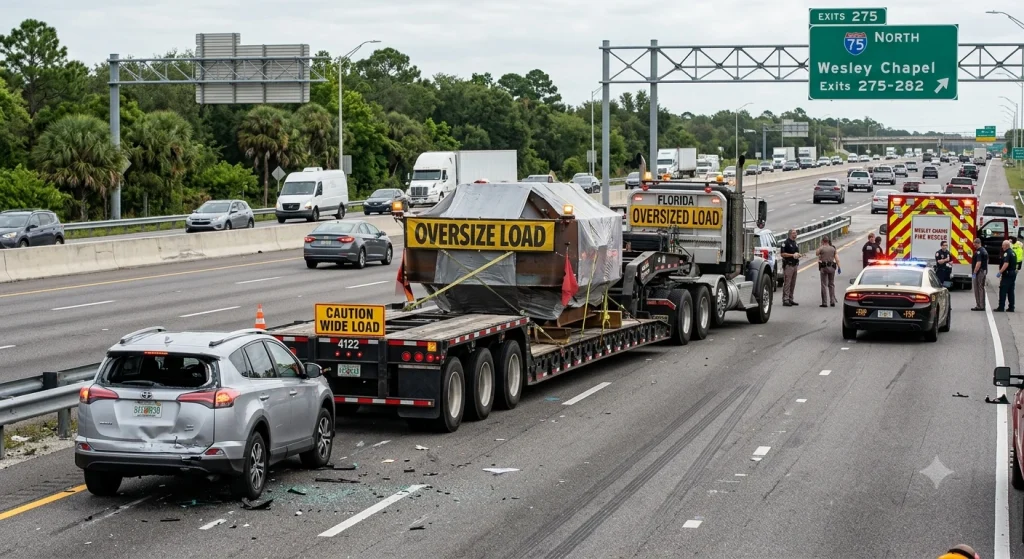
What You Need to Know A semi-truck trailer reportedly detached and crushed an SUV on northbound I-75 near Milepost 280 in Wesley Chapel. Fox 13 reported that two Georgia women in the SUV were hospitalized with minor injuries. Trailer detachments can raise questions about driver decisions, helper vehicles, equipment, inspection, and load securement. Truck crash evidence can disappear fast, including inspection records, driver logs, dashcam footage, and company communications. Florida law may allow fault to be divided among more than one person or company. Had a bad day? Call The Reyes Firm at 833-4 BAD DAY. Introduction A normal drive on I-75 can turn terrifying in seconds when a semi-truck trailer comes loose. If you were inside the SUV, or if someone you love was hurt, you may be shaken, sore, and unsure what happens next. This I-75 semi-truck trailer crash near Wesley Chapel involved an oversized tractor-trailer, a helper vehicle, and a passenger SUV that was trapped under a detached trailer, according to Fox 13. The report said the crash happened Saturday morning near Milepost 280 on northbound I-75. Truck crashes near Tampa are different from regular car crashes. The evidence is more complex. The insurance companies move fast. You need answers before the trucking company controls the story. What happened in the I-75 semi-truck trailer crash near Wesley Chapel? Fox 13 reported that a tractor-trailer with two oversized trailers was traveling northbound on I-75 when the helper vehicle driver unlocked the rear trailer during a lane change. FHP said the rear trailer swung left, struck a Subaru Forester, and rode over the SUV before traffic stopped. According to the report, the crash happened around 9:52 a.m. near Milepost 280. The trailer was described as an empty evaporator tank. Northbound lanes were blocked until about 11:40 a.m. The SUV driver was a 23-year-old woman from Georgia. Her passenger was a 22-year-old woman from Georgia. Both were taken to a nearby hospital. Fox 13 reported that officials had not said if the helper vehicle driver would face legal charges. Where the I-75 Semi-Truck Trailer Crash Happened The crash was reported on northbound I-75 near Milepost 280 in Wesley Chapel, near the SR 54/Wesley Chapel Boulevard interchange. Map shown for illustrative purposes only. Exact crash location should be confirmed through the official crash report. Why can a detached semi-truck trailer create a serious injury claim? A detached trailer can crush, trap, or override a passenger vehicle. Even when early reports describe injuries as minor, pain can worsen after shock fades. A crash like this can involve neck injuries, back injuries, shoulder injuries, concussion symptoms, anxiety, and fear of driving. Commercial vehicle crashes remain a serious issue across Florida. FLHSMV’s preliminary 2024 “By the Numbers” report lists 46,651 commercial motor vehicle crashes and 315 CMV-related fatalities statewide. NHTSA’s 2024 overview also reported that large-truck crash deaths decreased from 2023 to 2024, but estimated injuries in large-truck crashes increased by 5.0 percent. 📊 Did you know? FLHSMV’s preliminary 2024 data reported 46,651 commercial motor vehicle crashes in Florida. That number shows why I-75 truck crashes near Tampa need careful evidence review, not quick assumptions. Who may be responsible after an oversized trailer detaches on I-75? Responsibility may extend beyond the semi-truck driver. The helper vehicle driver, trucking company, trailer owner, maintenance provider, loading crew, route planner, or another company may have played a role. The key question is who had control, who made the lane-change decision, and who failed to keep the trailer secure. In a crash involving an oversized hauler, lawyers may look at: Possible party What must be reviewed Semi-truck driver Speed, lane position, driver logs, training, route planning Helper vehicle driver Communication, unlocking decision, timing, lane-change role Motor carrier Hiring, supervision, safety policies, insurance coverage Trailer owner Coupling equipment, inspection history, maintenance records Maintenance company Repairs, defects, prior warnings, service records Cargo or equipment company Securement, trailer setup, oversized load procedures This is why a Tampa truck accident lawyer should move fast. A simple police report may not answer every question. What evidence matters after a semi-truck trailer detaches? The strongest evidence often comes from the truck, trailer, company files, and nearby cameras. It may show how the trailer was connected, who gave instructions, how the lane change was planned, and if the equipment was safe before the crash. Important evidence may include: FHP crash report and scene photos Truck and trailer inspection records Maintenance and repair records Driver qualification files Helper vehicle communications Dashcam or bodycam footage Event data recorder information GPS and dispatch records Oversized load permits Cell phone records Witness statements Nearby traffic or business camera footage ⚠️ Warning: Florida Statute § 95.11 generally gives two years to file a negligence injury lawsuit. Do not wait that long to protect truck crash evidence. Video, records, and electronic data can be lost much sooner. If you were hurt near Wesley Chapel, Tampa, or another part of the I-75 corridor, preserve your medical records, photos, vehicle damage images, and insurance letters. Do not give a recorded statement to the trucking company’s insurer before getting advice. For more context, read our guides on what happens after a commercial vehicle accident and what to do if you need a vehicle-with-logo accident lawyer. What Florida laws affect an I-75 semi-truck trailer crash claim? Florida law can affect deadlines, fault, load securement, and commercial vehicle safety rules. In this type of crash, the most important issues may include how the trailer was secured, how the commercial vehicle was operated, and how fault is apportioned among all persons or companies involved. Florida Statute § 316.520 says a vehicle may not be driven or moved on a highway unless it is built or loaded to prevent its load from dropping, shifting, leaking, blowing, or escaping. It also refers to cargo securement devices that meet 49 C.F.R. § 393.100. Florida Statute § 316.302 applies federal commercial motor vehicle safety rules to many owners and drivers of commercial motor vehicles operating on Florida roads. Those rules