After A Car Accident

Car accident?
After A Car Accident, After an Accident, Blog, Car accident, FAQ, Legal, Migraines, Motorcycles, Personal Injury, Teen Accidents, TMJ, Traumatic injury, Why does this hurt

WHAT DO I DO AFTER MY ACCIDENT? FOLLOW THESE 5 EASY STEPS!

WHAT DO I DO AFTER MY ACCIDENT? FOLLOW THESE 5 EASY STEPS! Call 911 Serious injuries are common in auto accidents. Call 911 no matter what. Do not assist others unless necessary.  Exchange Information Get names and numbers of everyone at the scene. If possible get the plate of the cars involve and the driver’s license number.  Get Photos To help your memory later on try to get as many photos as possible of the damage that has been done. Also take photos of the lighting and weather, the scene as a whole.  Call Your Insurance Company File a claim with your insurance as soon as you can to avoid needless problems later on. CALL ME! By contacting me we will be able to discuss your injury case in depth. Consultations are FREE! No obligations! Learn about your rights with an expert before you lose the chance to preserve them. Contact The Reyes Firm at 813-421-3411 We are here for you 24/7 and have the experience to protect your interests and get you the recovery you deserve. Call us today – and above all be safe on the roads!

Should I call my auto insurance
Accident Injuries & why, After A Car Accident, After an Accident, Car accident, Injury, Legal, Uninsured Motorist Coverage, Why we serve

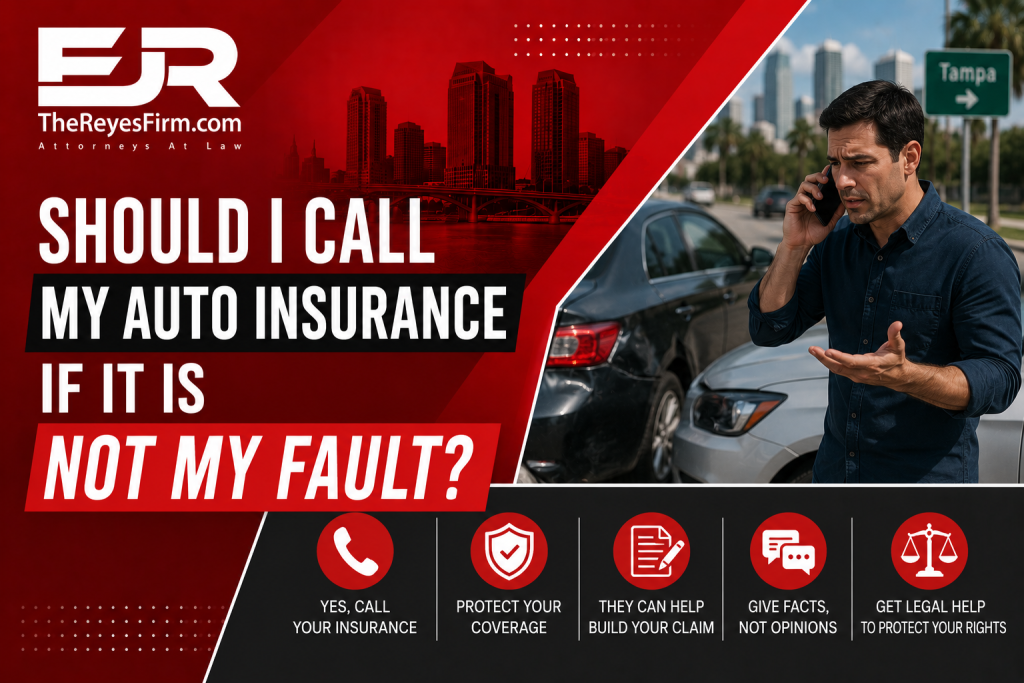
Should I call my auto insurance if it is not my fault?

You were just going about your day. Then someone rear-ended you at a red light. It clearly wasn’t your fault, so calling your own insurance company feels backwards, maybe even risky. In Florida, though, that phone call is one of the most important things you can do, and here’s why. TL;DR — QUICK SUMMARY Yes, you should call your own auto insurer even when the crash wasn’t your fault, because Florida is a no-fault state. Your Personal Injury Protection (PIP) coverage pays the first portion of your medical bills regardless of who caused the accident. You must seek medical treatment within 14 days of the crash, or you can lose your PIP benefits entirely. Reporting an accident you didn’t cause should not raise your rates, and most policies require you to report promptly anyway. Under Florida Statute 95.11(3)(a), you generally have two years to file an injury lawsuit, but the deadlines that bite first are your insurer’s reporting and treatment windows. The Reyes Firm Hurt in a Tampa Crash That Wasn’t Your Fault? Get clear next steps and protect your PIP benefits. Had a bad day? Contact Us Now 14 Days Deadline to seek care for PIP benefits Fla. Stat. 627.736 $10,000 Florida minimum PIP coverage Fla. Stat. 627.736 2 Years Florida injury filing deadline Fla. Stat. 95.11(3)(a) $0 Upfront cost with a contingency fee firm The Reyes Firm Should you call your own auto insurance if the accident wasn’t your fault? Yes. In Florida, you should report the crash to your own insurer even when another driver clearly caused it. That feels counterintuitive, but it comes down to one fact: Florida is a no-fault auto insurance state. Your own policy is designed to step in first, no matter who was to blame. Reporting promptly does two things. It opens your Personal Injury Protection (PIP) benefits so your medical bills start getting paid, and it satisfies the notice requirement built into nearly every auto policy. Wait too long, and you risk both your benefits and a dispute with your own company over late reporting. At The Reyes Firm, a Tampa personal injury law firm, the most common mistake we see after a not-at-fault crash isn’t saying too much. It’s saying nothing at all to the one insurer that’s actually obligated to help you first. ⚠️ Deadline Warning: Under Florida Statute § 95.11(3)(a), you generally have two years from the date of your crash to file a personal injury lawsuit. But your PIP coverage requires medical treatment within 14 days, so the clock that runs out first is usually the one on your benefits. Don’t wait. What is Florida’s no-fault system and how does PIP work? Florida’s no-fault system means that after most car accidents, your own insurance pays your initial medical expenses and lost wages, regardless of who caused the crash. The coverage that does this is Personal Injury Protection, and every Florida auto policy is required to carry it. Under Florida Statute § 627.736, PIP provides a minimum of $10,000 in coverage and typically pays 80% of reasonable medical bills and 60% of lost wages, up to that limit. It applies whether you were rear-ended, sideswiped, or hit by a driver who ran a stop sign. The trade-off for this quick, fault-free coverage is that PIP comes with strict rules, and the strictest is the deadline to get care. Because PIP has a cap, it often isn’t enough to cover a serious injury. When your damages exceed your PIP limits, you may be able to pursue the at-fault driver for the rest, which is where the no-fault system ends and a liability claim begins. 💡 Did You Know? Florida’s 14-day rule is one of the most important deadlines after a crash. Under Fla. Stat. § 627.736, you must receive initial medical care within 14 days of the accident to be eligible for PIP benefits at all. Miss that window and your own insurer can deny the entire claim, even if your injuries are real and serious. Source: Fla. Stat. § 627.736. Watch: Should I Call My Auto Insurance If It’s Not My Fault? This short video explains why Florida drivers need to report a crash to their own insurer even when someone else caused it, and how the no-fault system shapes what happens next. If you’re unsure what to say to either insurance company, The Reyes Firm offers free consultations, so you can call 833-4 BAD DAY before you make the call. Will calling my own insurer raise my rates or count against me? This is the fear that keeps people from making the call, and it’s largely unfounded for a crash you didn’t cause. Filing a PIP claim after a not-at-fault accident is exactly what the coverage exists for, and insurers are limited in how they can treat policyholders who report accidents that weren’t their fault. What can actually hurt you is the opposite choice. Failing to report can violate your policy’s notice requirement, give your insurer a reason to question the claim later, and leave your medical bills unpaid while the 14-day window closes. The downside of calling is small. The downside of staying quiet can cost you your benefits. If an adjuster, yours or the other driver’s, starts asking for a recorded statement or pressing for details, that’s a different matter. You can decline to give a recorded statement until you’ve spoken with a lawyer. Do I still deal with the at-fault driver’s insurance company? Often, yes, but carefully. Your PIP covers the first layer of your expenses. When your injuries are serious enough to exceed those limits, a claim against the at-fault driver’s insurer is how you pursue the rest, including the portion of medical bills PIP didn’t pay, full lost wages, and pain and suffering. That second insurer has no duty to look out for you, and its adjuster is working to pay as little as possible. In a serious or catastrophic crash, the difference between handling that claim alone and having a

Law firm pre-suit guide infographic
After A Car Accident, Legal

How Is My Case Going During Pre-Suit? A Florida Guide

You signed with a lawyer months ago. You are still going to physical therapy, the bills keep coming, and you have not heard much lately. So you start to wonder: is anything actually happening with my case? It is the question we hear most often, and the honest answer usually surprises people. Here is what is really going on during the pre-suit phase of your accident case. The Reyes Firm Wondering What’s Happening With Your Case? You deserve a straight answer about where your claim stands. Had a bad day? Contact Us Now MMI When your claim can finally be valued Maximum Medical Improvement Permanent Finding needed for pain and suffering Fla. Stat. § 627.737(2) $10,000 PIP limit that runs out first Fla. Stat. § 627.736 2 Years Deadline that runs during pre-suit Fla. Stat. § 95.11 Pre-suit is the stage of your case before any lawsuit is filed, and it is where the large majority of personal injury claims are resolved. It is also the stage that feels the slowest, because most of the work happening is not the kind you can see. Understanding what is going on behind the scenes tends to make the wait a lot less stressful. How is my case going during pre-suit? In most cases, the honest answer is that it depends on whether you are still treating. If you are still going to doctors, your case is doing exactly what it should be doing, which is waiting. That is not your lawyer ignoring your file. It is your lawyer refusing to guess at what your injuries are worth before your doctors know. The instinct is understandable. Silence feels like inaction. But in pre-suit, the medical picture drives everything, and until that picture is complete, there is nothing to negotiate with. What actually happens during the pre-suit phase? A lot more than most clients realize. While you are focused on recovering, your legal team is generally working through the following: Investigating and preserving evidence. The police report, photographs, witness statements, and any video are gathered early, while they still exist. Establishing liability. Your lawyer builds the case for why the other party is at fault, before the insurer starts shaping its own version. Identifying every available policy. That includes the at-fault driver’s coverage, your own PIP, and any uninsured or underinsured motorist coverage. Managing your PIP benefits. Florida’s $10,000 in Personal Injury Protection is usually exhausted quickly, and your team coordinates what pays after that. Tracking your treatment and collecting records. Every visit, bill, and diagnosis becomes evidence, and records are requested continually as you treat. Watching the filing deadline. The clock never stops, so your lawyer is protecting that date whether or not you are hearing from them weekly. Most of that work produces no news for you. It is documentation, phone calls, and records requests. Real progress in pre-suit rarely looks dramatic. 💡 Did You Know? In a Florida car accident case, you generally cannot recover anything for pain and suffering unless a doctor determines your injury is permanent within a reasonable degree of medical probability, or you suffered significant permanent scarring, disfigurement, or loss of an important bodily function. That medical finding is a legal requirement, and it is one more reason your case waits on your doctors. Source: Fla. Stat. § 627.737(2). What is Maximum Medical Improvement, and why does everything wait for it? Maximum Medical Improvement, or MMI, is the point at which your condition has stabilized and your doctors do not expect meaningful further recovery. You may still have pain. You may still need ongoing care. MMI does not mean you are fine. It means your medical picture is finally clear enough to put a number on. Until you reach MMI, nobody can answer the real question. If you settle at month three and need a surgery at month nine, that surgery is your problem, not the insurance company’s. A release is permanent. There is no reopening it, no matter how much worse things get. That is the whole reason a good lawyer will tell you to be patient rather than take an early check. Why is my case taking so long? Usually because your body is still deciding how it is going to heal, and that is not something anyone can rush. A soft-tissue injury may resolve in a few months. A back injury that leads to injections, and eventually a surgical consult, can take a year or more to stabilize. Your case timeline is really your medical timeline. Other things can add time too. Disputed liability, multiple at-fault parties, a commercial insurer, or a serious injury that requires specialists all extend pre-suit. If your injuries are severe enough to require long-term care, a life care plan may be needed to project future costs, which takes additional time but can substantially change what your claim is worth. ⚠️ Deadline Warning: Under Florida Statute § 95.11, you generally have two years from the date of your crash to file a lawsuit, and that clock keeps running through the entire pre-suit phase. Being in negotiations does not pause it. This deadline was shortened from four years in March 2023, which is exactly why pre-suit is more time-sensitive than it used to be. What happens when the demand goes out? Once you reach MMI, the case shifts gears quickly. Your team assembles a demand package containing your complete medical records and bills, proof of lost wages, evidence of liability, and documentation of how the injury has affected your life. That package goes to the insurer with a deadline to respond. Then negotiation begins. The first offer is almost always low, and a few rounds of back and forth are normal. If the insurer will not offer fair value, the next step is filing suit, which is when your case leaves pre-suit and enters litigation. Filing a lawsuit does not mean a trial is coming, since many cases still settle afterward, but it does signal that your lawyer is prepared

Accident Injuries & why, After A Car Accident, After an Accident, FAQ, Legal, personal injury attorney, Settlement, Why we serve

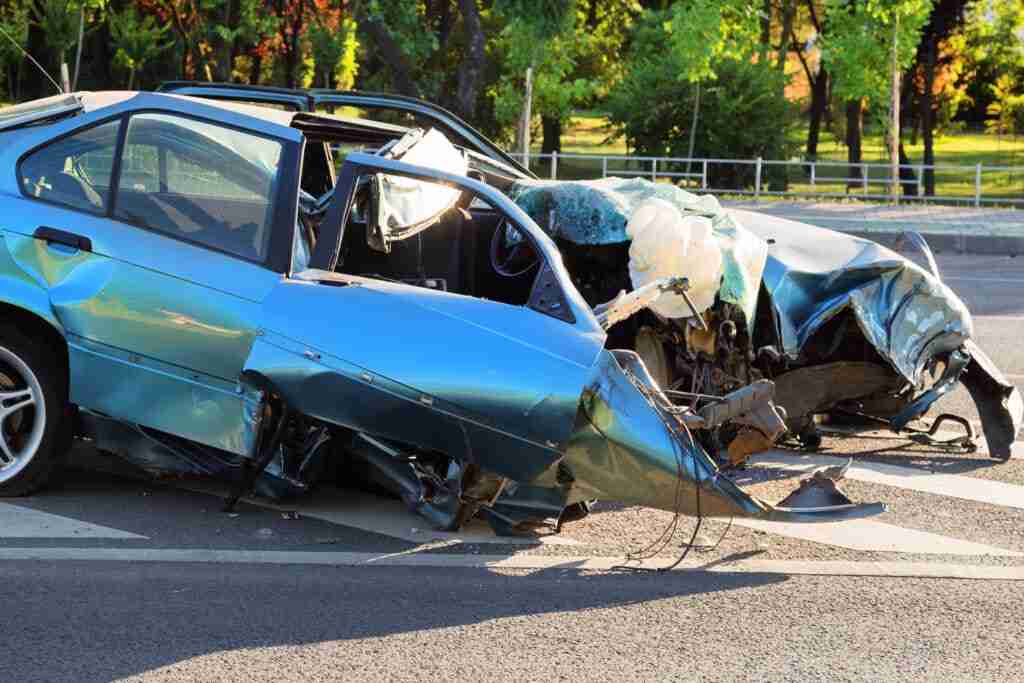
Please keep us updated on your treatment to avoid delays in settlement

You know when you are finishing up with your treatment after an accident. Unfortunately as your attorney we are not always updated by your doctors. It is important to keep us in the loop to avoid undue delays in making and sending your demand for settlement. When there are big gaps in treatment it hurts your case. Please keep us in the loop. call us 813-421.3411

Accident Injuries & why, After A Car Accident, After an Accident, Car accident, FAQ, florida cities we serve, Legal, Why we serve

Florida is a no-fault state

Florida is a no fault state. This means your insurance company pays for your medical and lost wages and the at-fault insurance company pays for that person’s medical/ loss wages. However, this does not mean that you will not recover from the at-fault party’s insurance company after an accident. If you have any questions, please call our office 813-421-3411.

Accident Injuries & why, After A Car Accident, After an Accident, Car accident, Spanish, Why we serve

Accidente?

Los accidentes automovilísticos son estresantes. En el momento del accidente es posible que no sepa qué hacer o decir. Puede decir demasiado o no obtener la información correcta. Puede que no sepa a quién llamar. Este video explica lo que sucede y lo que debe hacer. Si está involucrado en un accidente automovilístico, llámenos al 813-421-3411 Auto accidents are stressful. At the time of the accident you may not know what to do or say. You may say too much or not get the correct information. You may not know who to call. This video explains what happens and what you need to do. If you are involved in a car accident, call us 813-421-3411

Quién Paga las Reparaciones del Automóvil en Florida
After A Car Accident, Body Shops, Settlement

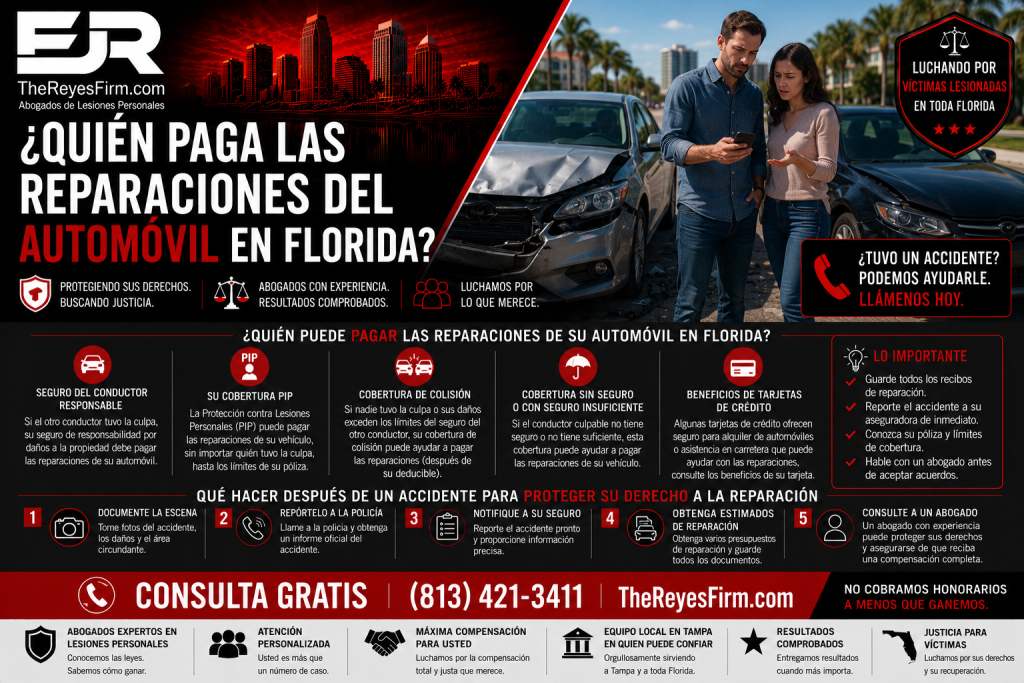
¿Quién Paga las Reparaciones del Automóvil en Florida?

Su automóvil quedó destrozado y no fue su culpa. El otro conductor lo chocó, así que su seguro debería pagar la reparación de inmediato, ¿verdad? No es tan sencillo. Las reglas de Florida sorprenden a casi todos, y la cobertura que usted está obligado a tener es precisamente la que no le va a servir. Esto es quién paga realmente las reparaciones después de un accidente automovilístico en Florida, y por qué. The Reyes Firm ¿Su Automóvil Quedó Dañado en un Choque en Tampa? Averigüe quién debe pagar la reparación. Had a bad day? Contáctenos Ahora $0 Lo que PIP paga por reparaciones Fla. Stat. § 627.736 $10,000 Mínimo de daños a la propiedad en Florida Fla. Stat. § 324.022 2 Años Plazo para demandar por negligencia Fla. Stat. § 95.11 50% Culpa que impide la recuperación Fla. Stat. § 768.81 Quedarse sin automóvil después de un choque es mucho más que una molestia. Afecta su trabajo, la escuela de sus hijos y sus citas médicas. Lo frustrante es que el sistema de seguros de Florida no fue diseñado para devolverlo al camino rápidamente, y la cobertura que todos asumen que los va a ayudar es justamente la que no lo hace. ¿Quién paga las reparaciones de su automóvil después de un accidente en Florida? En la mayoría de los casos, la responsabilidad final recae sobre la cobertura de responsabilidad por daños a la propiedad del conductor que causó el choque. Esa cobertura existe precisamente para pagar los daños que ese conductor le ocasiona al vehículo de otra persona, y esa persona es usted. El problema está en el tiempo y en los límites. La aseguradora del otro conductor no autoriza nada hasta terminar su investigación y aceptar la responsabilidad, y aun cuando la acepta, solo paga hasta el límite de la póliza. Por eso la respuesta práctica casi siempre depende de qué cobertura tiene usted mismo. 💡 ¿Sabía usted? Su cobertura PIP no paga absolutamente nada por reparar su automóvil. A pesar de ser la cobertura que todo conductor de Florida está obligado a tener, PIP cubre únicamente gastos médicos y una parte de la pérdida de salario. No toca los daños a la propiedad ni las reparaciones del vehículo. Fuente: Fla. Stat. § 627.736. ¿Por qué el seguro obligatorio de Florida no repara su automóvil? Porque Florida exige muy poco. Todo conductor debe tener $10,000 en Protección contra Lesiones Personales (PIP) y $10,000 en responsabilidad por daños a la propiedad, según el Estatuto de Florida § 324.022. Ninguna de las dos funciona como la gente espera. PIP es cobertura médica y de salario, nada más. La responsabilidad por daños a la propiedad paga los daños que usted le causa a la propiedad de otra persona, así que no hace nada por su propio vehículo. El resultado es que un conductor que solo tiene el mínimo legal de Florida no tiene ninguna cobertura para reparar su propio automóvil. Eso no es una laguna legal, así fue diseñado el mínimo. ¿Cuáles son sus opciones para reparar el automóvil? Usted tiene principalmente tres caminos, y se diferencian sobre todo en la rapidez: La cobertura de daños a la propiedad del conductor culpable. Es quien debe pagar al final, pero es la vía más lenta. Espere a que acepten la responsabilidad, y tenga en cuenta que solo pagan hasta el límite de su póliza. Su propia cobertura de colisión. Es opcional, pero es la vía más rápida. Repara su vehículo sin importar quién tuvo la culpa, menos su deducible. Su aseguradora luego busca recuperar ese dinero del culpable mediante la subrogación. Pagar de su bolsillo y reclamar después. Guarde absolutamente todos los recibos y estimados, porque el costo razonable de la reparación es recuperable del conductor responsable. Si un vehículo comercial causó el choque, el reclamo pasa por la aseguradora de una empresa y las reglas cambian bastante. Puede leer más sobre la responsabilidad de la empresa de camiones después de un choque en Florida. ¿Qué pasa si el conductor culpable solo tiene la cobertura mínima? Aquí está el problema que más sorprende a la gente. El mínimo de $10,000 en daños a la propiedad se estableció hace décadas, y un vehículo moderno puede superar fácilmente esa cifra en daños. Si el conductor culpable solo lleva el mínimo y su automóvil sufrió $18,000 en daños, la póliza de esa persona simplemente no alcanza. Cuando eso ocurre, sus opciones se reducen a su propia cobertura de colisión, a demandar personalmente al conductor culpable (algo que rara vez sirve si esa persona no tiene bienes), o a absorber la diferencia. En algunos casos el dueño del vehículo también puede ser responsable aunque no manejaba, como explicamos en nuestra guía sobre la entrega negligente de un vehículo en Florida. ⚠️ Advertencia de plazo: Bajo el Estatuto de Florida § 95.11, generalmente tiene dos años desde la fecha del choque para presentar una demanda por negligencia, y ese mismo plazo aplica a los reclamos por daños a su propiedad. Este plazo se redujo de cuatro años a dos en marzo de 2023, así que las guías más antiguas están desactualizadas. No espere para llamar a un abogado. ¿Puede recuperar el “valor disminuido” de su vehículo? Es posible, y casi nadie lo reclama. Aunque el taller repare su automóvil perfectamente, el vehículo ahora tiene un historial de accidente y por lo general vale menos en el mercado de reventa que antes del choque. Esa pérdida se llama valor disminuido, y en Florida puede formar parte de su reclamo por daños contra el conductor responsable. Hay un detalle importante que conviene entender. El valor disminuido generalmente se reclama contra el conductor culpable y su aseguradora, no contra su propia póliza de colisión, porque la obligación de su aseguradora normalmente se limita a reparar el vehículo. Para sustentar un reclamo de este tipo suele hacer falta un avalúo profesional que documente la diferencia de valor. Un abogado puede evaluar si su caso lo justifica. ¿Qué pasa si su

Who pays for rental cars after a crash
After A Car Accident, Uninsured Motorist Coverage

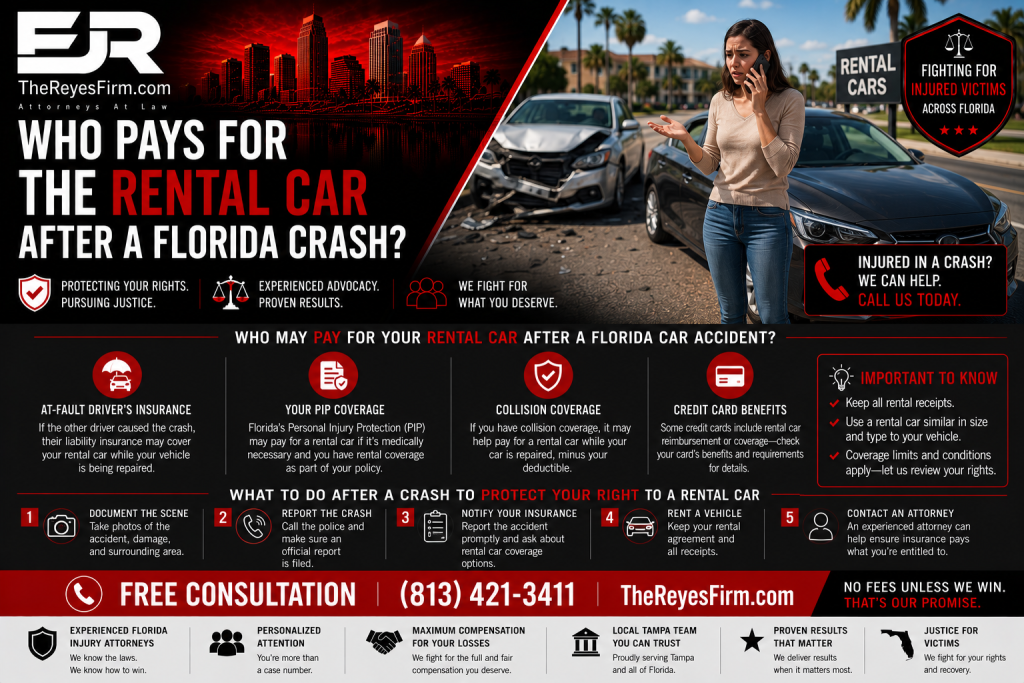
Who Pays for the Rental Car After a Florida Crash?

Your car is in the shop and you still have to get to work tomorrow. The other driver caused the crash, so their insurance should just hand you a rental, right? Not quite. Florida’s rules surprise almost everyone, and the wrong assumption can leave you paying for weeks of rental out of pocket. Here is who actually pays for a rental car after a car accident in Florida, and why. The Reyes Firm Stuck Without a Car After a Tampa Crash? Find out who should be paying for your rental. Had a bad day? Contact Us Now $0 What PIP pays toward a rental Fla. Stat. § 627.736 $10,000 Florida minimum property damage liability Fla. Stat. § 324.022 2 Years Deadline to file a negligence claim Fla. Stat. § 95.11 50% Fault share that bars recovery Fla. Stat. § 768.81 Losing your car after a crash is more than an inconvenience. It affects your job, your kids’ school run, and your medical appointments. The frustrating part is that Florida’s insurance system was not built to get you back on the road quickly, and the coverage most people assume will help is the one coverage that will not. Who pays for a rental car after a car accident in Florida? In most cases the at-fault driver’s property damage liability coverage is ultimately responsible for your rental while your car is being repaired. But “ultimately” is doing a lot of work in that sentence. Their insurer generally will not authorize a rental until it has investigated and accepted liability, and that can take days or weeks. Meanwhile, you still need to get to work. That gap is why the real answer usually depends on what coverage you carry yourself. Understanding your options before you call anyone can save you both money and a lot of frustration. 💡 Did You Know? Your Personal Injury Protection coverage pays nothing toward a rental car. Despite being the coverage every Florida driver is required to carry, PIP covers only medical expenses and lost wages. It does not touch property damage, vehicle repairs, or rentals. Source: Fla. Stat. § 627.736. Why doesn’t your required Florida insurance cover the rental? Florida requires very little. Every driver must carry $10,000 in Personal Injury Protection and $10,000 in property damage liability under Florida Statute § 324.022. Neither of those helps you the way most people expect. PIP is medical and wage coverage only. Property damage liability is coverage that pays for damage you cause to someone else’s property, so it does nothing for your own car or your own rental. The result is that a driver carrying Florida’s legal minimum has no coverage at all for their own vehicle or a replacement while it is repaired. That is not a loophole, it is how the minimum was designed. What are your options for getting a rental right now? You generally have four paths, and they differ mostly in how fast they work: Rental reimbursement on your own policy. This optional add-on is usually the fastest route. It pays a set daily amount, often something like $30 to $50 per day up to a maximum number of days. Check your declarations page, because many people carry it without realizing. The at-fault driver’s property damage liability coverage. The correct payer in the end, but slow. Expect to wait for their liability decision, and expect them to limit the rental to a “reasonable” repair period and a modest class of vehicle. Your collision coverage. This repairs your car regardless of fault, minus your deductible. Important caveat: collision pays for the repair, not the rental. Without rental reimbursement, you are still on your own for the car. Pay out of pocket and claim it later. Keep every receipt. The reasonable cost of a substitute vehicle is recoverable from the at-fault party as part of your damages. If a commercial vehicle caused your crash, the process runs through a business insurer instead, which changes the dynamics considerably. Our overview of truck and commercial vehicle accidents explains how those claims differ. What is “loss of use,” and can you recover it? Loss of use is the legal term for being deprived of your vehicle, and in Florida it is a real, recoverable category of damages. When someone else’s negligence takes your car off the road, the reasonable cost of a substitute vehicle for a reasonable period is part of what you can recover from them. Two words carry the weight there: reasonable cost and reasonable period. An insurer will not pay for a luxury SUV when you were driving a sedan, and it will not pay indefinitely because a shop is slow for reasons unrelated to the repair. This is also why documentation matters. Receipts, repair timelines, and written communication with the shop are what turn a disputed rental bill into a paid one. ⚠️ Deadline Warning: Under Florida Statute § 95.11, you generally have two years from the date of your crash to file a negligence lawsuit, and that same two-year deadline applies to negligence claims for property damage. This was shortened from four years in March 2023, so older guides are out of date. Don’t wait to call a lawyer. What if your car is a total loss? The rental math changes completely, and this catches people off guard. When a car is repairable, the rental generally covers the reasonable repair period. When a car is declared a total loss, there is nothing to repair, so the insurer typically pays for a rental only through a short, reasonable period after it makes its total loss offer, often just a handful of days for you to arrange a replacement. That means the moment your car is totaled, your rental clock is close to running out, even though buying a replacement vehicle usually takes far longer than a repair. If you disagree with the insurer’s valuation of your car, you can push back, but you should not assume the rental keeps running while you argue.

Accident Injuries & why, After A Car Accident, After an Accident, Car accident, Company-Caused Car Accidents, Personal Injury, personal injury attorney, Spanish, Why we serve

Quién paga el alquiler del auto cuando te involucras en un accidente automovilístico?

Quién paga el alquiler del auto cuando te involucras en un accidente automovilístico? Usted está involucrado en un accidente automovilístico, ¿quién paga el alquiler? Para emergencias legales, ER está aquí para su familia. Abogado de accidentes automovilísticos 813-421-3411 www.TheReyesFirm.com   Who pays for the rental car when you involved in a car accident? You are involved in a auto accident, who pays for the rental car? For Legal Emergencies, ER is here for your family. Auto accident attorney 813-421-3411 www.TheReyesFirm.com

Savings on your insurance
Accident Injuries & why, After A Car Accident, After an Accident, Car accident, For Parents, For Teens, Injury, Teen Accidents, Texting, Why does this hurt

11.5 great take aways from today’s video on teen driving and auto accidents!

1. Save on your insurance rates by having your teen get their restrictive license early. Wait 2 years before they get a car. The longer you wait to better the discount. 2. Safety: Teens are more likely to get in car accidents if they have passengers. 3. Tip: after 9pm most accidents happen. 4. Clearly texting and driving is not good. 5. You can install an insurance monitor device to reduce your auto insurance rates. 6. Parents try to be a role model for your kids. I struggle with this myself. But understand the importance. 7. Add the kids to your policy to get the multi car discounts. 8. Good credit is huge on saving on insurance rates. 9. Try to wait until the kids are out of college until you take off your insurance policy. 10. Check your coverage every 2-3 years for discounts. 11. FYI: if your kid is in college or the Miltary there are insurance protection (being that they are in your policy) even if they don’t live with you. 11.5: If you had a bad day, call us and we can help your teen and you through this accident process.   For legal emergencies, ER is here for you! 813-421-3411 www.TheReyesFirm.com

Scroll to Top