Health

Know your case, know your value
After A Car Accident, Health, Legal, Migraines, Personal Injury, personal injury attorney, Settlement, Traumatic injury

How To Calculate The Value of Your Injury?

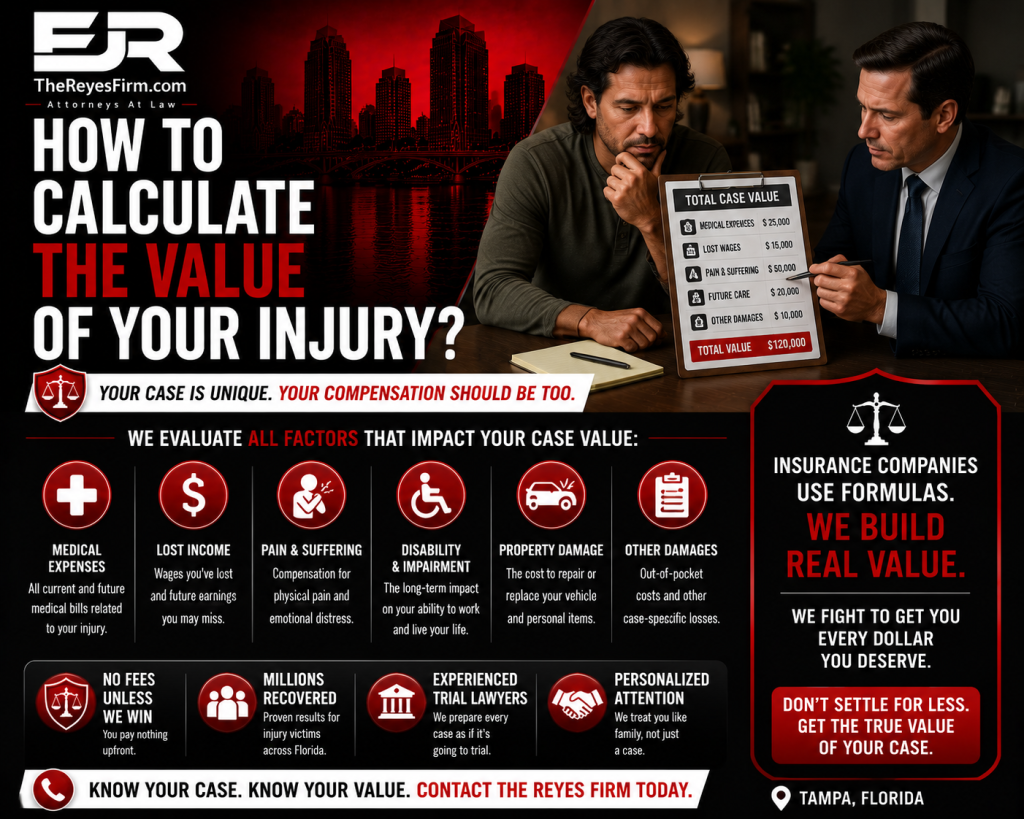
After a serious Tampa accident, one question outweighs almost every other: how much is my case actually worth? Put a number too high and the insurer stops taking you seriously. Settle for too little and you are stuck paying for an injury that was never your fault. Here’s how the value of an injury claim is really calculated in Florida, and what quietly raises or lowers that number. TL;DR — QUICK SUMMARY Your claim’s value is the sum of your economic damages and your non-economic damages, then adjusted for your share of fault and the available insurance. Economic damages are documentable losses like medical bills, lost wages, and future care; non-economic damages cover pain, suffering, and lost quality of life. Most insurers start with the multiplier method, adding up your medical bills and multiplying by a number, usually between 1.5 and 5, based on how serious your injury is. In Florida you can only recover pain and suffering from an at-fault driver if your injury meets the permanency threshold under Florida Statute 627.737. Comparative fault and insurance policy limits can shrink what you actually collect, and you have two years to file under Florida Statute 95.11(3)(a). The Reyes Firm Wondering What Your Case Is Worth? Get an honest valuation of your Tampa injury claim. Had a bad day? Contact Us Now 1.5 to 5 Common multiplier applied to your damages Industry standard No Cap On pain and suffering in most FL injury cases Florida law >50% Your fault share that bars recovery Fla. Stat. 768.81 2 Years To file an injury lawsuit Fla. Stat. 95.11(3)(a) How do you calculate the value of a personal injury claim? You calculate the value of an injury claim by adding together two kinds of damages, your economic losses and your non-economic losses, and then adjusting that total for real-world factors like your share of fault and the insurance coverage available. There is no single official formula a court hands you, but insurance companies and experienced attorneys both start from a recognized method and refine it based on the facts of your case. The goal of these damages is to make you whole, meaning to put you back, as much as money can, in the position you would have been in if the injury had never happened. Getting the number right matters in both directions. Aim too high and the insurer assumes you are not serious about settling. Accept too little and you are left covering costs that should have been someone else’s responsibility. What are economic, or special, damages? Economic damages are the losses you can put a receipt to. They include your past and future medical bills, your lost wages, your reduced earning capacity if you cannot work the way you used to, the property damage to your vehicle, and out-of-pocket costs like medication and travel to appointments. In a Florida auto case, your own Personal Injury Protection coverage pays the first portion of these medical bills before you pursue the at-fault party for the rest. The piece people most often undervalue is the future. A catastrophic injury can require surgeries, therapy, and care for years or even a lifetime, and all of that belongs in your claim. Counting only the bills you have already received is one of the fastest ways to settle for far less than your case is worth. What are non-economic, or general, damages? Non-economic damages compensate you for harm that has no invoice: physical pain, mental anguish, the loss of enjoyment of your life, disfigurement, and the strain an injury puts on your relationships. These losses are real, but because they are subjective, they are the hardest part of a claim to value and the part insurers fight the most. In Florida there is an important gate. You can only recover non-economic damages from an at-fault driver if your injury meets the permanency threshold under Florida Statute § 627.737, which generally requires a permanent injury such as a spinal cord injury or a traumatic brain injury. The good news is that Florida does not cap pain and suffering in typical injury cases, so when the threshold is met, the value of these damages is limited by the evidence, not by an arbitrary ceiling. 💡 Did You Know? In a Florida car accident, you cannot recover pain and suffering from the at-fault driver unless your injury meets the permanency threshold in Fla. Stat. § 627.737. When it does, Florida places no cap on non-economic damages in ordinary injury cases, so the value is driven by the strength of your medical evidence. Source: Fla. Stat. § 627.737, leg.state.fl.us. How does the multiplier method work? The multiplier method is the most common starting point for valuing pain and suffering. An adjuster or attorney adds up your economic damages, focusing on your medical bills, and multiplies that total by a number, usually between 1.5 and 5. A minor injury with a full recovery sits near the bottom of that range, while a severe, permanent injury sits near the top, and the result is an estimate of your non-economic damages that gets added to your economic losses. A second approach, the per diem method, assigns a set dollar amount for each day you live with your injury, which works better for shorter-term injuries than for lifelong ones. Both are only starting points. This is also why the free calculators you find online are unreliable, because they cannot weigh permanency, fault, your future prognosis, or the specific facts that move the multiplier up or down. Watch: How injury value is calculated In this short video, attorney Edward Reyes breaks down how the value of an injury claim is calculated and the mistakes that leave money on the table. If you want a clear, honest read on what your case is worth, The Reyes Firm offers free consultations at no cost to you. How do fault and insurance limits change what you actually collect? Two factors can separate what your claim is worth from
After A Car Accident, After an Accident, FAQ, For Parents, For Teens, Health, Injury, Legal, Migraines, Traumatic injury, Why we serve

How accidents cause Depression, PTSD, Coping and mental health issues?

Personal injury attorney in Tampa, Edward Reyes talks about depression, post traumatic stress, mental health and how it relates to accidents. We see depression from people that are exposed in extreme trauma. Sometimes it is mistakenly attributed as marital issues, increased intake of alcohol, or family problem. We have to treat auto-accidents as a grieving process and a loss. We are not just talking about losing a loved one but also includes the loss of your job or the loss of your finances and in some ways are taking out of their role if there’s a significant injury then mental stress should be addressed too. If it disrupts you day to day activities, there’s stress that you need to cope with because we are creatures of habit. Watch this video for the full details about coping with Post Traumatic Stress Disorder caused by car accidents.

After an Accident, FAQ, For Parents, For Teens, Health, Legal, Our Community, Personal Injury, Trust, Why does this hurt, Why we serve

Mediation Is Not Always The Case Resolution

Is mediation a resolution? Typically a mediation is a meeting of the minds to meet with and agreeable solution. But when you’re involved in a car accident, any law suit, or whatever case it may be. Mediation is joke for most part. You’ll be sitting there to discuss when you already know what your injuries are worth yet the insurance company is saying you’re not really injured. Mediation is just a fact-finding thing for the insurance company to discredit your claim. Mediation is not always the case resolution. Sometimes, it is during mediation that the insurance company will try to discredit the value of your injuries. The insurance company want you to receive the lowest settlement check possible. So a lawyer like Atty. Edward Reyes will help you get the most out of your injuries. Watch this video for the full details.

Law firm medical treatment settlement infographic
Health, Settlement

How Medical Treatment Affects Your Injury Settlement

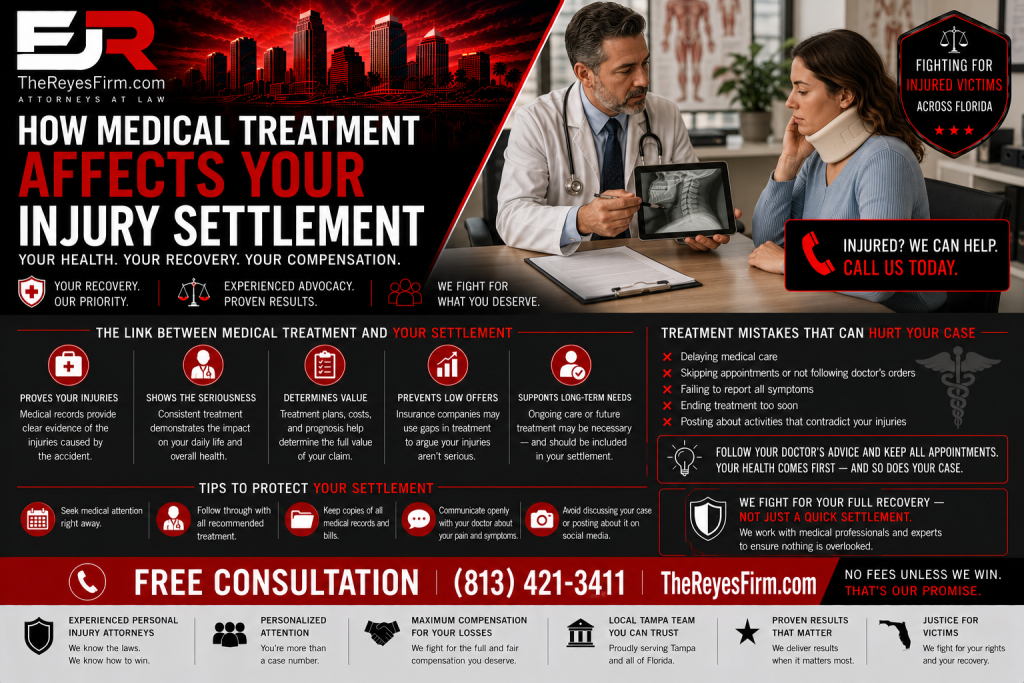
You know medical treatment matters for your health after a crash. What surprises many people is how much it matters for their settlement. In a Florida injury claim, the care you receive does more than help you heal, it becomes the evidence that decides what your case is worth. Here is how medical treatment and documentation shape your injury settlement, and why gaps in your care can quietly cost you. The Reyes Firm Making Sure Your Injury Is Documented Right? Your medical records can make or break your claim. Had a bad day? Contact Us Now Your Evidence Records link your injury to the crash Causation Claim Value Documentation shapes what your case is worth Why it matters Treatment Gaps What insurers exploit to pay less The key risk Permanent Finding needed for pain and suffering Fla. Stat. § 627.737(2) After a crash, most people think about medical care purely in terms of getting better, as they should. But if someone else caused your injuries, there is a second reality worth understanding: an insurance company will eventually decide what to pay based largely on your medical records. What those records show, and what they leave out, has a direct effect on your settlement. How does medical treatment affect your injury settlement? Medical treatment affects your settlement because your medical records are the primary evidence of your injury. They establish that you were hurt, that the crash caused it, and how serious it is. Without that documentation, you may have a genuine injury and still struggle to prove it, because to an insurance company, an injury that is not in the medical record effectively did not happen. This is why two people with similar injuries can end up with very different settlements. The one whose treatment is thoroughly documented has the evidence to support full compensation. The one who toughed it out, skipped care, or has a thin medical file is left arguing without proof. The treatment itself, and the record it creates, is what gives your claim its foundation. Why are medical records the foundation of your claim? Medical records do three jobs at once in an injury claim. They connect your injury to the crash, which lawyers call causation, by showing that you sought care for specific problems right after the accident. They document the nature and severity of your injury, from the initial diagnosis through every test, treatment, and follow-up. And they create a timeline that tells the story of your recovery in a way an adjuster or a jury can follow. Contrast that with the alternative. If you wait weeks to see a doctor, or never fully explain your symptoms, the record becomes ambiguous, and ambiguity is exactly what an insurer uses to pay less. A clear, consistent medical record does not just describe your injury, it protects your ability to be compensated for it. This is closely tied to identifying the true source of your pain, which our guide to where injuries come from after a car accident explains. What happens if you have gaps in your treatment? Gaps in treatment are among the most damaging things to an injury claim, and they are also among the most common. When you miss appointments, delay care, or stop treating before you have recovered, you create holes in the record that insurers are trained to exploit. Their argument is simple and effective: if you were really hurt, you would have kept treating, so the gap must mean you were fine. That argument is often unfair, since people miss appointments for all kinds of ordinary reasons, work, childcare, cost, or simply feeling a bit better for a while. But fair or not, a gap gives the insurer ammunition to discount your injury and reduce your settlement. The most reliable way to avoid this is to follow the treatment plan your doctor sets and to keep your appointments until you are formally released from care. 💡 Did You Know? A gap in your medical treatment is one of the first things an insurance adjuster looks for. If you stop treating or miss appointments, they will argue that you must have recovered or were never seriously hurt, and use that gap to justify a lower settlement, even when the real reason you missed care had nothing to do with how you felt. How does medical documentation affect what you can recover? Your recovery in an injury claim generally falls into two categories, and medical documentation drives both. The first is economic damages, the concrete costs, and your medical bills are a central part of this. The documented cost of your treatment, past and future, is a direct component of what you are owed, which is one reason a complete billing record matters. The second is non-economic damages, meaning pain and suffering and the impact on your life. In a Florida car accident case, this is where documentation becomes especially important, because you generally cannot recover for pain and suffering unless your injury meets a legal threshold, such as a permanent injury. Your medical records, and your doctors’ findings, are what establish whether that threshold is met. 🛡️ Your Rights Under Florida Law: Under Florida Statute § 627.737(2), you generally cannot recover for pain and suffering in a car accident case unless a doctor documents a permanent injury, significant permanent scarring or disfigurement, or significant and permanent loss of an important bodily function. Your medical treatment and records are what establish this, which is why proper documentation directly affects your right to full compensation. Does the type of treatment matter? It can. Treatment that is guided and documented by medical professionals generally carries more evidentiary weight than informal self-care. When your doctor orders imaging, refers you to a specialist, or prescribes physical therapy, each step both addresses your injury and adds objective documentation to your file. Diagnostic findings, specialist opinions, and a consistent course of care paint a far stronger picture than a single visit followed by silence. Transitions between providers

After an Accident, FAQ, For Parents, For Teens, Health, Injury, Personal Injury, Strict Negligence, Why does this hurt, Why we serve

Minor Injuries can be a Threat: Mechanism of Injury Explained!

You’re probably wondering why does your jaw hurt so much, why do your wrists hurt, why does your knee hurt? When you are involved in a car accident, this is the thing. When you are driving, let’s say you’re driving a car then somebody rear-ends you. The first thing that happens if you notice, your wrist goes back because the impact it pushes forward puts a lot of strain in your elbow and it pushes your shoulder back. That is how you can have problems at the wrist, your elbow, and your shoulder. Many times it also hurts the vertebrates in the back. But because of the accident that happens your knee hits the steering wheel and your body goes side to side hitting other parts of the car. Your jaw, because you’re doing the whiplash motion back and forth, goes backward and forward creating that stretch in these ligaments and that’s called TMJ- temporal mandibular joint dysfunction. Tampa personal injury lawyer Edward Reyes represents people in Tampa and Hillsborough County, Florida who have suffered an injury in an incident or accident type of accident. Speak Directly to Me, At No Cost, Today 813.421.3411 Sometimes you can also have issues with your brain that has micro-tears and the reason why because your brain sits inside a gel-like substance and when you go back and forth it swishes back and forth crashing into your skull. So, when you’re involved in a car accident, many people think it’s just their neck in their back. In fact, there are memes about my neck and my back but there is so much more to it. You got to look at the injury and how it happened slowly it down in your mind and that’s how you can figure out what is really hurting you and what can hurt you for the foreseeable future. You have to understand many attorneys may not get this idea. Many individuals may not get this idea because automatically they assume that that had to come from something else. But when you are involved in a car accident or some sort of major impact you’ve got to slow down the process because you’ll realize that that accident caused many other issues to happen because of the incident. So, if you’re falling, you’re compensating one side, you’re bending to protect yourselves. Our very smart and our bodies will do whatever it takes to protect ourselves from these injuries. But many times creates more injuries in different areas because it tightens up. So, the mechanics of injury is very important when thinking about your injuries and thinking about your future care. If you have any questions on this feel free to give us a call at 813-421-3411 or 833- 4 BAD DAY. (Transcript from the video, transcribed but not reviewed)

Settlement process infographic for attorneys
Health, Settlement

What Happens After We Receive the Settlement Check?

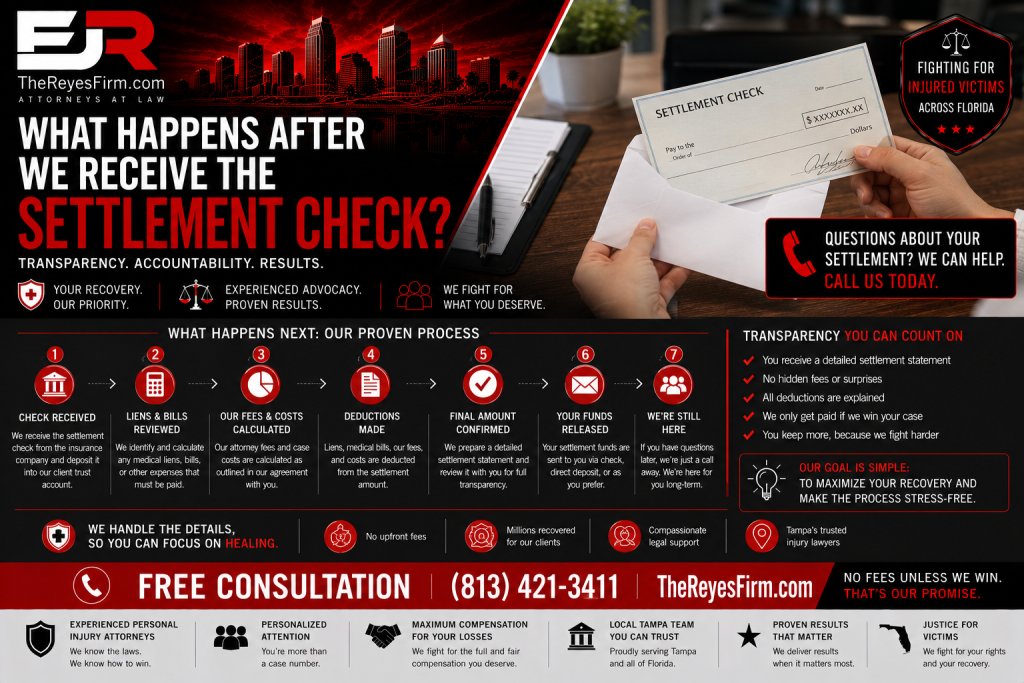
The call finally comes: your case has settled, and the check is on its way. It feels like the finish line, and in many ways it is. But there is one more important stretch between the settlement and the money landing in your pocket, and understanding it helps you see exactly why the work continues. Here is what happens after your lawyer receives the settlement check in your injury case. The Reyes Firm Questions About Your Tampa Settlement? We fight to maximize what actually reaches you. Had a bad day? Contact Us Now Your Net What matters is the money you keep After liens and fees Liens Bills repaid from your settlement Medical and other liens Negotiable Many liens and bills can be reduced Where a lawyer adds value Held in Trust Your funds are safeguarded first How it works After months of treatment and negotiation, a settlement can feel like the moment everything is finally over. In truth, a good lawyer’s job shifts at this point rather than ending. The goal now is to make sure that as much of that settlement as possible ends up with you, the person who actually went through the injury, rather than being eaten up by bills that could have been reduced. What happens after your lawyer receives the settlement check? When the settlement check arrives, it does not go straight to you, and that is by design and for your protection. The funds are first deposited into the firm’s trust account, and then a series of obligations tied to your case are resolved before the remainder, your net recovery, is paid to you. Those obligations typically include medical liens, outstanding bills, case costs, and the attorney’s fee. This is the part of the process most people never hear about until they are in it. Handled well, it is where a lawyer can meaningfully increase the amount you actually take home, by reducing what has to be paid out along the way. What are medical liens, and why must they be repaid? A medical lien is a right to be repaid from your settlement, held by a party that paid for or provided your accident-related care. Several kinds can appear in an injury case. A health insurer that covered your treatment may assert a right to reimbursement. A hospital may file a lien. A provider who treated you under a letter of protection agreed to be paid from your eventual settlement. And government programs like Medicare and Medicaid have their own reimbursement rights under federal and state law. For valid liens, repayment is not optional, and your lawyer is generally required to satisfy them from the settlement. That obligation exists to reimburse those who effectively advanced the cost of your care. The key is making sure each claimed lien is actually valid and correctly calculated, and then reducing it wherever the law and the circumstances allow. How does using health insurance increase your net recovery? It sounds backward, but running your accident treatment through your health insurance often leaves you with more money at the end. The reason is that health insurers do not pay providers the full billed amount. They pay a contracted, negotiated rate that is usually far lower, and the amount repaid from your settlement is generally tied to that reduced figure rather than the original bill. Suppose a hospital billed $10,000 for your care. If your health insurer had a contracted rate of roughly $3,000 for that treatment, the repayment obligation from your settlement is generally based on that lower negotiated number, not the full $10,000. That difference stays in your pocket, which is a significant and often overlooked benefit of using your coverage. 💡 Did You Know? Using your health insurance for accident treatment can increase your net recovery. Because health insurers reimburse providers at negotiated rates well below the billed charges, the amount that must be repaid from your settlement is often much smaller than the original bill, leaving more money with you. Can medical bills and liens be reduced? Yes, and this is one of the most valuable things a lawyer does after a settlement. Liens and outstanding bills are frequently negotiable, and reducing them directly increases what you keep. Lawyers negotiate with health insurers, hospitals, and providers to lower the amounts owed, sometimes citing the costs and effort that produced the recovery, sometimes on grounds of hardship, and sometimes simply because a provider would rather accept a reduced sum than risk collecting nothing. If you did not have health insurance and have outstanding bills, the same principle applies. Your lawyer works with those providers to reduce the balances as much as possible before the final numbers are set, so that more of the settlement reaches you rather than the billing department. ⚠️ Important Warning: Never spend or disburse settlement money before your liens are resolved. Funds paid out before valid liens are satisfied can leave you personally responsible for repaying them later, and unresolved Medicare or Medicaid obligations in particular can create serious problems. This is exactly why the work continues carefully after the check arrives. What other obligations come out of a settlement? Beyond medical liens, a few other items are typically resolved from the settlement. The attorney’s fee, usually a contingency percentage agreed to at the start, comes out of the recovery, as do the case costs advanced during your case, such as records fees, expert charges, and filing costs. In some situations, other legal obligations apply as well, such as a child support lien, which the law may require be paid from a settlement. None of this should be a mystery to you. A reputable firm accounts for every one of these items in a written settlement statement, so you can see precisely how the total was distributed and how your net figure was reached. 🛡️ Your Rights: You have the right to a clear, itemized settlement statement showing exactly how your settlement was distributed, every lien, every case cost, the

Protect your rights medical liens explained
After an Accident, Car accident, Health, Legal, Settlement, Why we serve

What You Should Know About Medical Liens?

You did the smart thing after your Tampa accident and used your health insurance to get the care you needed. Then you hear a word that makes your stomach drop: lien. Suddenly it sounds like everyone who paid a medical bill wants a piece of your settlement. Here’s what a medical lien really is, who can claim one in Florida, and why the right approach often leaves more money in your pocket, not less. TL;DR — QUICK SUMMARY A medical lien is a legal claim to be repaid from your settlement by whoever covered your accident-related medical care. Your health insurer can seek repayment through subrogation, but under Florida Statute 768.76 its lien is reduced by its share of your attorney’s fees and costs. Medicare and Medicaid have far stronger repayment rights that cannot be ignored, with Medicaid’s lien attaching automatically under Florida Statute 409.910. Using health insurance usually shrinks the bill, because insurers pay providers at reduced negotiated rates, so less comes out of your recovery. Most liens are negotiable, and resolving them before you sign is how you protect what you actually take home. The Reyes Firm Worried a Lien Will Eat Your Settlement? Let us protect what you take home from your Tampa claim. Had a bad day? Contact Us Now $10,000 Florida PIP pays before health insurance Fla. Stat. 627.736 Pro Rata Health insurer liens cut by their share of fees Fla. Stat. 768.76(4) Automatic Medicaid’s lien attaches by law Fla. Stat. 409.910(6) 2 Years To file an injury lawsuit Fla. Stat. 95.11(3)(a) What is a medical lien, and why does it come out of your settlement? A medical lien is a legal claim to be repaid from your settlement by an insurer, provider, or government program that covered your accident-related medical care. The idea behind it is simple: those bills were paid on the understanding that, if someone else caused your injuries, the money would be paid back out of whatever you recover from the at-fault party. This matters most when your injuries are serious and your bills are large, such as after a catastrophic crash. A lien does not reduce what the at-fault party owes you. It determines how much of your recovery you actually keep after the people who paid your bills are reimbursed, which is why understanding and controlling these liens is a real part of winning your case. Who can put a lien on your personal injury settlement in Florida? Several different parties can claim repayment, and they do not all have the same rights. The most common lien holders are your private health insurer, which may seek reimbursement through subrogation; hospitals, which in some Florida counties, including parts of the Tampa and Hillsborough County area, can assert a lien under a local ordinance; and government programs like Medicare and Medicaid, which have powerful repayment rights set by statute. There is also a fourth situation. If you had no health insurance, or chose not to use it, a doctor may have treated you under a Letter of Protection, which is an agreement to wait and be paid directly from your settlement. That arrangement creates a lien-like claim on your recovery too. The first job in any case is identifying every one of these claims, because a lien you forget about does not disappear, it follows you. How does health insurance subrogation actually work? When your health insurer pays accident-related bills, it often has a right to be paid back out of your settlement, and that right is called subrogation. Under Florida Statute § 768.76, a health insurer that has properly asserted this right can be reimbursed only from what you actually recover, and its claim is reduced by its pro-rata share of the attorney’s fees and costs you paid to obtain that recovery. Two things make this far better for you than it first sounds. The insurer is usually repaid based on the discounted rate it actually paid the provider, not the much higher billed amount, and that repayment is then cut down by its share of your legal costs. The main exception is a self-funded employer health plan governed by federal ERISA law, which can have stronger reimbursement rights than a state-regulated plan, so the type of plan you have genuinely matters to the outcome. 💡 Did You Know? Under Fla. Stat. § 768.76, a health insurer’s reimbursement is limited to what you actually recovered and must be reduced by the insurer’s pro-rata share of your attorney’s fees and costs. Combined with the discounted rates insurers pay providers, this often means using your health insurance leaves you with more money than letting the full medical bill ride to settlement. Source: Fla. Stat. § 768.76, leg.state.fl.us. What about Medicare and Medicaid liens? Government liens are a different animal, and they cannot be ignored. Florida Medicaid is automatically subrogated to your claim and holds an automatic lien for the full amount it paid under Florida Statute § 409.910, while Medicare’s repayment rights come from federal law and function as a so-called super lien on your recovery. The good news is that the amount these programs actually collect can often be reduced, for Medicaid by reasonably allocating your settlement to past medical expenses, and for Medicare through its conditional-payment resolution process. The bad news is that disbursing your settlement without addressing them is a serious mistake, because the government can pursue repayment afterward, with interest. These claims come up in any case with major medical care, including large truck and commercial vehicle settlements. ⚠️ Deadline Warning: Under Florida Statute § 95.11(3)(a), you have two years from the date of your crash to file a personal injury lawsuit. Missing this deadline almost always means losing your right to recover anything. Don’t wait to call a lawyer. Watch: How medical liens affect your settlement In this short video, attorney Edward Reyes explains how medical liens work and why using your health insurance can still be the smart move after an accident. Tampa personal injury

Drugs, florida cities we serve, For Parents, For Teens, Health, Legal, Why we serve

Leave Your Weed at Home if you are Traveling

People asked me the same thing going to an airport. They’ll say hey I have a medical marijuana card and I’m flying going to Colorado where I can buy there recreationally. The problem is once you get into that federal jurisdiction the federal law is going to hold. So, if you go into an airport, if you go into a federal building those federal officers are not going to care that you have a Florida medical marijuana card. They’re going to say hey it’s illegal under the federal system and they can still prosecute you for it. Tampa personal injury lawyer Edward Reyes represents people in Tampa and Hillsborough County, Florida who have suffered an injury in an incident or accident type of accident. Speak Directly to Me, At No Cost, Today 813.421.3411So, if you’re flying to a VA hospital or you’re going to a federal courthouse leave your marijuana at home and don’t count on anything having to do with the federal government allowing you to have marijuana because right now it is still legal. For more questions, call us at 833-4-BAD DAY (833-422-3329). (Transcript from the video, transcribed but not reviewed)

Pain and suffering compensation guide
Accident Injuries & why, After an Accident, Car accident, FAQ, Health, Injury, Legal, Settlement

Should I Get Paid for Pain and Suffering? | Tampa, FL

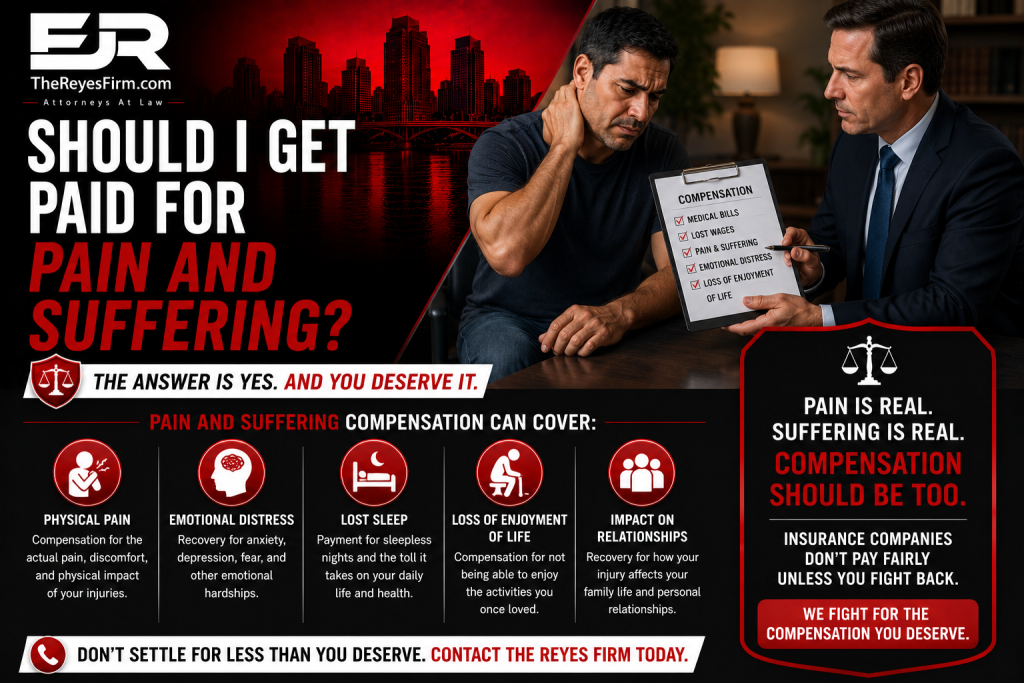
You’re in real pain. The medical bills are only part of it — you can’t sleep, you can’t do the things you used to love, and a car accident you didn’t cause turned your daily life upside down. So can you actually be paid for that suffering, not just your bills? Here’s how pain and suffering compensation works in Florida. TL;DR — QUICK SUMMARY Yes, you can recover money for pain and suffering after a Florida crash that wasn’t your fault, but only if your injuries clear Florida’s serious-injury threshold. Pain and suffering is a type of non-economic damage. It covers physical pain, mental anguish, loss of enjoyment of life, and inconvenience, on top of your medical bills and lost wages. Florida’s no-fault system means your own PIP pays your first $10,000 in bills regardless of fault, but pain and suffering generally comes from the at-fault driver once you meet the injury threshold under Florida Statute § 627.737. There’s no fixed formula. The value depends on the severity and permanence of your injuries, your treatment, and how the crash has changed your life. You have two years from the date of your crash to file a personal injury lawsuit under Florida Statute § 95.11(3)(a). Uninsured/underinsured motorist coverage can also be a source of recovery if the at-fault driver has no insurance. The Reyes Firm Hurt and in Pain After a Tampa Crash? Find out what your pain and suffering claim may be worth. Had a bad day? Contact Us Now 2 Years Florida statute of limitations Fla. Stat. § 95.11(3)(a) $10,000 Florida PIP minimum coverage Fla. Stat. § 627.736 4 Ways To meet FL injury threshold Fla. Stat. § 627.737(2) 50% Fault bar to recovery in FL Fla. Stat. § 768.81 Can you get paid for pain and suffering after a Florida car accident? Yes, you can be compensated for pain and suffering, as long as the crash wasn’t your fault and your injuries are serious enough to clear Florida’s threshold. Whether it actually happens depends on the facts: how badly you were hurt, whether the at-fault driver had insurance, and whether they have assets to reach if they didn’t. If you’re in genuine pain, you should be able to recover for that pain, for the loss of enjoyment of life, for time you couldn’t work, and for the damage to your vehicle. That’s the principle. In practice, it doesn’t happen automatically, which is why how you handle your claim matters so much. One of the biggest obstacles is uninsured drivers. Florida has a high number of people driving without adequate coverage, which is exactly why carrying uninsured/underinsured motorist coverage on your own policy is one of the smartest protections you can have. ⚠️ Deadline Warning: Under Florida Statute § 95.11(3)(a), you have two years from the date of your crash to file a personal injury lawsuit. Wait too long and you can lose the right to recover anything for your pain and suffering, no matter how badly you were hurt. Don’t let the clock run out. What counts as pain and suffering in a Florida injury claim? Pain and suffering is a category of non-economic damages, meaning losses that don’t come with a receipt. Unlike a medical bill or a paycheck stub, these harms are real but harder to put a dollar figure on, which is exactly why insurers fight them. In a Florida injury claim, pain and suffering can include physical pain from your injuries, mental anguish and emotional distress, loss of enjoyment of life, inconvenience and disruption to your routine, and the lasting effect of scarring or disfigurement. A serious back or neck injury that limits you for years carries very different value than a sprain that heals in weeks. These damages sit on top of your economic damages, which cover medical bills, future treatment, lost wages, and lost earning capacity. Together they make up the full value of your claim. Watch: Should you get paid for pain and suffering in Tampa? In this short video, Tampa personal injury attorney Edward Reyes explains when you can recover for pain and suffering after a Florida crash and what factors affect it. If you’re hurting and unsure whether your injuries qualify, The Reyes Firm offers a free case review to walk you through where you stand. How does Florida’s injury threshold affect pain and suffering? Florida’s injury threshold is the gateway to recovering pain and suffering from an at-fault driver. Because Florida is a no-fault state, your own Personal Injury Protection (PIP) coverage pays your first medical bills regardless of who caused the crash, but PIP does not pay for pain and suffering. To step outside no-fault and pursue non-economic damages from the at-fault driver, your injury generally has to meet the serious-injury threshold in Florida Statute § 627.737. That statute recognizes injuries involving significant and permanent loss of an important bodily function, permanent injury within a reasonable degree of medical probability, significant and permanent scarring or disfigurement, or death. Whether your injury clears that threshold is often the central fight in a Florida case. Strong medical documentation and the right expert opinions are what move an injury from “soft tissue” in the insurer’s eyes to a permanent, compensable harm. 💡 Did You Know? Florida’s PIP system pays up to $10,000 in medical bills and lost wages no matter who caused the crash under Fla. Stat. § 627.736 — but PIP never pays for pain and suffering. Those damages only become available once your injury meets the threshold in Fla. Stat. § 627.737. How is pain and suffering calculated in Florida? There is no fixed formula for pain and suffering in Florida. Two cases with similar bills can settle for very different amounts depending on how the injuries affect each person’s life, which is why a number pulled from an online calculator means little. In practice, the value turns on factors like the severity and permanence of your injuries, the length and intensity of your treatment, whether you’ll

Car Accident
Accident Injuries & why, After A Car Accident, After an Accident, Car accident, FAQ, For Parents, For Teens, Health, Injury, Legal, Settlement, Why we serve

Car Accident? What Happens Next?

So, you went through the whole process. You got treated, you went to the doctor, you did everything you’re supposed to do for your injuries and to recover. So, what happens next? Well, the doctors, the urgent care facilities, the medical doctor, the spine specialist, the MRIs, everybody else. We request the records, or they’ll send us the records for your treatment. Now that we get all the records, we can create the story of what are you and how does this accident affected your life. I have to get the medical records so we can put together a demand for settlement. Now that tells us about your medical records, that tells us a lot of things about what’s hurting you and how this has affected your life per the doctor’s perspective from what you’ve told them during your exams. Now, one of the things that we like to do as a firm- we do an impact sheet. How has the accident impacted your life, that’s the most important part because in litigation there are two parts? There are economic damages which are your heart damages meaning what did you lose as far as monetary, how much are your medical bills cost-wise. Tampa personal injury lawyer Edward Reyes represents people in Tampa and Hillsborough County, Florida who have suffered an injury in an incident or accident type of accident. Speak Directly to Me, At No Cost, Today 813.421.3411 But then there’s the whole other part of life that has affected your life or your relationship with your kids. How it has affected your life while brushing your teeth, tying your shoes, playing, doing all these things. So, we want to know the story of how it has affected you, not just the cost of treatment but how does that affect you in your life and going forward. Now that will give us a full story or a much better story to wrap it up in a pretty bow to put it in front of the insurance company so they can understand you as a person and not you as just a piece of paper. So, it’s very important to put the general damages, which is how it affected your life your actual life and the economic damages which is how much did it cost because if you’ve gone through this issue, did you miss work, did you have to go to the multiple visit, did you spend a lot of money back with gas and time mending opportunity things that you missed out. All these things are important to correctly tell the story to the adjuster from the insurance company. Now we can start the negotiations. That’s what we have to do to prepare a demand for settlement. If you have any questions, call us at 813.421.3411. (Transcript from the video, transcribed but not reviewed)

Scroll to Top