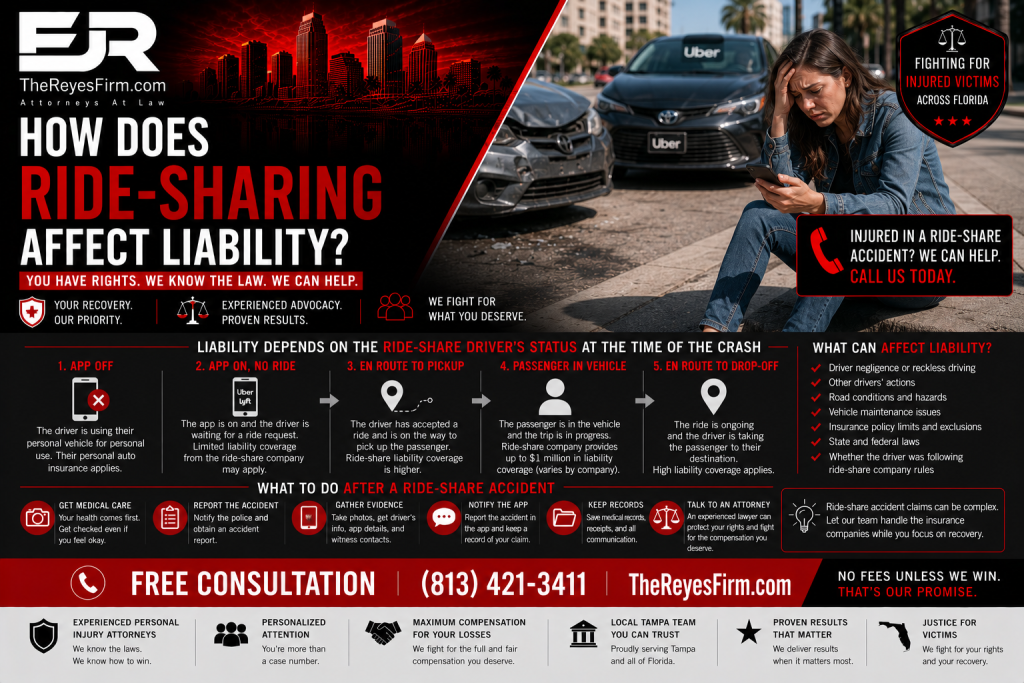
How Does Ride-Sharing Affect Liability?
You called an Uber to be safe, or you were just driving through Tampa when a Lyft ran the light. Either way, you are hurt, and the insurance question is stranger than any ordinary crash: whose policy even applies? With rideshare, the answer can swing from a driver’s personal coverage to a $1 million policy depending on a single detail. Here is how ridesharing affects liability in Florida, and why the moment of the crash changes everything about your rideshare accident claim. The Reyes Firm Hurt in an Uber or Lyft Crash in Tampa? Which policy applies can change everything. We can help. Had a bad day? Contact Us Now $1 Million Coverage once a ride is accepted Fla. Stat. § 627.748(7)(c) $50K/$100K Coverage when logged on, no ride yet Fla. Stat. § 627.748(7)(b) App Off Only the driver’s personal policy applies Personal insurance 2 Years Deadline to file an injury claim Fla. Stat. § 95.11 Rideshare has changed how Tampa gets around, and for many people it is a safer choice than driving after a night out. But that convenience comes with a coverage system unlike anything in a normal crash. When an Uber or Lyft is involved, the single most important question is not who owns the car, but what the driver’s app was doing at the instant of impact. How does ridesharing affect liability in Florida? Ridesharing affects liability by tying the available insurance coverage to the driver’s status at the moment of the crash. Florida regulates companies like Uber and Lyft, known legally as transportation network companies, under Florida Statute § 627.748, which sets specific minimum coverage requirements for different phases of a driver’s work. That means two crashes that look identical can involve completely different insurance. A collision caused by a rideshare driver who was off the clock is handled by their personal policy alone. The same collision moments after they accept a ride may be covered by a $1 million policy. Understanding those phases is the key to knowing where your compensation comes from. What are the three insurance periods for Uber and Lyft? Florida law divides a rideshare driver’s activity into phases, and coverage rises as the driver moves from simply having the app open to actually carrying a passenger. There are three practical periods to understand: App off. When the driver is not logged on to the rideshare app, they are just a regular driver. Only their personal auto insurance applies, and Uber or Lyft provides no coverage. Logged on, waiting for a ride. Once the driver is logged on and available but has not yet accepted a request, Florida requires primary liability coverage of at least $50,000 for death or bodily injury per person, $100,000 per incident, and $25,000 for property damage, along with personal injury protection and uninsured motorist coverage. Engaged in a prearranged ride. From the moment the driver accepts a ride request, through driving to pick you up, and until the passenger is dropped off, a much larger policy of at least $1 million in liability coverage applies. The jump from the middle period to the last one is enormous, from $50,000 per person to $1 million. That gap is why pinning down the driver’s exact status is often the single most important step in a rideshare claim. Why does the moment of the crash matter so much? Because the driver’s status decides which policy, and how much coverage, is available to you. A serious injury can easily exceed a $50,000 per-person limit, so whether the driver had accepted a ride seconds before the crash can be the difference between a claim that is fully covered and one that is not. This is also why rideshare companies and their insurers pay close attention to exactly when a driver logged on, logged off, and accepted a ride. There is a second reason the details matter, and it surprises many people. A rideshare driver’s own personal auto policy may not fill the gap you expect it to, because personal policies are generally not written to cover driving for hire. 💡 Did You Know? Many rideshare drivers’ personal auto policies specifically exclude coverage while they are driving for Uber or Lyft, and Florida law expressly allows insurers to write that exclusion. That is exactly why the company’s statutory coverage tiers matter so much, since the driver’s own policy may provide nothing at all during rideshare activity. Source: Fla. Stat. § 627.748(8)(b). Can you sue Uber or Lyft directly? Usually not in the way people expect. Under Florida law, rideshare drivers are generally treated as independent contractors rather than employees, and the statute limits a company’s vicarious liability simply for operating the app and connecting drivers with riders. In most cases, you are not suing Uber or Lyft as an employer. You are pursuing the insurance coverage that applies to the driver’s phase of work. Notably, Florida law also specifies that a rideshare company and its drivers are not common carriers, which is a different status than a public bus. That does not leave you without options, though. The right path is usually to identify every applicable policy, from the company’s coverage to the driver’s insurance to your own, and pursue the ones that apply. Sorting out which coverage governs, and whether personal or commercial insurance applies, can be genuinely complicated, and our guide to commercial versus personal insurance after a Florida crash explains why. 🛡️ Your Rights Under Florida Law: Under Fla. Stat. § 627.748, an injured person has real leverage. In a claims investigation, the rideshare company must promptly provide the precise times the driver logged on and off in the 12 hours before and after the crash, and the driver must disclose whether they were logged on or on a prearranged ride. That information is often the key to unlocking the correct coverage, and an experienced Tampa injury lawyer knows how to demand it. What if you were a passenger, another driver, or a pedestrian? The same period-based