Settlement

Legal, Settlement, Why we serve

Settle your case privately: Yes, that’s possible!

How do you do settlement privately? You just got paid and you don’t want people to find out. Most cases, they settle in pre-suit. That means most cases settle before you even go to a court. But that doesn’t absolve you from your liability. You can settle your case without the public knowing it. Of course, you still have to do it with an attorney by your side. Watch this video for the full details.

Legal, Personal Injury, personal injury attorney, Settlement, Traumatic injury, Why we serve

Personal Injury Protection (PIP)

What is PIP? Why is PIP important? In Florida, PIP is Personal Injury Protection. What that means is that for the medical coverages after an accident, you got 14 days to see a doctor. That locks in your coverages to pay your PIP benefits which is the $10,000 worth of coverages. However if you’re not injured or not injured enough, they’ll cut you at $2500. Watch this video for the full details.

Accident insurance guide and legal help
After A Car Accident, Settlement

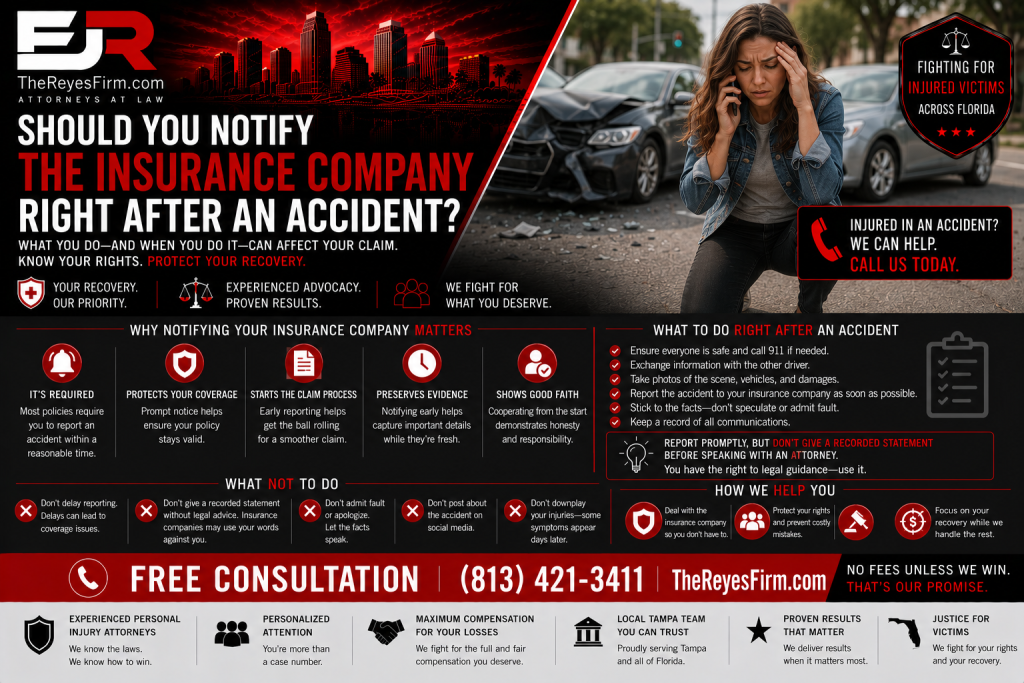
Should You Notify The Insurance Company Right After An Accident?

Moments after a crash, your phone starts ringing with insurance calls, and it is easy to say the wrong thing to the wrong company without realizing it. Which insurer should you talk to, what should you say, and who can you politely shut down? Getting this right in the first days protects your claim. Here is what you need to know about notifying the insurance company after an accident in Florida. The Reyes Firm Insurance Calling After Your Tampa Crash? Know what to say before you pick up. Had a bad day? Contact Us Now Yes, Notify Tell your own insurer promptly Your policy requires it Not Required No recorded statement to the other insurer Protect your claim Duty to Defend Your insurer defends covered claims Even if at fault 2 Years Deadline to file an injury lawsuit Fla. Stat. § 95.11 The hours after a crash are chaotic, and insurance companies know it. That is often when their adjusters reach out, while you are shaken, in pain, and unsure of your rights. Understanding the simple difference between the insurer you should call and the one you can decline puts you back in control of those conversations. Should you notify the insurance company right after an accident? Yes, you should notify your own insurance company promptly after a crash. Reporting the accident starts your claim and creates an official record, and just as importantly, your policy almost certainly requires you to do it. The key is understanding that “notify the insurance company” means your own insurer, which is very different from the other driver’s insurer. That distinction is the whole point of this article. You have obligations to your own insurance company, and you have protections when it comes to the other side’s. Confusing the two is one of the most common and costly mistakes people make right after an accident. Why should you notify your own insurance company? There are three good reasons. First, nearly every auto policy contains a cooperation and notice provision that requires you to report an accident promptly, and failing to do so can give your insurer a reason to dispute coverage later. Second, reporting starts your claim and, in Florida, is tied to accessing your Personal Injury Protection benefits under Florida Statute § 627.736, which pay for your initial medical care regardless of fault. Third, your own insurer stands behind you if a claim is made against you. Whether or not the crash was your fault, notifying your insurer puts the accident on record so the company can step in and protect you if the other party pursues a claim. That protection is part of what you pay for. 💡 Did You Know? Even if the accident was your fault, your own insurance company generally has a duty to defend you against claims covered by your policy. That means if someone makes a claim against you, your insurer can provide the defense, which is a core part of what your liability coverage is for, and one more reason to notify your own insurer promptly. What should you tell your own insurance company? Keep it factual and simple. Your insurer needs the basic information to open your claim: that an accident happened, when and where it occurred, who was involved, and the other driver’s information. Providing those facts is exactly what starting a claim requires. What you should avoid is just as important. Do not guess about who was at fault or volunteer opinions about how the crash happened, because you may not have the full picture, and speculation can come back to hurt you. Do not downplay your injuries by saying you feel fine, since many injuries appear days later, and do not exaggerate them either. Stick to what you know for certain, and let the facts speak. Do you have to talk to the other driver’s insurance company? No, and this is where your protections come in. You are generally not required to give the at-fault driver’s insurance company a recorded statement, and you should be very cautious about doing so. That insurer’s job is to pay as little as possible, and a recorded statement gives them material to twist, take out of context, or use to argue that your injuries are minor or that you were partly to blame. If the other insurer contacts you, you can simply get the claim number for your records and decline to give a detailed or recorded statement. You do not owe the other side an account of the crash, and politely declining is well within your rights. ⚠️ Important Warning: The at-fault driver’s insurer may call soon after the crash, sounding friendly and eager to help you. Remember that you are generally not required to give them a recorded statement, and anything you say can be used to minimize or deny your claim. Get the claim number, stay polite, and refer them to your lawyer rather than discussing the crash or your injuries. What should you do if the other insurer calls you? Handle it calmly and briefly. You can be courteous without giving the other insurer what it is looking for. In practice, that means taking down the claim number and the adjuster’s contact information, then declining to provide a recorded statement or to discuss fault, the details of the crash, or the extent of your injuries. The simplest and safest response is to let them know that your attorney will be in touch, and then end the call. Once you have a lawyer, all of this communication can go through your lawyer, so you never have to worry about saying the wrong thing to someone whose goal is to reduce your recovery. 🛡️ Your Rights Under Florida Law: Under Florida Statute § 768.81, your compensation is reduced by your share of fault. This is exactly why what you say to insurers matters so much, because an offhand apology or a guess about what happened can be treated as an admission and used

Accident Injuries & why, After A Car Accident, After an Accident, Car accident, Legal, Road Accidents, Settlement, Strict Negligence, Uninsured Motorist Coverage, Why we serve

The at-fault party has no insurance: What to do

What should you do if the person that you crash into has no insurance coverage at all? What to do when the at-fault party has no insurance? How can you recover from your injuries? How can you get settlement from your damaged properties? Here’s what you can do. Watch this video for the full details.

Law firm medical treatment settlement infographic
Health, Settlement

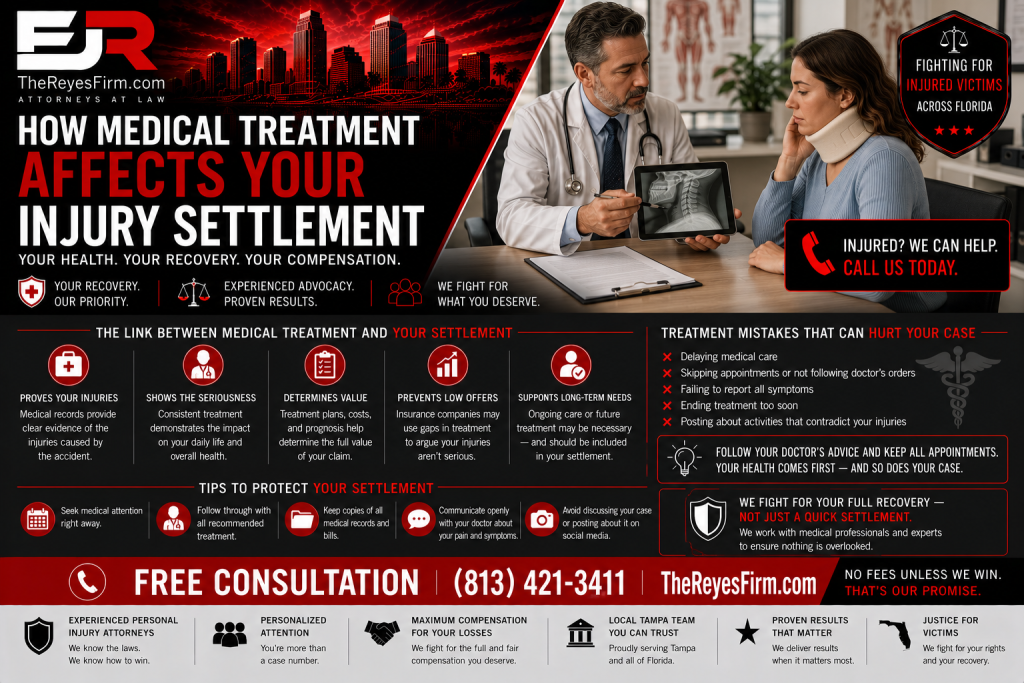
How Medical Treatment Affects Your Injury Settlement

You know medical treatment matters for your health after a crash. What surprises many people is how much it matters for their settlement. In a Florida injury claim, the care you receive does more than help you heal, it becomes the evidence that decides what your case is worth. Here is how medical treatment and documentation shape your injury settlement, and why gaps in your care can quietly cost you. The Reyes Firm Making Sure Your Injury Is Documented Right? Your medical records can make or break your claim. Had a bad day? Contact Us Now Your Evidence Records link your injury to the crash Causation Claim Value Documentation shapes what your case is worth Why it matters Treatment Gaps What insurers exploit to pay less The key risk Permanent Finding needed for pain and suffering Fla. Stat. § 627.737(2) After a crash, most people think about medical care purely in terms of getting better, as they should. But if someone else caused your injuries, there is a second reality worth understanding: an insurance company will eventually decide what to pay based largely on your medical records. What those records show, and what they leave out, has a direct effect on your settlement. How does medical treatment affect your injury settlement? Medical treatment affects your settlement because your medical records are the primary evidence of your injury. They establish that you were hurt, that the crash caused it, and how serious it is. Without that documentation, you may have a genuine injury and still struggle to prove it, because to an insurance company, an injury that is not in the medical record effectively did not happen. This is why two people with similar injuries can end up with very different settlements. The one whose treatment is thoroughly documented has the evidence to support full compensation. The one who toughed it out, skipped care, or has a thin medical file is left arguing without proof. The treatment itself, and the record it creates, is what gives your claim its foundation. Why are medical records the foundation of your claim? Medical records do three jobs at once in an injury claim. They connect your injury to the crash, which lawyers call causation, by showing that you sought care for specific problems right after the accident. They document the nature and severity of your injury, from the initial diagnosis through every test, treatment, and follow-up. And they create a timeline that tells the story of your recovery in a way an adjuster or a jury can follow. Contrast that with the alternative. If you wait weeks to see a doctor, or never fully explain your symptoms, the record becomes ambiguous, and ambiguity is exactly what an insurer uses to pay less. A clear, consistent medical record does not just describe your injury, it protects your ability to be compensated for it. This is closely tied to identifying the true source of your pain, which our guide to where injuries come from after a car accident explains. What happens if you have gaps in your treatment? Gaps in treatment are among the most damaging things to an injury claim, and they are also among the most common. When you miss appointments, delay care, or stop treating before you have recovered, you create holes in the record that insurers are trained to exploit. Their argument is simple and effective: if you were really hurt, you would have kept treating, so the gap must mean you were fine. That argument is often unfair, since people miss appointments for all kinds of ordinary reasons, work, childcare, cost, or simply feeling a bit better for a while. But fair or not, a gap gives the insurer ammunition to discount your injury and reduce your settlement. The most reliable way to avoid this is to follow the treatment plan your doctor sets and to keep your appointments until you are formally released from care. 💡 Did You Know? A gap in your medical treatment is one of the first things an insurance adjuster looks for. If you stop treating or miss appointments, they will argue that you must have recovered or were never seriously hurt, and use that gap to justify a lower settlement, even when the real reason you missed care had nothing to do with how you felt. How does medical documentation affect what you can recover? Your recovery in an injury claim generally falls into two categories, and medical documentation drives both. The first is economic damages, the concrete costs, and your medical bills are a central part of this. The documented cost of your treatment, past and future, is a direct component of what you are owed, which is one reason a complete billing record matters. The second is non-economic damages, meaning pain and suffering and the impact on your life. In a Florida car accident case, this is where documentation becomes especially important, because you generally cannot recover for pain and suffering unless your injury meets a legal threshold, such as a permanent injury. Your medical records, and your doctors’ findings, are what establish whether that threshold is met. 🛡️ Your Rights Under Florida Law: Under Florida Statute § 627.737(2), you generally cannot recover for pain and suffering in a car accident case unless a doctor documents a permanent injury, significant permanent scarring or disfigurement, or significant and permanent loss of an important bodily function. Your medical treatment and records are what establish this, which is why proper documentation directly affects your right to full compensation. Does the type of treatment matter? It can. Treatment that is guided and documented by medical professionals generally carries more evidentiary weight than informal self-care. When your doctor orders imaging, refers you to a specialist, or prescribes physical therapy, each step both addresses your injury and adds objective documentation to your file. Diagnostic findings, specialist opinions, and a consistent course of care paint a far stronger picture than a single visit followed by silence. Transitions between providers

FAQ, Felony, florida cities we serve, Legal, Our Community, Settlement, Why we serve

“Honesty issues”: How to deal with each party’s “truth”

“Honesty is the best policy” they say. Everyone has its own version of truth. Your version may not be their version… and this applies most of the time during cases brought in court. How do we deal with “honesty issues”? The other party crashed into you may have a different set of facts in their minds of what happened. Everyone is entitled with their own opinion and they all have their own set of excuses. Keep in mind that your honesty does not always translate to the honesty of the person that’s at-fault. Watch this video. “Honesty issues”: How to deal with each party’s “truth

Family Law, FAQ, For Parents, For Teens, Legal, mass transit, Our Community, Settlement, Why we serve

Immigrants and Discrimination

Prejudices on immigrants from certain countries depending from where they’re from. Immigrants from Europe are less discriminated as compared to immigrants from hispanic countries. If it’s a marriage based petition, the difference in culture makes it more challenging. The couple will face the difference in language, culture, and belief. This marks the question as to how bonafide this marriage is. Prejudice also play a role on the tickets served on these individuals. The individual might have multiple tickets but they are only minor ones like no seat belt. Prejudice applies as the officers usually have a hunch on certain trucks being pulled over because they have a hunch. Thus, they will look for violation once the vehicle is being pulled over. Watch the video here.

Proposal for Settlement (1)
FAQ, Legal, Settlement, Why we serve

Litigation Series: Proposal for Settlement

Let’s talk about proposal for settlement. It’s a tool that can be used to push the defendant, the other side to settle early. now there’s drawbacks and there’s pluses to involve in the settlement. both sides can file one. I’ll explain it. the first thing that has to happen you get away 91 days after you serve the paperwork to the at-fault party, to the defendant before you could even do this proposal for settlement. Proposal for settlements is that you’re asking for a settlement. It’s in the title- proposal for settlement now. Let’s use an example. if you ask for $50,000 as payment, you have to get a settlement 25% higher so a verdict of $75,000. So if you ask for 50, 000 and you get a verdict of 75, 000.01 the other side, the at-fault party has to pay all the attorney’s cost and fees. the moment you file a proposal for settlement there’s a strict 30 days. Tampa personal injury lawyer Edward Reyes represents people in Tampa and Hillsborough County, Florida who have suffered an injury in an incident or accident type of accident. Speak Directly to Me, At No Cost, Today 813.421.3411If the other side doesn’t pay you the money that you requested in your proposal for settlement in those 30 days, the attorney can start clocking every single hour from that 30 days. And if you get 25 percent of a verdict, higher than what you asked you get all your attorney fees and costs back Now the double-edged sword is that the defendant can do the same thing. now the defendant can do one against you the plaintiff. and if we don’t get a verdict 75 percent or higher because they’re going to lowball many times the proposal for settlement and then we have to pay their attorney fees in cost. So, it puts pressure on both sides. it depends on how comfortable you feel with the case. but it’s a very strong tool to push the case to long when nothing’s happened. Many times this goes back and forth as well the 30-day lapse can happen if nobody covers and then all depends on what happens at time of settlement. whether you’re covering costs or not. it doesn’t necessarily have to go to trial but those percentages still apply. If you have any questions on this of course call the office at 833-4 bad day.   (Transcript from the video, transcribed but not reviewed)

The Reyes Firm
After A Car Accident, After an Accident, FAQ, Legal, Settlement, Why we serve

Litigation Series: Filing A Complaint

Okay, so the first part of litigation is filing a complaint. We are complaining to the courts that this person did something wrong to you. So, we put this in the paper, we put all the complaints that we are doing against that person. In Florida and in Civil Procedure or anywhere in the United States we had to serve that paper to those people to the other side. That way they know they are getting sued. You cannot sue somebody if they do not know they are getting sued. Once a process server, somebody that officially goes and takes it drops off and runs away or whatever the case is. once they give it to that person, now the clock starts ticking. In Florida, once they receive that paper, they give that paper to their insurance company and there are 20 days that they need to respond back to our complaint. So, we are complaining, and they are responding. They got 20 days to do so. Tampa personal injury lawyer Edward Reyes represents people in Tampa and Hillsborough County, Florida who have suffered an injury in an incident or accident type of accident. Speak Directly to Me, At No Cost, Today 813.421.3411If in the complaint we file discovery requests and discovery requests, I will go deeper in another video. I will break down each individual discovery request. but the discovery request is asking the other side for information. it could be questions if they were speeding questions, if they broke a law, questions about if they had criminal records if they were using a cell phone. There is a lot of different questions that we ask in the discovery proceedings. If we file the discovery with the complaint remember they have never seen it before, they are getting it for the first time. if they get it for the first time, they got 20 days to respond to the complaint, but they got 45 days to answer all those questions. We are asking a lot of questions, so they need time to put things together to answer back. so that is the initial pleadings. if we do not attach the discovery, like the question that we are asking to that complaint and we do it separately now that person has 30 days to respond back to our request. in the next video, I am going to walk you through what discovery actually is and talk to you about the different elements of discovery. If you have any questions on this feel free to give us a call at 813-421-3411 or 833- 4 BAD DAY.   (Transcript from the video, transcribed but not reviewed)

Litigation (1)
After A Car Accident, After an Accident, Legal, Settlement, Why we serve

Litigation: All You Need to Know

Hey, my name is attorney Edward Reyes and we are right about to get into litigation. What does that mean? Litigation sounds scary. You see it on TV, you watch shows going to court. It’s nothing like what you think going to court. No one’s running in the courtroom. No one has that last piece of evidence. No one is interrupting and a witness is flying in. That does not happen in litigation. But what litigation does mean is that they are going to go deep into your life and we’re going to go deep into the person who caused the accident. Tampa personal injury lawyer Edward Reyes represents people in Tampa and Hillsborough County, Florida who have suffered an injury in an incident or accident type of accident. Speak Directly to Me, At No Cost, Today 813.421.3411We want to find out what caused the accident to happen, what are your injuries, and how much is that valued. They were going to fight with the other side- the person that caused the accident’s insurance company to prove our case to them. In these series of videos, I’m going to explain to you what to expect going forward because litigation is a very fast and slow process and I’ll explain that as well. thank you for watching and I look forward to partnering with you during your litigation case. If you have any questions on this feel free to give us a call at 813-421-3411 or 833- 4 BAD DAY.   (Transcript from the video, transcribed but not reviewed)

Scroll to Top