Uninsured Motorist Coverage

Hit And Run Concept. Injured Man On Road In Front Of A Car.
Accident Injuries & why, After an Accident, Blog, Car accident, FAQ, For Parents, For Teens, Injury, Legal, Our Community, Pedestrian Accident, Road Accidents, Spanish, Teen Accidents, TMJ, Uninsured Motorist Coverage, Why does this hurt, Why we serve

Accidentes de Peatones

Accidentes de Peatones En nuestra comunidad, miles de peatones están gravemente heridos o incluso asesinados. Al vivir en un estado de sol de un año de duración, el número de peatones aumenta a medida que aumenta la temperatura. ¿Cuáles son las causas comunes de los accidentes peatonales? Las causas más comunes de los accidentes de peatones se deben a la negligencia de un conductor de auto. Estas son las causas comunes de los accidentes peatonales: Conducción distraída Conducir bajo la influencia Maniobras rápidas. Conducción temeraria Malas condiciones del camino (baches, superficies desiguales, condiciones climáticas y derrames y escombros) Aceras que están cerradas y obligan a los peatones a caminar por la calle. Visibilidad oculta (automóviles estacionados, objetos colocados en bordillos y falta de iluminación del techo) ¿Qué son las lesiones comunes? Ser el peatón que se lastima en un accidente puede ser muy grave y provocar daños permanentes. Estas lesiones pueden aparecer inmediatamente o días después. Las lesiones comunes son: Huesos rotos Lesiones de la médula Lesiones de cabeza y cerebro. Concusiones Traumatismo facial Cortes y pinchazos. ¿Qué daños puedo recuperar? Si la negligencia de otra persona le causó una lesión, puede reclamar daños compensatorios contra la parte responsable. Los daños compensatorios incluyen daños económicos y no económicos. La reclamación por daños económicos puede incluir gastos médicos, salarios perdidos, pérdida de ingresos futuros, modificaciones en el hogar y necesidades no médicas. Los daños no económicos incluyen dolor y sufrimiento, pérdida de consorcio, daño a la reputación, angustia emocional y pérdida de compañía. También puede ser capaz de recuperar daños punitivos. Los daños punitivos pueden ser recuperables si la parte responsable actuó por malicia o fraude. Estos pueden incluir que la parte responsable esté bajo la influencia mientras conduce, huye de la policía y / o que conduce de manera imprudente. ¿Cómo calculas mis daños? Aunque no puedo garantizar un cierto resultado, pero al tenerme como su abogado, le garantizaré el mejor resultado posible. Observaré estos factores para obtener el monto total de la compensación que se le debe: La cantidad gastada para su tratamiento pasado y futuro. El monto de sus ingresos que se perderá mientras se recupera ¿Cuánto afectarán tus lesiones a tu futuro? El efecto que su lesión en motocicleta tendrá en sus relaciones con los demás. Coste de cualquier atención domiciliaria que vaya a necesitar. ¿Cómo demostrarás mis daños? Puede pensar que esos documentos o fotografías pueden no fortalecer su caso, pero en realidad lo hacen aún más sólido. Puede ser obvio que la parte responsable causó su lesión cerebral, pero va a necesitar esas fotografías y documentos para fortalecer su caso. Algunos ejemplos que fortalecerán su caso son: Documentos médicos Cualquier imagen médica. Fotografías de la escena del accidente y sus heridas. Reporte policial Prueba de beneficios de perdida Cualquier recibo que muestre los gastos relacionados con su lesión. ¡Déjame ayudarte a obtener toda la compensación que mereces porque no mereces nada menos!  Póngase en contacto con la firma Reyes al 813-421-3411 Estamos aquí para usted 24/7 y tenemos la experiencia para proteger sus intereses y conseguirle la recuperación que merece. Llámanos hoy y, sobre todo, quédate seguro en las carreteras.

Close-up of the hand of a man calling the emergency number for h
Accident Injuries & why, After an Accident, Blog, Car accident, FAQ, For Parents, For Teens, Injury, Legal, Our Community, Pedestrian Accident, Ride Sharing, Road Accidents, Teen Accidents, TMJ, Uninsured Motorist Coverage, Why does this hurt, Why we serve

Pedestrian Accidents

Pedestrian Accidents In our community thousands of pedestrians are seriously injured or even killed. By living in a yearlong sunshine state, the number of pedestrians increases as it warmer. What are the common causes of pedestrian accidents? The most common causes of pedestrian accidents are due to the negligence of an auto driver. These are the common causes of pedestrian accidents: Distracted driving Driving under the influence Rapid maneuvers Reckless driving Bad road conditions (potholes, uneven surfaces, weather conditions, and spills and debris) Sidewalks that are closed and force pedestrian to walk on the street Obscured visibility (parked cars, objects placed on curbs, and lack of overhead lighting) What are common injuries? Being the pedestrian that gets hurt in an accident can be very serious and can lead to permanent damages. These injuries can show up immediately or days later. Common injuries are: Broken bones Spinal injuries Head and brain injuries Concussions Facial trauma Cuts and punctures What damages can I recover? If someone else’s negligence caused you to have an injury you can claim compensatory damages against the liable party. Compensatory damages include economic and non-economic damages. Economic damage claim can include medical expenses, lost wages, loss of future earnings, home modifications, and non-medical needs. Non- economic damages include pain and suffering, loss of consortium, damage to reputation, emotional distress, and loss of companionship. You may also be able to recover punitive damages. Punitive damages can be recoverable if the liable party acted malice or fraud. These may include the liable party being under the influence while driving, fleeing from the police, and/or reckless driving. How do you calculate my damages? Though I cannot guarantee a certain outcome, but by having me as your attorney I will guarantee the best possible outcome out there. I will be looking at these factors to get the total amount of compensation you are owed: The amount spent for your past and future treatment The amount of your income that will be lost while you’re recovering How much your injuries will affect your future The affect your motorcycle injury will have on your relationships with others They cost of any home care you are going to need How will you prove my damages? You may think that those documents or photographs may not strengthen your case, but they actually make your case even stronger. It may be obvious that the liable party caused your brain injury but you are going to need those photographs and documents to make your case even stronger. Some examples that will make your case stronger is: Medical documents Any medical imaging Photographs of the accident scene and your injuries Police report Proof of loss benefits Any receipts that show any expenses related to your injury Let me help you get all the compensation you deserve because you don’t deserve anything less! Contact The Reyes Firm at 813-421-3411 We are here for you 24/7 and have the experience to protect your interests and get you the recovery you deserve. Call us today – and above all be safe on the roads!  

Gemini_Generated_Image_sbovvgsbovvgsbov
Accident Injuries & why, After an Accident, Car accident, FAQ, Legal, Uninsured Motorist Coverage, Why we serve

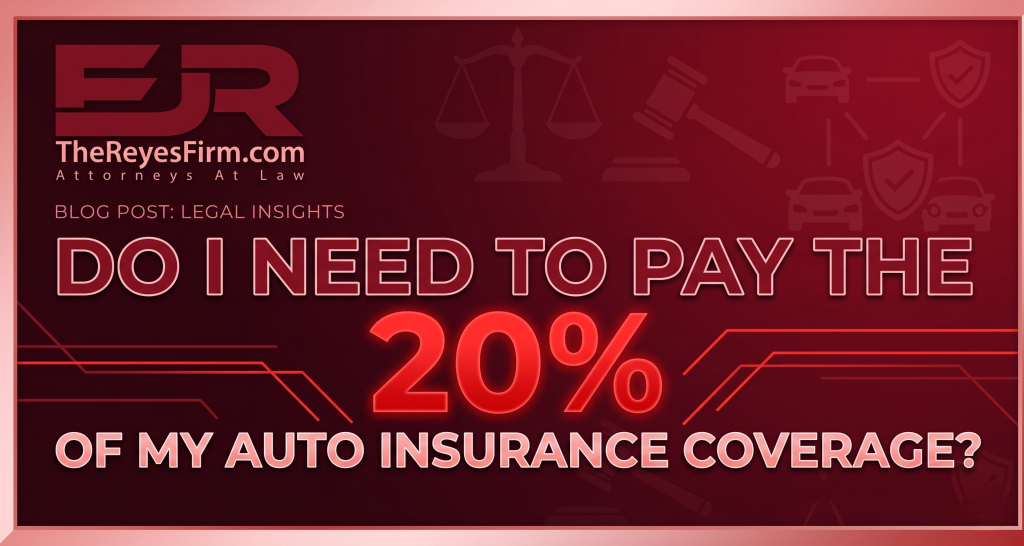
Do I need to pay the 20% of my auto insurance coverage?

You were just in a car accident in Tampa — and now your doctor’s office is telling you that your PIP coverage only paid 80% of your medical bills. The other 20% is sitting on your kitchen table, and you have no idea who’s supposed to pay it. Here’s what Florida law actually says about that gap, and what your options are. TL;DR — QUICK SUMMARY Florida’s Personal Injury Protection (PIP) insurance covers 80% of reasonable and necessary medical expenses up to the $10,000 policy limit — leaving a 20% gap you may owe out of pocket unless other coverage applies. If another driver caused your accident, their bodily injury liability (BIL) coverage — or a lawsuit against them — can cover the 20% gap and any costs beyond your PIP limit. Your health insurance may cover the unpaid 20%, but coordination of benefits rules and subrogation rights can complicate how that works. Under Florida Statute § 95.11(3)(a), you have two years from the date of your crash to file a personal injury lawsuit to recover that gap and all other damages from an at-fault driver. Medical providers cannot legally balance-bill you for amounts above the PIP fee schedule unless you signed an assignment of benefits or a separate agreement — knowing this can protect you from improper bills. The Reyes Firm Confused About Your PIP Bills After a Tampa Crash? Get clear answers about the 20% gap and who should really be paying it. Had a bad day? Contact Us Now $10,000 Florida minimum PIP coverage limit Fla. Stat. § 627.736 80% PIP pays of covered medical bills Fla. Stat. § 627.736(1)(a) 2 Years Florida personal injury statute of limitations Fla. Stat. § 95.11(3)(a) $0 Cost to consult The Reyes Firm Contingency fee — no recovery, no fee What is Florida’s PIP 20% gap and do you have to pay it? Florida’s Personal Injury Protection law requires that your auto insurance cover 80% of reasonable and necessary medical expenses — and only 80%. That 20% remainder is what people call the “PIP gap.” Whether you personally owe it depends on several factors: who caused the accident, what other insurance you carry, and what agreements you signed with your medical provider. Florida is a no-fault state, which means after a car accident, your own PIP coverage pays first — regardless of who was at fault. Under Florida Statute § 627.736, every Florida driver must carry at least $10,000 in PIP coverage, and that coverage pays 80% of covered medical costs and 60% of lost wages. The 20% gap on medical bills is built into the statute itself — it’s not a billing error and it’s not optional. The question is who ends up responsible for covering it. If the accident was someone else’s fault, you may have a legal claim against the at-fault driver that covers the 20% gap, all medical costs beyond your $10,000 PIP limit, lost income, pain and suffering, and more. That’s where a Tampa personal injury attorney can make a real difference. ⚠️ Deadline Warning: Under Florida Statute § 95.11(3)(a), you have two years from the date of your crash to file a personal injury lawsuit against the at-fault driver. If you’ve been carrying the 20% gap yourself and another driver was responsible, waiting too long could permanently close the door on recovery. Call a lawyer before that deadline passes. How does Florida PIP insurance actually work after a car accident? Florida PIP works by paying directly to your medical providers — not to you — based on a statutory fee schedule. When you receive treatment after an accident, your provider bills your PIP insurer. The insurer pays 80% of the allowable amount under the fee schedule. The remaining 20% is either written off by the provider, covered by your health insurance, or billed to you depending on what agreements are in place. There are a few important things to understand about how PIP processes your bills: The fee schedule controls what’s “reasonable.” Florida PIP doesn’t simply pay 80% of whatever a provider charges. It pays 80% of the amount set by the Medicare fee schedule or 200% of Medicare — whichever applies to the provider. If a provider charges more than the schedule allows, PIP will not cover the excess, and the provider generally cannot bill you for the difference under Florida law. Emergency vs. non-emergency treatment matters. Under Fla. Stat. § 627.736, if your injury is classified as an emergency medical condition (EMC), you can access the full $10,000 PIP limit. If your treating provider does not certify an EMC, your accessible PIP benefit is capped at $2,500. This is one of the most misunderstood and financially damaging aspects of Florida PIP. You must seek treatment within 14 days. Florida law requires that you seek initial medical treatment within 14 days of the accident to be eligible to use your PIP benefits at all. Missing this window means losing your PIP coverage entirely — regardless of how serious your injuries are. Watch: Do You Pay 20% After a Car Accident?  Who pays the 20% PIP gap — you, your health insurer, or the at-fault driver? The answer depends on your specific situation, and there’s no single rule that applies to every accident victim. The 20% gap can be absorbed in several different ways. Option 1 — The at-fault driver’s bodily injury liability coverage. If another driver caused your accident, their liability insurance may cover your 20% co-pay, all medical expenses above your $10,000 PIP limit, lost wages not covered by PIP, and pain and suffering damages. Florida does not require drivers to carry bodily injury liability (BIL) insurance, but many drivers do carry it — and if they do, it’s often the best source of recovery for your gap costs. Option 2 — Your health insurance. If you have private health insurance, an employer plan, Medicare, or Medicaid, your health insurer may pick up the 20% co-pay after PIP pays its 80%.

Should I call my auto insurance
Accident Injuries & why, After A Car Accident, After an Accident, Car accident, Injury, Legal, Uninsured Motorist Coverage, Why we serve

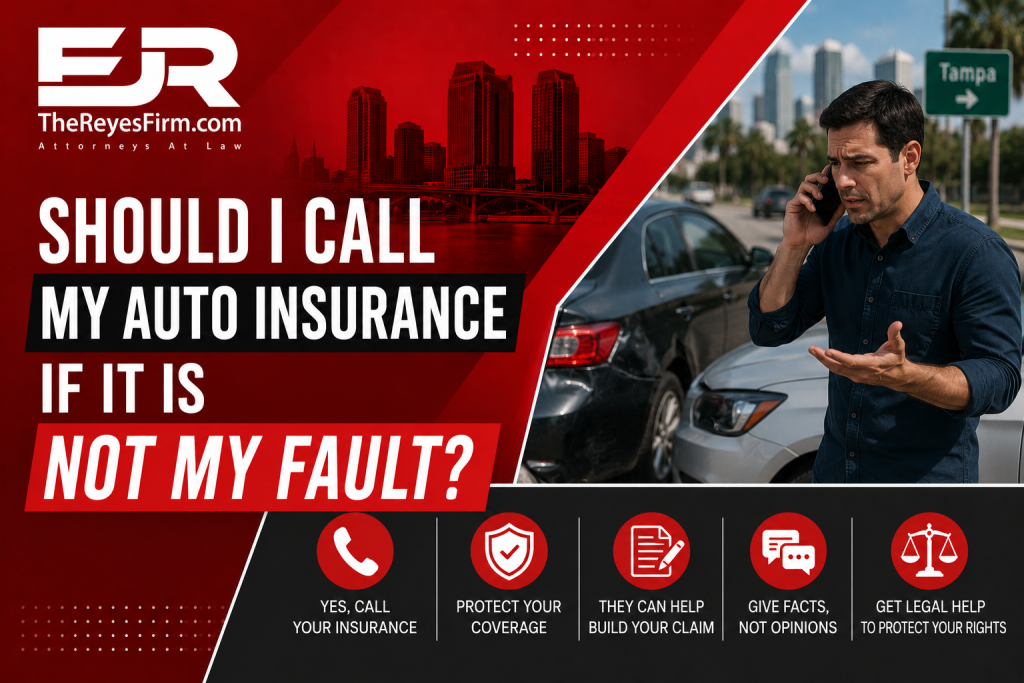
Should I call my auto insurance if it is not my fault?

You were just going about your day. Then someone rear-ended you at a red light. It clearly wasn’t your fault, so calling your own insurance company feels backwards, maybe even risky. In Florida, though, that phone call is one of the most important things you can do, and here’s why. TL;DR — QUICK SUMMARY Yes, you should call your own auto insurer even when the crash wasn’t your fault, because Florida is a no-fault state. Your Personal Injury Protection (PIP) coverage pays the first portion of your medical bills regardless of who caused the accident. You must seek medical treatment within 14 days of the crash, or you can lose your PIP benefits entirely. Reporting an accident you didn’t cause should not raise your rates, and most policies require you to report promptly anyway. Under Florida Statute 95.11(3)(a), you generally have two years to file an injury lawsuit, but the deadlines that bite first are your insurer’s reporting and treatment windows. The Reyes Firm Hurt in a Tampa Crash That Wasn’t Your Fault? Get clear next steps and protect your PIP benefits. Had a bad day? Contact Us Now 14 Days Deadline to seek care for PIP benefits Fla. Stat. 627.736 $10,000 Florida minimum PIP coverage Fla. Stat. 627.736 2 Years Florida injury filing deadline Fla. Stat. 95.11(3)(a) $0 Upfront cost with a contingency fee firm The Reyes Firm Should you call your own auto insurance if the accident wasn’t your fault? Yes. In Florida, you should report the crash to your own insurer even when another driver clearly caused it. That feels counterintuitive, but it comes down to one fact: Florida is a no-fault auto insurance state. Your own policy is designed to step in first, no matter who was to blame. Reporting promptly does two things. It opens your Personal Injury Protection (PIP) benefits so your medical bills start getting paid, and it satisfies the notice requirement built into nearly every auto policy. Wait too long, and you risk both your benefits and a dispute with your own company over late reporting. At The Reyes Firm, a Tampa personal injury law firm, the most common mistake we see after a not-at-fault crash isn’t saying too much. It’s saying nothing at all to the one insurer that’s actually obligated to help you first. ⚠️ Deadline Warning: Under Florida Statute § 95.11(3)(a), you generally have two years from the date of your crash to file a personal injury lawsuit. But your PIP coverage requires medical treatment within 14 days, so the clock that runs out first is usually the one on your benefits. Don’t wait. What is Florida’s no-fault system and how does PIP work? Florida’s no-fault system means that after most car accidents, your own insurance pays your initial medical expenses and lost wages, regardless of who caused the crash. The coverage that does this is Personal Injury Protection, and every Florida auto policy is required to carry it. Under Florida Statute § 627.736, PIP provides a minimum of $10,000 in coverage and typically pays 80% of reasonable medical bills and 60% of lost wages, up to that limit. It applies whether you were rear-ended, sideswiped, or hit by a driver who ran a stop sign. The trade-off for this quick, fault-free coverage is that PIP comes with strict rules, and the strictest is the deadline to get care. Because PIP has a cap, it often isn’t enough to cover a serious injury. When your damages exceed your PIP limits, you may be able to pursue the at-fault driver for the rest, which is where the no-fault system ends and a liability claim begins. 💡 Did You Know? Florida’s 14-day rule is one of the most important deadlines after a crash. Under Fla. Stat. § 627.736, you must receive initial medical care within 14 days of the accident to be eligible for PIP benefits at all. Miss that window and your own insurer can deny the entire claim, even if your injuries are real and serious. Source: Fla. Stat. § 627.736. Watch: Should I Call My Auto Insurance If It’s Not My Fault? This short video explains why Florida drivers need to report a crash to their own insurer even when someone else caused it, and how the no-fault system shapes what happens next. If you’re unsure what to say to either insurance company, The Reyes Firm offers free consultations, so you can call 833-4 BAD DAY before you make the call. Will calling my own insurer raise my rates or count against me? This is the fear that keeps people from making the call, and it’s largely unfounded for a crash you didn’t cause. Filing a PIP claim after a not-at-fault accident is exactly what the coverage exists for, and insurers are limited in how they can treat policyholders who report accidents that weren’t their fault. What can actually hurt you is the opposite choice. Failing to report can violate your policy’s notice requirement, give your insurer a reason to question the claim later, and leave your medical bills unpaid while the 14-day window closes. The downside of calling is small. The downside of staying quiet can cost you your benefits. If an adjuster, yours or the other driver’s, starts asking for a recorded statement or pressing for details, that’s a different matter. You can decline to give a recorded statement until you’ve spoken with a lawyer. Do I still deal with the at-fault driver’s insurance company? Often, yes, but carefully. Your PIP covers the first layer of your expenses. When your injuries are serious enough to exceed those limits, a claim against the at-fault driver’s insurer is how you pursue the rest, including the portion of medical bills PIP didn’t pay, full lost wages, and pain and suffering. That second insurer has no duty to look out for you, and its adjuster is working to pay as little as possible. In a serious or catastrophic crash, the difference between handling that claim alone and having a

Accident Injuries & why, After an Accident, Car accident, FAQ, Legal, Uninsured Motorist Coverage, Uninsured Motorists Coverage, Why we serve

What happens after the Letter of representation

The letter of representation is the letter that notifies your insurance and other insurance company that you are being represented after an accident. After the insurance company receives the letter, you do not need to speak to the at-fault insurance co. You may have to speak to yours, but it can still be under representation. If you have any questions on this, please call our office 813-421-3411

Who pays for rental cars after a crash
After A Car Accident, Uninsured Motorist Coverage

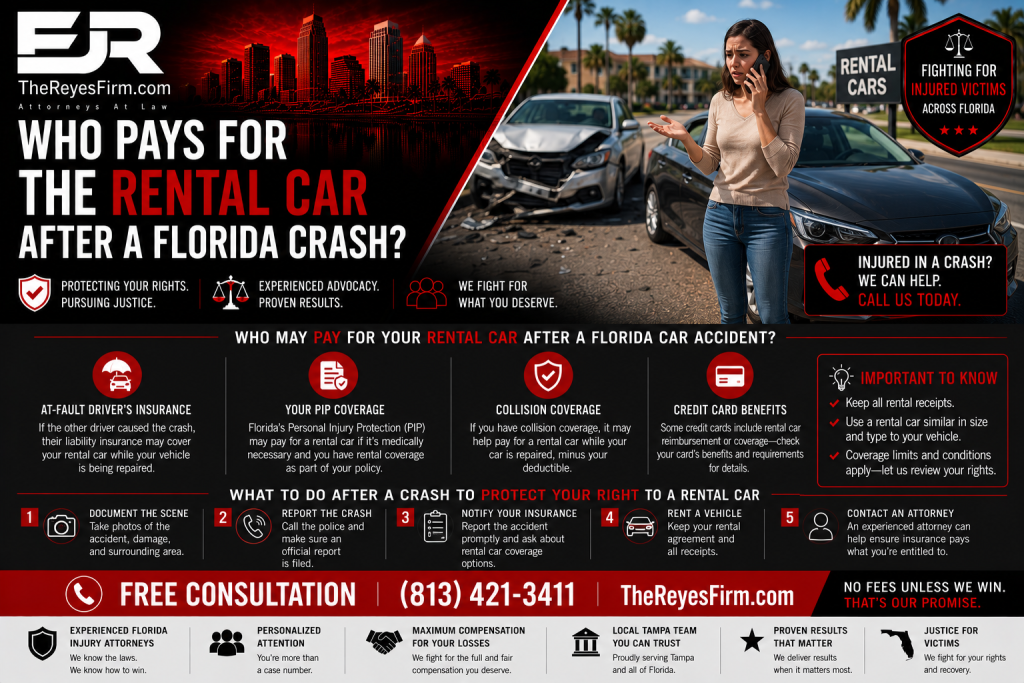
Who Pays for the Rental Car After a Florida Crash?

Your car is in the shop and you still have to get to work tomorrow. The other driver caused the crash, so their insurance should just hand you a rental, right? Not quite. Florida’s rules surprise almost everyone, and the wrong assumption can leave you paying for weeks of rental out of pocket. Here is who actually pays for a rental car after a car accident in Florida, and why. The Reyes Firm Stuck Without a Car After a Tampa Crash? Find out who should be paying for your rental. Had a bad day? Contact Us Now $0 What PIP pays toward a rental Fla. Stat. § 627.736 $10,000 Florida minimum property damage liability Fla. Stat. § 324.022 2 Years Deadline to file a negligence claim Fla. Stat. § 95.11 50% Fault share that bars recovery Fla. Stat. § 768.81 Losing your car after a crash is more than an inconvenience. It affects your job, your kids’ school run, and your medical appointments. The frustrating part is that Florida’s insurance system was not built to get you back on the road quickly, and the coverage most people assume will help is the one coverage that will not. Who pays for a rental car after a car accident in Florida? In most cases the at-fault driver’s property damage liability coverage is ultimately responsible for your rental while your car is being repaired. But “ultimately” is doing a lot of work in that sentence. Their insurer generally will not authorize a rental until it has investigated and accepted liability, and that can take days or weeks. Meanwhile, you still need to get to work. That gap is why the real answer usually depends on what coverage you carry yourself. Understanding your options before you call anyone can save you both money and a lot of frustration. 💡 Did You Know? Your Personal Injury Protection coverage pays nothing toward a rental car. Despite being the coverage every Florida driver is required to carry, PIP covers only medical expenses and lost wages. It does not touch property damage, vehicle repairs, or rentals. Source: Fla. Stat. § 627.736. Why doesn’t your required Florida insurance cover the rental? Florida requires very little. Every driver must carry $10,000 in Personal Injury Protection and $10,000 in property damage liability under Florida Statute § 324.022. Neither of those helps you the way most people expect. PIP is medical and wage coverage only. Property damage liability is coverage that pays for damage you cause to someone else’s property, so it does nothing for your own car or your own rental. The result is that a driver carrying Florida’s legal minimum has no coverage at all for their own vehicle or a replacement while it is repaired. That is not a loophole, it is how the minimum was designed. What are your options for getting a rental right now? You generally have four paths, and they differ mostly in how fast they work: Rental reimbursement on your own policy. This optional add-on is usually the fastest route. It pays a set daily amount, often something like $30 to $50 per day up to a maximum number of days. Check your declarations page, because many people carry it without realizing. The at-fault driver’s property damage liability coverage. The correct payer in the end, but slow. Expect to wait for their liability decision, and expect them to limit the rental to a “reasonable” repair period and a modest class of vehicle. Your collision coverage. This repairs your car regardless of fault, minus your deductible. Important caveat: collision pays for the repair, not the rental. Without rental reimbursement, you are still on your own for the car. Pay out of pocket and claim it later. Keep every receipt. The reasonable cost of a substitute vehicle is recoverable from the at-fault party as part of your damages. If a commercial vehicle caused your crash, the process runs through a business insurer instead, which changes the dynamics considerably. Our overview of truck and commercial vehicle accidents explains how those claims differ. What is “loss of use,” and can you recover it? Loss of use is the legal term for being deprived of your vehicle, and in Florida it is a real, recoverable category of damages. When someone else’s negligence takes your car off the road, the reasonable cost of a substitute vehicle for a reasonable period is part of what you can recover from them. Two words carry the weight there: reasonable cost and reasonable period. An insurer will not pay for a luxury SUV when you were driving a sedan, and it will not pay indefinitely because a shop is slow for reasons unrelated to the repair. This is also why documentation matters. Receipts, repair timelines, and written communication with the shop are what turn a disputed rental bill into a paid one. ⚠️ Deadline Warning: Under Florida Statute § 95.11, you generally have two years from the date of your crash to file a negligence lawsuit, and that same two-year deadline applies to negligence claims for property damage. This was shortened from four years in March 2023, so older guides are out of date. Don’t wait to call a lawyer. What if your car is a total loss? The rental math changes completely, and this catches people off guard. When a car is repairable, the rental generally covers the reasonable repair period. When a car is declared a total loss, there is nothing to repair, so the insurer typically pays for a rental only through a short, reasonable period after it makes its total loss offer, often just a handful of days for you to arrange a replacement. That means the moment your car is totaled, your rental clock is close to running out, even though buying a replacement vehicle usually takes far longer than a repair. If you disagree with the insurer’s valuation of your car, you can push back, but you should not assume the rental keeps running while you argue.

Scroll to Top