Settlement

What to Do If My Car Insurance Company Won’t Pay
Accident Injuries & why, After A Car Accident, After an Accident, Car accident, FAQ, For Parents, For Teens, Legal, Moped Accidents, Road Accidents, Settlement, Why we serve

Who is paying your medical bills if you don’t own a car or have insurance?

So what happens if you are involved in a car accident, it’s not your fault, but you don’t have insurance, but you don’t have a car? What happens then? There are a couple of things. One if you live in a household that somebody has a car and insurance you may be covered under a resident relative. Two, if you do not live in a household that someone has insurance or a car you may be covered by the person that crashed into, their auto insurance company may cover you for personal injury protection. Three, if none of those apply, you can still be covered under the other person’s policy if they have bodily injury coverage. Tampa personal injury lawyer Edward Reyes represents people in Tampa and Hillsborough County, Florida who have suffered an injury in an incident or accident type of accident. Speak Directly to Me, At No Cost, Today 813.421.3411 It won’t cover you for medical coverages as far as your personal injury protection but it will cover you for recovery for pain and suffering and then eventually it will pay back the medical expenses if you’ve incurred any. Give us a call at 813.421.3411 today. (Transcript from the video, transcribed but not reviewed)

Car accident claims We fight back.
After A Car Accident, Car accident, Legal, Settlement, Why we serve

Car Insurance Company Won’t Pay After a Crash? | Tampa, Florida

You did everything right after your car accident. You reported the claim, you got treatment, you waited. Now the insurance company is dragging its feet, lowballing you, or flat-out refusing to pay, and you’re still in pain with bills piling up. Here’s exactly what you can do about it before you accept a penny less than your claim is worth. TL;DR — QUICK SUMMARY If a Florida insurer refuses a fair payout, you generally have two real options: reject the bad offer and negotiate, or file a lawsuit. Accepting a lowball offer is almost never the right move. Insurance adjusters are trained and paid to keep payouts low. A delay, denial, or insulting offer is a business tactic, not the final word on your case. When an insurer refuses to pay what it owes, Florida law lets you file a Civil Remedy Notice under Florida Statute § 624.155, which gives the company 60 days to fix the problem before a bad faith claim can move forward. You have two years from the date of your crash to file a personal injury lawsuit in Florida under Florida Statute § 95.11(3)(a). Waiting too long can cost you the right to recover anything. Under Florida’s no-fault system, your own PIP coverage pays first up to $10,000, but serious injuries can open the door to a claim against the at-fault driver and their insurer. The Reyes Firm Insurance Company Won’t Pay After a Tampa Crash? Get clear next steps when an adjuster delays, denies, or lowballs your claim. Had a bad day? Contact Us Now 2 Years Florida statute of limitations Fla. Stat. § 95.11(3)(a) 60 Days Insurer’s window to cure bad faith Fla. Stat. § 624.155 $10,000 Florida PIP minimum coverage Fla. Stat. § 627.736 50% Fault bar to recovery in FL Fla. Stat. § 768.81 Why won’t my car insurance company pay after a car accident? An insurance company refuses to pay because paying less is how it protects its bottom line, not because your injuries aren’t real. Whether it’s your own insurer or the at-fault driver’s, the adjuster handling your file is one of dozens of people whose job is to close claims for as little money as possible. You are one of hundreds of files on that adjuster’s desk. Some are reasonable. Others delay, deny, and dispute everything, hoping you’ll get frustrated and take whatever they offer. None of that changes what your claim is actually worth, and none of it is the final answer. Common reasons an insurer gives for not paying include disputing who was at fault, claiming your injuries existed before the crash, arguing your treatment wasn’t necessary, or simply making an offer so low it doesn’t begin to cover your medical bills and lost wages. Each of those positions can be challenged with the right evidence. What does it mean when a car insurance company acts in bad faith in Florida? Bad faith means an insurance company has failed to settle a claim fairly and honestly when it had the chance to do so. Florida law requires insurers to act in good faith toward the people they cover and toward injured claimants, and when they don’t, you may have a separate legal claim against the company itself. Under Florida Statute § 624.155, an insurer can be held liable for not attempting in good faith to settle a claim when it could and should have. Examples include ignoring clear evidence, refusing to explain a denial, or sitting on a reasonable demand without responding. Bad faith is not the same as a low offer you simply disagree with. It involves conduct that crosses the line from hard negotiation into a refusal to do what the law and the policy require. A Tampa personal injury attorney can tell you whether what you’re experiencing rises to that level. ⚠️ Deadline Warning: Under Florida Statute § 95.11(3)(a), you have two years from the date of your crash to file a personal injury lawsuit. Missing this deadline almost always means losing your right to recover anything, no matter how strong your case is. Don’t let an insurer run out the clock on you. Watch: What to do when your insurance company won’t pay in Tampa In this short video, Tampa personal injury attorney Edward Reyes explains your options when an insurer makes a bad offer or refuses to move on your claim. If an adjuster has already given you a number that doesn’t feel right, The Reyes Firm offers free consultations to review the offer before you sign anything. What is a Civil Remedy Notice and how does it pressure the insurer? A Civil Remedy Notice is a formal filing that tells Florida’s Department of Financial Services in Tallahassee that an insurance company is acting in bad faith. It is one of the strongest tools available when an insurer should have paid and hasn’t. Under Fla. Stat. § 624.155, once a Civil Remedy Notice is filed, the insurance company has 60 days to cure the violation, meaning it can pay what it owes and avoid a bad faith lawsuit. The notice gets the file in front of a supervisor and puts the company on official record. If the 60 days pass and nothing changes, the next step is usually filing a lawsuit. That decision is never automatic. We walk you through exactly what litigation involves before you commit to it, including the discovery questions both sides have to answer. 💡 Did You Know? Florida is a no-fault insurance state. Under Florida Statute § 627.736, your own Personal Injury Protection (PIP) coverage pays up to $10,000 in medical bills and lost wages regardless of who caused the crash. But PIP rarely covers a serious injury in full, and that gap is often where insurance disputes begin. Should I accept a low settlement offer or file a lawsuit? You should almost never accept a low offer when your injuries are serious and the number doesn’t cover your losses. Once you sign a release,

Car Accident
Accident Injuries & why, After A Car Accident, After an Accident, Car accident, FAQ, For Parents, For Teens, Health, Injury, Legal, Settlement, Why we serve

Car Accident? What Happens Next?

So, you went through the whole process. You got treated, you went to the doctor, you did everything you’re supposed to do for your injuries and to recover. So, what happens next? Well, the doctors, the urgent care facilities, the medical doctor, the spine specialist, the MRIs, everybody else. We request the records, or they’ll send us the records for your treatment. Now that we get all the records, we can create the story of what are you and how does this accident affected your life. I have to get the medical records so we can put together a demand for settlement. Now that tells us about your medical records, that tells us a lot of things about what’s hurting you and how this has affected your life per the doctor’s perspective from what you’ve told them during your exams. Now, one of the things that we like to do as a firm- we do an impact sheet. How has the accident impacted your life, that’s the most important part because in litigation there are two parts? There are economic damages which are your heart damages meaning what did you lose as far as monetary, how much are your medical bills cost-wise. Tampa personal injury lawyer Edward Reyes represents people in Tampa and Hillsborough County, Florida who have suffered an injury in an incident or accident type of accident. Speak Directly to Me, At No Cost, Today 813.421.3411 But then there’s the whole other part of life that has affected your life or your relationship with your kids. How it has affected your life while brushing your teeth, tying your shoes, playing, doing all these things. So, we want to know the story of how it has affected you, not just the cost of treatment but how does that affect you in your life and going forward. Now that will give us a full story or a much better story to wrap it up in a pretty bow to put it in front of the insurance company so they can understand you as a person and not you as just a piece of paper. So, it’s very important to put the general damages, which is how it affected your life your actual life and the economic damages which is how much did it cost because if you’ve gone through this issue, did you miss work, did you have to go to the multiple visit, did you spend a lot of money back with gas and time mending opportunity things that you missed out. All these things are important to correctly tell the story to the adjuster from the insurance company. Now we can start the negotiations. That’s what we have to do to prepare a demand for settlement. If you have any questions, call us at 813.421.3411. (Transcript from the video, transcribed but not reviewed)

Car insurance rates after a crash
After A Car Accident, Settlement

What Affects Your Car Insurance Rates After a Crash?

You were just in a crash, and beyond the dented bumper and the sore neck, a nagging worry sets in: is this going to spike my premium? The honest answer is that it depends, and understanding what it depends on puts you in a much stronger position. Here is what actually drives your car insurance rates after a car accident in Florida, and what you can do about it. The Reyes Firm Worried About Your Rates After a Tampa Crash? Know your rights before your insurer makes a move. Had a bad day? Contact Us Now Not at Fault Rates generally should not rise for this alone Fla. Stat. § 626.9541 Your History Repeated claims matter more than one crash Insurer rating factor Your ZIP Code Where you live affects your premium Territory rating 2 Years Deadline to file an injury claim Fla. Stat. § 95.11 The fear of a rate hike after a crash is real, and it stops some people from doing things they should do, like using their own coverage or filing a legitimate claim. The truth is more nuanced than a simple yes or no. Your premium is shaped by several factors, only some of which have anything to do with the crash you were just in. Will your car insurance rates go up after a crash? It depends, and the most honest answer is yes, no, or maybe, depending on the circumstances. The outcome turns on a handful of factors: whether you were at fault, how many claims you have had, where you live, and the business decisions your insurer makes about its book of customers. A single not-at-fault crash sits at the low-risk end of that spectrum. Understanding which of these factors applies to you is the key to knowing what to expect, and to spotting an increase that should not be happening in the first place. When should your rates not go up? As a general rule, if the crash was not your fault, your premium should not increase because of it. When another driver causes the wreck, their insurance is responsible for the damage, and Florida law under Florida Statute § 626.9541 generally prohibits an insurer from surcharging you or refusing to renew your policy solely because you were in an accident, absent a good-faith finding that you were substantially at fault. A single claim, especially a not-at-fault one, also should not by itself push your rates up. We cover the specific legal protections against improper surcharges, including the situations that entitle you to a reimbursement, in depth in our guide to what happens to your rates after a car accident. That article is the place to go if you believe you have been surcharged unfairly. What factors actually make your rates rise? Several factors genuinely influence your premium, and most have to do with risk rather than any single crash: Fault and your at-fault history. Being at fault in a crash, and especially having a pattern of at-fault accidents, is the factor most likely to raise your rates. Frequency of claims. One claim is one thing. Several claims in a short span, even minor ones, signal risk to an insurer and can drive an increase. Where you live. Insurers rate by territory, so a ZIP code with high rates of accidents, theft, or vandalism can raise premiums for everyone in it, regardless of individual fault. Your driving record. Tickets, moving violations, and prior incidents all factor into how an insurer prices your policy. Coverage and vehicle changes. Adding a vehicle or a driver, changing your coverage, or switching to a more expensive car to insure can all move your premium. Notice how few of these are about a single not-at-fault accident. That is the point. A crash that was not your fault is usually a small factor compared to your overall risk profile. 💡 Did You Know? There is a difference between a surcharge and a rate increase. A surcharge is aimed at you specifically because of your accident, and Florida law limits when an insurer can impose one. A general rate increase applies to everyone in your area or risk class, and it can raise your premium even with a spotless record, because it is not tied to your individual accident at all. Why do insurers raise rates even when it’s not your fault? Here is the reality the fine print does not advertise: an insurance company is a business, and its pricing decisions serve that business. Even when you did nothing wrong, an insurer may adjust rates across a region based on claim frequency, repair costs, litigation trends, and its own financial targets. Those increases are spread across many customers, and they are not a surcharge tied to your specific crash. In some cases, repeated claims can also lead an insurer to price a customer higher or decline to renew, which is sometimes a way of steering higher-risk customers elsewhere. None of this means you did anything wrong, and it does not mean an improper surcharge is acceptable. It simply means it helps to understand the difference between a lawful business decision and a surcharge the law limits, so you know when to push back. 🛡️ Your Rights Under Florida Law: Florida law protects you from being surcharged solely because you were in a not-at-fault accident, and it lists specific situations that entitle you to have an improper surcharge reimbursed or your policy renewed. You also have the right to ask your insurer for the proof of fault behind any increase. We explain these protections in detail in our guide on your rates after a car accident. What can you do if your rates go up? You are not powerless when your premium rises. A few practical steps can protect you: Ask your insurer for the reason. You are entitled to understand why your rate changed, and to request the proof of fault behind any accident-based surcharge. Shop around. Insurers weigh the same factors differently, so a rate

Crash recovery legal help infographic
Settlement, Uninsured Motorist Coverage

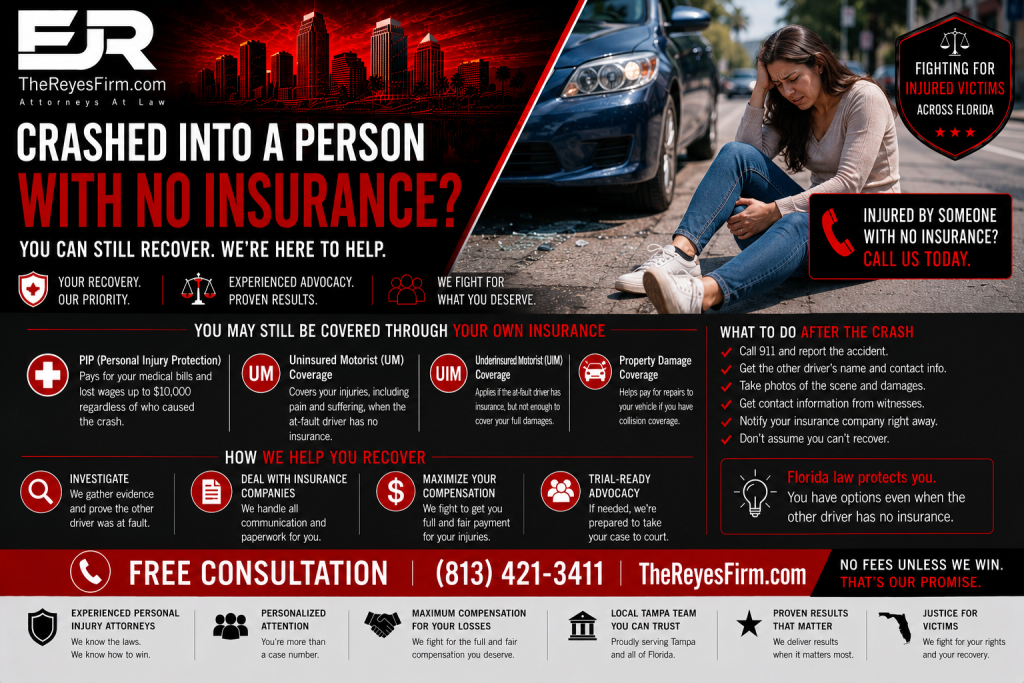
Crashed Into A Person With No Insurance?

The other driver ran the light, wrecked your car, and left you hurting. Then comes the gut punch: they have no insurance. It feels like you have no way to recover, but in Florida that is often not true. Between your own coverage and the state’s rules, you may have far more protection than you realize after a car accident with an uninsured driver. Here is how it works. The Reyes Firm Hit by an Uninsured Driver in Tampa? You may have more coverage than you think. Let us check. Had a bad day? Contact Us Now UM Coverage Your protection when the other driver has none Fla. Stat. § 627.727 In Writing UM applies unless you rejected it in writing Fla. Stat. § 627.727 $10,000 PIP pays your bills regardless of fault Fla. Stat. § 627.736 2 Years Deadline to file an injury lawsuit Fla. Stat. § 95.11 Discovering that the person who hurt you carried no insurance is one of the most frustrating moments after a crash. It feels like the responsible party gets to walk away while you are left with the bills. The good news is that Florida’s insurance system was built with this exact problem in mind, and the path to recovery usually runs through coverage you may already have. What happens if the driver who hit you has no insurance? You still have options. In Florida, being hit by an uninsured driver does not mean you are out of luck, because your recovery does not depend entirely on the other driver’s insurance. It depends first on your own coverage, which Florida’s no-fault system and uninsured motorist rules are designed to provide. This matters more here than in most states, because Florida consistently ranks among the states with the highest percentage of uninsured drivers. Being prepared for this situation is not paranoia in Florida, it is simply realistic, and the drivers who come through it best are usually the ones who understand their own policy. Does Florida’s no-fault system still cover you? Yes. Florida is a no-fault state, which means your own Personal Injury Protection coverage under Florida Statute § 627.736 pays your medical bills first, regardless of who caused the crash. Because PIP is your own coverage, it applies whether the other driver had insurance or not, as long as you seek initial medical care within 14 days of the crash. The limitation is that PIP only goes so far. It covers a portion of your medical expenses and lost wages up to a $10,000 cap, and it does not compensate you for pain and suffering. For a serious injury, PIP is a starting point, not the whole answer, which is where uninsured motorist coverage becomes essential. What is uninsured motorist coverage, and how does it help? Uninsured motorist coverage, often called UM, is the single most important protection when the at-fault driver has no insurance. It essentially steps into the shoes of that driver’s missing policy and pays for the harm they caused you, including the pain and suffering and the excess medical costs that PIP does not cover. A closely related coverage, underinsured motorist coverage, applies when the at-fault driver has some insurance but not enough to cover your injuries. There is an important wrinkle worth understanding. When you file a UM claim, you are making a claim against your own insurance company, which means your insurer is now on the other side of your claim. That can feel strange, and it is one reason these claims sometimes become contentious even though you have paid your premiums faithfully. 💡 Did You Know? You may already have uninsured motorist coverage without realizing it. Under Fla. Stat. § 627.727, an insurer generally must offer UM coverage equal to your bodily injury liability limits, and you can only reject it or choose lower limits in writing on an approved form. If you never signed such a rejection, there is a good chance you have this coverage. Source: Fla. Stat. § 627.727. What if you didn’t think you had uninsured motorist coverage? Check before you assume the worst. Because Florida law requires insurers to offer UM coverage and to obtain a written rejection if you decline it, many drivers carry this coverage even though they do not remember choosing it. The rejection form itself must carry a bold warning that you are giving up valuable protection, precisely because the state wants drivers to have it. The practical takeaway is simple: do not give up before someone reviews your actual policy. Pulling your declarations page and reading exactly what coverage you carry is one of the first things worth doing, and a lawyer can do it with you to make sure nothing is missed. What looks like a hopeless situation frequently turns out to be a covered one. 🛡️ Your Rights Under Florida Law: Under Florida Statute § 768.81, your compensation is reduced by your share of fault, and you may be barred from recovery if you are found greater than 50% responsible. When the at-fault driver is uninsured, insurers sometimes lean harder on blaming you, and an experienced Tampa injury lawyer works to keep the facts straight and your assigned fault as low as the evidence allows. Can you sue an uninsured driver personally? You can, but it is often not the most productive path. A driver who cannot afford insurance frequently cannot afford to pay a judgment either, and a court award means little if there are no assets to collect from. This is the old problem of trying to get blood from a stone, and it is why your own uninsured motorist coverage usually matters far more than a lawsuit against the individual. That said, an uninsured driver is not always the only responsible party. Sometimes another person or company shares liability, such as an employer if the driver was working, or the owner of the vehicle if someone else let them drive it. Identifying every potentially responsible party is part of what

I Just Had A Car Accident
Accident Injuries & why, After A Car Accident, After an Accident, Car accident, For Parents, For Teens, Health, Injury, Legal, Settlement, Why we serve

I Just Had A Car Accident, How Long Does My Case Take?

You are probably wondering, how long does my case? Your case will depend on a lot of factors. If you have big injuries and there is a low policy, many times the insurance company would not want to pay right away because they know they are putting their clients at risk. This does not mean that it’s a good position for you because depending on circumstances, that may be all that you can get. Now, there are all the things that can happen within that, but it gets a bit more complicated. The insurance company in good effort must do everything compliant with the demands of the compliant. That is the first. Next, you have big injuries, bad injuries- big policy. Yes, that sounds like a good idea, however sometimes when the policy is big, the insurance company will fight it because they have enough money to fight it. With that being said, if you bad injuries and big policy, the chances of recovery are much greater. Case scenario number three, you have little injuries, big policy. The insurance company has a lot of money to fight, so it takes much longer to settle the case. Case option number four, you have big injuries, decent policy. Now, this is a more realistic scenario. When this happens, you have bad injuries and your coverage is valued out what the injuries could be, now the insurance offer is more reasonable. Tampa personal injury lawyer Edward Reyes represents people in Tampa and Hillsborough County, Florida who have suffered an injury in an incident or accident type of accident. Speak Directly to Me, At No Cost, Today 813.421.3411 At the end of the day, the insurance company has adjusters that work for them. Their job is to adjust claims down. Their job is not to pay you, but they are trying to reduce the amount for their company. That is what they are paid to do, so do not take it personally. They do not know you; they only know what’s on paper. So, if you feel that the adjusters are not treating you fairly, that is where we have to put more pressure, we have to use techniques so they raise the offer and we may have to file a suit. By filing suit, it comes in the hands of the adjusters and goes to the hands of another person which is the litigation adjuster and an attorney. If you have questions on this, call us at 813.421.3411. (Transcript from the video, transcribed but not reviewed)

Mass transit crash legal help guide
mass transit, Settlement

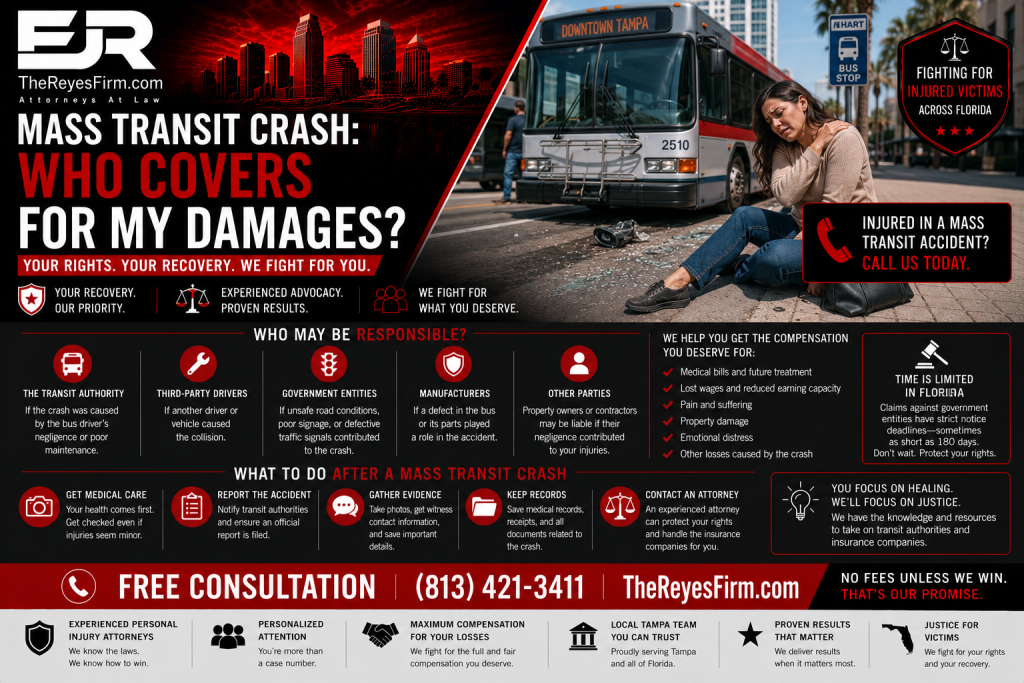
Mass Transit Crash: Who Covers for My Damages?

You were riding the bus, or stopped beside one, when the crash happened. Now you are hurt and facing a confusing question that an ordinary fender bender never raises: who is actually responsible for covering your damages? The answer depends on who owns the vehicle and who caused the wreck, and the rules for serious transit crashes in Florida are unlike any other kind of accident. Here is how it works. The Reyes Firm Injured in a Bus or Transit Crash in Tampa? Figuring out who pays is complicated. We can help. Had a bad day? Contact Us Now $200K/$300K Caps on claims against a government agency Fla. Stat. § 768.28(5) Highest Duty Care a carrier owes its passengers Common carrier law 3 Years To give written notice of a government claim Fla. Stat. § 768.28(6) 2 Years To file a negligence lawsuit Fla. Stat. § 95.11 A crash involving a bus, trolley, shuttle, or train is rarely simple. These vehicles are large, they carry many people, and the entity that operates them may be a private business or a branch of government, which completely changes how a claim works. Understanding the possibilities helps you know where to turn after you have been hurt. Who covers your damages after a mass transit crash? It depends on two questions: who operates the transit vehicle, and who caused the crash. Those two answers determine which insurance policies and which legal rules apply to your case, and they can point to very different sources of recovery. Broadly, there are three possibilities. A private company that operates the vehicle may cover you through its liability insurance. A government agency that operates it may be responsible, but only within strict limits. And when a separate at-fault driver caused the crash, that driver may be responsible directly. In many serious cases, more than one of these applies at once. What counts as mass transit? Mass transit is essentially anything designed to carry a large number of people. That includes public buses like those operated by Hillsborough Area Regional Transit, along with trolleys, streetcars, light rail and trains, airport shuttles, and privately operated charter and tour buses. School buses fall into their own related category. The single most important distinction is not the type of vehicle but who runs it. A privately operated shuttle and a public city bus are treated very differently under Florida law, even if the crash looks identical from the outside. What if a private company operates the transit vehicle? When a private company operates the vehicle, your claim generally works more like a case against any other commercial operator. These companies are typically required to carry substantial liability insurance because they transport passengers for a living, and that coverage is available to injured passengers up to the policy limits. Because buses and similar vehicles are large commercial vehicles, our overview of truck and commercial vehicle accidents covers related territory. Sorting out which policy applies, and whether personal or commercial coverage governs, is often more complicated than it looks. We explain that distinction in our guide to commercial versus personal insurance after a Florida crash. The advantage in these cases is that private carriers usually have real coverage, without the government limits described below. What if a government agency operates it? This is where transit claims become genuinely different. When a public entity operates the vehicle, it is protected by sovereign immunity, an old legal doctrine that shields the government from many lawsuits. Florida has waived that immunity in part under Florida Statute § 768.28, but only up to strict caps. Under that statute, recovery against a government agency is generally capped at $200,000 per person and $300,000 per incident, no matter how severe your injuries are. Public entities are typically self-insured, meaning they pay claims from their own funds up to those limits. Recovering more than the cap is possible only through a claim bill, a special act that the Florida Legislature must pass individually, which is a difficult and lengthy process. These limits are a major reason government transit claims require experienced handling. ⚠️ Deadline Warning: Claims against a government transit agency carry a strict condition you will not find in an ordinary car accident case. Under Fla. Stat. § 768.28(6), you must generally provide written notice of your claim within three years, and you usually cannot file suit until the agency has denied the claim or 180 days have passed. That is separate from the two-year deadline to file a negligence lawsuit under Florida Statute § 95.11. These rules interact in unforgiving ways, so speak with a lawyer immediately. What if another driver caused the crash? Here is the possibility many injured passengers do not realize they have. If a separate driver crashed into the bus or transit vehicle and caused your injuries, that driver is the at-fault party, and you can generally pursue a claim directly against them and their insurance. You do not necessarily have to go through the transit company’s commercial policy or fight the government’s sovereign immunity caps at all. This can matter enormously, especially when a public agency is involved, because it may let you avoid the $200,000 cap entirely by pursuing the responsible driver instead. And when that at-fault driver does not carry enough insurance to cover your injuries, your own uninsured or underinsured motorist coverage may apply. A lawyer can identify every source of recovery available to you, which is often the difference between a capped claim and a full one. You can read more about what drives the value of a claim in our detailed guide. 🛡️ Your Rights Under Florida Law: Under Florida Statute § 768.81, fault can be divided among everyone responsible for a crash, including a transit operator and an at-fault driver, and your own recovery is reduced by any share of fault assigned to you. As a passenger you are rarely at fault, and an experienced Tampa injury lawyer works to hold the right parties accountable for

My Friend’s Cousin Made 1 Trillion Dollar
After A Car Accident, After an Accident, Legal, Settlement, Why we serve

My Friend’s Cousin Made 1 Trillion Dollar

If they’re in the same car accident, but that may be the first accident their injuries may be substantially different, the insurance company may be different as well, the adjusters may be different. So every case is a little bit different. It’s very difficult to compare one person to one person. It’s like DNA because everybody is actually different in their own ways. Every settlement’s going to be different, that’s why they’re separated. Whenever you hear the comment, my friend made 50,000, 100,000, or whatever the number may be, one they may be lying, off the top. Two, it could also be that their situation is different or very unique, specifically to them. We work with your conditions, we work with your history, we work with your damages, in order for us to come up with value and fight for you to get as much money as possible in your pocket for recovery. Tampa personal injury lawyer Edward Reyes represents people in Tampa and Hillsborough County, Florida who have suffered an injury in an incident or accident type of accident. Speak Directly to Me, At No Cost, Today 813.421.3411 But again, everybody is a little bit different, so if you’re hearing people talk about somebody’s third cousin to the fourth, it’s not factual because everybody is a little bit different. Plus, everybody likes to blemish a little bit and make their settlements a little bit higher than what they typically are. If you have any questions on this, feel free to give us a call at 813-421-3411. (Transcript from the video, transcribed but not reviewed)

Ride-share liability and legal guidance
Ride Sharing, Settlement

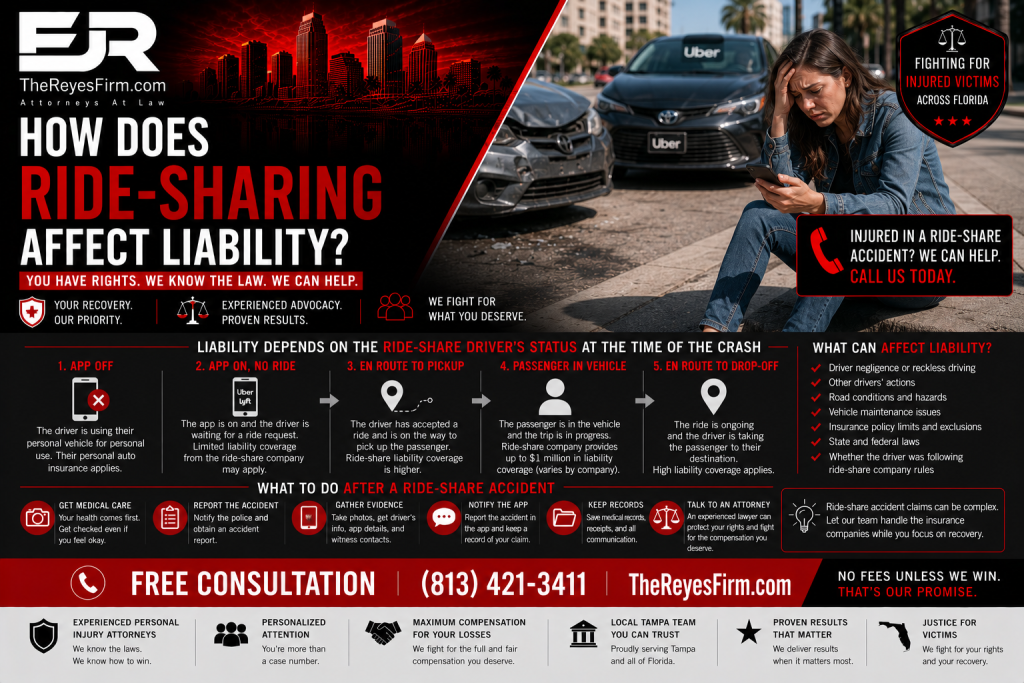
How Does Ride-Sharing Affect Liability?

You called an Uber to be safe, or you were just driving through Tampa when a Lyft ran the light. Either way, you are hurt, and the insurance question is stranger than any ordinary crash: whose policy even applies? With rideshare, the answer can swing from a driver’s personal coverage to a $1 million policy depending on a single detail. Here is how ridesharing affects liability in Florida, and why the moment of the crash changes everything about your rideshare accident claim. The Reyes Firm Hurt in an Uber or Lyft Crash in Tampa? Which policy applies can change everything. We can help. Had a bad day? Contact Us Now $1 Million Coverage once a ride is accepted Fla. Stat. § 627.748(7)(c) $50K/$100K Coverage when logged on, no ride yet Fla. Stat. § 627.748(7)(b) App Off Only the driver’s personal policy applies Personal insurance 2 Years Deadline to file an injury claim Fla. Stat. § 95.11 Rideshare has changed how Tampa gets around, and for many people it is a safer choice than driving after a night out. But that convenience comes with a coverage system unlike anything in a normal crash. When an Uber or Lyft is involved, the single most important question is not who owns the car, but what the driver’s app was doing at the instant of impact. How does ridesharing affect liability in Florida? Ridesharing affects liability by tying the available insurance coverage to the driver’s status at the moment of the crash. Florida regulates companies like Uber and Lyft, known legally as transportation network companies, under Florida Statute § 627.748, which sets specific minimum coverage requirements for different phases of a driver’s work. That means two crashes that look identical can involve completely different insurance. A collision caused by a rideshare driver who was off the clock is handled by their personal policy alone. The same collision moments after they accept a ride may be covered by a $1 million policy. Understanding those phases is the key to knowing where your compensation comes from. What are the three insurance periods for Uber and Lyft? Florida law divides a rideshare driver’s activity into phases, and coverage rises as the driver moves from simply having the app open to actually carrying a passenger. There are three practical periods to understand: App off. When the driver is not logged on to the rideshare app, they are just a regular driver. Only their personal auto insurance applies, and Uber or Lyft provides no coverage. Logged on, waiting for a ride. Once the driver is logged on and available but has not yet accepted a request, Florida requires primary liability coverage of at least $50,000 for death or bodily injury per person, $100,000 per incident, and $25,000 for property damage, along with personal injury protection and uninsured motorist coverage. Engaged in a prearranged ride. From the moment the driver accepts a ride request, through driving to pick you up, and until the passenger is dropped off, a much larger policy of at least $1 million in liability coverage applies. The jump from the middle period to the last one is enormous, from $50,000 per person to $1 million. That gap is why pinning down the driver’s exact status is often the single most important step in a rideshare claim. Why does the moment of the crash matter so much? Because the driver’s status decides which policy, and how much coverage, is available to you. A serious injury can easily exceed a $50,000 per-person limit, so whether the driver had accepted a ride seconds before the crash can be the difference between a claim that is fully covered and one that is not. This is also why rideshare companies and their insurers pay close attention to exactly when a driver logged on, logged off, and accepted a ride. There is a second reason the details matter, and it surprises many people. A rideshare driver’s own personal auto policy may not fill the gap you expect it to, because personal policies are generally not written to cover driving for hire. 💡 Did You Know? Many rideshare drivers’ personal auto policies specifically exclude coverage while they are driving for Uber or Lyft, and Florida law expressly allows insurers to write that exclusion. That is exactly why the company’s statutory coverage tiers matter so much, since the driver’s own policy may provide nothing at all during rideshare activity. Source: Fla. Stat. § 627.748(8)(b). Can you sue Uber or Lyft directly? Usually not in the way people expect. Under Florida law, rideshare drivers are generally treated as independent contractors rather than employees, and the statute limits a company’s vicarious liability simply for operating the app and connecting drivers with riders. In most cases, you are not suing Uber or Lyft as an employer. You are pursuing the insurance coverage that applies to the driver’s phase of work. Notably, Florida law also specifies that a rideshare company and its drivers are not common carriers, which is a different status than a public bus. That does not leave you without options, though. The right path is usually to identify every applicable policy, from the company’s coverage to the driver’s insurance to your own, and pursue the ones that apply. Sorting out which coverage governs, and whether personal or commercial insurance applies, can be genuinely complicated, and our guide to commercial versus personal insurance after a Florida crash explains why. 🛡️ Your Rights Under Florida Law: Under Fla. Stat. § 627.748, an injured person has real leverage. In a claims investigation, the rideshare company must promptly provide the precise times the driver logged on and off in the 12 hours before and after the crash, and the driver must disclose whether they were logged on or on a prearranged ride. That information is often the key to unlocking the correct coverage, and an experienced Tampa injury lawyer knows how to demand it. What if you were a passenger, another driver, or a pedestrian? The same period-based


Will your rates go up
After A Car Accident, Settlement

Will your Rates Go Up After A Car Accident?

Someone else ran the light. Your car is wrecked, your neck hurts, and somewhere in the back of your mind a smaller worry is nagging at you: is this going to cost me on my insurance? It is a fair question, and Florida law has a clearer answer than most people realize. Here is what can and cannot happen to your rates after a car accident that was not your fault. The Reyes Firm Not Your Fault? Know What Your Insurer Can’t Do Protect your claim and your policy at the same time. Had a bad day? Contact Us Now Substantial Fault Standard required to surcharge you Fla. Stat. § 626.9541(1)(o)3. 8 Ways To qualify for surcharge reimbursement Fla. Stat. § 626.9541(1)(o)3.b. 24 Hours To report a hit-and-run and qualify Fla. Stat. § 626.9541(1)(o)3.b. 14 Days Deadline to seek care for PIP Fla. Stat. § 627.736(1)(a) The fear of a rate hike is real, and insurers do not go out of their way to correct it. But Florida has specific consumer protections written into its insurance code that most drivers have never heard of. Knowing them changes how you handle the days after a crash, and in particular whether you make the one mistake that costs people the most. Will your insurance rates go up after a car accident that wasn’t your fault? Typically they should not, because it was not your fault. That is not just common sense, it is Florida law. An insurer generally may not impose or request an additional premium, or refuse to renew your policy, solely because you were involved in a motor vehicle accident, unless its file contains information from which it determines in good faith that you were substantially at fault. The phrase that matters there is substantially at fault. Being in a crash is not enough. Filing a claim is not enough. The insurer needs an actual, good-faith, documented basis in its file that you caused it. If it does not have that, the surcharge is not supposed to happen. What does Florida law actually prohibit? The protection lives in Florida Statute § 626.9541, which defines unfair methods of competition and unfair or deceptive insurance practices. Several provisions matter to a driver who was just hit: No surcharge or nonrenewal without substantial fault. Under § 626.9541(1)(o)3., an insurer generally cannot raise your premium on liability, PIP, medical payments, or collision coverage, or refuse to renew, solely because you were in an accident, absent a good-faith determination of substantial fault. No surcharge at all on comprehensive or uninsured motorist coverage. Under § 626.9541(1)(o)10., an insurer may not impose an additional premium for comprehensive or UM coverage solely because you were in an accident or convicted of a moving violation. There is no fault exception written into that one. You can demand their proof. Under § 626.9541(1)(o)5., on your request, the insurer and the licensed agent must supply you with the complete proof of fault or other criteria justifying the additional charge or cancellation. That last point is quietly powerful. If your premium jumps and you were not at fault, you are entitled to ask the company to show its work. 💡 Did You Know? If an insurer does surcharge you or refuse to renew after an accident, Florida law requires it to tell you, right in the premium or nonrenewal notice, that you may be entitled to reimbursement of that amount or renewal of the policy. The obligation to inform you is on them, not on you to discover it. Source: Fla. Stat. § 626.9541(1)(o)3.b. What if your insurer surcharges you anyway? Florida law spells out eight specific situations in which you are entitled to have that surcharge reimbursed, or the policy renewed, if you can demonstrate that the operator involved in the accident was: Lawfully parked. Reimbursed by, or on behalf of, the person responsible for the accident, or holds a judgment against that person. Struck in the rear by another vehicle headed in the same direction, and was not convicted of a moving traffic violation in connection with the accident. Hit by a hit-and-run driver, if the accident was reported to the proper authorities within 24 hours after discovering it. Not convicted of a moving traffic violation in connection with the accident, while the driver of the other vehicle was convicted of one. Finally adjudicated not liable by a court of competent jurisdiction. Issued a traffic citation that was dismissed or nolle prossed. Not at fault, as shown by a written statement from the insured establishing facts demonstrating lack of fault, which the insurer’s file does not rebut with a good-faith determination of substantial fault. Look closely at number four. Reporting a hit-and-run within 24 hours is not just good practice, it is what preserves this specific protection. And number three covers one of the most common crash types on Florida roads: getting rear-ended. Can your insurer refuse to renew your policy after an accident? Not for a single at-fault accident. Florida law provides that an insurer may not fail to renew a policy where the insured has had only one accident in which he or she was at fault within the current three-year period. An insurer may still nonrenew for reasons unrelated to accidents, and the protection does not extend to a driver with three or more accidents, regardless of fault, in the most recent three-year period. So one crash, even one you caused, should not by itself end your policy. A pattern is a different conversation. Why might your rates go up anyway? Being protected from a not-at-fault surcharge is not the same as being protected from every increase. A few things can move your premium regardless of what happened in your crash: Statewide and territory rate changes. Insurers adjust rates across whole regions based on claim frequency, repair costs, litigation trends, and fraud. That increase hits everyone in the area, not just you, and it is not a surcharge tied to your accident. Other drivers in your

Scroll to Top